Goals, Milestones, Status Reports: Discipline That Ships Projects
Project drift isn't a tooling problem; it's a discipline problem. Goals, milestones, tracking, and honest status reporting that actually moves work to done.
Most failed projects don't fail at the end. They drift in the middle.
The kickoff is sharp, there's a goal, a deadline, an owner. By week eight, no one is sure what "done" looks like, the dashboard hasn't been updated in a fortnight, and status reports have quietly turned into activity logs. The work continues. The goal does not.
This is not a tooling problem. Every project management platform on the market, Onplana included, can hold goals, milestones, and weekly status updates. The platforms aren't the issue. The issue is the daily, unglamorous discipline of using them well: writing goals that point at outcomes, breaking them into milestones that are verifiable, tracking against those milestones with honesty, and reporting status in a way that surfaces problems instead of hiding them.
This post is about that discipline, what each piece is for, how they compound, and where they fail.
Why discipline beats ambition
Ambitious goals are easy to write. "Become the market leader in our segment by Q3." "Ship the redesign with zero downtime." Anyone can produce them in a brainstorm. They feel directional and important.
The problem is that ambitious goals don't carry their own enforcement. They tell you what you want, not what you have to do today to get there. Without a structure that translates ambition into weekly visible progress, the goal becomes a poster on the wall, read once, ignored thereafter.
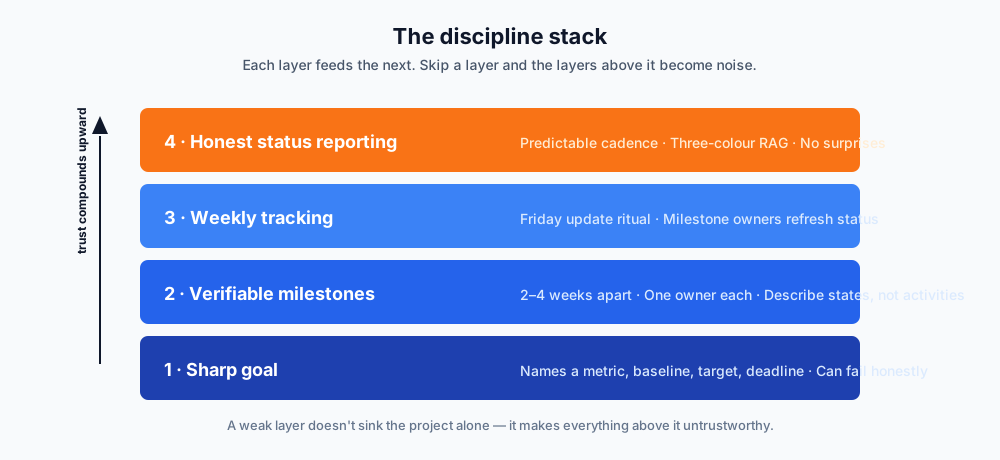
Discipline is the structure that turns ambition into work that ships. It has four parts:
- Goals that are specific enough to disprove
- Milestones that are verifiable enough to count
- Tracking that is regular enough to catch drift early
- Status reporting that is honest enough to be useful
Each part is cheap on its own. The compounding effect comes from running all four every week, on every project, without exception. That consistency, not the elegance of any individual artifact, is what separates teams that ship from teams that drift.
Goals: the destination problem
A good project goal answers two questions in one sentence: what changes, and how do we know.
Bad: "Improve onboarding." Better: "Cut the median time-to-first-project from 9 minutes to under 3." Best: "Cut the median time-to-first-project from 9 minutes to under 3 by July 15, measured on signups from organic search."
The third version is harder to write because it forces the team to commit to a metric, a baseline, a target, and a deadline. It is also harder to fake. You cannot half-ship "cut median time to under 3 minutes", you either did or you didn't, and the analytics will tell you which.
A few patterns that produce sharper goals:
Name the metric and the baseline. "Reduce churn" is aspirational. "Reduce monthly logo churn from 4.2% to under 2.5%" is operational. The baseline matters because it makes regression visible. Without it, you're committed to a destination but not anchored to where you started.
Tie to the user, not the team. Goals about user behavior ("customers complete migration in under an hour") survive reorganizations and team handoffs. Goals about team activity ("ship version 2.0") evaporate when scope changes.
Make sure it can be wrong. If you can't write the sentence "we will know we failed when X," the goal is too vague. A goal that can't fail can't succeed either.
Milestones: the ratchet
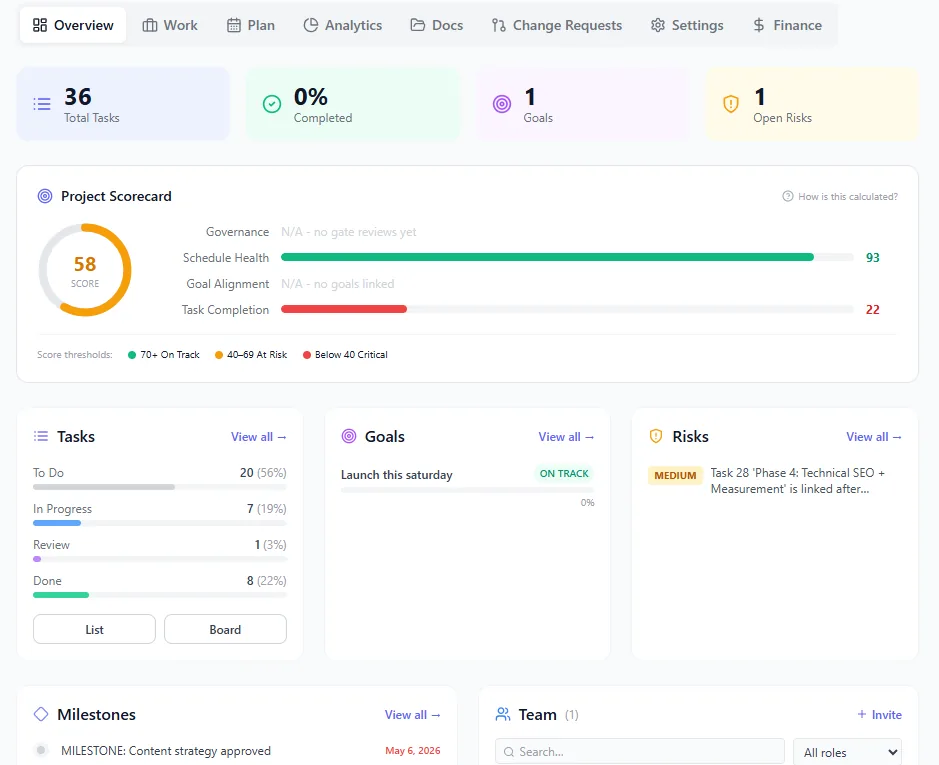
The project scorecard: health badge, current phase, next milestone with a hard date, schedule and budget variance tiles, and at-risk flags with the cause named. A milestone moves the scorecard; a status update without one does not.
A goal is the destination. A milestone is a checkpoint that proves you're closer to it, and crucially, you can't go backwards through it.
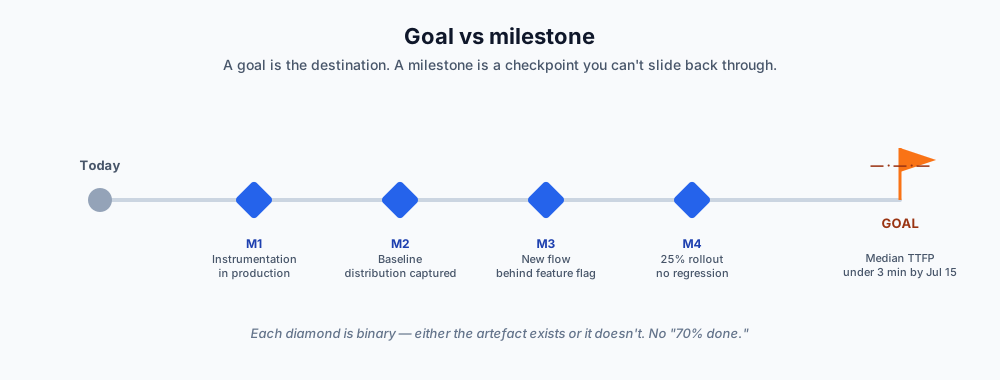
The mechanical purpose of a milestone is to ratchet progress. Once "new checkout flow in production behind a feature flag" is true, it stays true; the next conversation is about adoption, not about whether the flow exists. This is what a goal alone cannot do. Goals describe an end state; milestones describe a verifiable middle. A milestone is also not a deliverable or a task, a distinction worth getting right before it corrupts the same status report this discipline is trying to fix.
Three rules for setting them.
Milestones describe states, not activities. "Run user research" is an activity. "Five interview transcripts coded with three validated jobs-to-be-done" is a state. The first you can do for two weeks and have nothing to show; the second is binary, you either have the artifact or you don't.
Space them two to four weeks apart. Tighter than two weeks and milestones become activity tracking, every standup churns through them. Wider than four and you lose the feedback loop; you find out you're behind too late to do anything cheap about it. The two-to-four window matches roughly how long a focused team can hold context on a single sub-problem.
Every milestone has an owner. Not a team, a person. "Engineering owns the migration milestone" diffuses responsibility across five people, which means it lives nowhere. "Sara owns the migration milestone" puts a single throat to choke and a single person who cares about the date. This is uncomfortable to enforce, which is exactly why it works.
Milestones are also where dependencies live. The schedule between milestones is a question of capacity; the order of milestones is a question of logic. If "deploy new auth" must happen before "migrate customer data," that order is fixed regardless of who's available. A project plan that doesn't make these dependencies explicit is a wish list, not a schedule.
Tracking: the feedback loop
Tracking is the cheapest part of the system and the most often skipped. The mechanics are trivial: percent complete on each task, status on each milestone, dates on each deliverable. The discipline is updating it weekly without skipping a week.
Two failure modes are worth naming.
The dashboard that's never wrong because it's never fresh. A burndown that hasn't been updated in three weeks isn't a tracking artifact, it's a souvenir. If the dashboard is an afterthought, no one trusts it, which means no one consults it, which means decisions get made on vibes. The fix is to make tracking a calendar event, not a vibe. Block 30 minutes every Friday for status hygiene and protect it.
The dashboard that's always green because it's always lying. This is more pernicious. If milestones never go red, two things are true: either the project is impossibly well-run (rare), or the milestones aren't being marked honestly (common). Green status that never moves is data with no signal. The first time a project goes red, the response should be neutral, that's the system working. If it can't go red without consequences, it can't be useful.
A tracking system earns trust the way a thermometer does: by reading the temperature accurately even when nobody likes the number.
Status reporting: the social contract
Tracking is for the team. Status reporting is for everyone else, the sponsor, the cross-functional partners, the people who need to know whether to plan around your delivery date.
A weekly status report is a contract. It says: I will tell you the truth about this project once a week, in a predictable format, whether the news is good or bad. In exchange, you give me the trust and air cover to handle problems without running an emergency meeting every time something slips.
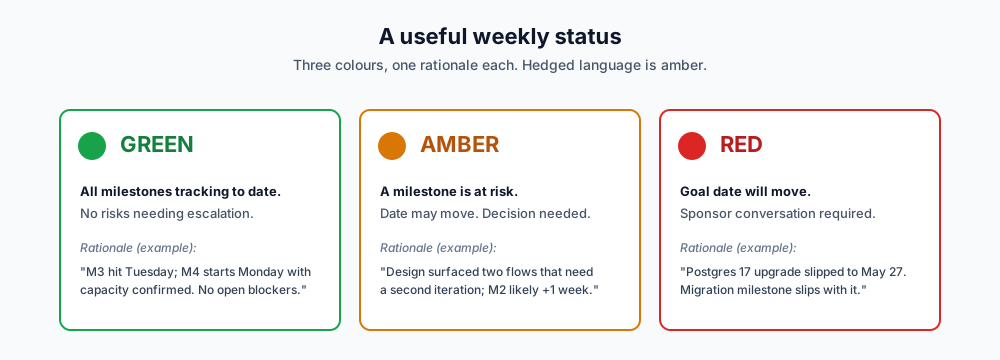
What goes in a useful status report:
- The headline RAG. Red, amber, or green, with a one-line rationale. "Amber, design review surfaced two flows that need a second iteration; pushing dev start by a week." Measurable thresholds for each color, not gut feel, are what keep one PM's amber comparable to another's.
- Milestone progress. Each milestone with its current status and the date it's tracking to. If a date moved, why.
- Risks and decisions needed. Specific. Not "platform stability is a risk" but "if Postgres 17 upgrade slips past May 20, the migration milestone slips with it; we need a go/no-go from infra by May 13."
- Asks. What you need from the reader. If nothing, say "no asks this week"; silence reads as confused.
Three things that should not go in:
- Activity narration. "The team completed sprint 3 with 42 story points" is data, not status. Stakeholders want to know if you're going to make the date, not how busy you were.
- Hedged language. "Trending green" is amber. "Mostly on track" is amber. Pick one of three colors; let the rationale carry the nuance.
- Surprises a week before launch. If the status report has been green for eight weeks and turns red the Friday before launch, the report failed before the project did. The job of a weekly status is to surface problems while they're cheap.
The hardest part of status reporting is the first amber. Every team has a project where someone goes from "tracking nicely" to "we need to talk" in one week, and everyone, sponsor, PM, team, would have preferred a smaller bump three weeks earlier. The discipline is rewarding the smaller bump publicly: thanking the PM who flagged amber early, never punishing the messenger. Teams that get this right have status reports that are slightly anxious to read, which is exactly what makes them useful.
If the writing itself is what slows the loop, the free Status Report Writer drafts a weekly report from a few bullet points: same RAG structure, same rationale-first format, in about a minute. The discipline is still on you; the friction is gone.
How the four pieces compound
Each piece in isolation is easy to undervalue.
A goal without milestones is a wish. A milestone without tracking is a date on a wall. Tracking without status reporting is private optimism. Status reporting without honest goals is performance art.
What makes the system work is that the pieces feed each other.
- A sharp goal makes it possible to write verifiable milestones. ("Cut time-to-first-project to under 3 minutes" lets you set the milestone "instrumentation in production showing baseline distribution" without having to argue about scope.)
- Verifiable milestones make tracking trivial. ("Behind feature flag in prod" is true or false; no debate about whether it's 70% or 80% done.)
- Honest tracking makes status reporting fast. (When the milestone view is up to date, the weekly status writes itself in 15 minutes.)
- A predictable status report locks in the discipline of the rest. (The Friday status is a forcing function, the team that wants to send a clean status on Friday updates the tracker on Thursday.)
The compounding goes the other way too. Sloppy at any layer and the layers above it become noise. A team that updates milestones once a month writes status reports nobody trusts. A team with goals like "improve quality" writes milestones nobody can verify. The fastest way to fix a project that's drifting isn't to add more meetings; it's to walk back down the stack and fix the layer that's been left to rot.
What this looks like in practice
The shape of a healthy project, viewed monthly:
- One goal, written in the first week, that survives unchanged or is explicitly updated through a scope-change conversation. Not silently rewritten on slide 17 of a deck.
- Five to ten milestones, each owned by one person, each spaced two to four weeks apart, each describing a verifiable state.
- A weekly tracking ritual where the milestone owners update status with the discipline of someone who knows their teammates will read it on Friday.
- A weekly status report that uses three colors, says what moved, names the risks, and asks for what's needed.
That's it. There's no clever tooling that makes this work. There's no clever process that lets you skip parts of it. The teams that ship, across industries, across team sizes, across methodologies, run some version of this loop without flinching.
What good software does is reduce the friction of running it. A project management platform that makes milestone updates take 10 seconds instead of 10 minutes doesn't change the discipline; it just removes the excuse. A burndown that updates itself, a status report that drafts itself from milestone state, a goal that's visible on every screen instead of buried in a kickoff doc, these don't replace the loop. They remove the friction that lets teams skip it.
If you take one thing from this post, take this: the difference between projects that ship and projects that drift is not the goals they set, the milestones they break work into, or the reports they send. It's whether they run the loop every single week, on every single project, when nothing dramatic is happening. Discipline isn't visible until you remove it. By then it's too late.
Pick a project this week. Write the goal in one sentence that names a metric and a date. List five milestones that are verifiable states. Schedule the Friday status. And then, the only part that actually matters, do it again next week.
Draft your Friday status report in under a minute The free Status Report Writer turns three bullet points into a complete weekly status with RAG headline, milestone block, risks, and asks. Three tone modes, downloadable, no signup. → Open the Status Report Writer
Frequently asked questions
What's the difference between a goal and a milestone?
A goal is the outcome you want, the destination. A milestone is a checkpoint that proves you're closer to it. Goals describe value ("reduce checkout abandonment by 20%"); milestones describe verifiable progress ("new checkout flow in production behind a flag"). One project usually has one goal and several milestones.
How often should you report project status?
Weekly is the sweet spot for most projects under six months. Daily reports become noise; monthly is too coarse to course-correct. The cadence matters less than the consistency, a predictable Friday status that's always honest beats a polished monthly that's selectively true.
What makes a status report 'honest' versus 'green-shifted'?
An honest status surfaces problems before stakeholders notice them. Green-shifted status reports describe what's on track and skip what isn't, which trains everyone to distrust the report. The fix is structural: report against milestones with explicit RAG status (red/amber/green) and require a one-line rationale for each.
Do small teams really need this much process?
Yes, but lighter. A two-person project can run on three milestones and a Friday Slack message. The discipline scales down by reducing volume, not by skipping the loop. The teams that drift are the ones that decide they're 'too small for milestones,' then six weeks later can't tell whether they're behind.
How do you set realistic milestones?
Work backwards from the goal: what would have to be true on the day you ship? List the verifiable states (not activities) that prove each piece is done, then space them so the gap between any two is two to four weeks. Milestones tighter than two weeks become activity tracking; wider than four weeks lose feedback value.
Ready to make the switch?
Start your free Onplana account and import your existing projects in minutes.