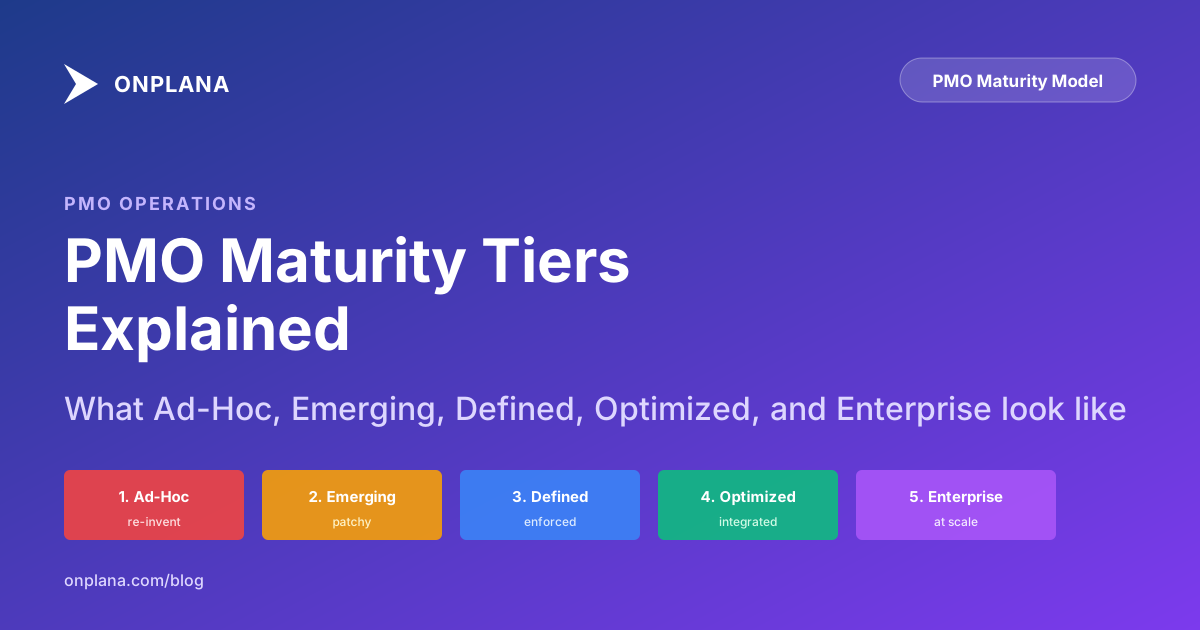
PMO Maturity Tiers: The 5 Levels From Ad-Hoc to Enterprise
Five PMO maturity tiers across Process, Tooling, Governance, Risk, and Reporting: what each looks like in real organizations and how to move up one.
There's a lot of PMO maturity-model literature out there. Most of it reads like it was written for a consulting pitch, long scoring rubrics, weighted dimensions, tiers with names like "Transcendent" that imply the goal is to keep paying for consulting engagements indefinitely.
This is different. What follows is a practical description of what each of the five tiers (Ad-Hoc, Emerging, Defined, Optimized, and Enterprise) actually looks like inside a real PMO, across the five dimensions most PMOs actually care about: Process, Tooling, Governance, Risk, and Reporting. No weighted rubrics. No consulting engagement. Just what day-to-day operations feel like at each tier, and what it realistically takes to move up one step.
If you want a specific read on where your PMO sits today, we built a free 15-question PMO Maturity Assessment that produces a tier + your weakest dimension + next-step recommendations. No email capture, no pitch. The content below explains what the scoring is actually checking for.
The five tiers at a glance:
| Tier | Name | Defining characteristic | You know you are here when |
|---|---|---|---|
| 1 | Ad-Hoc | Every project re-invents its own templates, tools, and cadence | Three PMs give three different answers on the standard report format |
| 2 | Emerging | Standards are written but adoption is patchy and unenforced | PMs skip the templates and nobody gets called on it |
| 3 | Defined | Standards are written, enforced, and exceptions are documented | Ten random status reports all match, with no nagging |
| 4 | Optimized | The five dimensions feed each other automatically | A reported risk reaches the portfolio heatmap without re-typing |
| 5 | Enterprise | Optimized practices at multi-portfolio, multi-geography scale | Multiple portfolios plus board-ready health reports on demand |
Why maturity models exist at all
PMO performance is notoriously hard to measure. You can count projects delivered on time, but on-time is a budget-and-scope artifact: if the original plan was wrong, an on-time delivery is a coincidence, not a win. You can count status reports produced, but nobody reads them. You can count governance gates passed, but gate pass rates say more about gate difficulty than PMO quality.
Maturity models exist because direct performance metrics are unreliable but operational practices are observable. An organization that has written, consistently-followed change-control procedures is almost certainly producing better project outcomes than one that handles each change ad-hoc, even if the specific project metrics look similar in a given quarter. The model captures the practice, which predicts the outcome over time.
The five dimensions (Process, Tooling, Governance, Risk, Reporting) are the ones where maturity actually changes outcomes. Everything else (culture, training, career pathing) is either downstream of these five or runs in parallel without a clean causal link.
Tier 1: Ad-Hoc
What it looks like: Every project has its own planning format, its own status-report template, its own governance (usually "whoever shouts loudest"). Tool choice is per-project, one team uses MS Project, another uses a shared Excel sheet, a third runs the whole thing in Confluence pages. Status reports go out when someone remembers. Risks are tracked in individual PMs' heads.
What it feels like: Exhausting. Every new PM spends their first month learning how each project-sponsor-pair prefers their updates. Onboarding a new team member requires a month of shadowing because there are no canonical artifacts to read. The PMO director spends most of their time negotiating which format to use for the steering committee, and the answer differs per steering committee.
What gets missed: Risk patterns across the portfolio. If every project tracks risks separately, nobody sees that three projects are all dependent on the same overloaded vendor. Dependencies across projects, the critical-path stuff, are invisible because each PM draws their plan on its own axis.
How to know you're here: If you asked three PMs in your organization "what's our standard status-report format?" and got three different answers, you're Ad-Hoc. If the answer was "it depends on the project," you're Ad-Hoc. If the answer was a shrug, definitely Ad-Hoc.
Tier 2: Emerging
What it looks like: Someone, usually a new PMO director, has written down how things should work. There's a standard template for project charters. There's a preferred status-report format. A tool of record has been picked (usually MS Project, sometimes Smartsheet, sometimes an enterprise suite). But adoption is patchy. Some PMs use the templates; others still run their own system because "my sponsor prefers it that way."
What it feels like: Progress but frustrating. The PMO director can point at the standards and say "this is how we do it," but when you audit actual projects, 30-60% of them are running off-template. Every PMO meeting includes at least one "we should really get everyone on the same format" sidebar that never leads to enforcement.
What gets missed: Most of what Ad-Hoc misses, plus a new problem, inconsistent signal. A portfolio review pulling status from 20 projects sees 12 in the standard format and 8 in bespoke formats. Roll-up is manual. The "red" in one PM's RAG status means something different from the "red" in another PM's. The portfolio dashboard looks complete but is comparing apples to oranges.
How to know you're here: If you have templates but PMs regularly don't use them, and nobody gets called on it, you're Emerging. If every portfolio roll-up requires a human to manually normalize the data, you're Emerging. Most organizations live here for years. Moving out of Emerging is the hardest single step in the maturity model.
Tier 3: Defined
What it looks like: Standards exist, are written, and are enforced. Every project goes through the same intake gate. Every status report uses the same template. Every risk is logged in the same tool. Exceptions exist but require a specific approval from the PMO director, and the approval is documented. Resource allocation is visible at the portfolio level (not per-project but per-portfolio) because the underlying data is uniform enough to roll up, which is what makes a written resource allocation process in a matrix organization actually enforceable instead of a document nobody follows.
What it feels like: Predictable. A new PM can read three project charters from three different teams and understand all three, because they all have the same sections in the same order. The steering committee meeting runs in 45 minutes instead of 90 because everyone is looking at the same RAG definitions. The PMO director spends less time answering "how do we…" questions and more time on portfolio strategy.
What gets missed: Integration across dimensions. A risk identified in a status report might not automatically propagate to the project's risk register. Resource capacity data from the tool doesn't feed the quarterly portfolio planning exercise. The dimensions are each healthy but siloed.
How to know you're here: Pull 10 projects' latest status reports at random. If they all use the same template, the same RAG definitions, and the same blocker format, and you didn't have to nag anyone to get them, you're Defined. This is the tier most high-performing PMOs sit at.
Tier 4: Optimized
What it looks like: The five dimensions aren't siloed. A risk logged in a status report writes to the risk register automatically. A resource overallocation flagged by the tool triggers a governance check-in. Process improvements captured in a retrospective update the standard template for the next project. Lessons learned from one project's gate review feed the next project's charter. The system is integrated.
What it feels like: Calm. The PMO doesn't spend time chasing data, because data moves between systems without human re-keying. Portfolio views are live, not snapshots. When a risk changes severity, the RAG status on the relevant dashboards updates within minutes. The director's calendar shifts from "hunting signal" to "making decisions."
What gets missed: Complacency. Optimized PMOs sometimes stop questioning their own standards because the standards work. That's how good practices become bureaucratic calcification three years later. Maintaining Optimized requires a steady trickle of process re-examination that most organizations forget to schedule.
How to know you're here: If a risk identified on a Wednesday status report shows up on Thursday's portfolio-risk-heatmap without anyone re-typing it, you're Optimized. If quarterly portfolio planning pulls real resource-capacity data from your active tool instead of people typing it into a spreadsheet, you're Optimized.
Tier 5: Enterprise
What it looks like: Everything from Optimized, plus scale. Multi-portfolio, multi-geography, multi-methodology. Hybrid agile-waterfall delivery models with shared governance. Formal change-control boards that handle 50+ change requests per quarter without drowning. Benefits-realization tracking that follows projects six to twelve months after close. Vendor and partner ecosystems integrated into the same governance frameworks.
What it feels like: Industrial. The PMO operates as a running system, not a project. New portfolios spin up with pre-built infrastructure. Acquisitions integrate into the governance framework within a quarter. The director's job is now organizational design, not operational problem-solving; the operational problems are handled by the system.
What gets missed: The individual project. Enterprise-tier PMOs sometimes optimize for governance legibility at the expense of delivery flexibility. A 90-day delivery engagement starts to feel like a 120-day engagement because the governance overhead is calibrated for 12-month programs. Knowing when to break your own rules is an Enterprise-tier skill that isn't always practiced.
How to know you're here: If your PMO has more than one portfolio, runs formal governance at the portfolio level, and can produce a board-ready portfolio health report on demand without a multi-day scramble, you're Enterprise. If any of those three pieces is missing, you're running a sophisticated version of Optimized, not Enterprise.
The five dimensions in detail
The tiers above describe an organization-wide reading, but every PMO is stronger in some dimensions than others. A common pattern: Defined in Process and Tooling, Emerging in Governance and Risk, Ad-Hoc in Reporting (or some permutation). The weakest dimension is where to invest.
Process: Are your intake, change control, and delivery workflows written down and followed? Ad-Hoc has none; Emerging has some; Defined has all and enforces them; Optimized integrates them; Enterprise scales them.
Tooling: Is there a single source of truth for schedules, resources, and status? Most organizations think they're higher here than they are. If your tool-of-record has 70%+ adoption across active projects, you're at Defined in tooling; below that and you're still Emerging.
Governance: Are intake decisions, change approvals, and gate reviews consistent across projects? Gating is where most PMOs underinvest because the payoff is indirect (better project selection, fewer scope disasters) but the cost is visible (meetings, documentation).
Risk: Are risks identified early, logged centrally, and escalated on a consistent schedule? Risk management at Ad-Hoc lives in individual PMs' heads; at Enterprise it's a board-level discipline with quantified exposure metrics.
Reporting: Do status reports, portfolio dashboards, and executive summaries use consistent definitions and formats? Defined-tier reporting means a single template across the portfolio with consistent RAG definitions; moving to Optimized reporting requires the tool's output to feed your portfolio rollup automatically, not via manual re-entry.
Moving up one tier
The hardest transitions in the model:
Ad-Hoc → Emerging requires leadership commitment to writing things down. Usually triggered by a failed high-visibility project or a change in PMO leadership. Takes 4-12 weeks of focused work.
Emerging → Defined is the biggest step. It requires enforcement: someone in the PMO has to be willing to tell a senior PM "no, you can't use your own format this quarter, here's the template." Cultural resistance is significant. Takes 6-18 months. Half of PMOs that try this transition stall out and drift back to Emerging.
Defined → Optimized requires real tool integration, which usually means a tool migration. The cost of that migration is often underestimated; the benefits take 12-24 months to show up in portfolio metrics.
Optimized → Enterprise is scale, not sophistication. You can't reach Enterprise tier with 20 projects; there isn't enough volume to justify the operating overhead. Most PMOs should not attempt this transition; Optimized is the right endpoint for the majority. A PMO that does coordinate agile delivery at that scale usually meets a framework such as the Scaled Agile Framework and has to decide how much of it to adopt.
The assessment
The assessment doesn't email you afterwards. It doesn't route to a sales rep. It gives you the read, suggests one or two actions, and, if you decide your reporting or tooling dimension needs work, points you at the specific Onplana feature that addresses it. If you decide it doesn't, you leave with a tier score and nothing in your inbox. That seems fair.
Take the free PMO Maturity Assessment Fifteen questions across the five dimensions, an honest tier read, and a specific recommendation on which dimension to invest in next. No signup. No follow-up email. → Start the assessment
Microsoft Project Online™ is a trademark of Microsoft Corporation. Onplana is not affiliated with Microsoft.
Frequently asked questions
How is this different from PMMM: OPM3, P3M3, or the other formal maturity models?
It's smaller, faster, and more honest. The formal models (CMMI-derived PMMM, PMI's OPM3, Axelos's P3M3) run 200-500 questions and produce certifications. They're designed for a consulting engagement. The five-tier model here uses 15 questions across the five dimensions most PMOs actually care about, and surfaces specific gaps rather than a score. If you already have a PMMM or P3M3 assessment on file, use that. If you don't and you want a directional read in 10 minutes, our free assessment is designed for that.
Is 'Enterprise' the goal every PMO should aim for?
No. Enterprise-tier practices are expensive to run and only pay off above a certain portfolio size. A 15-project PMO that reaches Defined and stays there is healthier than one that tries to operate Enterprise practices on 15 projects and burns its PMs out on governance overhead. Match the tier to the scale. The assessment surfaces your weakest dimension, not a push toward Enterprise by default.
What does 'Optimized' actually require?
Real integration between the five dimensions. Optimized means your process, tooling, governance, risk management, and reporting talk to each other, a risk identified in a status report triggers a governance check that updates the process document that changes a tooling default. Most PMOs plateau at Defined because integration requires the five dimensions to all be healthy simultaneously. Moving one dimension to Optimized while others are still Emerging produces a brittle system that looks sophisticated but breaks under load.
Why do so many PMOs stay at Emerging?
Because moving from Emerging to Defined requires written standards and consistent enforcement, and writing standards is boring work that doesn't produce a project. Most PMOs produce projects, not PMO documentation. The tier break happens when leadership decides the opportunity cost of the current inconsistency is higher than the cost of two weeks of standards work. That's a leadership decision, not a tooling decision, which is why no tool can move you across it.
Does tooling maturity actually track the other four dimensions?
Usually. Organizations that reach Defined in tooling often reach Defined in process within 6-12 months because the tool forces process questions to the surface ('what's the canonical task-status workflow?', 'who approves scope changes?'). Organizations with strong tooling and weak governance are the exception, it happens when a PMO buys a tool before defining its operating model, and spends the next year retrofitting. Tooling doesn't CAUSE the other dimensions to mature, but it surfaces the gaps faster.
How often should a PMO re-take a maturity assessment?
Annually for established PMOs. Quarterly for PMOs in active transformation (new leadership, new tool rollout, new portfolio). Anything more frequent than quarterly is noise, the dimensions don't move that fast and the assessment results become a vanity metric. The value of re-assessing is in the delta, not the score: which dimensions moved, which didn't, and why.
Ready to make the switch?
Start your free Onplana account and import your existing projects in minutes.