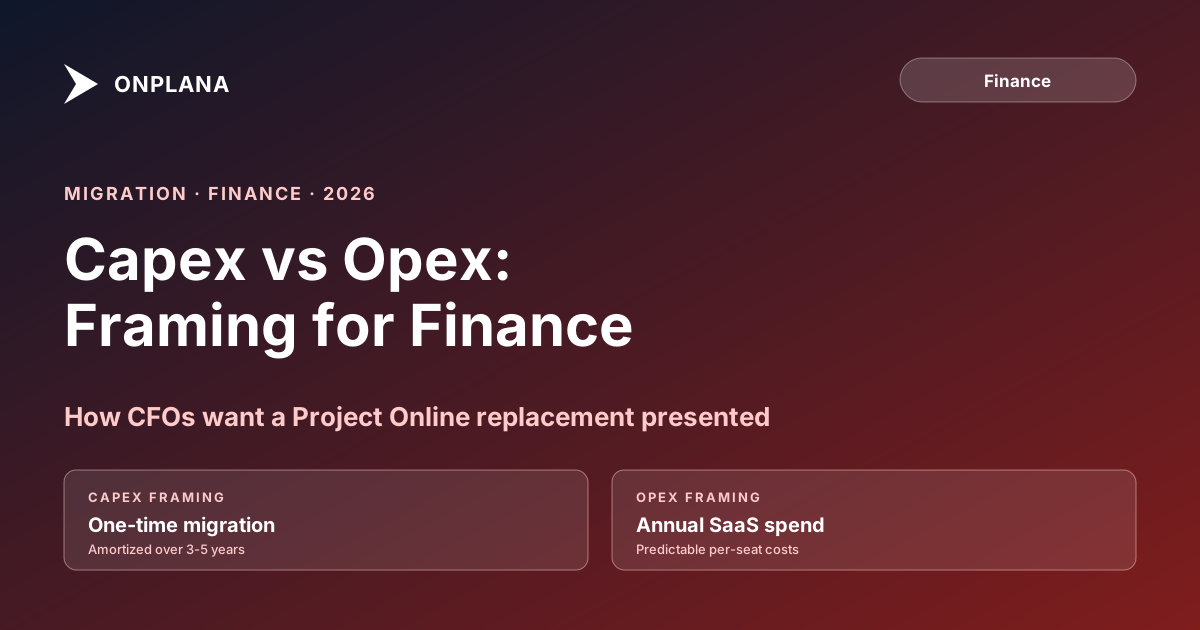
Capex vs Opex: How to Frame a Project Online Replacement to Finance
PMO capex vs opex framing decides whether your Project Online replacement gets CFO approval or stalls. Here is the language finance teams accept in 2026.
Most PMOs walk into the CFO meeting and frame a SaaS migration as a software purchase. The PMO capex vs opex distinction gets ignored, and the CFO often rejects the request on the framing alone before looking at a single number. The rejection is not about cost. It is about category: "software procurement" routes to capital approval workflows, requires committee sign-off above certain thresholds, and lands on the balance sheet in ways that most CFOs would rather avoid in 2026.
The good news: you are not asking for a capital purchase. You are asking to replace a retiring operating system with a SaaS subscription, the same budget category as the M365 licenses the finance team already approves every year without a capital committee. The PMO capex vs opex distinction is not an accounting technicality. It is the fastest path to a yes.
TL;DR: PMO capex vs opex for a Project Online replacement
- SaaS subscription fees are generally classified as opex under GAAP/ASC 350-40, not capex. Confirm with your finance team.
- Framing a migration as "software procurement" triggers capital approval; framing it as "replacing a retiring operating system with a SaaS service" keeps it in operating budget authority.
- CFOs in 2026 typically prefer opex for SaaS: no balance sheet impact, no capital committee threshold, and the cost matches the vendor's actual billing cycle.
- Keep one-time migration costs and ongoing subscription fees on separate budget lines. Finance treats them differently, and bundling them invites a capex classification for the entire project.
- Project Online retires September 30, 2026. The replacement is not optional, which is itself a framing asset: forced replacements are not discretionary capital projects.
Why the CFO Rejects the Wrong Framing Before the Numbers
CFOs have a capital approval threshold. The exact number varies by organization, but $50,000 is a common floor above which capital expenditures require a separate approval process: a capital committee review, sometimes a board sign-off, almost always a longer timeline than operating budget approvals.
When a PMO walks in and says, "We want to buy new project management software," the CFO hears a capital request. The project management tool is software. Software purchases have historically been capex. The threshold gets triggered, the committee gets notified, and the timeline for approval stretches by weeks or months. Meanwhile, Project Online's retirement date does not move.
The irony is that a modern SaaS subscription does not fit the traditional definition of a capital expenditure at all. You are not acquiring an asset. You are paying for access to a service. The vendor owns the infrastructure. You own no depreciable property. Under GAAP and specifically under ASC 350-40, which governs the accounting treatment of cloud computing arrangements, ongoing hosting fees for SaaS are operating expenses. They are not capitalized.
The PMO that walks into the same CFO meeting and says, "We need to replace a retiring Microsoft service with a SaaS subscription, same budget line as our existing M365 licenses," is making an opex request. That request often sits within the CIO's or CFO's existing operating budget authority. No capital committee. No board vote. Faster approval, smaller friction, same migration.
What GAAP and ASC 350-40 Actually Say
This post cannot give you accounting advice, and you should confirm the classification with your own finance team or external auditors before presenting the business case. That said, understanding the framework helps you have the right conversation.
ASC 350-40 covers internal-use software and cloud computing arrangements. For a SaaS tool like the replacement for Microsoft Project Online, the key distinction is whether the arrangement conveys a software license to the customer or whether it is purely a service.
Most modern SaaS project management tools are services: the vendor hosts everything, the customer accesses via browser or API, and no software is installed on company infrastructure. Under ASC 350-40, the ongoing subscription fees for such arrangements are generally expensed as incurred, which means opex.
Implementation costs are a different story. The same standard creates a three-phase model: preliminary project (expense as incurred), application development (potentially capitalizable), and post-implementation (expense as incurred). Whether your migration's consulting and configuration work falls in the capitalizable application development phase depends on the specific activities, and finance will want to make that call. The practical takeaway: keep the one-time migration cost on a separate budget line from the recurring subscription, and let finance decide how to classify each independently.
PMO Capex vs Opex: The Side-by-Side CFOs Want to See
The diagram below shows the core differences between capex and opex treatment across the dimensions that matter most to a finance team.
The Wrong Language vs. the Right Language
The language in the budget request matters as much as the numbers. Finance teams parse words carefully, and certain phrases trigger capex classification almost automatically.
Phrases that read as capex (avoid these):
- "Software procurement"
- "Purchasing a project management platform"
- "Capital investment in new PMO tooling"
- "Acquiring a replacement system"
- "Software implementation project"
Each of these implies you are buying something: an asset, a license in perpetuity, or a custom-built system. All of those carry capex signals.
Phrases that read as opex (use these):
- "Replacing a retiring Microsoft service with a SaaS subscription"
- "Transitioning from an end-of-life system to an ongoing service contract"
- "Operating cost for PMO tooling, same category as existing M365 licenses"
- "System transition costs covering a one-time migration and recurring subscription fees"
- "Subscription-based replacement for a vendor-retired platform"
The second set frames the spend as a service cost, not an asset acquisition. It also emphasizes the involuntary nature of the replacement: Project Online is retiring on September 30, 2026, and the migration is not a discretionary upgrade. The forced-replacement framing is genuinely advantageous here. Discretionary capital projects compete with every other priority in the capital plan. A mandatory system replacement is in a different category.
A Concrete Budget Language Template
The following language is the kind that finance teams accept. Adapt the numbers to your PMO size.
Budget request: PMO system transition, FY2026
Category: Operating expenses
| Line item | Classification | Amount (mid-case) |
|---|---|---|
| SaaS subscription, new PMO platform (12 months) | Opex, recurring | $18,000 |
| System transition consulting (one-time) | Opex or capex per ASC 350-40 (confirm with finance) | $45,000 |
| Training and change management (one-time) | Opex | $8,000 |
| License overlap period, 90 days | Opex, one-time | $4,500 |
| Total | $75,500 |
Note: Project Online Plan 3 (the retiring service) costs $30 per user per month. The replacement subscription is $X per user per month, representing a per-seat reduction of $Y. The one-time transition cost is partially offset by the recurring license delta beginning in Year 1.
This table does three things the CFO needs: it separates the one-time from the recurring, it flags the implementation line for independent accounting treatment, and it shows the license delta that turns the migration into a cost-reduction over a three-year horizon. For a deeper walkthrough of each line item and realistic ranges for your PMO size, the migration budget template covers a 100-user deployment in full detail.
Why CFOs Prefer Opex for SaaS in 2026
The shift is structural, not cyclical. Over the past decade, finance teams have adapted their budgeting models to treat SaaS as a recurring operational cost. The reasons are practical:
No capital approval threshold friction. A recurring SaaS subscription that falls within existing operating budget authority does not need a capital committee. The CIO or PMO director can approve it within their delegated spend authority. That removes weeks from the approval timeline, which matters acutely given the September 30, 2026 retirement date.
No balance sheet complexity. A capitalized software asset requires a useful-life estimate, a depreciation schedule, and a write-off policy. If you switch tools before the end of the useful life, you take a loss on the undepreciated balance. SaaS subscriptions have no balance sheet residue: cancel at renewal, no write-off, no impairment.
The cost matches the billing. When Project Online invoices monthly, treating the replacement subscription as monthly opex aligns the P&L recognition with the cash outflow. CFOs prefer this alignment because it removes the timing distortions that capitalization introduces.
The lock-in argument is gone. Under a traditional perpetual software license, writing off the asset prematurely was a real financial deterrent to switching tools. Under SaaS, the sunk cost at any renewal point is zero. Finance teams know this, and they value the optionality it preserves. Approving opex does not commit the organization to the tool forever.
The Three-Year Cost Framing That Closes the Conversation
One of the strongest moves in a PMO capex vs opex conversation is reframing the migration spend as a cost reduction rather than a new spend. It is genuinely accurate.
Project Online Plan 3 costs $30 per user per month. Comparable modern SaaS tools with equivalent portfolio management capability typically cost less per user at equivalent feature tiers. Check Onplana's pricing for current rates. The delta is not a new expense; it is an opex saving that begins in Year 1 and compounds over the three-year horizon.
The framing in the CFO meeting:
"The current Project Online subscription costs $X per year. The replacement subscription costs $Y per year, a delta of $Z. The one-time transition cost is $W, fully recovered by the license delta in [N] months. After month [N], the organization runs PMO operations at a lower operating cost than today."
That framing turns the approval question from "should we spend money on this?" to "should we capture this cost reduction before the September 30, 2026 hard deadline?" Most CFOs find the second question significantly easier to answer.
For the full three-year model with supporting-stack costs included, the Project Online TCO three-year analysis walks through the numbers at three PMO scales. The CFO-proof business case framework covers how to layer the capex/opex framing into the full slide deck alongside cost-of-inaction and risk-adjusted ROI.
The section below also belongs in your business case appendix. Finance teams appreciate seeing the accounting dimensions spelled out so they do not have to ask separately.
| Dimension | Capex (traditional software) | Opex (SaaS subscription) |
|---|---|---|
| Cash flow pattern | Large upfront, depreciated over useful life | Predictable monthly or annual payments |
| Balance sheet impact | Creates depreciable asset | No asset; expense recognized as incurred |
| Tax deduction timing | Spread over useful life via depreciation | Deducted in the period incurred |
| Capital approval threshold | Usually triggered above org threshold | Often within operating budget authority |
| CFO sentiment (2026) | Increasing resistance for SaaS tools | Preferred for subscription services |
| PMO flexibility | Early exit requires asset write-off | Cancel at renewal with no write-off |
| Alignment with vendor billing | Misaligned (lump capitalization vs monthly bill) | Aligned (monthly/annual matches invoice) |
What to Do If Finance Insists on Capex Classification
It happens. Some finance teams have internal policies that classify all software implementations above a dollar threshold as capex regardless of the SaaS vs. perpetual distinction. If you encounter this:
Do not fight the classification in the meeting. Finance owns the classification decision. Arguing accounting standards in a CFO review rarely ends well for the PMO. Accept the classification and focus on making the capex case as strong as possible.
Separate the lines. Even if finance classifies the implementation consulting as capex under ASC 350-40's application development phase rules, the ongoing subscription fee is still opex. Get finance to confirm the subscription line is operating cost so the recurring portion does not hit the capital committee every year.
Use the capex argument to your advantage. If the implementation is capitalized, the upfront cash impact on the P&L is reduced (it moves to the balance sheet and depreciates). The P&L-year-one cost drops, which can actually help the approval case in organizations that are managing earnings closely.
Show the three-year model either way. Whether the migration cost is capex or opex, the three-year license delta is the same. Use the Migration Cost Calculator to build the scenario output that shows total spend under both accounting treatments. The calculator produces the low/mid/high format that finance teams need to audit the assumptions.
Model the full three-year cost before your finance presentation The Migration Cost Calculator outputs low, mid, and high scenarios with line-item detail, exactly the format a CFO can audit. No signup required. → Open the Migration Cost Calculator
Microsoft Project Online™ is a trademark of Microsoft Corporation. Onplana is not affiliated with Microsoft.
Ready to make the switch?
Start your free Onplana account and import your existing projects in minutes.