Claude vs OpenAI for Project Management: Which Leads Where
Two strong models, different strengths on PM tasks. Claude vs OpenAI on status synthesis, plan generation, risk detection, and comment analysis, head-to-head.
The product page says "Claude" or "OpenAI" or "both," and most procurement conversations stop there. They should not. The choice between Claude and OpenAI inside a project management tool is not a brand preference; it is four distinct task-shape decisions, each of which the two model families handle differently. A team that picks one model for everything leaves measurable quality on the table on the tasks that family handles less well.
This is not a benchmark race. It is a practitioner's read on what each model family is reliably good at when wired into the four PM tasks where AI actually matters: synthesizing status across many sources, generating plans from briefs, detecting risks, and parsing comment threads. The differences are real. The framing "which is better overall" is the wrong question.
TL;DR. On Claude vs OpenAI for project management, neither dominates. Claude tends to lead on long-context synthesis and hedged language; OpenAI tends to lead on structured outputs and concise executive summaries. The pragmatic answer is to route different PM tasks to different providers based on task shape, not to pick one vendor and use them for everything. Onplana runs on both and routes between them at the platform level; the same principle applies to any tool built on more than one model.
Why Claude vs OpenAI matters for project managers
The PM-facing parts of a project management tool that actually use AI are narrower than vendor marketing suggests. Strip away the chat sidebar and the demo-ware, and four task shapes carry most of the value:
- Status synthesis. Take a week of updates (Slack messages, commits, schedule deltas, comments) and produce a coherent weekly status the PM can review and send.
- Plan generation. Take a brief or charter and produce a draft project plan: phases, milestones, tasks, dependencies.
- Risk detection. Look across project artifacts (schedule, status history, resource allocations) and surface risks the PM should triage.
- Comment-thread analysis. Read a long discussion on a task or risk and produce a one-paragraph summary plus the open questions.
These four are where the model choice shows up in the work. Other AI features (autocomplete, single-prompt rewrites, dashboard summaries) are too short or too generic to differentiate; both vendors handle them roughly the same.
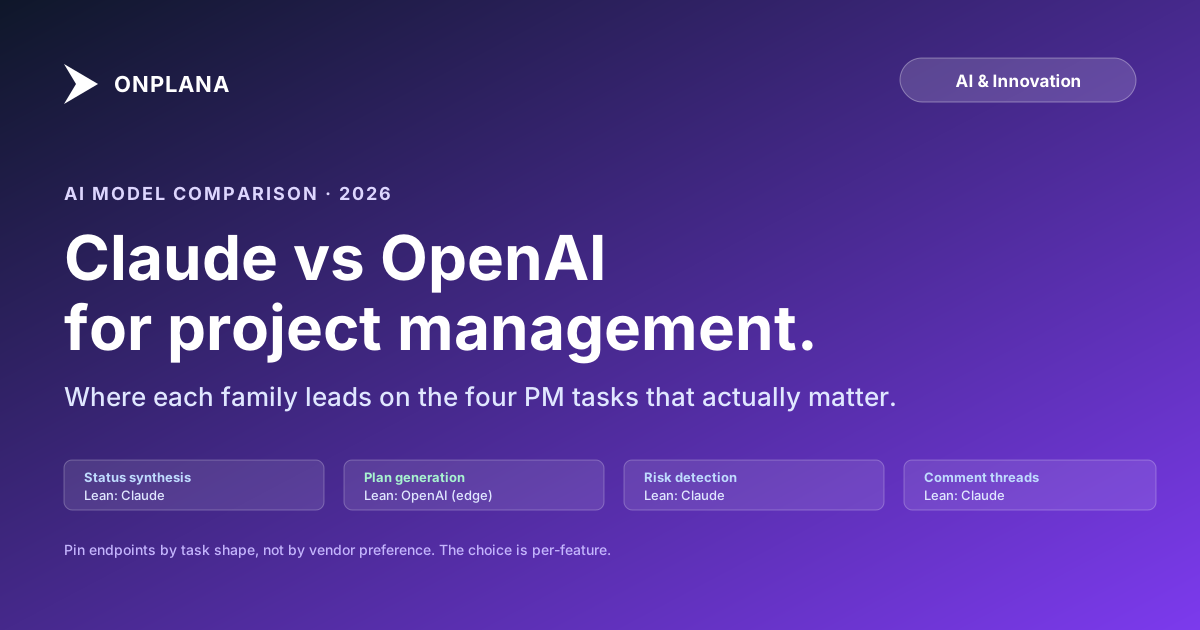
The diagram below sketches where each family tends to lead, based on practitioner-side observations across teams running both providers in production. It is not a benchmark; it is a framing.
The diagram is a starting point, not a verdict. Each row below explains the why and the failure modes that make the lean what it is.
Status synthesis: where Claude tends to lead
Status synthesis is the task where you hand the model a week's worth of mixed signal (Slack messages, schedule changes, comments, commits, meeting notes) and ask for a coherent weekly status report. It is the highest-value AI task for most PMs and the one where model choice shows up most clearly.
Claude leads here for two reasons. First, long-context coherence: when the input is 30 KB of mixed-source text, the model has to hold the whole picture in working memory while writing, and Claude handles that without losing thread. The same task on a smaller-context model produces summaries that quote the most recent inputs accurately and the earlier inputs vaguely, which is exactly the failure mode that turns "weekly summary" into "summary of the last two days."
Second, the hedged-language style. A useful weekly status surfaces uncertainty without panic. Claude defaults to phrasings like "the integration milestone is at moderate risk; the test environment dependency has not been confirmed" rather than "the integration is on track" or "the integration is at risk." That hedging reads as honest to a sponsor. OpenAI's default is more confident, which produces tighter prose but occasionally turns "we have not yet confirmed" into "we have confirmed" through paraphrase compression. On status, where the cost of false confidence is real, this matters.
OpenAI is competitive here on shorter status (one-page weekly for a single project, light input) but loses ground as input volume rises. The crossover is roughly at the point where the input would not fit on a printed page.
The right move is to default the Status Report Writer endpoint to Claude when the input bundle is over a few thousand words, and let the operator override per-tenant.
Plan generation: OpenAI's structural edge
Plan generation is the inverse problem: take a short brief and produce a structured plan with phases, milestones, tasks, and dependencies. The bias here flips.
OpenAI tends to produce tighter task lists. Where Claude will write "the discovery phase should include user interviews and competitive analysis," OpenAI will write a numbered list of five tasks with estimated durations and an owner placeholder. Both can be prompted for either style; the difference is what each does with a loose prompt.
OpenAI's structural-output reliability is the deeper reason for this lean. When you ask for JSON or a strict schema, OpenAI's structured-output mode is more likely to produce parseable output on the first attempt. For an AI feature that has to populate a real task list in a database, that reliability is worth a lot. Claude's tool-use mode handles structured outputs well too, but the failure modes are different: Claude is more likely to add a clarifying note in the wrong place, OpenAI is more likely to silently drop a field.
The lean here is "edge to OpenAI," not "OpenAI dominates." Claude often produces plans with better-articulated milestones and more honest dependency notes; OpenAI produces plans with more reliable structure. If the workflow is "AI generates a plan that a human refines," Claude's planning is often better starting material. If the workflow is "AI populates a structured artifact that downstream automation consumes," OpenAI's structural reliability is the reason teams pin that endpoint there. The trade is real and well-documented in Onplana's AI-first architecture where the planning endpoint defaults differ by workflow.
For a PM evaluating either model on plan generation, the right test is: feed the same brief to both, generate plans, and compare against a manually written project plan you trust. Whichever output requires fewer edits to reach the bar is the better fit for that team's workflow.
Risk detection: Claude's caution as a feature
AI risk detection takes project artifacts (schedule, status history, resource allocations, recent commits or comments) and surfaces risks the PM should triage. The metric that matters here is not "how many risks did the model find" but "how many of the surfaced risks were real, and how many were false positives that wasted the PM's time."
Claude's default disposition is more cautious. When the evidence is ambiguous, Claude is more likely to phrase a finding as "this pattern is consistent with X, though it could also indicate Y" rather than asserting X. For risk detection, where false-positive fatigue is a real failure mode, that caution is a feature. PMs who get a daily risk digest dismiss confident-but-wrong risks faster than they dismiss genuinely uncertain ones, and the dismissal pattern eventually trains the team to ignore the digest entirely.
OpenAI is competitive here on the easy cases (overdue tasks, missing assignees, unbaselined milestones) where the signal is unambiguous. The differentiation shows up on the harder cases: the schedule that looks fine numerically but has a dangerous dependency pattern, the status report that has been green for too long without amber transitions, the resource allocation that adds up to 100% but masks a single critical engineer being on three projects. Claude is more likely to surface these as "worth a look" rather than missing them or asserting them too confidently.
The pragmatic pattern: route the risk detection endpoint to Claude by default, accept that the surfaced risks will be slightly fewer but noticeably higher signal, and let the operator override.
Comment-thread analysis: tone matters
A 40-comment thread on a contentious task or risk is hard work to read. AI summarization is one of the tasks PMs use most often inside a tool, and the model choice shows up in how the summary feels.
Claude's summaries of comment threads tend to preserve tone better. When the discussion is heated, the summary acknowledges the heat ("the team is divided on whether to delay the launch; engineering and design have raised concerns about technical readiness, marketing has expressed concern about the campaign timing"). OpenAI's summaries tend to neutralize tone toward an executive register, which produces a cleaner read but sometimes hides the actual signal. If five out of seven comments are pushing back hard against a proposed change, the summary should make that visible; "team has raised some concerns" does not.
Claude is also more quote-accurate. When a summary says "Sarah said X," Claude is more likely to be reproducing close to what Sarah actually said. OpenAI tends to paraphrase more, which is sometimes better and sometimes worse: better for a tight executive summary, worse if the PM needs to act on what was actually argued.
OpenAI has an edge on very short threads (under five comments) where its tighter prose produces a one-sentence summary that reads cleanly. The crossover is roughly at the point where the thread has multiple distinct positions that need to be represented.
What about cost?
Both vendors price their high-end models within roughly the same range, and the absolute numbers move enough quarter to quarter that any specific figure here would be stale by next month. The right way to think about cost is not list price but token volume.
The dominant cost driver in any production AI feature is how many tokens the system sends and receives, which is set by retrieval design, prompt engineering, and conversation length, not by which provider you picked. A team that retrieves 8,000 tokens of context per call will pay roughly twice what a team that retrieves 4,000 tokens pays, regardless of provider. Optimizing the retrieval beats vendor-shopping on price by a wide margin.
Two cost-relevant patterns are worth naming. First, prompt caching: both vendors now offer it, and for any feature that re-uses a system prompt across calls (most do), enabling cache reduces effective cost meaningfully. Second, model tiering: both ship a "fast and cheap" tier and a "smart and expensive" tier; routing easy tasks to the fast tier and reserving the smart tier for the tasks that need it can cut spend without hurting output quality.
For Microsoft Project Online migrations specifically, where the cost case is part of the broader business case for moving to a modern PM tool, AI inference cost is a small fraction of the total, but the same retrieval-design discipline applies. Run the migration sizing first, treat AI cost as a controllable line item, and let the model choice be a quality decision, not a price one.
A direct comparison table
The summary table below pulls the leans together with a one-line "use this when" for each.
| PM Task | Lean | Use Claude when... | Use OpenAI when... |
|---|---|---|---|
| Status synthesis | Claude | Inputs are large and mixed-source; honesty in language matters | Status is short, single-project, executive register required |
| Plan generation | OpenAI (edge) | Output goes to a human for refinement | Output populates a structured artifact directly |
| Risk detection | Claude | False-positive cost is high; PM trust in the digest matters | Risks are unambiguous and you need surface coverage |
| Comment-thread analysis | Claude | Thread is long, contentious, or quote-accuracy matters | Thread is short and an executive summary is enough |
| Short autocomplete | Tied | Either is fine | Either is fine |
| Tool-call structured output | OpenAI (edge) | Tool calls are forgiving and outputs go to humans | Strict schema enforcement is required |
A team that pins everything to one provider is making one of two trades. Pinning to Claude trades structured-output reliability and tighter executive prose for stronger long-context synthesis and more cautious risk handling. Pinning to OpenAI trades hedge quality and quote accuracy for tighter outputs and stronger schema enforcement. Both trades are defensible; neither is optimal.
How a PM tool should handle the choice
The pragmatic architecture routes each kind of work to the model that suits it, with automatic failover if a provider is degraded, and it does this at the platform level rather than pushing the decision onto customers. That is the pattern Onplana uses: API keys for both providers live in Azure Key Vault, Onplana runs Claude and Azure OpenAI side by side, and it routes between them (with the other available as failover) so you get the model fit without configuring anything. The architecture is covered in the dual-provider announcement; the broader design is in the AI-first architecture writeup.
For PMOs evaluating AI-native tools, three questions to ask the vendor:
- Does the tool run on more than one model provider, and how does it decide which serves a given request? "One model, take it or leave it" is a weaker answer than "we route by task shape."
- What is the failover behavior when a provider has an outage? "Calls fail" is not the right answer; "automatic failover to the alternate provider" is.
- Where do the API keys live, and who has access to them? Azure Key Vault or equivalent is the right answer; "in the database" or "in environment variables on the production server" is not.
A vendor whose answer to all three is vague is offering AI as a marketing label, not as a production capability. That is a different product than one that has thought through the model-choice architecture.
What this means for the PM today
If your tool exposes the model choice, the right defaults are roughly: status synthesis on Claude, plan generation on OpenAI (with Claude as fallback for plans that need refinement), risk detection on Claude, comment-thread analysis on Claude, structured-output endpoints on OpenAI. Override based on what your team actually observes. The leans here are reliable but not absolute; your specific workload may push different.
If your tool only exposes one provider, that is a constraint to live with. The features will still work; they will be measurably worse on some tasks than they would be on the alternative provider. Push your vendor on whether they plan to offer the choice; teams that pin to one provider in 2026 are leaving quality on the table that the alternative would have caught.
Try the free Status Report Writer Generate a draft weekly status from a few bullet points, with model routing tuned for the task. The same task-aware routing pattern this post recommends, applied. No signup required. Open the writer
Frequently asked questions
Is Claude better than OpenAI for project management tasks?
Neither is uniformly better. Claude tends to lead on long-context synthesis (status reports across many sources, comment-thread analysis) and on cautious, well-hedged language. OpenAI tends to lead on structured-output reliability and tight, executive-style summaries. The right answer is task-dependent, not vendor-loyalty.
What are the four PM tasks AI models differ most on?
Status synthesis from messy inputs, plan generation from a brief, risk detection over project artifacts, and comment-thread analysis. These four cover most of what AI does inside a PM tool day-to-day, and the model choice noticeably affects each one.
Should I use both models in the same project management tool?
Yes, if the tool routes by task shape. The pragmatic pattern is: send long-context synthesis to Claude, send structured generation and short executive summaries to OpenAI, and let the tool handle that routing. Pinning every endpoint to one provider leaves quality on the table.
Does the model choice affect cost meaningfully?
Usage is dominated by token volume, not list price. Both vendors price the high-end models within roughly the same range; the variance you see month over month comes from prompt size and retrieval design, not from which model you chose. Optimizing token volume beats vendor-shopping on price.
How does Onplana use Claude and OpenAI together?
Onplana runs on both Anthropic Claude and Azure OpenAI. Onplana manages which provider serves each request (for example, risk detection on Claude, plan generation on GPT-4), with the other available as automatic failover if one is degraded. That routing happens at the platform level, not as a setting customers configure. Provider API keys live in Azure Key Vault, never in the database.
Are there PM tasks where AI shouldn't be used at all?
Yes. Final go or no-go decisions, performance reviews, and any output that needs to be defensible in audit should not be AI-generated. AI is right for drafting and synthesis; the human is right for judgment, accountability, and anything that ends up in HR or compliance records.
Ready to make the switch?
Start your free Onplana account and import your existing projects in minutes.