Project Kickoff Meeting Agenda That Aligns the Team
Most project kickoff meetings are status updates in disguise. An agenda that surfaces disagreement early, sets a working agreement, and ends with decisions.
The calendar invite says "Project X Kickoff," 60 minutes, 14 attendees. The agenda is a slide deck titled "Charter Overview." Forty minutes in, the PM has read past the project goal slide; six attendees are on email; one VP joins late and asks "so what's the timeline again?" The meeting ends with a polite "any questions?" and a thirty-second silence.
That meeting does not align anything. The team leaves with the same private uncertainties they walked in with: a designer who thinks the goal is "redesign the checkout," a back-end engineer who heard "build a checkout API," and a marketing lead who is planning a launch around a date the team has not actually committed to. Six weeks later, when those private interpretations collide, the team blames "scope creep." It was never scope creep. It was a kickoff that informed instead of aligning.
A project kickoff meeting has one job: surface the disagreements that already exist in the room before they become invisible work for the PM. The fix is structural, like every other meeting structure that fails the same way every time. Below is a 90-minute agenda you can run starting Tuesday morning, the prep that makes it work, and the artifacts you walk out with.
TL;DR. A working project kickoff meeting is 90 minutes built around four blocks: goal alignment, scope and success criteria, working agreement, and first decisions. It runs on a pre-read sent 48 hours ahead so the meeting itself uses synchronous time for disagreement, not narration. You leave with three written artifacts: a one-sentence goal, a working agreement, and three committed first decisions. Anything else is decoration.
Why most kickoff meetings fail to align
The default kickoff is shaped like a status meeting because that is the only meeting shape most teams know. The PM walks the room through the charter. The sponsor adds a few words about strategic importance. The functions speak briefly about their commitment. Everyone agrees the project is important. The meeting ends. The team gets back to their inboxes feeling that something happened.
Three things did not happen.
Disagreement did not surface. The designer who thinks the project is about redesigning the entire checkout flow and the engineer who thinks it is about adding one API endpoint never had to put their interpretations in the same sentence. They will discover the gap in week three when designs land that engineering cannot build in the time available.
The working agreement did not get set. How will decisions be made when the sponsor is unavailable? How often will the team meet, and for what? What counts as "done" for a milestone? These questions get answered ad-hoc later, which means they get answered inconsistently, which means the team relitigates them every time a borderline case shows up.
Nothing was decided. A kickoff that produces zero decisions is a meeting that did not need to be a meeting. It could have been a project charter document and a Slack channel. The reason to put 14 people in a room is to make use of the room: to commit to things that everyone can hear committed.
These failures are not personal. They follow from the agenda. Change the agenda and the room behaves differently in a single meeting.
The 90-minute kickoff agenda
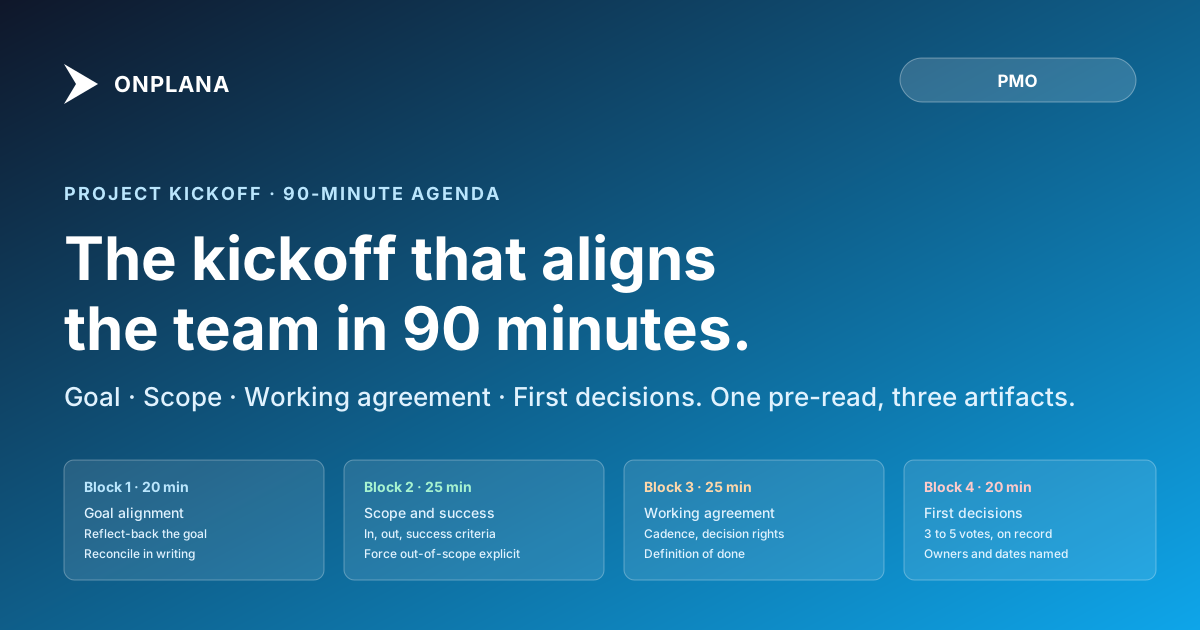
Four blocks, in order. The diagram below shows the time allocation.
The goal of the agenda is decision-density and disagreement surfacing, not coverage. The pre-read covers what would otherwise consume the first 30 minutes (project charter, scope summary, team list, key dates). The meeting is for what only synchronous time can produce: alignment that gets stated out loud and committed to in writing.
Block 1: Goal alignment (20 minutes)
The PM reads the project goal aloud. One sentence. "We are building a self-serve checkout flow that reduces median checkout abandonment from 38% to under 25% by August 15." Then, around the room, every function representative answers the same question: "in your own words, what does this project produce, and how will you know it succeeded?"
The goal of this exercise is to find the gaps. The designer says "a redesigned checkout that reduces friction." The engineer says "an API that handles guest checkout flows under 200 ms." The marketing lead says "a launch we can promote in late August." Three valid interpretations, three different scopes, all reasonable from each person's vantage point. Surface them now. Reconcile by either picking one definition or holding all three explicitly with named owners.
Twenty minutes is enough for six to eight people to do this around a normal-size project team. Larger rooms cluster the function leads and have leads represent. The artifact is a written goal, agreed upon by everyone in the room, recorded in the project's permanent home before the meeting ends.
Block 2: Scope and success criteria (25 minutes)
Three lists, on a shared screen, written in real time:
- In-scope. What this project will deliver. Phrased as outcomes, not activities.
- Out-of-scope. What this project will not deliver, especially items the room might assume are included. This is the more important list.
- Success criteria. How the team will know the project succeeded, with a measurable bar.
The out-of-scope list is the one most teams skip. Skipping it does not make those items go away; it ensures they show up as "scope creep" three months later. Force at least five items onto the out-of-scope list, even if you have to ask "is migrating the legacy admin tool in scope?" to draw out a "no, that's a separate project." The five-item exercise is uncomfortable, which is why it works. Stakeholders who would have pushed those items in over time push back here, where the conversation is cheap.
Success criteria need numbers wherever possible. "Customers can complete checkout in under 90 seconds at the 75th percentile" beats "customers find checkout faster." Without numbers, the team and sponsor will end up disagreeing about whether the project succeeded six months from now, and there will be no objective way to settle it. The discipline of writing measurable goals is the same one that supports honest status reporting later in the project; it pays compound interest.
Block 3: Working agreement (25 minutes)
Five questions, each answered in writing in the room.
- Meeting cadence. What recurring meetings will this project hold, and what is each one for? The default failure: too many recurring meetings, none with clear purpose. Pick the smallest set: a weekly working session, a bi-weekly stakeholder review, a monthly steering committee. Anything else gets created on demand.
- Decision rights. Who decides what, and at what threshold does a decision escalate? The PM decides scheduling and task assignments. The sponsor decides budget over $X and scope changes over Y impact. The steering committee decides cross-functional tradeoffs and gate go or no-go.
- Definition of done. What does "done" mean for a deliverable? Code merged is not done. Code merged, tested, and deployed to staging is done for an engineering deliverable; "user can complete the flow without help" might be done for a UX deliverable.
- Escalation path. Who gets pulled in when, and how. Specifically: when does a risk become an issue, an issue become an escalation, and an escalation reach the sponsor? Vague escalation paths produce panicked Friday-afternoon emails to executives.
- Async expectations. What is the team's expected response time for messages, and what is the boundary between "immediate" and "tomorrow"? This question is small but its answer prevents weeks of friction. Distributed teams without a written async agreement burn at least an hour per person per week relitigating it.
The working agreement is the artifact most teams skip and most projects later wish they had. The right move is to draft a one-page version live in the meeting and pin it where the team will actually see it.
Block 4: First decisions and asks (20 minutes)
Three to five decisions on the table, brought by the PM. Each decision has a one-line statement, a recommendation, and a named decider. The room votes (verbal "yes" or "no" or "needs more info"), the PM records the result, and each closed decision exits with an owner and a deadline.
Sample first-meeting decisions for a typical project:
- "We will use [tool X] as the project's source-of-truth for tasks. Owner: PM. Effective: today."
- "The launch date is August 15, with no scope reduction. Owner: Sponsor. Effective: today."
- "We will run a usability test on the checkout flow at week 6. Owner: UX lead. Effective: week 6."
- "The integration with [external system] is out-of-scope for v1. Owner: Engineering lead. Effective: today."
- "The team will hold weekly working sessions on Tuesdays at 10:00. Owner: PM. Effective: next week."
The point is not the specific decisions; it is that the meeting ends with five things written and committed. A kickoff that produces five written decisions has more momentum behind it than a kickoff that produces no decisions but lots of "great energy in the room."
The PM closes the meeting by reading back the three artifacts: the goal, the working agreement, and the decisions. Five minutes, no slides, no questions. That five-minute close is the most important moment of the meeting. It converts verbal agreement into a written record that survives whatever everyone forgets in the next four weeks.
What the pre-read needs to contain
A 90-minute kickoff only works if the pre-read does the heavy lifting. Send it 48 hours ahead. Treat it as a precondition for participation; if someone shows up without having read it, the meeting either does not start or starts without them.
The pre-read is one document, around three to five pages, with five sections.
- Project context. Why this project, why now. One paragraph. The strategic problem it addresses.
- Draft project goal. The PM's best one-sentence formulation. The meeting will refine it; the pre-read presents it.
- Scope summary. A first cut at in-scope, out-of-scope, and success criteria. Imperfect on purpose; the meeting will revise.
- Team and roles. Who is in the room, what each person owns, the sponsor. RACI optional but useful for projects with more than 10 contributors.
- First-meeting decisions. The three to five items the PM is bringing for committee vote, with recommendations.
The pre-read is not a charter document. A charter is longer, more formal, and signed at the end of the kickoff. The pre-read is a working draft that the kickoff turns into a real charter. The split matters: charters are signed deliverables; pre-reads are working artifacts. Treat them as different things.
Common kickoff failure patterns and how to spot them
A working kickoff produces three artifacts; a failed kickoff produces zero or one. The failures cluster into a few recognizable shapes.
| Failure pattern | Tell | Fix |
|---|---|---|
| Charter walk-through | 30+ min on slides recapping the pre-read | Send pre-read 48 h ahead; ban slides in the meeting |
| Big-tent invite list | 14+ attendees, multiple silent | Cut to one named rep per function; absentees catch up via record |
| No out-of-scope list | "We didn't get to scope" | Force five items onto the out-of-scope list before moving on |
| No working agreement | "We'll figure that out as we go" | Block 3 is mandatory; do not skip even if running long |
| No decisions made | Meeting ends on "any questions?" | Block 4 is the close; cut earlier blocks first |
| No written record | Verbal agreement, nothing posted | PM owns artifact capture; published within 24 h |
If your last three kickoffs produced zero decisions and no working agreement, the kickoff is decoration; the actual alignment work is happening (or not happening) somewhere else. Restructure the agenda once and watch the change.
Tailoring the agenda by project shape
The 90-minute agenda is the default. Tailor it for projects that sit outside normal shape.
For very small projects (one or two functions, under three months), compress to 45 minutes: 10 min goal, 10 min scope, 10 min working agreement, 15 min first decisions. The same four blocks, half the time. Do not skip any block.
For very large or program-level projects (five or more functions, over a year), split into two sessions: a 90-minute leadership kickoff and a 90-minute team kickoff. Leadership kickoff covers blocks 1, 2, and the strategic decisions in 4. Team kickoff covers block 3 in detail and the operational decisions in 4. Do not try to do both in one room; the dynamics are too different.
For migration projects (especially Microsoft Project Online migrations approaching the 2026 retirement), front-load block 2 to 35 minutes and add an explicit dependency map. Migrations fail less because of bad tools and more because of unsurfaced dependencies between teams; the kickoff is the cheapest place to catch them. The Project Online Inventory Checklist can feed directly into block 2 if you are running a tenant audit.
For projects inheriting from an earlier project (a v2 of something), spend 10 minutes of block 1 reading the prior project's lessons learned and explicitly committing to which patterns to repeat and which to break. The team that "inherits" without explicit handover ends up rebuilding the same trap the prior team fell into.
What changes after a single kickoff this way
The first time a team runs the agenda above, two things happen. The pre-read takes the PM longer to write than they expected, because writing a one-sentence goal that survives scrutiny is hard work. And the meeting ends on time, with three artifacts in writing, with the PM faintly surprised that the room agreed to so much in 90 minutes.
The compounding shows up over the next month. The disagreements that would have surfaced as "scope creep" in week six surface as agenda items in week one. The working agreement gets cited the first time someone proposes adding a daily standup; "we agreed weekly is the cadence, what's changing?" The decision log starts on the day of the kickoff, not in the first emergency.
For the team's first project planned this way, walking through how to create a project plan before the kickoff helps the PM produce the pre-read. If the project is a product launch, the software product launch template gives you a pre-built plan structure to kick off against instead of a blank page. After the kickoff, the PMO Maturity Assessment gives a useful read on which governance practices the team should layer on next.
Run the free PMO Maturity Assessment Score your project governance, including whether your kickoffs and decisions are operating at the maturity level your project complexity needs, against five PMO tiers. No signup required. Open the assessment
Frequently asked questions
What is a project kickoff meeting?
A project kickoff meeting is the first working session where the project team, sponsor, and key stakeholders align on goals, scope, success criteria, working agreements, and the first concrete commitments. It is not a status review; it is the moment the project becomes real.
How long should a project kickoff meeting be?
Ninety minutes is the right length for most projects. Shorter and you cannot get past introductions and a charter overview; longer and the back half becomes a tour of slides nobody reads. Use 90 minutes well, and the rest of the project benefits for months.
Who should attend a project kickoff meeting?
The project sponsor, the project manager, the core delivery team, and one named representative from every function the project depends on. Add anyone whose absence would cause the team to relitigate a decision later. Keep the room small enough that everyone speaks.
What's the biggest mistake in a kickoff meeting?
Letting the slides drive. Most kickoffs spend 60 of 90 minutes on a charter walk-through and 5 on the actual work of alignment. The fix is to send the charter as a pre-read and use the meeting time to surface disagreement and set commitments.
What should the team leave the kickoff with?
Three things in writing: the project goal in one sentence, the working agreement that names how the team will operate, and the first three decisions the team has committed to. If any of those are fuzzy, the meeting did not finish even if the calendar invite ended.
How is a kickoff meeting different from a sprint planning meeting?
Sprint planning sequences work the team has already agreed to deliver. A kickoff meeting establishes whether and how the team will deliver in the first place. Skip the kickoff and every sprint planning session ends up relitigating questions the kickoff was supposed to settle.
Ready to make the switch?
Start your free Onplana account and import your existing projects in minutes.