PMO Finance Tools: What Banks and Insurers Must Prove
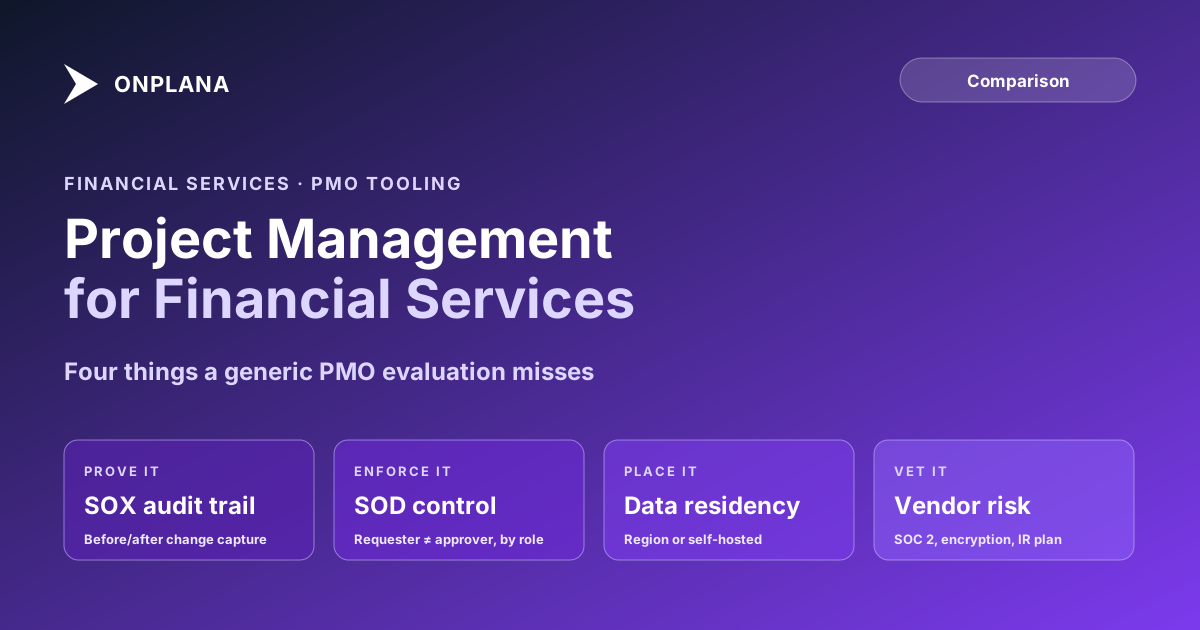
PMO finance tools for banks and insurers must prove four things: an audit trail, segregation of duties, data residency and vendor risk. Check them first.
PMO finance tools for a bank, insurer or asset manager face a test that generic PM software never sees: when the compliance team asks who changed a schedule eight months ago and who approved it, the tool either has the answer or it does not. FINRA Rule 4511 sets a default of at least six years for books and records with no specified retention period (FINRA books and records, checked 2026-10-03), so that history has to exist and stay retrievable.
The direct answer: A PMO finance tool has to prove four things before it reaches a shortlist: an audit trail with before-and-after capture for SOX-relevant change control, role-based access that enforces segregation of duties, a data residency answer for your jurisdiction, and a vendor risk file that clears procurement. Most generic PM tools handle scheduling and fail one or more of the four. Gauge where your PMO's governance stands with the free PMO Maturity Assessment.
That question routinely eliminates half a shortlist after it has already been built. Banking, insurance and asset management PMOs run portfolios that look like any corporate PMO's (system upgrades, process changes, product launches); the difference is the regulatory shadow over every one of them.
What do PMO finance tools have to prove?
The table below turns each requirement into the evidence an auditor asks for and the Onplana plan that carries it, read from src/lib/plans.ts on 2026-10-03. Plan tiers move, so confirm them on the pricing page before you commit.
| Requirement | Evidence an auditor wants | Onplana capability | Plan |
|---|---|---|---|
| SOX-relevant change history | Who changed what, when, with before and after | Audit logs and compliance trail, exportable to CSV and JSON | Enterprise and up |
| Segregation of duties | Requester and approver are different people | Permission matrix per role; custom roles | Pro and up; custom roles Business and up |
| Approval of schedule, scope or budget changes | A recorded decision | Change Control Board workflow per project | Enterprise and up |
| Identity control | Joiners and leavers handled centrally | SSO (SAML 2.0 / OIDC) and SCIM provisioning | Enterprise and up |
| Data residency | Where data physically sits | Dedicated deployment in your own Azure subscription | Enterprise+ only |
| Retention | Records kept for the required period | Retention presets, including FINRA and SOC 2 | Set in Org Settings; see the security overview |
Two of those rows decide most evaluations. The audit trail and the change board both start at Enterprise, which matters for a PMO budgeting a rollout on a lower tier. The change control board guide covers how the approval step works in practice, and building audit-ready project plans covers baselines and documentation for the same reviewers.
Why Financial Services PMOs Need Different Evaluation Criteria
A commercial PMO chooses software based on scheduling depth, resource management, and ease of adoption. A financial services PMO adds a second evaluation track entirely: does the tool produce evidence a regulator or internal auditor would accept.
That second track changes which tools even make the shortlist. A well-reviewed, popular PM tool built for software teams may have no concept of an approval chain, no audit log beyond basic activity history, and a single flat permission model. None of that matters for a marketing team's task board. All of it matters when the project in question changes a system that feeds financial statements, or when a regulator's examination asks for a documented history of who approved a schedule change to a compliance-driven initiative.
Banking, insurance, and asset management PMOs share three regulatory pressures that a generic evaluation criteria list does not capture: Sarbanes-Oxley change-control obligations, segregation of duties requirements, and jurisdiction-specific data residency rules. Add to that the practical reality of running dozens of regulatory-deadline-driven initiatives simultaneously, and the tool selection question stops being about which one has the nicer Gantt chart.
SOX Compliance and Audit Trails: What a PM Tool Must Prove
Sarbanes-Oxley does not regulate project management software directly. It regulates internal controls over financial reporting, and if your PMO manages projects that touch systems, processes, or controls tied to financial reporting, the change-management discipline SOX expects extends to how those projects are run.
In practice, this means an auditor or examiner may ask: who approved this schedule change, when, and what was the schedule before the change. A PM tool that overwrites history on every edit, or that logs activity in a form no one can export into a readable record, cannot answer that question. The audit trail has to capture before-and-after state on every material change, tie each change to an identified user, and be exportable in a format an auditor can review without a guided tour of the tool's internal data model.
This is a narrower requirement than full SOX compliance, and it is worth being precise about the distinction: the PM tool does not need to be a financial reporting system. It needs to produce the same category of evidence, who did what and when, that any SOX-relevant system is expected to produce.
Segregation of Duties: What a PM Tool Must Enforce
Segregation of duties is the control that prevents the same person from both creating and approving a consequential action. In a PMO context, this typically shows up as change requests: a PM proposes a schedule or scope change, and someone other than the PM has to approve it before it takes effect.
A PM tool with a single admin role and no distinction between requester and approver cannot enforce this on its own. The control ends up living entirely in process, a policy document that says "PMs should not approve their own changes," with no system-level check behind it. That works until it doesn't, usually surfacing during an audit when the reviewer asks the tool to demonstrate the control rather than describe it.
What to look for instead: role-based access control that distinguishes who can propose a change from who can approve it, with the distinction enforced at the system level, not just documented in a policy. A governance workflow that routes change requests through a defined approval chain, and an audit log that records the approver's identity alongside the change, gives the SOD control a system-level backstop instead of relying entirely on people following a rule.
Can Financial Services Firms Put Project Data in Any Cloud?
No, not without checking first. Data residency requirements vary by regulation and jurisdiction, and financial services firms face more of them than most industries. EU-regulated firms operate under GDPR's data transfer rules. UK firms answer to the FCA. US firms may face state-level financial privacy requirements depending on which states they operate in, and firms with international operations often need to keep certain project data inside specific borders entirely.
This becomes a PM tool question the moment project data references client relationships, account-level details, or regulated financial activity, even indirectly. A schedule for a client onboarding system migration, for instance, may reference client segments or account volumes that fall inside a data residency boundary even though the schedule itself is not client data in the traditional sense.
The practical answer is deployment control. Onplana Enterprise+ is a dedicated deployment: Onplana sets up and runs a private copy of Onplana in your own Azure subscription, so your data stays in your environment. That turns the residency question into a question about your own subscription, rather than a case-by-case legal review of a vendor's hosting for every project. See how an Enterprise+ dedicated deployment works. Firms that cannot get a straight answer from a vendor about where data physically resides should treat that as a disqualifying gap, not a detail to resolve later.
Regulatory Deadline Tracking Across Banking, Insurance, and Asset Management
Financial services PMOs carry a category of deadline that most industries do not: the externally imposed, non-negotiable regulatory date. A new capital reporting requirement, an insurance solvency framework update, an asset management disclosure rule change, each arrives with a fixed compliance date set by a regulator, not by the PMO's own planning process.
A financial services PMO often carries many regulatory-driven initiatives at once, each with its own hard date and its own compliance owner. Tracking that volume in spreadsheets, or in a generic task tool with no concept of a portfolio-level deadline view, loses visibility fast. The failure mode is not usually a single missed date; it is a slow drift where three or four regulatory initiatives quietly slip behind schedule at once because no single view surfaced all of them together.
A portfolio dashboard that flags regulatory deadlines distinctly from internal milestones, with a clear escalation path when a hard date is at risk, is the practical minimum. This is a governance capability, not a scheduling one, and it is one of the dimensions the PMO Maturity Assessment evaluates directly. For the wider portfolio view, see PMO operating models.
What Vendor Risk Assessment Actually Checks For
Financial services procurement runs a structured vendor risk assessment before any PM tool reaches a contract, and it is worth knowing what that process actually checks so the evaluation does not stall on questions the vendor cannot answer.
The core items: SOC 2 Type II attestation (not just SOC 2 Type I, which only confirms controls exist at a point in time rather than operating effectively over a period), data encryption at rest and in transit, documented incident response procedures, subprocessor disclosure, and business continuity planning. Our experience is that infosec review and vendor response time each add weeks, and the two stack. Starting the vendor risk assessment in parallel with feature evaluation, rather than after a tool is already selected, is the single biggest time-saver in a financial services PMO's procurement timeline.
The security and compliance overview covers the specific controls, SSO, SCIM, retention presets, and audit trail mechanics, that a vendor questionnaire will ask about in detail.
The diagram below walks through the evaluation branches a financial services PMO should run before shortlisting any PM tool.
Financial Services PM Tool Comparison
The table below compares three common approaches financial services PMOs consider.
| Dimension | Generic PM tools (Asana, Monday) | Legacy enterprise PPM (Project Online, Clarity) | Onplana |
|---|---|---|---|
| Audit trail with before/after diffs | Rare | Via external reporting layer | Native audit log, CSV and JSON export (Enterprise and up) |
| Segregation of duties enforcement | No | Category-based, indirect | Permission matrix by role (Pro and up), custom roles (Business and up) |
| SOC 2 Type II | Varies by vendor | Yes (Microsoft) | Readiness controls live; Type II audit in progress |
| FINRA / SOX retention presets | No | Manual configuration | Built-in retention presets |
| Dedicated deployment in your own environment | No | Microsoft cloud only | Dedicated deployment in your own Azure subscription (Enterprise+, contact sales) |
| Regulatory deadline dashboard | Basic due-date view | Via Power BI build | Portfolio dashboard; flag hard dates with milestones |
| Vendor questionnaire turnaround | Often slow, ad hoc | Established but rigid | Documented security packet on request |
| Pricing | $10-25/user/month | $30-55/user/month plus M365 | Free to $29/user/month; Enterprise+ priced per deal (contact sales) |
Legacy enterprise PPM tools like Project Online carry real regulatory strengths, Microsoft's SOC 2 posture and years of enterprise vendor-risk precedent, but their audit and reporting capability typically routes through an external Power BI build rather than shipping natively, and category-based permissions require translation work to demonstrate segregation of duties directly. Generic PM tools are fast to adopt but fail the compliance track outright for most of the dimensions above.
A modern PM platform with a native audit trail (Enterprise and up on Onplana), role-based SOD controls, and built-in retention presets for regulatory frameworks (Onplana ships presets for FINRA and SOC 2 retention periods specifically, alongside GDPR and HIPAA) removes the need to build the compliance layer as a separate project on top of the PM tool itself.
Making the Call
The mistake most financial services PMOs make is running the compliance evaluation after the feature evaluation, treating audit trails and segregation of duties as a procurement afterthought rather than a shortlisting criterion. Run both tracks together from the start. A tool that scores well on scheduling and resource management but cannot produce a clean audit trail, enforce SOD at the system level, or answer the data residency question directly is not actually a finalist, no matter how good its Gantt chart looks.
For firms moving off Project Online, which retired on September 30, 2026, the financial services sector guide post covers the compliance-specific migration timeline in more depth, including vendor risk assessment sequencing and SOD control mapping during cutover.
FINRA's books and records guidance outlines the retention and recordkeeping expectations that shape how long financial services firms need to keep project audit data accessible, well beyond what most generic PM tools default to.
Run the free PMO Maturity Assessment Get a structured baseline of your PMO's governance, audit readiness, and resource planning maturity in about 10 minutes. No signup required. → Open the PMO Maturity Assessment
Microsoft Project Online™ is a trademark of Microsoft Corporation. Onplana is not affiliated with Microsoft.
Frequently asked questions
What makes financial services project management different from a generic PMO?
Financial services PMOs operate under audit and regulatory obligations that a generic PMO does not: SOX-driven change control on any system that touches financial reporting, segregation of duties enforcement, data residency rules that vary by jurisdiction, and regulatory deadline tracking with real penalties for a missed date.
Does a PM tool need to comply with SOX directly?
The PM tool itself is rarely the system of record for financial reporting, but if it manages projects that change financial systems or controls, SOX's change-management expectations extend to it. You need a documented audit trail of who changed what, when, and with what approval.
What is segregation of duties in a PM tool context?
Segregation of duties means the same person cannot both initiate and approve the same action, such as creating a change request and then approving it. A PM tool that only offers a single admin role, with no distinction between requester and approver, cannot enforce SOD on its own and pushes the control burden onto manual process instead.
Can financial services firms use any cloud-hosted PM tool?
Not without checking data residency requirements first. Firms under GDPR, UK FCA rules, or various US state financial privacy laws may face restrictions on where project data can be stored or processed, particularly when that data references client relationships or regulated financial activity.
What should a financial services PMO look for during vendor evaluation?
SOC 2 Type II attestation at minimum, a documented audit trail with before-and-after change capture, role-based access control that supports segregation of duties, retention settings that match regulatory record-keeping periods, and a willingness to complete a vendor security questionnaire without months of delay.
How long must a financial services firm keep project records?
FINRA Rule 4511 sets a default of at least six years for books and records that have no specified retention period, so a PMO's audit data should stay retrievable for at least that long. Confirm the period that applies to your firm with compliance, because some records carry longer ones.
Does Onplana have SOC 2 Type II?
Not yet. The formal third-party audit is in progress, and until it completes Onplana can supply SOC 2 readiness controls and an evidence package on request, not a report.
Ready to make the switch?
Start your free Onplana account and import your existing projects in minutes.