Cloud-Agnostic Project Management Tools: Why It Matters in 2026
A cloud-agnostic PM tool is not a nice-to-have until an acquisition, an outage, or a sovereign-cloud clause turns single-vendor lock-in into an emergency.
A single-cloud PM tool works fine until the day it doesn't. An acquisition brings in a team already standardized on a different cloud than yours. A government contract requires a specific sovereign region your vendor doesn't operate in. Or, the scenario nobody plans for, the vendor decides to retire the product entirely and your data's location was never actually your choice. Cloud-agnostic project management is the kind of insurance nobody buys until the day they need it, and by then it's too late to add.
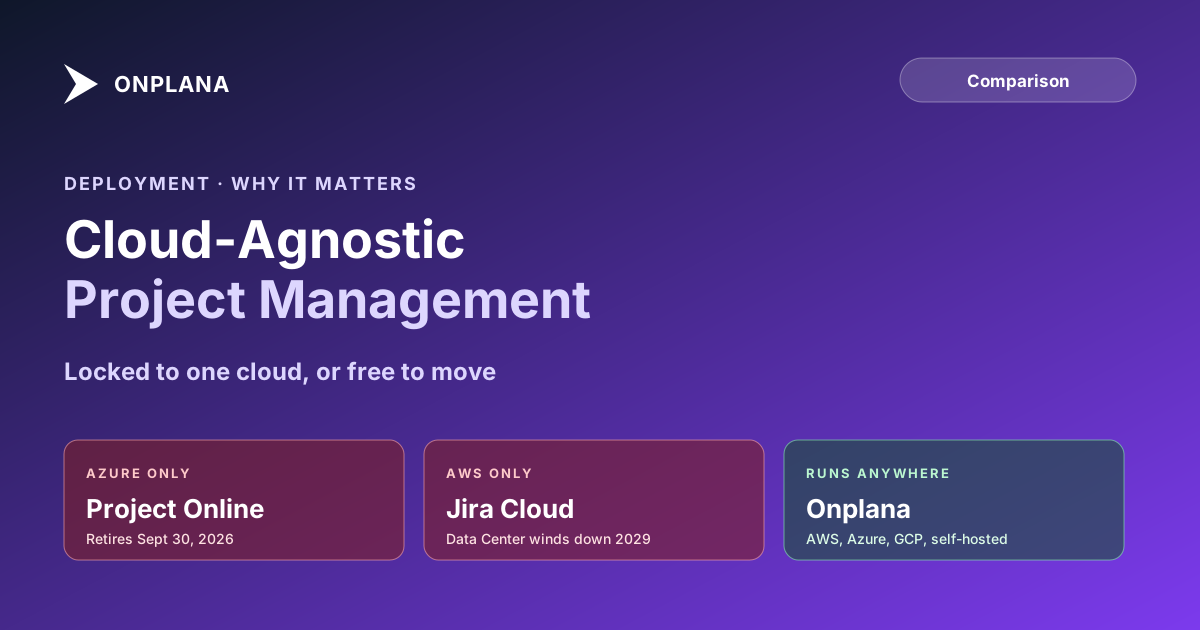
Project Online is the sharpest current example. It runs only inside a customer's Microsoft 365 tenant on Azure, and it retires September 30, 2026, regardless of how well it served any given PMO. The lesson generalizes past that one deadline: a cloud-agnostic PM tool is not an infrastructure detail buried in an RFP appendix. It is a decision about who controls your exit options.
TL;DR. A cloud-agnostic PM tool runs on more than one infrastructure provider, AWS, Azure, GCP, or self-hosted, without the vendor rebuilding the product for each. Project Online (Azure-only) and Jira Cloud (AWS-only) are the two most common single-cloud PM tools in active enterprise use today. OpenProject, Plane, Redmine, GitLab, and Onplana all support deployment across more than one cloud or on customer-owned infrastructure. The decision matters most for regulated industries, organizations pursuing deliberate multi-cloud strategy, and anyone who has lived through an M&A integration where two teams inherited two different clouds.
What "Cloud-Agnostic" Actually Means for a PM Tool
A cloud-agnostic PM tool is built so its architecture does not assume any single infrastructure provider. The same product, the same codebase, the same feature set, runs on AWS, Azure, GCP, or a customer's own servers, without a separate product line for each.
This is a narrower claim than "the vendor is a good company" or "the product is flexible." It is specifically about where the compute and data physically live, and whether that location is the vendor's unilateral choice or the customer's. Two products can look identical in a feature comparison and be completely different on this axis: one ships as a Docker image that runs anywhere; the other exists only inside one vendor's data centers, under one vendor's terms, with no export path that preserves the product's own architecture.
Cloud-agnostic is not the same claim as self-hosted, which is worth separating explicitly since the two get conflated constantly.
Cloud-Agnostic vs Self-Hosted: Related, Not Identical
Self-hosted means you run the software on infrastructure you control. Cloud-agnostic means the vendor's product does not assume a single cloud, full stop, whether or not you ever choose to self-host it.
A tool can be self-hostable and still awkward to run across more than one cloud, if the self-hosted package assumes specific managed services that only exist on one provider. And a tool can be genuinely multi-cloud on the backend, offered only as SaaS, with the vendor running your instance on whichever region or provider your contract specifies, without you ever touching a server yourself. Self-hosted project management is the deeper dive on the first axis; this post is about the second one, deployment flexibility, which matters even for teams that will never self-host anything.
Which PM Tools Are Locked to a Single Cloud?
Two widely deployed PM/PPM tools illustrate single-cloud lock-in clearly, for different reasons.
Microsoft Project Online exists entirely inside a customer's Microsoft 365 tenant, which runs on Azure. There is no alternative cloud, no export path that preserves the product's architecture, and no self-hosted option. When Microsoft set a retirement date for the product, every customer's only choice was which migration path to take, not whether to take one. The retirement date is September 30, 2026.
Jira Cloud is Atlassian's multi-tenant SaaS product, and according to Atlassian's own cloud architecture documentation, it is hosted on AWS, with no option to choose Azure, GCP, or on-premises infrastructure. The only Atlassian product line that lets a customer choose their own infrastructure is Jira Data Center, a separate self-managed product that exists specifically for organizations that need infrastructure control, distinct from Jira Cloud itself, and Atlassian has set its end-of-life date for March 28, 2029, with new Data Center license sales already stopped. A customer who wants Jira's workflow model but needs it on Azure or GCP, or air-gapped, has to evaluate a product Atlassian itself is winding down, not a deployment option within Jira Cloud.
Neither of these is a criticism of the products on their own terms. Both are widely used and well-regarded for what they do. The point is structural: if your compliance requirement, your M&A integration, or your sovereign-cloud clause points somewhere other than the one cloud these products run on, the product itself cannot follow you there. A closer look at Project Online's Azure-only architecture versus a cloud-agnostic alternative walks through what that gap looks like in practice for a PMO evaluating a replacement.
The PM Tools That Already Run Anywhere
A different set of tools was built, or has evolved, without a single-cloud assumption baked in. The table below compares deployment flexibility across products PMOs actually evaluate against each other.
| Tool | Deployment lock-in | Self-hosted option | Clouds supported | Container support | Scheduling depth | Best fit |
|---|---|---|---|---|---|---|
| Project Online | Azure only (M365 tenant) | No | Azure only | No | Deep (native Gantt, ERP, baselines) | Existing M365 shops, until Sept 2026 |
| Jira Cloud | AWS only | Separate product (Data Center) | AWS only | No (SaaS only) | Shallow (Advanced Roadmaps add-on) | Software teams already on Atlassian |
| OpenProject | None | Yes, free Community tier | Any (Docker/Kubernetes) | Yes | Moderate (Gantt, work packages) | Budget-constrained classical PM |
| Plane | None | Yes, AGPL Community edition | Any (Docker/Kubernetes/S3-compatible storage) | Yes | None (no critical path engine) | Dev-focused issue tracking |
| GitLab (self-managed) | None | Yes | AWS, Azure, GCP, bare metal | Yes (Docker, Helm, Operator) | Shallow (epics/milestones, not PPM-grade) | Engineering orgs already on GitLab |
| Redmine | None | Yes (source or third-party images) | Any | Via third-party images | Moderate (basic Gantt) | Lightweight, low-budget self-hosting |
| Onplana | None | Yes, Enterprise+ tier | AWS, Azure, GCP, self-hosted | Yes (Docker/Kubernetes) | Deep (critical path, ERP, 12-stage governance) | PMOs needing full PPM depth with deployment choice |
Three of these (OpenProject, Plane, Redmine) are open source, which is a separate axis worth naming honestly: open source guarantees you can inspect and run the code anywhere, but it does not guarantee PPM-grade scheduling. Plane, for example, has no critical path engine at all; it's a modern issue tracker with project structure, not a resource-loaded scheduling tool. GitLab's project management features are similarly built for tracking engineering work, not for the enterprise resource pools, baselines, and gate-review governance a PMO with 50+ concurrent projects needs.
Why Enterprises Choose Multi-Cloud Anyway
Deliberate multi-cloud strategy is now the norm, not the exception. Flexera's 2026 State of the Cloud Report found 73 percent of organizations now embrace hybrid cloud, up three percentage points year over year, meaning most large organizations already run infrastructure across more than one provider or alongside a private cloud. A PM tool that only runs on one cloud is, by definition, out of step with how most of its enterprise customers already operate everything else.
Three concrete drivers push this beyond a general industry trend and into a specific PM-tool decision:
Data residency and sovereignty requirements. Regulations like GDPR restrict where certain categories of personal data can be processed, and some government and defense contracts specify an authorized cloud, sometimes a specific sovereign region. AWS launched its European Sovereign Cloud, with its first region in Brandenburg, Germany, generally available in January 2026, precisely because enterprise and public-sector customers were asking for infrastructure that guarantees EU-only operational control. A PM tool locked to a different cloud cannot follow a customer whose compliance requirement points there.
Mergers and acquisitions. Multi-cloud is frequently accidental rather than planned: an acquirer inherits whatever cloud the acquired company already standardized on. Unifying PMO tooling across two organizations that built on different clouds is a real post-merger integration problem, and it's one a single-cloud PM tool actively makes worse instead of solving.
Vendor risk management. IT leadership increasingly treats "what happens if this vendor's infrastructure has an outage, or the vendor exits the market" as a real question to ask before signing, not a hypothetical. A PM tool that depends on a single cloud inherits that cloud's outage risk with no fallback, and inherits the vendor's own business risk with no exit path that doesn't mean rebuilding your entire PMO from scratch.
When Cloud Lock-In Actually Costs You
The abstract argument above has a concrete, current example: Project Online. Every one of its customers is now running a forced migration on a timeline they did not choose, because the product only ever existed on one cloud, inside one vendor's roadmap. It doesn't matter whether a given PMO was happy with the product. The retirement date is fixed, and the only decision left is which tool to move to and how fast. If you want a concrete sense of what that move looks like before committing to one, the free Migration Preview tool walks through what a Project Online migration involves for your specific project count and complexity, without requiring a sales call first.
This is the scenario cloud-agnostic deployment is insurance against. Not "the vendor might go out of business" in the abstract, but the specific, now-happening case of a single-cloud product reaching the end of its road with the entire customer base holding the same forced deadline at once.
How to Evaluate a PM Tool's Deployment Flexibility
If deployment flexibility matters for your organization, whether because of a compliance requirement, an active M&A integration, or plain vendor-risk hygiene, evaluate it explicitly rather than assuming a vendor's marketing page answers the question.
- Ask which specific clouds the product runs on today, not which clouds the vendor's own infrastructure happens to use for its website. Get a direct answer: AWS, Azure, GCP, self-hosted, or some subset.
- Confirm whether self-hosted is the same product or a different one. A vendor with a "self-hosted edition" that's a stripped-down fork of the SaaS product isn't offering real deployment flexibility; you're evaluating two products, not one with an option.
- Check feature parity across deployment modes. If the self-hosted or alternate-cloud version drops AI features, integrations, or governance capabilities present in the SaaS version, the "option" is a downgrade, not a real choice.
- Ask what a re-platforming to a different cloud actually requires, in hours or weeks, not just whether it's theoretically possible. A tool that "can" run elsewhere but requires a consulting engagement to move isn't meaningfully cloud-agnostic in practice. Compare the vendor's published feature list across its SaaS and self-hosted editions line by line rather than taking parity on faith.
- Verify the claim against the vendor's own technical documentation, not just a sales deck. Docker images, Kubernetes Helm charts, and cloud-specific deployment guides in public docs are a much stronger signal than a bullet point on a features page.
A cloud-agnostic PM tool isn't a feature you'll use on day one. It's the option you'll be glad exists on the day your organization's cloud strategy changes and your PM tool doesn't get a vote.
See what a move actually looks like The free Migration Preview walks through what migrating your specific project count and complexity off a locked-in tool involves, no sales call required. → Run the Migration Preview
Microsoft Project Online™ is a trademark of Microsoft Corporation. Onplana is not affiliated with Microsoft.
Frequently asked questions
What does 'cloud-agnostic' mean for a project management tool?
A cloud-agnostic PM tool can run on more than one infrastructure provider, AWS, Azure, GCP, or a customer's own servers, without the vendor rebuilding the product for each one. The opposite is a single-cloud tool that only exists inside one vendor's infrastructure, with no option to move it.
Which popular project management tools are locked to a single cloud?
Microsoft Project Online runs only inside a customer's Microsoft 365 tenant on Azure, with no alternative. Atlassian's Jira Cloud runs exclusively on AWS; the only way to choose your own infrastructure is Jira Data Center, a separate self-managed product Atlassian is steering customers away from.
Is self-hosted the same thing as cloud-agnostic?
No. Self-hosted means you run the software yourself. Cloud-agnostic means the vendor's architecture does not assume any single cloud, so self-hosting is one of several equally supported options alongside the vendor's own AWS, Azure, or GCP deployments. A tool can be self-hostable and still awkward to run on more than one cloud, or SaaS-only and genuinely multi-cloud on the backend.
Does cloud-agnostic deployment cost more?
Running your own infrastructure, on any cloud, always carries operational overhead the vendor's own SaaS absorbs for you. What cloud-agnostic buys is optionality: the same product runs on whichever cloud a contract, regulation, or M&A event requires, without a re-platforming project.
Why does cloud-agnostic deployment matter for regulated industries?
Regulations like GDPR restrict where certain categories of data can be processed, and government contracts often specify an authorized cloud or an air-gapped environment. A PM tool that only runs on one cloud cannot serve a customer whose compliance requirement points to a different one.
What happens to a PMO when its PM tool's only cloud goes away?
Microsoft Project Online is the live example: it retires September 30, 2026, and every customer, regardless of how satisfied they were with the product, is forced into a migration on Microsoft's timeline, not their own. That is the structural risk of single-cloud dependency; it is not about product quality.
Ready to make the switch?
Start your free Onplana account and import your existing projects in minutes.