Startup Project Management: Why Lightweight Beats Heavy PPM
Startup project management fails two ways: no tool until chaos forces one, or a heavy PPM platform bought too early. Here's how to pick by stage, not by hype.
The advice every early-stage founder gets is the same: don't overthink tooling, just use a spreadsheet, move fast, revisit later. That advice is right for the first 10 people and wrong for the next 40. The founders who get burned aren't the ones who under-invested in tooling on day one. They're the ones who never revisited the decision, and by the time three teams are silently fighting over the same two engineers, nobody can say who's blocking whom.
The opposite mistake in startup project management is just as common and gets far less airtime. A startup raises a seed round, hires a VP of Ops, and within a month is paying for an enterprise PPM platform built for a 300-person PMO: approval workflows, portfolio governance, custom field taxonomies nobody has time to configure. Three people touch it. The rest of the company keeps working in Slack threads because the tool takes longer to update than the work itself takes to do.
Startup project management isn't a tooling question first. It's a staging question: what does a 12-person team actually need to coordinate, what does a 40-person team need that the 12-person team didn't, and what's the cost of picking a tool that can't grow with you across that gap.
The direct answer: Startups under roughly 15 people rarely need more than lightweight task tracking with real dependencies; the coordination problem is small enough that a spreadsheet's failure mode is annoyance, not missed launches. Between 15 and 50, resourcing conflicts and cross-team dependencies start silently costing weeks, and that's the point to add a tool with actual scheduling and resource visibility. Past 50, with multiple concurrent initiatives and finance asking for roadmap-level reporting, you need something closer to PMO-grade capability. The costly mistake is picking a tool at stage one that has no path to stage three, forcing a full replatform mid-growth.
Why "just use a spreadsheet" stops working around 15 people
At under 10 people, one team is usually shipping one thing. Coordination overhead is close to zero because everyone is in the same three Slack channels and the same standup. A spreadsheet, a Notion doc, or a Trello board isn't a compromise at this stage. It's genuinely sufficient, and adopting anything heavier just adds a tool nobody needed to check.
The failure mode shows up when a second workstream starts. Now two initiatives want the same senior engineer's time in the same sprint, and nothing in a shared doc surfaces that conflict before it becomes a missed deadline. The founder finds out when one of the two projects quietly slips, not when the conflict was created. This is the same invisible-overallocation problem larger PMOs deal with, just at a smaller scale and with higher relative cost, because a two-week slip at a 20-person startup can be the difference between hitting a fundraising milestone and missing it.
The fix isn't more process. It's visibility: a tool that shows who's committed to what, across both workstreams, without anyone having to ask.
What lightweight startup project management actually needs
Three things matter at this stage, and almost nothing else does.
Fast setup with zero admin overhead. If getting the tool running takes longer than the sprint it's meant to track, it has already failed. A startup PM tool should go from signup to a real project with real tasks in minutes, not after a week of configuring custom fields and approval workflows nobody asked for.
Real dependency tracking, not just a task list. The difference between a Kanban board and an actual schedule is whether the tool understands that Task B can't start until Task A finishes. Without that, "we're behind" is a feeling, not a fact you can point to. A lightweight tool that tracks dependencies gives you the one signal that actually predicts slippage: a task with a blocked predecessor.
Pricing that doesn't punish hiring. Startups add headcount unevenly and often fast. A per-seat pricing model with a steep jump between tiers, or a tool that requires a new contract negotiation to add five people, creates friction at exactly the moment you're trying to move fast. Flat or genuinely linear pricing matters more here than it does for an enterprise buyer negotiating an annual contract.
Governance features, portfolio rollups, and approval gates aren't wrong to have. They're wrong to pay for before there's a portfolio to govern.
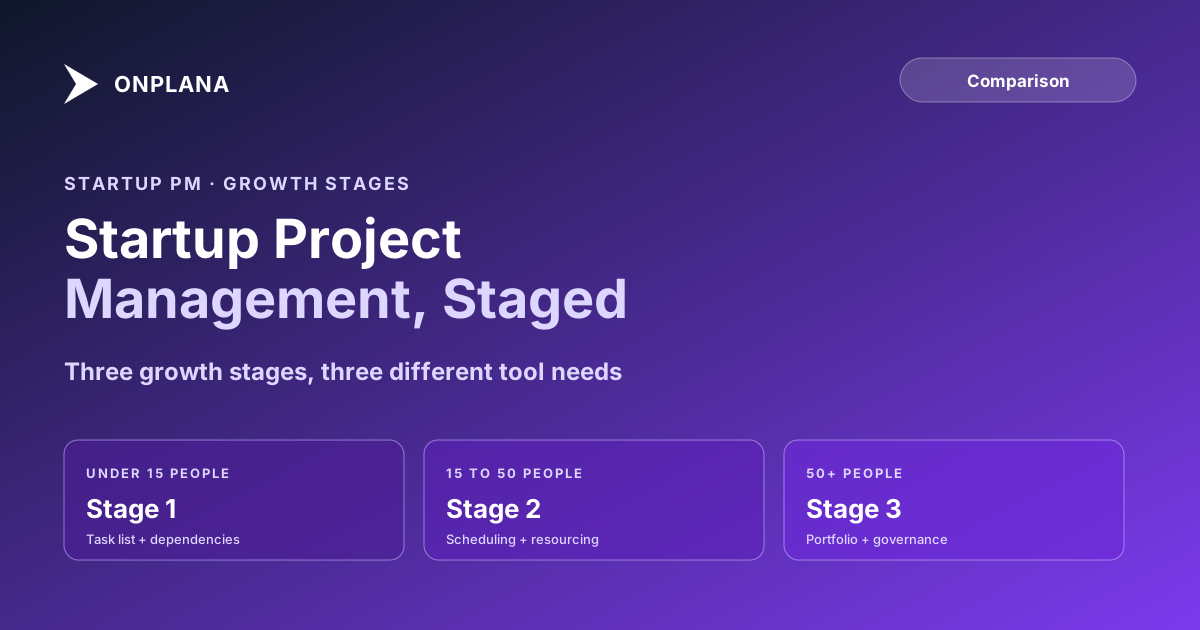
The diagram below maps what actually changes at each stage of startup growth and what kind of tool fits each one.
Most startups skip straight from Stage 1 tooling to nothing, then get forced into a rushed Stage 3 purchase during a crisis, because nobody revisited the decision at Stage 2. The cheapest fix is treating this as three separate decisions made at three separate times, not one tool picked once and never reconsidered.
Stage 1: what actually matters under 15 people
At this size, optimize entirely for speed of adoption. The tool that wins is the one your team is already using for something else, extended slightly, or a purpose-built lightweight tracker with a two-minute setup. Signing up and running a real project inside two minutes is a reasonable bar; anything that takes longer is asking a 12-person team to pay an admin tax it can't afford.
Don't buy governance you don't need yet. Approval workflows, custom field taxonomies, and portfolio dashboards are solving a problem you don't have. The only capability worth paying for at this stage beyond a basic task list is dependency awareness: knowing that the launch task is blocked on the integration task, automatically, without someone remembering to say so in standup.
Stage 2: where dependencies and resourcing start to bite
Between 15 and 50 people, the failure mode changes. It's no longer "we forgot to write this down." It's "two people made commitments that can't both be true, and neither of them knew about the other's commitment." This is a resourcing problem, and no amount of task-list discipline fixes a resourcing problem.
What to look for at this stage:
- A resource view across workstreams, not just within one project. If your tool can't answer "who's overcommitted this month" in under a minute, it's still a Stage 1 tool.
- Dependency chains with lag, so a two-day delay on an upstream task shows up as a two-day delay downstream automatically, instead of someone catching it manually three days later.
- Lightweight status reporting that doesn't require a weekly meeting to produce. If your ops lead spends an afternoon each week compiling a status deck by hand, the tool isn't doing its job.
This is also the stage where a founder or ops lead starts doing informal resource management without the title. The pattern is worth naming even at startup scale, because the resource manager function that formal PMOs build out later is solving the exact same coordination problem you're improvising at 25 people, just without a name yet.
Stage 3: when you actually need PMO-grade capability
Past roughly 50 people, with several concurrent initiatives and a board or investors asking for roadmap-level visibility, the requirements shift again. Now you need a portfolio view (not just per-project views), some governance so that a new initiative doesn't start without someone checking it against existing resource commitments, and reporting that doesn't require manually assembling numbers from five different sources.
This doesn't mean adopting the full weight of an enterprise PMO. It means the specific capabilities that solve problems you now actually have: cross-project resourcing, a lightweight approval gate before a team commits to a new initiative, and dashboards that answer "how's the roadmap doing" without a meeting. Buying heavier than this, before the company needs it, recreates the mistake from the opening of this piece: paying for governance nobody uses.
The tool categories compared
| Dimension | Lightweight tracker (Stage 1) | Mid-weight PM tool (Stage 2) | PPM / PMO platform (Stage 3) |
|---|---|---|---|
| Setup time | Minutes | Under an hour | Days to weeks |
| Dependency tracking | Basic or none | Full FS/SS/FF/SF with lag | Full, plus baselines |
| Resource visibility | None | Cross-project resource view | Portfolio-level capacity planning |
| Governance / approvals | None | Optional, lightweight | Approval gates, change control |
| Pricing model | Flat or free tier | Per-seat, linear | Per-seat, often tiered with minimums |
| Best fit | Under 15 people, one workstream | 15 to 50 people, shared resources | 50+ people, multiple initiatives |
| Risk if adopted too early | N/A | Adds friction with no payoff | Governance nobody uses, low adoption |
| Risk if adopted too late | Silent resourcing conflicts | Missed launches from invisible overcommitment | No board-level roadmap visibility |
Why the switching cost is the real decision criterion
The single most expensive mistake in startup project management isn't picking the "wrong" tool at any one stage. It's picking a tool at Stage 1 that has a hard ceiling: a task-count cap, no real dependency model, no path to resource-level planning without exporting everything and starting over somewhere else. That ceiling doesn't cost you anything at 12 people. It costs you a disruptive mid-growth migration at 40, during exactly the period when the team can least afford a two-week tooling distraction.
The practical test: before adopting a Stage 1 tool, ask what it looks like at Stage 2 and Stage 3 inside the same product, not a different one. A tool that scales its own feature set as you grow saves you a replatform later. A tool that was only ever built for 10-person teams will force one.
What to do this week
If you're under 15 people and using a shared doc, the honest answer is you probably don't need to change anything yet, unless you already have two workstreams competing for the same person's time. If that's happening, that's the signal, not the headcount number.
If you're between 15 and 50 and status updates take more than five minutes to produce, or you've had a launch slip because of a resourcing conflict nobody saw coming, that's the point to add real dependency and resource tracking. Onplana's free tier covers exactly this range: no seat minimums, full dependency modeling, and a resource view that shows conflicts before they cost you a launch date. Check the pricing to see what's actually free versus what unlocks as you grow, and revisit the decision again at 50 people rather than waiting for a crisis to force it.
The founders who get tooling right aren't the ones who pick the perfect tool once. They're the ones who treat it as a staged decision and revisit it on purpose, before the coordination cost forces their hand.
Frequently asked questions
Do early-stage startups need a dedicated project management tool?
Below about 10 people, a shared doc and a Slack channel usually cover it. Past 10 to 15 people running more than one workstream, informal tracking starts costing more time than a lightweight tool would take to set up.
What's the biggest project management mistake startups make?
Buying a heavy PPM platform built for enterprise PMOs before there's a portfolio to manage. The second-biggest mistake is the opposite: staying on sticky notes and spreadsheets past 40 people because switching feels risky.
What should a 15-person startup look for in a PM tool?
Fast setup with no admin overhead, real dependency tracking (not just task lists), and a pricing model that doesn't punish you for adding seats as you hire. Governance features like approval gates and portfolio rollups aren't worth paying for yet.
When should a startup upgrade from a lightweight tool to a heavier one?
When you can no longer answer 'what's blocking this launch' without a status meeting, or when more than one team is competing for the same engineer's time and nobody owns that tradeoff. Those are resourcing and dependency problems, not task-list problems.
Can startups use the same PM tool all the way to Series C?
Some can, if the tool scales its own feature set rather than forcing a migration. The tools that fail startups are the ones with a hard ceiling: task counts, custom field limits, or no path to resource-level planning without a full replatform.
Is Trello or Notion good enough for a startup's first project management setup?
For a single team under 10 people shipping one thing at a time, yes. Once you have two workstreams competing for the same three engineers, neither tool shows you the conflict until it's already a missed deadline.
Ready to make the switch?
Start your free Onplana account and import your existing projects in minutes.