The Resource Manager Role: A Handbook for Growing PMOs
The resource manager role exists in mature PMOs and almost nowhere else. What they own, how their week runs, and when a PMO is large enough to need one.
Most PMOs have a resource allocation problem and no one whose job it is to solve it. PMs negotiate capacity directly with functional managers, each PM advocating for their own project's needs. Functional managers manage availability in isolation, without visibility into what the rest of the portfolio has already committed. When conflicts arise, they escalate to whoever runs the PMO, who resolves them one at a time, reactively, without the cross-project picture that would let them catch conflicts before they escalate.
That is the job description of a resource manager, assembled from the tasks nobody else owns. The resource manager role exists formally in mature PMOs and almost nowhere else. Everyone else assigns the function by default to whoever happens to be senior enough to get pulled into resource conflicts, which means it gets done slowly, reactively, and without institutional ownership.
This handbook covers what the role actually owns, how a week runs, when a PMO is large enough to formalize it, and how to start without a headcount approval.
The direct answer: The resource manager role sits between functional managers (who own people) and project managers (who own delivery). It owns three things none of them should try to own simultaneously: the cross-project utilization picture, the weekly capacity review, and the allocation conflict resolution protocol. A PMO running more than five concurrent projects with twenty or more shared resources is almost certainly running this function informally. Making it formal reduces the tax on everyone else.
What the resource manager role actually owns
The resource manager role is not a senior project manager. It is a distinct function with a distinct scope:
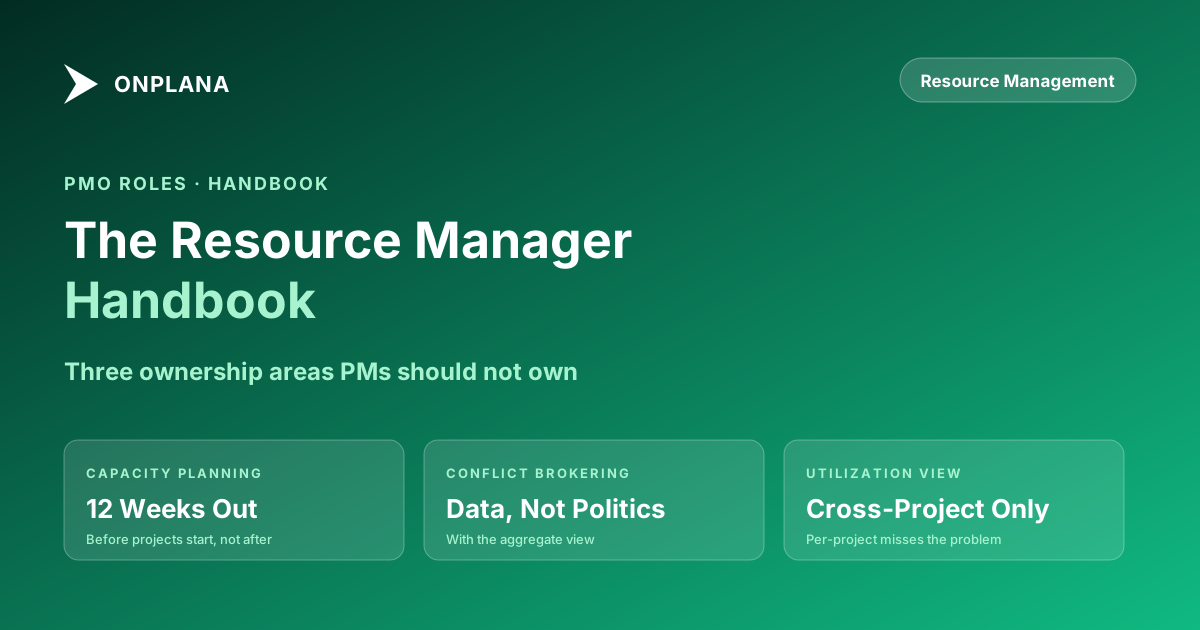
Cross-project utilization visibility. The resource manager maintains the weekly view of every shared resource's committed hours across all active projects. This is not a per-project report: it is the aggregate. When a new project starts and wants 60% of a senior engineer, the resource manager is the person who knows whether that 60% is actually available or whether it is already committed to two other projects.
Forward capacity planning. Twelve weeks out, which projects are in the pipeline? What headcount does the portfolio need to start them on schedule? Which functional teams will face shortfalls, and when? The resource manager surfaces these gaps before projects start rather than after they slip. This is the planning function that makes a PMO proactive rather than reactive.
Allocation conflict resolution. When a PM's request and a functional manager's commitment cannot both be satisfied with available capacity, the resource manager brokers the resolution. They bring the cross-project data to the conversation, facilitate the option-generation process, and document the decision. They do not escalate by default; escalation is the fallback when the brokered process fails.
Utilization reporting. The resource manager produces the weekly portfolio-level utilization report that shows which resources are over-committed, which are available, and where the next four to eight weeks look risky. This report is one of the inputs to the PMO director's weekly decisions and to the steering committee's resource-approval decisions.
What the resource manager does not own: individual project schedules, delivery accountability, or functional team headcount decisions. Those belong to PMs and functional managers respectively.
The typical week of a resource manager
A useful way to understand the role is to see what the work actually looks like from Monday to Friday.
Monday morning: Run the weekly utilization review. Pull the cross-project data, flag any resource at over 90% for the coming two weeks, and flag any project that has a staffing gap in the next four weeks. This is a 30-to-45-minute analysis, not a meeting. The output is a short weekly utilization brief that goes to the PMO director and is available to PMs before their Monday syncs.
Monday to Tuesday: Three to five short conversations with PMs about flagged items from the utilization review. These are not status meetings. They are conversations about specific resource risks: "You have the senior developer at 110% in weeks three and four. What's driving that, and what are your options?" The resource manager surfaces the data; the PM owns the response.
Tuesday to Wednesday: Process incoming allocation requests from PMs starting new work phases. Check each request against the current capacity picture. Respond with either a confirmation or a flag: "This is available," or "This conflicts with the security audit commitment. Here's what that means for your timeline." Most allocation requests can be answered in ten minutes with the right data in front of you.
Thursday: Capacity planning meeting with functional managers, covering the four-to-eight-week horizon. What is the engineering team's availability for new commitments next month? Is the QA team hitting capacity constraints? Are there planned leaves or transitions in that window? This meeting prevents the surprise functional manager conversation where availability turns out to be much lower than the PM assumed.
Friday: Update the capacity ledger with new commitments, changes from this week's conversations, and any resolved conflicts. This is the maintenance work that makes Monday morning's analysis possible. Twenty minutes of diligent data entry prevents two hours of reconstruction the following week.
Recurring but not weekly: a monthly pipeline review covering the next quarter's project starts, and a quarterly headcount reconciliation with the PMO director and HR.
What the resource manager owns that project managers should not
The clearest way to define the resource manager role is to describe what happens when PMs try to own these functions themselves.
Each PM advocates for their own project. In the absence of a resource manager, allocation decisions get made by whoever argues most effectively for their project. This produces outcomes that are good for the loudest PM and bad for the portfolio. A resource manager brings cross-project data to every decision and optimizes for portfolio health, not individual project health.
PMs without cross-project data cannot catch stacking early. A PM who needs a senior engineer at 70% sees their own project's utilization. They cannot see that two other PMs have already committed that engineer to 40% and 30% respectively. Only the person maintaining the aggregate view can catch the 140% total before it materializes as a delivery crisis. This is the core of what resource overallocation at the invisible level looks like in practice.
Functional managers without portfolio context overbooking their teams. A functional manager saying yes to three sequential PM requests, each seeming reasonable, produces overallocation they cannot see because they lack the portfolio utilization picture. The resource manager provides that picture and creates a feedback loop between functional capacity and portfolio demand that neither party can maintain alone.
Where the resource manager role gets confused with the project manager role
The most common confusion is treating the resource manager as a senior PM with cross-project visibility. The roles are structurally different:
A PM is accountable for delivery. They own the schedule, the scope, the stakeholder communication, and the milestone dates. Their success metric is whether their project ships.
A resource manager is accountable for capacity. They own the utilization picture, the conflict resolution process, and the pipeline-capacity match. Their success metric is whether the portfolio has the headroom it needs, consistently, without crisis mode.
A PM who also covers resource management for the portfolio is wearing two hats that pull in opposite directions. When their project needs a resource that the portfolio needs held for a higher-priority project, the PM role and the resource manager role will conflict. That is why mature PMOs separate the functions.
The separation also matters for trust. PMs trust a resource manager who is not also competing for resources. If the person running the capacity review is also a PM on one of the projects, every allocation decision looks like it might be self-serving.
At what PMO maturity level this role is worth formalizing
The resource manager role becomes worthwhile when the coordination cost of not having it exceeds the cost of filling it. A rough guide:
Below five concurrent projects with fewer than fifteen shared resources: resource management can be a part-time PMO director responsibility. The coordination surface is small enough that one person can hold it informally. A weekly 30-minute capacity check is sufficient.
Five to ten concurrent projects with fifteen to thirty shared resources: the role is part-time or fractional. A senior PM or PMO analyst spending 40% of their time on cross-portfolio resource coordination is the most common form at this scale. The PMO Maturity Assessment will typically surface resource management as a Tier 2 (Emerging) weakness when a PMO is operating at this scale without the formal function.
More than ten concurrent projects or more than thirty shared resources: the role is full-time. At this scale, the weekly utilization review, the PM touchpoints, the functional manager meetings, and the capacity planning horizon are each individually significant work. Treating them as spare-cycle activities produces a PMO that is perpetually in reactive mode on resource allocation.
PMO maturity tier 3 (Defined) is where most PMOs that have formalized the resource manager role sit. The function being formally owned, with a written process and consistent execution, is precisely what moves the resource dimension from Emerging to Defined.
Signs you need a resource manager now
Five indicators that the function is overdue:
Resource negotiations happen in Slack. When PMs and functional managers are negotiating allocation in informal channels, it means the formal process does not exist or is not trusted. Every Slack negotiation that bypasses the capacity ledger creates a phantom commitment nobody can see.
Your PMO director spends significant time on resource conflicts. If the person who should be doing portfolio strategy is spending Tuesdays brokering engineer allocations, the resource management function is consuming executive capacity it should not need.
Projects consistently slip in the third or fourth week. Early slips are often resource surprises: a commitment turned out to be unavailable, a utilization estimate was wrong, or an informal commitment that never appeared in the plan failed to materialize. These are the symptoms of absent cross-portfolio visibility.
Functional managers push back on every PM request. When functional managers feel that their teams are constantly being over-requested, it is often because they have no visibility into the aggregate demand. Each PM's request looks reasonable in isolation; the functional manager only sees the stack when all the requests land simultaneously. A shared utilization picture fixes this.
No one can answer the question "who is available in weeks six through ten?" This is the simplest test for whether the resource management function exists. If the answer requires a round of emails or Slack messages, the function is not formalized.
How to start: three entry paths
Path 1: Part-time expansion. Assign 20% of an existing senior PM or PMO analyst's time to own the weekly utilization review, the cross-project capacity ledger, and the functional manager capacity meeting. This costs nothing in headcount and can start next Monday. The risk is that 20% gets crowded out by project work; the function needs protected time, not spare cycles.
Path 2: Fractional role formalization. Create an explicit 40-to-50% resource management function within an existing role. Write a job description for that function. Tie it to specific deliverables: weekly utilization brief, monthly capacity plan, allocation conflict log. This is the right step for PMOs with five to ten projects. It also makes a useful case for the full-time hire when the 40-to-50% turns out to be insufficient.
Path 3: Full-time hire or promotion. At ten or more concurrent projects, the function is a full-time job. Hire externally or promote a senior PM who is natural at the coordination function and interested in the capacity-planning domain. The role title varies by organization: Resource Manager, Delivery Manager, Capacity Manager. The function is the same regardless of the title.
Whichever path you choose, the first action is the same: start the Resource Heatmap process to get a baseline view of your current cross-project utilization. You cannot manage what you cannot see, and the heatmap makes the existing situation visible before you commit to a process change. Run it this week with your active project files and bring the output to your next PMO sync.
Run the free Resource Heatmap Upload your project files and see your portfolio's cross-project utilization picture in about 30 seconds. The output tells you whether you have a resource management problem and how large it is. No signup required. → Open the Resource Heatmap
Frequently asked questions
What does a resource manager do in a PMO?
A resource manager maintains the cross-project utilization view, brokers allocation conflicts between project managers and functional managers, runs the weekly capacity review, and ensures the portfolio has the headcount it needs before projects start, not after they slip.
What is the difference between a resource manager and a project manager?
A project manager owns delivery for a specific project. A resource manager owns the health and utilization of shared resources across all projects. They do not run projects; they make sure projects have the people they need to run.
How many projects or resources justify hiring a resource manager?
The threshold is roughly 20 to 30 active resources shared across five or more concurrent projects. Below that, a PMO director or senior PM can cover the function part-time. Above it, the coordination work is a full-time job.
What does a resource manager own that PMs should not?
Portfolio-level capacity planning, allocation conflict resolution, utilization reporting across all projects, and the negotiation with functional managers about team availability windows. PMs who try to own these create coordination chaos at the portfolio level.
Does every PMO need a resource manager?
No. PMOs running fewer than five concurrent projects with fewer than 20 shared resources can handle resource management informally or as a PMO director responsibility. The role becomes necessary when coordination failures happen repeatedly and no one person owns the fix.
What tools does a resource manager use?
At minimum: a cross-project utilization view (updated weekly), a forward-looking capacity plan (covering the next 8 to 12 weeks), and a conflict log. These can live in a spreadsheet in small PMOs; larger PMOs use dedicated PM platforms with portfolio-level resource views.
Ready to make the switch?
Start your free Onplana account and import your existing projects in minutes.