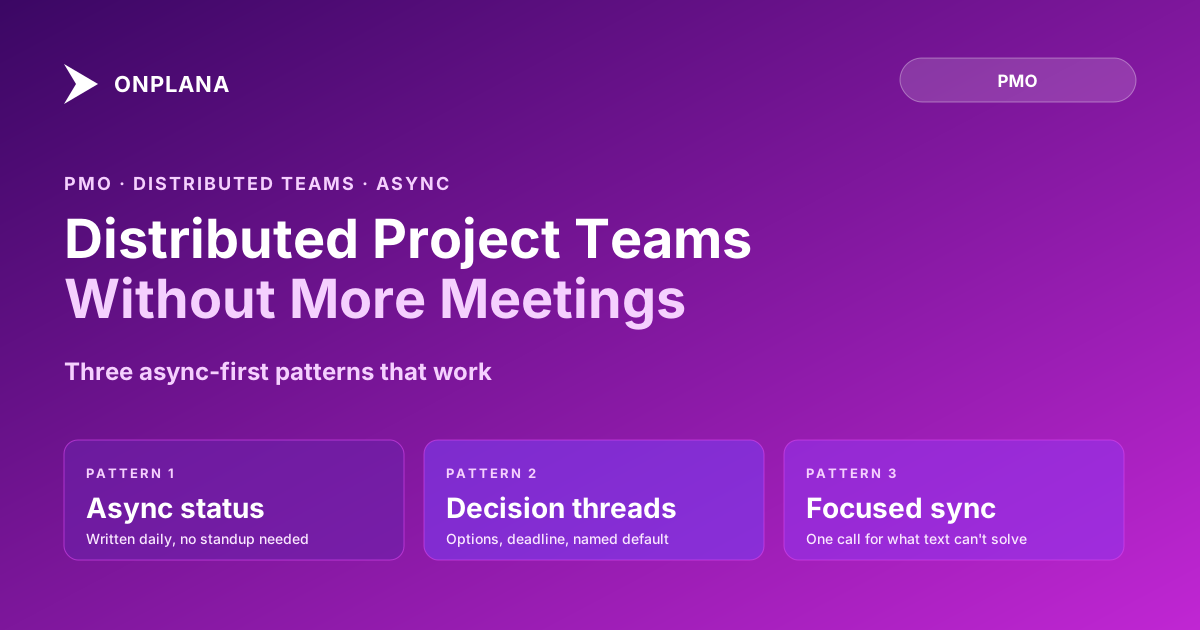
Distributed Project Teams: Fewer Meetings, More Progress
Distributed project teams default to more sync when coordination breaks down. The async-first patterns that restore progress without filling the calendar.
Here's what happens when a distributed project team hits its first coordination problem: someone schedules a meeting.
The coordination problem is real. Two engineers are working from different assumptions about an integration handoff. A design decision that felt settled gets contested in a code review. A stakeholder who was supposed to review an artifact last Tuesday still hasn't responded. The instinct is correct that something needs to happen. The meeting is rarely the right thing.
Distributed project team management has a gravity problem. Every coordination breakdown pulls toward sync. Sync feels like doing something about the problem. It fills a calendar slot, it puts everyone in the same virtual room, it generates a decision or at least a discussion. What it rarely generates is the 4-6 hours of focused work that actually closes the underlying issue.
This post is about the async-first patterns that let distributed project teams coordinate without defaulting to more meetings. Not because meetings are always wrong, but because most of what happens in recurring meetings can happen faster, more clearly, and with better documentation in writing.
TL;DR. Four patterns drive most distributed team coordination failures: status updates that require a meeting, decisions that drift without a meeting, progress reviews that require everyone on the call, and stakeholder updates that produce a sync rather than a written artifact. Each has an async-first replacement. The single sync call that survives this filter handles what async genuinely cannot: real-time conflict resolution, novel problems with no precedent, and the relationship maintenance that keeps trust alive across distance.
Why distributed project teams default to more meetings
The pattern is predictable. A team goes distributed. They set up a standup. Then a mid-week check-in for the sprint. Then a stakeholder sync for external reporting. Then an ad hoc "can we get everyone on a call" when something goes sideways. By month three, the team is spending 6 to 8 hours per person per week in meetings, and nobody can point to a decision made in more than one of them.
This happens for a structural reason, not a cultural one. When a co-located team hits a coordination gap, they solve it passively: a hallway conversation, a glance across the desk, a sticky note on a monitor. These interactions are cheap, low-friction, and leave no trace. When a distributed team hits the same gap, the only visible response available is to schedule something. The something becomes a meeting.
Over time, the meeting load compounds. Each meeting added to solve a specific problem stays on the calendar after the problem is solved, because removing a recurring meeting requires a conversation nobody wants to have. The standing Tuesday check-in that was added during the Q2 crunch is still happening in Q4 even though nothing it covers couldn't be handled in a two-paragraph message.
The cost is not just the time in the meeting. It is the cost of the context switches around the meeting: the 20 minutes before that can't be used productively because a meeting is coming, the 15 minutes after that it takes to re-enter deep work, and the frustration of a calendar that looks like a Tetris board with work squeezed into the gaps.
The distributed team meeting math
The average knowledge worker in a distributed environment attends 11 to 13 meetings per week according to consistent surveys of remote-work patterns. For a project team specifically, that count tends to cluster in the 6 to 9 range per person because project teams add coordination overhead that general teams don't have.
At 7 meetings per person per week averaging 45 minutes each, that's 5.25 hours. For an 8-person project team, that's 42 person-hours per week in meetings, before accounting for prep time and context switching. If the sprint is two weeks, 84 person-hours of the sprint are in meetings. That is more than two full person-weeks of output absorbed by coordination overhead.
The comparison most teams never make: a 10-person team running async-first with one focused 45-minute sync per week and daily written status updates spends approximately 3 hours per person per week on coordination. For the same 8-person team, that's 24 person-hours, versus 84. The delta is 60 person-hours per sprint available for work.
The diagram below shows what a typical sync-heavy week looks like against an async-first week for the same team.
Four async-first replacements for common sync patterns
The pattern of a sync-heavy distributed team maps to four specific meeting types. Each has a proven async replacement.
Daily standup becomes a written status update. The standing model is: each team member posts an end-of-day update in a shared channel or tool. Three fields: what I completed today, what I'm working on next, what is blocking me. The PM reads and responds to blockers asynchronously. The entire team can see the state of all work without attending a meeting. The 30-minute standup that nine people attend becomes a 10-minute write and a 5-minute read, with no overlap required.
The critical design choice is the end-of-day local time rule. Each person posts before they sign off for the day. The PM in a different timezone reads updates in the morning. This eliminates the time-zone coordination problem that kills standups for distributed teams: someone is always at an inconvenient hour. Written updates are timezone-agnostic.
Ad-hoc decision calls become decision threads. When a decision comes up, the requestor opens a thread with: the decision to be made, the options they see (with a brief assessment of each), the people whose input is required, and a deadline by which the thread closes. If no input is received before the deadline, a named default applies.
This structure forces the requestor to do the work of framing the decision before pulling others in, which is where most "quick decision calls" fail: the call gets scheduled before the decision is understood well enough to be framed clearly. A decision thread that can't be written coherently in three paragraphs is not ready for input, call or otherwise.
Status review calls become a written status report. The Status Report Writer drafts the headline-first, RAG-up-top format that stakeholders can read in two minutes and use to make decisions. The same format works for distributed team status: the PM synthesizes the team's daily updates into a weekly summary and distributes it. Stakeholders read it on their schedule. Questions come back as written comments, not calendar invitations.
Progress reviews become async video walkthroughs. For complex artifacts that benefit from explanation, a recorded 10-15 minute walkthrough captures tone and context that prose can miss. Reviewers watch and comment on their schedule. The PM replies in writing. This is slower than a live review call by wall-clock time but faster by contributor time because no one's schedule needs to be coordinated.
Running async status without losing visibility
The most common objection to replacing standups with written updates is that the PM loses visibility into what's really happening. The objection usually rests on a belief that verbal check-ins surface problems that written updates don't.
The opposite is more often true. When status is verbal, it is filtered through whatever the team member thinks the PM wants to hear in the moment. When status is written, it is searchable, comparable week to week, and creates a record that can be audited. A team member who says "on track" in a standup every day for two weeks is harder to question than one who writes "on track" in a daily update that can be compared against yesterday's.
Written updates also surface patterns that verbal updates hide. The engineer who is blocked on the same dependency for three days in a row is invisible in a daily standup where blockers get acknowledged verbally and then not acted on. In a written update thread, the same blocker appearing on day 1, day 2, and day 3 is visible to everyone including the project sponsor.
The format that works for distributed project teams at all sizes is the three-field update: Done, Next, Blocked. Done is what was completed since the last update. Next is what will be worked on before the next update. Blocked is anything that cannot proceed without an input from someone else, with a specific name where possible. Anything beyond these three fields adds noise without adding information.
For the PM, the daily read of team updates is 15 to 20 minutes of focused attention that surfaces more actionable information than a 30-minute standup produces, because the information arrives in writing and can be processed without interrupting the person who provided it.
Connect the status writing format your team uses for internal daily updates to the format you use for external stakeholder reports. When both formats share the same structure, the weekly stakeholder report becomes a synthesis of the team's updates rather than a separate writing exercise.
Making decisions without a meeting
The decision thread format described above fails in two consistent ways. Both failures point to a design error rather than an inherent limitation of async decisions.
Failure 1: No decision is made because input never arrives. This happens when the requestor does not set a hard deadline, or sets one but allows it to slip. The fix is a named default: "If I don't hear otherwise by Thursday at 5pm GMT, we proceed with Option A." The default removes the ability to stall by not responding. Silence becomes an implicit vote.
Failure 2: The decision reopens after it's been made. Someone who didn't see the thread, or who saw it and didn't respond, objects after the decision has been applied. This is the async equivalent of the steering committee that re-decides: the written record of the decision exists, but the person objecting treats it as optional because they weren't in the "room." The fix is an explicit acknowledgment in the thread that the decision has closed and is now in effect, plus a link to the decision log where it is recorded.
A decision log is the async equivalent of meeting minutes. One entry per decision: date, summary, options considered, choice made, owner, deadline. Visible to the whole team. Referenced when someone asks why something was done a certain way. Without a decision log, async decisions are as easy to re-open as decisions made verbally in a meeting.
What sync time is actually for
Not everything belongs in a written thread. Some coordination genuinely requires real-time interaction. Identifying which is which is what lets the remaining sync time be useful rather than defensive.
Three categories of work legitimately require synchronous communication in a distributed project team.
Conflict resolution that prose can't achieve. When two team members have a genuine disagreement about a direction, a technical approach, or a priority, and the thread has gone back and forth four times without resolution, a 30-minute call typically resolves it in the first ten minutes because tone and body language carry information that text cannot. The meeting is warranted when the text exchange has demonstrably failed.
Novel problems with no established framework. When the team encounters a problem that has no precedent and no obvious structure, synchronous brainstorming produces higher-quality options faster than async. The async alternative, where each person proposes an idea in sequence, tends toward sequential refinement of the first idea rather than genuine exploration of the space. Save the async process for problems where the framework is known and only the details need confirmation.
Relationship maintenance across distance. Distributed project teams that go fully async without any regular human connection become transactional and eventually brittle. A weekly or biweekly all-team call with no agenda items, run purely to maintain the relational fabric of the team, is not overhead. It is the maintenance cost of a distributed team's social infrastructure. Keep it short and keep the agenda off.
Building async habits that actually stick
The hardest part of going async-first is that it requires discipline from the whole team, not just the PM. A team that agrees in theory but reverts to scheduling calls when friction increases is not async-first. It is async-adjacent.
Three practices make async habits stick on distributed project teams.
Write the team agreement. A one-page document that names the communication defaults: where daily updates go, how decisions are structured, what the response time expectation is for each channel. Without this, the team defaults to whatever the loudest person prefers. The agreement does not need to be elaborate. It needs to exist in writing and to have been read by everyone.
Make async the path of least resistance. If getting something reviewed requires scheduling a meeting, most people will schedule the meeting. If it requires posting a document in a thread and setting a three-day review window, most people will do that instead. Structure the tools so async is the default action and sync requires a deliberate extra step.
Protect focused work blocks. If the team knows that a calendar without meetings is the norm, they will protect it. If meetings are randomly scheduled against the workday, deep work never gets scheduled and never gets defended. Async works best when the focused work it enables is visibly happening. Use the PMO Maturity Assessment to audit the team's coordination patterns as part of a broader PMO effectiveness review; coordination overhead is one of the clearest signals in the maturity model.
The first sprint that runs async-first will feel slower than it is. Team members accustomed to the standing check-ins will feel uncertain about whether coordination is happening. The status updates will come in inconsistently until the habit forms. Expect this. The second sprint runs faster. By the third, the team has learned that no news in the decision thread means consensus, and the single Wednesday sync is a place to surface things that genuinely need real-time input, not a performance of being coordinated.
Run the free Status Report Writer Draft structured weekly status reports for distributed team stakeholders in under five minutes. No meeting required. No signup required. → Open the Status Report Writer
Frequently asked questions
How do you manage a distributed project team effectively?
Replace recurring sync meetings with structured async touchpoints: a daily written status update, async decision threads with stated options and a deadline, and a single focused sync call for issues that genuinely require real-time discussion. Most coordination that happens in meetings can happen faster in writing.
What is the biggest mistake distributed project teams make?
Adding meetings when coordination gets harder. Meetings feel like a response to coordination problems, but they often address the symptom rather than the cause. When the underlying issue is unclear ownership, inconsistent status, or ambiguous decisions, meetings surface those problems but don't fix them.
How do you run a daily standup for a distributed project team?
Replace the standup with a daily written status update. Each team member posts before their end of day local time: what they completed, what they're working on next, and what is blocking them. The PM reads and responds asynchronously. This takes less time and creates a searchable record.
How do you make decisions in a distributed team without endless meetings?
Use a decision thread: state the decision to be made, list the options with a brief assessment of each, name who needs to weigh in, and set a deadline by which the thread closes. If no objection or input is received, the named default applies. Reserve real-time discussion for decisions where the options are genuinely unclear or conflict between stakeholders is expected.
What meetings are worth keeping for a distributed project team?
Meetings where real-time interaction changes the outcome: conflict resolution that prose can't achieve, novel problems with no established framework, and relationship maintenance calls that keep the team connected across distance. Recurring status reviews, progress updates, and decision discussions are almost always better handled asynchronously.
How do you track distributed project team progress without meetings?
Structured daily written updates, a single-source schedule with milestone dates and task assignments, and async video walkthroughs for complex topics where tone matters. The PM synthesizes the daily updates into a weekly status report for stakeholders, removing the need for a separate stakeholder sync.
Ready to make the switch?
Start your free Onplana account and import your existing projects in minutes.