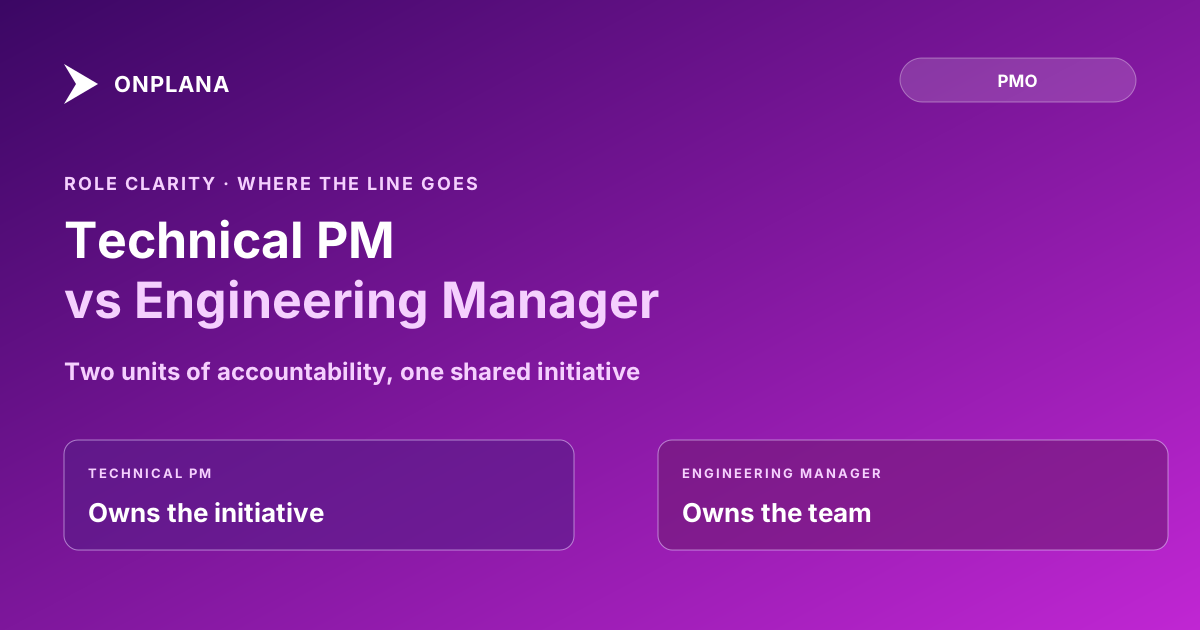
Technical Project Manager vs Engineering Manager Compared
A technical project manager owns cross-team delivery risk. An engineering manager owns the people building it. Confuse the two and both jobs quietly break.
An engineering manager and a technical project manager sit in the same incident review after a launch slips three weeks, and they give the VP two different explanations for the same delay. The EM talks about a backend team that has been carrying two open headcount reqs since March and quietly absorbing the gap through unsustainable hours. The TPM talks about a partner API dependency that slipped without anyone escalating it until it was already blocking two other teams. Both are correct. Neither is wrong. And the actual problem is that nobody had cleanly decided, before the incident forced the question, which of those two failure modes belonged to which role.
This is the technical project manager vs engineering manager confusion in its native habitat. Both titles show up on cross-functional engineering initiatives, both sound like they mean "the person in charge," and at most companies that run both roles, nobody has written down where one job stops and the other starts. The result is a slow drift: TPMs who quietly start doing performance management because a struggling engineer's real manager is too busy, or EMs who quietly start owning cross-team sequencing because their TPM counterpart doesn't have the technical standing to push back on an engineer's timeline.
The direct answer: A technical project manager owns delivery outcomes across teams: sequencing dependencies, tracking a cross-team technical initiative against its milestones, surfacing risk before it becomes a slip, and driving the initiative to completion. An engineering manager owns the people on one team: hiring, performance, career development, and the technical direction of that team's day-to-day work. The TPM's unit of accountability is the initiative; the EM's unit of accountability is the team. When an initiative spans multiple teams, both roles are usually needed, and the friction almost always shows up at the same seam: who decides what an engineer works on this week when the TPM's cross-team plan and the EM's team priorities disagree.
What a technical project manager actually owns
A technical project manager's job is to make a cross-team, technically complex initiative land, without owning any of the people delivering it.
Cross-team sequencing and dependency management. When Team A's API needs to ship before Team B can start integration work, the TPM is the one tracking that dependency chain, flagging it early, and pushing on whichever team is at risk of slipping before the slip cascades. No individual engineering manager has visibility into every team's schedule; the TPM's whole job is holding that map.
Technical risk surfacing. A TPM with real technical depth reads a design doc and asks "what happens if this third-party rate limit is lower than we're assuming," not because they'll implement the fallback, but because catching that question in week two is worth ten times catching it in week eight. This is where the "technical" in the title has to be real. A TPM who can't evaluate a technical claim can only relay what engineers tell them, which means they catch nothing an engineer didn't already flag.
Driving the initiative to a defined outcome. Cross-team initiatives don't have a natural owner the way a single team's roadmap does; someone has to hold the finish line. The TPM tracks milestones, runs the cross-team syncs, and is the person who can answer "are we still going to hit the date" with an honest answer, not an optimistic one.
Escalating what teams can't resolve themselves. When two teams disagree about a shared interface and neither wants to move first, the TPM escalates it to whoever has authority to decide, instead of letting the disagreement quietly stall the initiative for three weeks while both sides wait for the other to blink.
What an engineering manager owns that a TPM should not
This is the discipline engineering management is built around: applying management skill to a technology-driven team, which is a people and organizational job first, not a delivery-tracking job.
Hiring, performance, and career growth. The EM decides who joins the team, runs performance reviews, has the hard conversations about underperformance, and invests in each engineer's growth. This is deep, ongoing relationship work that a TPM, whose relationship with any given engineer is scoped to one initiative, is not positioned to do well even with good intentions.
Team-level technical direction. The EM (often alongside a tech lead) owns how the team builds things day to day: coding standards, technical debt tradeoffs within the team's own codebase, and which engineer works on which piece of the team's backlog. A TPM has a stake in the outcome but shouldn't be dictating a team's internal technical choices.
Team health and sustainable pace. Burnout, morale, and whether the team is being asked to do more than is sustainable is EM territory. A TPM tracking a cross-team date is structurally biased toward pushing for speed; someone needs to be structurally positioned to say "this team cannot absorb another slipped date without real cost," and that's the EM.
Protecting the team from initiative churn. When three different cross-team TPMs all want a slice of the same team's capacity this quarter, the EM is the one who says no to two of them, or negotiates a sequence, because unlimited access to a team's time isn't actually available no matter how important each initiative feels to its own TPM.
Why the line blurs so easily
The confusion isn't random. Both roles sit close to the same work, use overlapping vocabulary (both talk about "priorities," "risk," and "timelines"), and both are frequently the most technically literate non-engineer in a given room. That surface similarity is exactly what makes the boundary hard to hold in practice.
The most common failure pattern runs like this: a TPM without a technically strong counterpart on a given team starts making calls that are actually the EM's, because the EM is stretched thin and the TPM is right there, tracking the initiative daily, with more visibility into the immediate problem than the EM has that week. It rarely looks like a power grab. It looks like a competent person filling an obvious gap. But six months in, that TPM is quietly setting technical priorities for a team they don't manage, the EM has lost visibility into what their own team is actually working on, and nobody decided this should happen; it accreted.
The reverse pattern is just as common. An EM whose team is the anchor for a cross-team initiative, and who doesn't trust the TPM's technical judgment, starts running the cross-team coordination themselves: tracking other teams' dependencies, running the sync meetings, making the sequencing calls. The TPM becomes a notetaker for a job they were supposed to be doing. This usually happens when the TPM's technical depth genuinely isn't sufficient for the initiative, which is a real failure mode, not just an org-chart problem: a TPM who can't evaluate a technical tradeoff will get quietly worked around by any EM who can.
Does a technical project manager manage engineers?
Not as their line manager, and this is the distinction that resolves most of the confusion once it's made explicit. A TPM coordinates the engineers working on a shared initiative: setting shared priorities for that initiative, sequencing who needs to finish what first, and escalating conflicts. What a TPM does not have is authority over an engineer's performance review, compensation, career path, or which team they're on. That authority sits with the EM, full stop, and a TPM who starts weighing in on those decisions, even informally, is operating outside their actual scope.
This matters in the moments that actually create friction. When an engineer is behind on a task the TPM is tracking, the TPM's job is to understand why, help unblock it, and escalate if it threatens the timeline. It is not the TPM's job to decide that engineer needs a performance improvement plan; that's a conversation for the EM, informed by pattern, not by a single missed task on one initiative.
The role comparison
| Dimension | Technical project manager | Engineering manager |
|---|---|---|
| Unit of accountability | The cross-team initiative | The team |
| Primary skill | Dependency mapping, technical risk judgment | People development, technical direction within the team |
| Success metric | Did the initiative land on time with acceptable risk | Is the team healthy, growing, and shipping sustainably |
| Authority over people | None (coordinates, doesn't manage) | Hiring, reviews, career growth, staffing |
| Authority over the roadmap | Cross-team sequencing and priority | Team-internal priority and technical direction |
| Technical depth required | Enough to evaluate a tradeoff or a risk claim directly | Deep, plus people-management skill |
| Time horizon | The initiative's lifecycle | Ongoing, spans many initiatives |
| Fails silently when missing | Cross-team dependencies collide late, nobody owns the finish line | Team burns out, attrition rises, nobody develops junior engineers |
Where does the line actually blur in practice?
The cleanest boundary case is resourcing a shared initiative. When the TPM's cross-team plan says an engineer should start integration work Monday, and the EM knows that same engineer is three days behind on unrelated team work and needs the week to catch up, whose call wins? Neither, by default. The honest answer is that the TPM owns making the tradeoff visible (what slips on the cross-team initiative if this engineer isn't available Monday) and the EM owns the final call on that engineer's time, because the EM is accountable for that engineer's whole workload, not just the slice the TPM can see.
Organizations that handle this well write the default down before the first real conflict: the EM has final say over their own team's staffing, the TPM has an obligation to surface the tradeoff clearly and early, and disagreements that can't resolve at that level escalate to whoever the TPM and EM both report into, rather than getting relitigated informally every sprint. Without that default, the loudest or most senior person in the room wins the argument each time, which trains both roles to escalate earlier and louder than the actual stakes justify.
The diagram above is the version of the boundary worth pinning to a wiki page before the first cross-team initiative kicks off, because the two failure modes it prevents (a TPM quietly managing people, an EM quietly running cross-team coordination) both look like helpfulness in the moment and only look like a problem in the retro.
When does a team actually need a dedicated TPM?
Not every cross-team initiative needs one. A two-team integration with a light, well-understood dependency usually gets coordinated fine by the two EMs talking directly, the same way a small PMO doesn't need a separate portfolio manager and PMO director until the number of active projects grows past what one person can hold well.
The threshold worth watching for is three or more teams with real, two-way dependencies, or a single initiative complex and high-stakes enough that no individual EM has full visibility into the risk. Below that, a strong EM with good cross-team relationships usually covers the coordination informally. Above it, the coordination work becomes a full job on its own, and leaving it unowned means dependencies get discovered late, by whichever team's schedule breaks first.
Building the boundary before the first real conflict
Companies that keep this distinction clean do one thing consistently: they write down, at the start of a cross-team initiative, which specific decisions belong to the TPM and which belong to each team's EM, the same discipline that separates a Defined-tier PMO from one still improvising governance project by project. "Who decides the integration date" and "who decides if this engineer works on it this week" sound obviously different in the abstract, but they get renegotiated in real time under a status-report deadline, which is exactly when a fuzzy boundary produces a bad decision, a resentful EM, or both.
A short written default, reviewed at kickoff and revisited if the initiative's shape changes, does most of the work: the TPM owns the initiative's sequencing and surfaces tradeoffs, the EM owns final say over their own team's staffing and technical direction, and unresolved conflicts escalate to a named person rather than getting settled by whoever pushes hardest. This is the same kind of boundary work that shows up in discipline, goals, milestones, and status reporting: a status report that clearly separates initiative-level risk from team-level capacity risk is only possible if the TPM and EM roles feeding it are actually separated first.
The PMO Maturity Assessment is a fast way to check whether this kind of role boundary is documented anywhere in your organization, or whether it's still living in the heads of whichever TPM and EM happen to be paired up this quarter. PMOs and engineering orgs that score low on governance are frequently the ones where cross-functional role authority was never written down, which means every TPM-EM friction point gets rediscovered and re-argued on every new initiative instead of resolved once.
Run the free PMO Maturity Assessment Fifteen questions across process, tooling, governance, risk, and reporting. Get a tier read and a specific recommendation on whether your cross-functional role boundaries actually need to be written down. About ten minutes, no signup. → Open the assessment
Frequently asked questions
What is the difference between a technical project manager and an engineering manager?
A technical project manager (TPM) owns delivery outcomes across teams: sequencing dependencies, de-risking a cross-team roadmap, and driving a technical initiative to completion. An engineering manager (EM) owns the people on one team: hiring, performance, career growth, and the technical direction of that team's work. One drives outcomes across teams; the other develops people within one.
Does a technical project manager manage engineers?
Not as their line manager. A TPM coordinates the engineers working on a cross-team initiative and can set shared priorities and sequencing, but hiring, performance reviews, and career development stay with each engineer's engineering manager.
Is a TPM the same as a program manager?
They overlap heavily and the titles are often used interchangeably at software companies. Where a distinction exists, a TPM typically needs enough technical depth to evaluate an architecture tradeoff or a build-versus-buy call directly, while a generalist program manager relies more on the engineers in the room to make that judgment for them.
Can one person be both the TPM and the EM on the same initiative?
On a small initiative with one team and low cross-team dependency, yes, and it usually works. Once the initiative spans three or more teams with real dependencies between them, combining the roles forces one person to choose between managing people and managing delivery risk in the same week, and something gives.
What technical depth does a TPM actually need?
Enough to read a design doc critically, ask the right question when a team says a dependency will take longer than planned, and personally judge whether a proposed technical shortcut is reasonable. A TPM does not need to write production code, but a TPM who cannot evaluate a technical argument gets steamrolled by any engineer who wants to protect their own timeline.
Who decides architecture: the TPM or the EM?
Neither, cleanly. Architecture decisions belong to the engineers and tech leads doing the work, informed by constraints each role surfaces: the EM represents what their team can sustainably build and maintain, and the TPM represents what the cross-team timeline and dependency structure can absorb. A TPM who unilaterally picks an architecture, or an EM who unilaterally commits to a cross-team date, has stepped outside their actual authority.
Ready to make the switch?
Start your free Onplana account and import your existing projects in minutes.