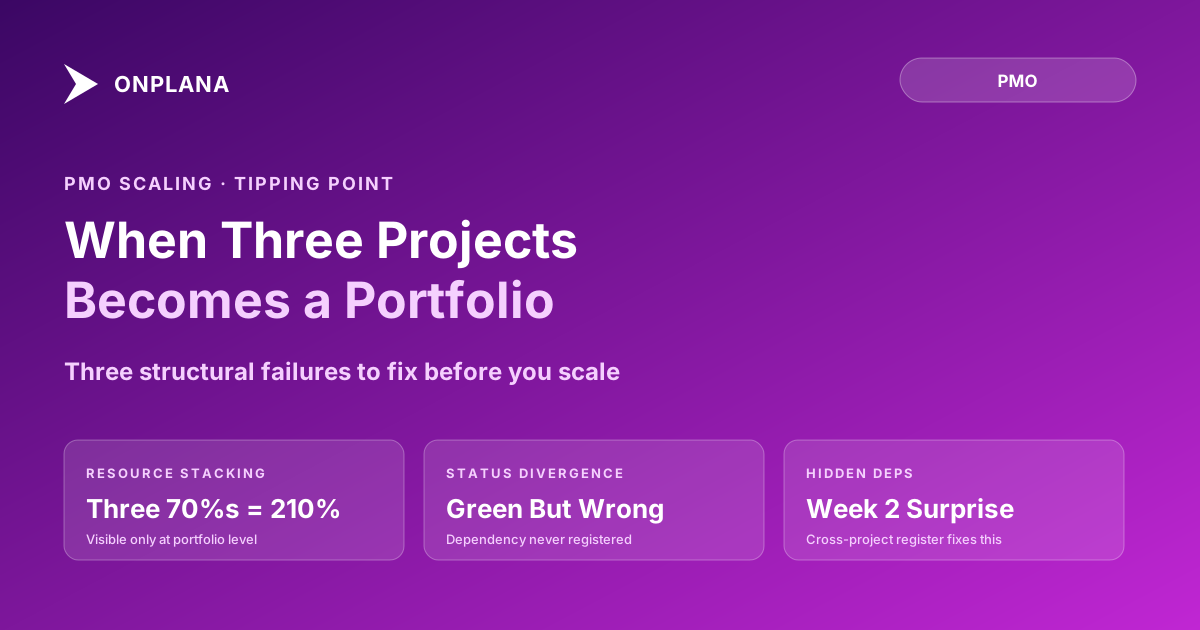
Project Portfolio Management Tipping Point: Three Projects
Two projects you can manage alone. Three is where project portfolio management breaks: resource stacking, status divergence, hidden dependencies surface.
Here's the pattern. A team runs two projects without significant problems. Status reports come in on time. Resources seem fine. Cross-project dependencies get tracked loosely in a shared spreadsheet. Then the third project lands.
Within six weeks: the same senior developer appears in all three project plans at 70% utilization each. Two PMs are writing contradictory status reports about the same shared milestone. A blocker on Project B that delays Project C's kickoff never appears in either plan. By month three, the project that looked like the safest bet is six weeks behind schedule, and no single person saw it coming.
None of this is a failure of individual PM skill. The single-project practices that worked fine at two projects simply do not scale to three. The failure modes are structural, and project portfolio management is the vocabulary for describing what breaks and how to fix it.
The direct answer: Three concurrent projects is where informal project management stops working. Below that threshold, a single PM can hold all cross-project context in their head. At three and above, the failure modes are predictable: resource stacking, status-report divergence, and invisible cross-project dependencies. Fixing them requires three specific structural changes, and no amount of individual PM effort closes the gap without them.
Why one or two projects feel manageable
At one or two projects, a single PM can track everything that matters. Resource availability is visible because there's only one place to check. Status reports describe a shared reality because there's only one set of facts. Dependencies between tasks are visible because all tasks live in one plan, or two plans that one person holds simultaneously.
The tools don't need to integrate. The processes don't need to formalize. The PM just knows. This is why many teams run one or two projects smoothly without any formal PMO infrastructure: the cognitive load is manageable at that scale, and the informal system holds.
The moment a third project enters the picture, the "PM just knows" model breaks. Not because the PM is less skilled, but because the volume of cross-project signals exceeds what any person can hold simultaneously, especially when each project has its own PM who sees only their own work.
Where resource conflicts actually come from
The resource conflict at three projects is rarely obvious. It forms through a series of small, individually-rational decisions that no single person sees adding up.
PM A sees the senior developer at 70% utilization on her project. Reasonable. PM B checks the same developer and sees 60% on his project. Also reasonable. PM C adds a design review, estimated at 10 hours for the week. Still reasonable on paper.
The total is 130%. Nobody sees 130% because each PM looks only at their own project. The developer works overtime, misses quality targets, and two projects slip in week four. The retrospective calls it "resource contention." It was mathematically visible from the day PM B made their assignment, if anyone had been looking at the aggregate.
This is resource overallocation in its most common form: not a single bad decision, but a series of individually-rational ones that compound into structural overload. At one or two projects, the shared PM sees both files and catches it. At three projects with separate PMs, no one person sees the sum.
The fix requires a single view of resource utilization across all projects simultaneously. The free Resource Heatmap tool pulls this view from project files and shows the cross-project picture in seconds. More importantly, the concept of a cross-project utilization review needs to become a regular artifact, not an emergency response to a missed deadline.
Why status reports start disagreeing
Two projects can share a PM who writes a single status report describing both. At three projects with separate PMs, you have three separate reports, and they will eventually contradict each other.
The contradiction is rarely intentional. It happens because each PM anchors their status to their own project's baseline. A milestone that slips two weeks on Project B triggers an "amber" flag in Project B's status report. But that milestone was never reflected in Project C's plan, even though Project C depends on it. Project C's PM reports "green."
The sponsoring executive sees two green reports and one amber, infers that the amber is isolated, and misses the fact that the amber is about to turn Project C red.
Fixing this requires a unified status-report format with explicit cross-project dependency callouts. When a milestone in Project B is also a dependency for Project C, both PMs need to know, and both reports need to reflect the dependency's current state. This does not happen without a formal mechanism to capture it.
Cross-project dependencies: the silent schedule killer
The diagram below shows the most common version of this failure. Three projects share a deliverable from one PM's plan. The delivering PM logs a slip. One consuming project's PM catches it. The second consuming project's PM never knew the dependency existed.
Three weeks later, Project C reports a "dependency issue" as a new problem. It was a known issue in Project B's plan for three weeks. Nobody told Project C.
This is not a communication failure in the ordinary sense. It is a structural failure: there was no mechanism to propagate the dependency's status from Project B to Project C. Dependencies between projects rarely get logged formally because it requires both PMs to know about each other's work in enough detail to see the connection. Without a cross-project dependency register, that knowledge never travels.
What project portfolio management actually requires at the three-project level
The phrase "project portfolio management" sounds like something reserved for large PMOs with dedicated portfolio analysts. The practices it implies are not complex at three projects. Three specific changes close most of the gap:
A single shared resource view. Resource utilization across all projects in one view, reviewed at least weekly. Without this, each PM is flying blind on shared capacity. This does not require expensive PPM tooling: a shared spreadsheet with each resource's weekly allocation across all three projects is a functional starting point. The critical requirement is cross-project coverage.
A cross-project dependency register. A simple log: one row per dependency, showing what each project depends on from each other project, expected delivery date, and current status. Reviewed at every PM sync. When a dependency slips, all consuming PMs see it in the same meeting, not two weeks later when it surfaces as a surprise.
A unified status-report format. Same template, same RAG definitions, same section structure across all three projects. When a sponsor reads three reports with three different formats, they work harder to build the portfolio picture and miss signals in the noise. Consistent format is not pedantry: it makes extraction of the relevant signal faster and more reliable.
These three practices are the core of PMO maturity tier 3 (Defined). None of them require a large PMO or enterprise tooling. They require the decision to treat the project collection as a portfolio rather than three separate engagements.
The tooling shift
Single-project tools stop helping when the critical information is cross-project. A few specific gaps that teams hit at the three-project threshold:
Per-project resource sheets. MS Project's resource sheet shows utilization within one file. Three separate files show three separate pictures, none of which add up to the real aggregate. Portfolio-level resource planning requires either a master project file that consolidates all three, a PM platform that aggregates automatically, or a dedicated capacity tool.
Separate status-report templates. If each PM built their own format, unifying them is a 30-minute task. The real work is agreeing on the RAG definitions. What does "red" mean for this portfolio? Is it a schedule variance of more than two weeks, or a PM judgment call? Defined PMOs write that down and enforce it.
No portfolio dashboard. At two projects, a sponsor can read two status emails and hold the portfolio picture in their head. At three, a shared dashboard with a single-pane view of all active projects' status is not optional: it is the artifact that makes portfolio-level decisions possible.
How to know you've already crossed the tipping point
Four symptoms indicate you've crossed the portfolio threshold without the supporting structure:
Status reports contradict each other. When two PMs describe the same shared milestone differently, the threshold is behind you.
Resource negotiation is happening outside the plan. When PMs negotiate resource time over email because the plans don't reflect the real allocation picture, the threshold is behind you.
Dependency surprises. When a PM says "I didn't know that was blocking us," a dependency existed in someone's plan but was never propagated across the portfolio. The threshold is behind you.
The single point of context. When the only way to answer a portfolio question is to find the one person who holds all three projects simultaneously in their head, the threshold is behind you. That person is a single point of failure.
What to build before the third project lands
The best time to implement portfolio-level practices is before you need them. Once you're inside a resource conflict or a dependency fire, you're implementing under pressure.
Before starting a third concurrent project:
- Agree on a single status-report format, including a written RAG definition table: what "green," "amber," and "red" mean in specific, measurable terms, not PM intuition.
- Create a cross-project dependency register. Start with whatever dependencies between the incoming projects are already known. It takes 30 minutes and prevents two months of surprises.
- Pick a resource tracking approach that covers all projects. A shared spreadsheet showing each resource's weekly allocation across all three is sufficient to start. What matters is cross-project coverage, not tool sophistication.
- Schedule a weekly PM sync to review the dependency register and the resource view. Sixty minutes per week prevents a surprising amount of downstream damage.
- Assess your current PMO with the free PMO Maturity Assessment before you scale. If your tooling or process dimension is at the Emerging tier, three projects will surface that gap faster and more painfully than two projects did.
According to the Project Management Institute, portfolio management is the centralized management of one or more portfolios to achieve strategic objectives while balancing resource capacity against portfolio demand. That balance is the job. The practices above are how you do it for three projects without overbuilding the infrastructure of a 50-project PMO.
Run the free PMO Maturity Assessment Fifteen questions across process, tooling, governance, risk, and reporting. Get a tier read and a specific recommendation on which dimension to invest in before scaling to three or more projects. No signup required. → Start the assessment
Frequently asked questions
When does a collection of projects become a portfolio?
Three concurrent projects is the practical tipping point. Below that, a single PM can hold all cross-project context informally. At three and above, resource conflicts, status divergence, and cross-project dependencies require formal portfolio management practices.
What is the difference between project management and project portfolio management?
Project management is focused on delivering a single project within its scope and schedule. Portfolio management is focused on selecting the right mix of projects, allocating shared resources across them, and resolving priority conflicts when timelines collide.
What tools do I need when I cross the portfolio tipping point?
At minimum: a single shared view of resource utilization across all projects, a unified status-report format with consistent RAG definitions, and a cross-project dependency register. These three structural changes address the most common portfolio failure modes.
How do I handle resource conflicts across three or more projects?
Surface the conflict visually with a cross-project utilization view. Once visible, resolve by pushing the least-critical timeline, reassigning work to available capacity, or adding contract resources for the specific overloaded window, in that order.
Is project portfolio management only for large PMOs?
No. The failure modes requiring portfolio management practices appear at three concurrent projects regardless of team size. A five-person team running three simultaneous projects faces the same structural problems as a fifty-person PMO.
What is resource stacking in project management?
Resource stacking is when the same person is assigned work across multiple projects simultaneously, with each PM seeing their own file's utilization but nobody seeing the aggregate. A resource at 70% in three project files is actually at 210%.
Ready to make the switch?
Start your free Onplana account and import your existing projects in minutes.