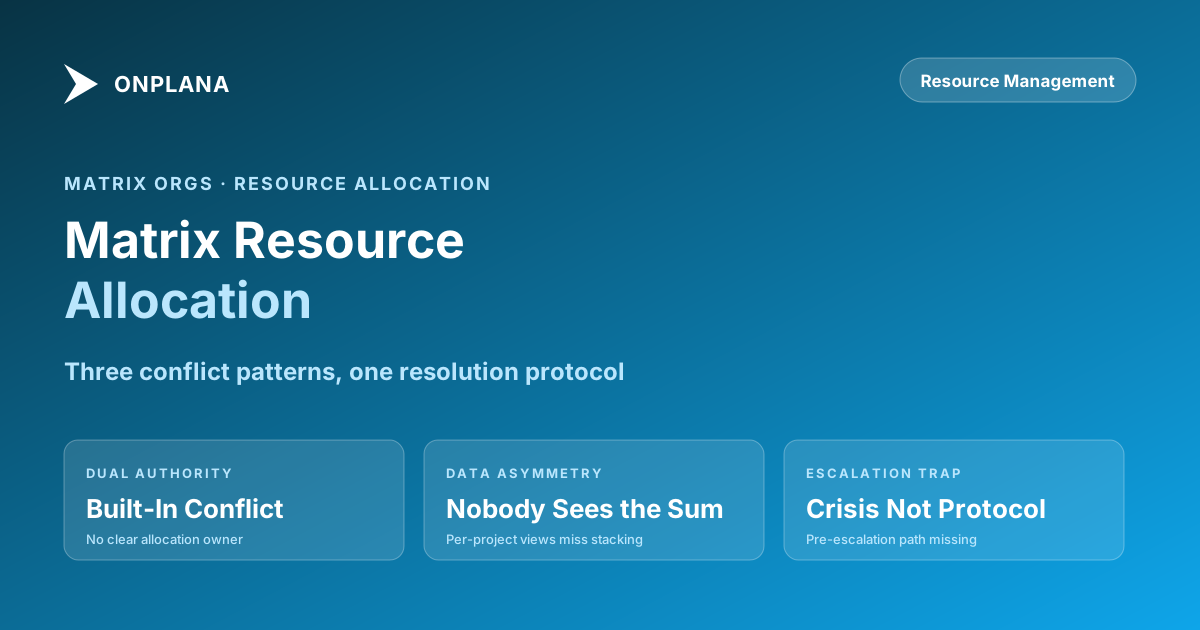
Resource Allocation in a Matrix Organization
Resource allocation in a matrix organization pits functional managers against PMs for the same person's time. Here's the process that resolves it weekly.
Resource allocation in a matrix organization has no single owner, which is exactly why this meeting happens in almost every one of them. A PM walks into a 1:1 with a functional manager to discuss an upcoming sprint. The PM needs the senior backend engineer for the next three weeks at 80% capacity. The functional manager says that engineer is already committed to a maintenance sprint at 60% and a security audit review at 30%. That's 90%, plus the PM's 80% request is 170%.
Both the PM and the functional manager are telling the truth. Neither is wrong. The system produced this conflict by design, and there is no obvious procedure for resolving it. The PM escalates. The functional manager escalates. Both escalations land with whoever runs the PMO, who now has to solve a resource allocation problem that should have been visible weeks earlier.
Matrix organization project management is the practice of managing projects in this structure without letting that structural conflict consume your PMO's escalation budget. The fix is not eliminating the conflict, which is impossible, but establishing who owns what decision and with what data.
The direct answer: In a matrix org, functional managers own the health and availability of the resource. Project managers own the delivery commitment that requires the resource. Neither owns the allocation decision outright. The protocol that works assigns the decision to whoever has visibility of the aggregate picture, backs it with shared utilization data, and escalates only when negotiation genuinely fails.
What a matrix organization actually means for resource allocation
A matrix organization is a structure where employees have two reporting relationships: a functional manager who owns their career, development, and discipline quality, and one or more PMs who direct their day-to-day delivery work on projects.
The three types differ in which authority dominates:
In a weak matrix, functional managers control resource allocation. PMs request time and may be declined. This produces predictable outcomes at the functional level but makes project scheduling unreliable: a PM who needs 30 hours per week from an engineer may get 15 with two days' notice.
In a strong matrix, PMs control allocation. Functional managers provide availability windows but do not approve individual project assignments. This produces predictable project schedules but can create tension around engineer development: a PM optimizing for delivery may assign someone to work that doesn't serve their career trajectory.
In a balanced matrix, both parties negotiate. Most real-world matrix organizations are some version of balanced, because neither pure form satisfies the needs of both the function and the portfolio. Balanced is also where the allocation conflicts are most frequent and most complex, because the decision authority is genuinely shared.
The conflict built into the design
The conflict is not a management failure. It is a consequence of the matrix structure optimizing for two different things simultaneously.
Functional managers optimize for team health and discipline quality: ensuring engineers aren't burning out, getting development opportunities, maintaining skills, and building toward the function's long-term capability. A functional manager watching utilization above 85% for three consecutive weeks is seeing a retention risk, not a delivery resource.
Project managers optimize for delivery commitments: milestones hit, blockers cleared, sponsors satisfied, dates held. A PM watching utilization at 70% is seeing underutilized capacity that could accelerate the critical path.
The same engineer's time is the scarce variable both parties are solving for, under different optimization objectives. The conflict is structural, and it will keep happening as long as the organization runs projects through a matrix.
The diagram below shows where the two authority lines cross and where the conflict zone sits.
Three conflict patterns and how they play out
Most matrix allocation conflicts fall into three recognizable patterns:
The invisible overcommit. The functional manager approves a 60% commitment to a maintenance project. Three PMs separately request the remaining 40%, each believing they have the headroom. Nobody tells the other two. The engineer is at 180% by week two. This is the most common pattern and the least intentional: it results from absent cross-project visibility, not bad faith.
The priority disagreement. A PM and a functional manager agree that the engineer has 40% available. They disagree about which project gets it. The PM believes the delivery date is the decision criterion. The functional manager believes the engineer's development roadmap should determine which project they join. Both have reasonable positions; neither has the authority to override the other without escalating.
The phantom commitment. An engineer verbally agrees to help a PM with "a few hours" of architecture review. The functional manager doesn't know about it. The PM informally counts on it. The few hours turn into 15 over three weeks. When the engineer's utilization spikes, both the PM and the functional manager are surprised. Informal commitments that bypass the allocation process are the hardest conflict to surface because they never appear in any plan until the damage is visible.
What each party actually sees (and doesn't)
The data asymmetry between PMs and functional managers is the root cause of most matrix allocation failures. Each party is solving the problem with incomplete information.
The project manager sees: their own project's utilization, their own plan's resource assignments, and, at best, verbal availability estimates from the functional manager. They cannot see what other projects have committed against the same engineer without asking each other PM individually.
The functional manager sees: their direct reports' declared availability, subjective wellbeing signals (energy level, engagement, expressed stress), and rough aggregate commitment across the team. They rarely see the actual hours-per-week committed across all active projects for each person.
Neither party sees: the actual cross-project utilization aggregate that would surface a conflict before it materializes. That view only exists if someone builds it explicitly.
This is why portfolio-level resource heatmaps matter in matrix organizations. Per-project utilization views are not the problem. The problem is that no one looks at the sum. A weekly cross-project utilization review that both the functional manager and the PMs attend is the simplest version of the fix. The numbers on the table change the conversation from a negotiation about competing claims to a shared problem-solving exercise with the same data.
The broader pattern of how overallocation forms in multi-project environments is covered in detail in Resource Overallocation: The Math That Breaks Schedules.
The Weekly Allocation Process: Publish, Negotiate, Book, Escalate, Review
Most allocation conflicts in matrix orgs escalate because there is no defined process for resolving them at the PM-functional manager level. The escalation path exists; the pre-escalation process does not. A process that works in most balanced-matrix environments runs in five steps, repeated on a weekly cadence rather than invoked only when a conflict has already become visible.
Publish demand. Before a PM builds a resource ask into a project plan, the ask goes into the shared cross-project utilization view, not a private conversation with the functional manager. Publishing the demand first means every other PM competing for the same person sees the claim before it hardens into a commitment, which is what prevents the invisible-overcommit pattern described above.
Negotiate with functional managers. The PM states an impact statement, not a demand: which milestone slips, by how many days, affecting which downstream dependency, if the allocation isn't granted. The functional manager states what the engineer's current utilization means for their health and trajectory. Both parties now describe the same problem from different angles, and generate at least two options (defer the PM's need by two weeks, split the work with another engineer, reduce scope on the competing project) before picking one, because the first option on the table usually favors whoever spoke first.
Book named or generic resources. Once negotiated, the allocation gets written down, using a named resource where the skill is scarce enough that substitution isn't realistic, or a generic resource placeholder (
Senior Backend Engineer, 0.6 FTE) where any qualified person on the team can fill it. A generic booking is more resilient: it survives the named person going on leave or changing teams, and it forces the functional manager to commit capacity rather than one individual's calendar. Use the allocation agreement template below to make the booking auditable instead of verbal.Agree the escalation path. If steps 1 through 3 do not produce an agreement, the conflict escalates to the PMO or portfolio steering, not to either manager's direct superior. Naming this in advance matters: without a defined escalation path, a stuck negotiation either drags on unresolved for weeks or jumps straight to a VP, both of which are worse than a fast, defined route to whoever owns the prioritization call.
Weekly review. The four steps above run continuously, but a standing weekly review is what catches drift before it becomes a crisis. Both parties look at the same cross-project utilization data every week, not just when someone raises an issue. A conflict caught in the Tuesday review is a five-minute conversation; the same conflict discovered when a milestone is already two weeks late is a much longer one.
The Allocation Agreement Template
Whatever allocation is agreed in step 3 goes into both the project plan and the functional manager's capacity ledger, not into a Slack thread that nobody can find in six weeks. Verbal agreements are the source of phantom commitments: if it is not written down, it does not exist. A minimal template that a PM and functional manager can fill out together in the negotiation itself:
| Field | Entry |
|---|---|
| Resource (named or generic) | e.g. "Maya Chen" or "Senior Backend Engineer, generic" |
| Requesting project | Project name and PM |
| Functional manager | Name |
| Allocation | Percent of capacity and date range |
| Priority if re-conflicted | Which project wins if a third claim appears |
| Review date | Next weekly review this allocation is checked at |
| Escalation owner | Who this goes to if the parties can't agree |
| Signed | PM and functional manager, with date |
Eight fields, one page, filled out in the same conversation as the negotiation. The "priority if re-conflicted" field is the one most templates skip and the one that saves the most re-negotiation time later, because it answers the next conflict before it happens instead of restarting the whole protocol from step 2.
A Worked Example: Two Projects, One Specialist
Maya is the only engineer on the team who has shipped the payment-gateway integration before. Project Atlas needs her for a compliance-driven rework: 60% of her time for eight weeks, starting in three weeks. Project Helix, running in parallel, needs her for a new checkout flow: 50% of her time for the same eight-week window, starting in two weeks. Neither PM knew about the other's request until the Tuesday utilization review surfaced both claims against Maya in the same week.
Run the process:
- Publish demand. Both asks are already visible in the shared view, which is why the conflict surfaced in week one instead of week six.
- Negotiate. Atlas's PM states the impact: the compliance deadline is regulatory and fixed, an eight-week slip risks a filing penalty. Helix's PM states the impact: the checkout flow ships before a marketing campaign already booked with a vendor, a two-week slip is recoverable, an eight-week slip is not. The functional manager adds a third fact neither PM had: Maya is also the only reviewer for a third team's pull requests, at roughly 10% load.
- Book. The math doesn't fit: 60% plus 50% plus 10% is 120% against 100% available. The negotiated resolution splits Maya's compliance work with a second, less experienced engineer who pairs with her for the first two weeks then runs solo, cutting her Atlas allocation to 30%. Helix keeps its 50%. The code-review load moves to a different senior engineer for the eight-week window. The allocation agreement is filled out for both bookings, with Atlas marked priority-if-reconflicted given the regulatory deadline.
- Escalation path agreed. Not invoked this time, both PMs reached agreement in the Tuesday review itself, but the escalation owner (the PMO director) is named in both agreements in case the pairing arrangement falls behind.
- Weekly review. The pairing handoff is checked explicitly at week two of the arrangement, the point of highest risk, rather than waiting for the standing eight-week checkpoint.
The conflict took one negotiation, one written agreement, and zero escalations, because it was caught with six weeks of runway instead of six days.
What tooling the protocol requires
The protocol above works in a spreadsheet. What it requires is a cross-project utilization view that both parties can access and trust. The common failure mode is that this view exists for one project but not across projects.
The minimum tooling: a shared resource capacity log covering all active projects, updated weekly, showing each resource's committed hours by week across every project they work on. This takes one hour to maintain weekly if the data is entered when assignments are made. It takes five hours to reconstruct weekly if it isn't.
More mature PMOs run this through a PM platform that aggregates utilization automatically, removing the maintenance burden and eliminating the "which version is current?" argument that derails every manual spreadsheet. The Resource Heatmap tool is a starting point for teams that want to see the cross-project picture from their existing project files before committing to a platform change.
When the conflict signals a healthy system
Not every allocation conflict is a problem. Some are signs the matrix is working.
A functional manager who pushes back on a PM's request because the engineer is already committed to high-priority maintenance work is doing exactly what a functional manager should do. The conflict surfaces the competing demand, forces a prioritization decision, and prevents the engineer from being overcommitted silently.
A PM who brings a resource request to the functional manager in week six instead of week ten, because the cross-project utilization review surfaced the future conflict, is using the system as designed. The conflict is earlier and smaller.
The difference between healthy and unhealthy matrix conflict is not whether the conflict occurs, but how early it surfaces, who surfaces it, and whether the resolution process produces a written commitment that both parties hold. A conflict caught in week two is a conversation. The same conflict caught in week eight, when the milestone is already at risk, is a crisis.
PMO maturity tier 3 (Defined) is where matrix organizations get this right: the conflict resolution protocol is written, enforced, and consistently followed, so the conflict that is structural and unavoidable becomes manageable rather than chronic.
Run the free Resource Heatmap Upload your project files and see cross-project utilization in a single view in about 30 seconds. The picture it shows is the starting point for every matrix allocation conversation. No signup required. → Open the Resource Heatmap
Frequently asked questions
What is a matrix organization in project management?
A matrix organization is a structure where employees report to both a functional manager (who owns their career and discipline) and one or more project managers (who direct their day-to-day work on specific projects). The result is a dual-authority model that creates resource allocation conflicts by design.
Who decides resource allocation in a matrix organization?
It depends on the type of matrix. In a weak matrix, functional managers control allocation and PMs request time. In a strong matrix, PMs control allocation and functional managers provide availability. In a balanced matrix, both parties negotiate, which is where most allocation conflicts occur.
Why do functional managers and project managers conflict over resources?
They optimize for different things. Functional managers optimize for team health, career development, and discipline quality. PMs optimize for delivery dates and milestone completion. The same engineer's time is the variable they're both competing over.
How do you resolve resource allocation conflicts in a matrix org?
Escalation is the last resort, not the first move. Start with a shared utilization view so both parties see the same data, then negotiate based on delivery impact and functional health implications. If negotiation fails, the conflict escalates to the PMO or a steering committee, not to either manager's direct superior.
What does a resource manager do in a matrix organization?
A resource manager acts as a broker between functional managers and PMs, maintaining the cross-project utilization view, running the weekly capacity review, and resolving allocation conflicts before they reach the escalation level. Not all matrix orgs have this role; most feel the absence.
How do I track resource utilization across a matrix org?
Portfolio-level utilization tracking, not per-project views, is the only way to surface matrix overallocation. Per-project views show each PM their own utilization picture, which looks fine in isolation. Only a cross-project view reveals the stacking.
Ready to make the switch?
Start your free Onplana account and import your existing projects in minutes.