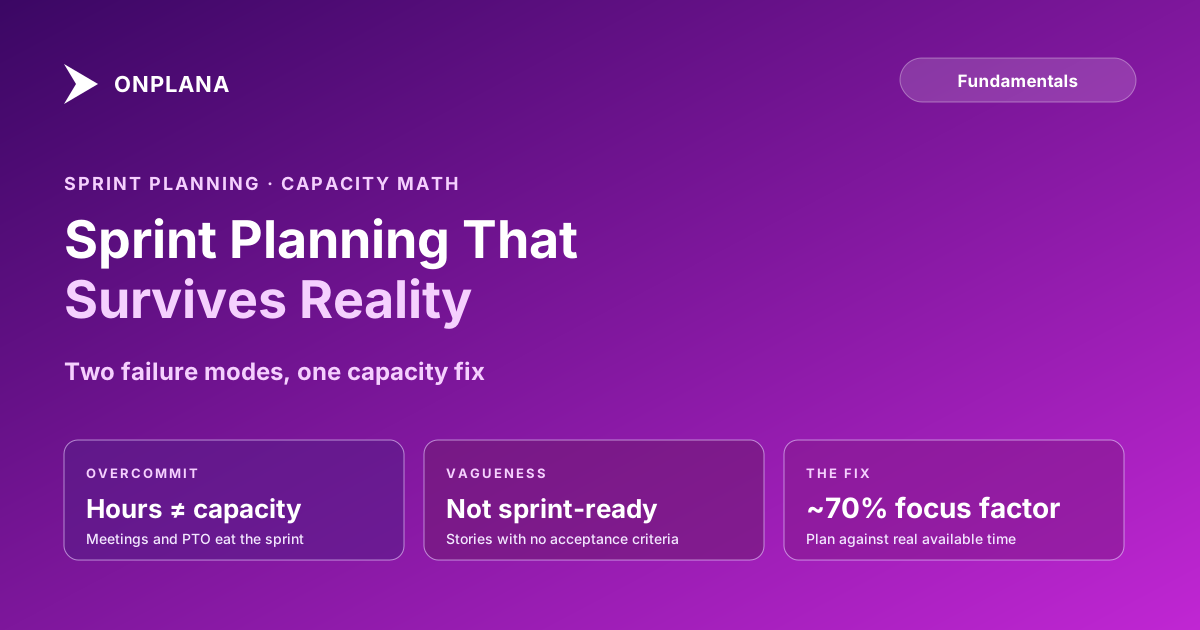
Sprint Planning That Survives Contact With Reality
Sprint planning fails one of two ways: overcommitment or vagueness. Here's the capacity math and meeting agenda that keeps every sprint commitment honest.
Here's the pattern that repeats every two weeks in half the teams running Scrum. Sprint planning ends with a full board: every story assigned, every point accounted for, the team nodding along. Three days in, half the board is blocked on something nobody flagged in planning. By the sprint review, the demo is a tour of what didn't get done instead of what did.
Sprint planning doesn't fail because teams are bad at estimating. It fails because the meeting quietly answers a different question than the one it's supposed to answer. The question is "what can we actually deliver," and most teams answer "what would we like to deliver" instead, then call the gap between those two answers a bad sprint.
TL;DR. Sprint planning fails one of two ways: overcommitment, pulling in more than the team's real capacity supports, or vagueness, pulling in stories nobody can actually start. The fix isn't a better planning poker session. It's treating capacity as a calculated number instead of a gut feel, distinguishing a sprint commitment from a forecast, right-sizing stories against a shared definition of ready before they enter the sprint, and handling carryover honestly instead of quietly re-committing to it. The planning meeting itself is a negotiation between what the product needs and what the team can deliver, not a status update wearing a different hat.
Why Does Sprint Planning Fail in One of Two Ways?
Overcommitment and vagueness look like opposite problems but come from the same root: the team is planning against a number it hasn't actually calculated. Overcommitment happens when a team pulls in stories until the backlog "feels full" for two weeks, without subtracting the meetings, support rotations, and planned absences that will eat into that time. The board looks complete on day one and starts bleeding capacity from day two.
Vagueness happens when the pressure to fill the sprint pulls in stories that were never actually ready. A story with acceptance criteria that read "improve the onboarding flow" gets pulled in because it's high priority, not because anyone can say what "done" looks like. The team starts the story, discovers three unanswered design questions on day one, and loses two days to clarification that should have happened before planning, not during the sprint.
Both failure modes produce the same visible symptom: a sprint that looked achievable on day one and clearly wasn't achievable by day three. The fix for each is different, which is why treating "sprint planning went badly" as one problem instead of two keeps teams fixing the wrong half of it.
What Capacity Math Actually Looks Like
Most teams that overcommit aren't ignoring capacity: they're calculating it wrong, usually by starting from total team hours instead of available team hours. A worked example for a five-person team on a two-week sprint:
- Start with raw working days. Five people, ten working days each in a two-week sprint, is 50 person-days of raw time.
- Subtract planned absences. One person has two days of PTO. That's 48 person-days remaining.
- Subtract recurring meeting load. Standups, backlog refinement, sprint review, and the retrospective typically consume 8 to 12 percent of a sprint for each person. At 10 percent, that's roughly 4.8 person-days, leaving 43.2.
- Subtract support or on-call rotation. If one person is on support rotation for the full sprint, that's effectively 8 of their 10 days unavailable for sprint work, another 8-day cut, leaving about 35.2 person-days.
- Apply a focus factor. Even with meetings and rotations accounted for, real work rarely fills 100 percent of remaining time; context switching, code review, and unplanned interruptions are normal. A focus factor of 70 percent applied to 35.2 person-days yields roughly 24.6 person-days of genuinely available capacity.
That final number, not the 50 person-days the team started with, is what the sprint should be planned against. The gap between raw capacity and available capacity is usually 40 to 55 percent, which is exactly the size of the gap that produces a sprint that looked full at planning and wasn't.
If the team already tracks velocity through a sprint board with per-sprint burndown history, pull the last three or four sprints' committed-versus-completed numbers before doing the capacity math by hand. A team that consistently completes 65 percent of what it commits doesn't need a lecture about discipline; it needs a capacity number that reflects the 65 percent it has actually been delivering, not the 100 percent the backlog assumes.
The diagram above shows what the shift looks like in practice: sprints 12 through 14 were planned against felt capacity and consistently overcommitted by 20 to 40 percent. Sprint 15, planned against the calculated 24.6-person-day style number instead of a gut-feel figure, committed to fewer points and actually delivered nearly all of them. A smaller, honest commitment beats a bigger, optimistic one on every metric a sponsor actually cares about.
Is a Sprint Commitment a Promise or a Forecast?
Treat it as a forecast built on the best information the team had at planning time, not a promise the team is failing if reality diverges from it. The distinction changes how a team responds when a story turns out bigger than expected: a promise gets defended by cutting corners to hit the number; a forecast gets updated, out loud, the moment new information arrives.
That doesn't mean commitments are meaningless. A forecast still carries accountability: the team is accountable for planning against real capacity, communicating early when a story is trending over its estimate, and not silently re-scoping to hide a miss. What a forecast frees the team from is the fiction that the number decided in a two-hour meeting, before any of the work actually started, should hold with promise-level certainty two weeks later regardless of what gets discovered along the way.
The practical test: if a team hits every sprint commitment exactly, that's a sign the sprints are being sandbagged, not a sign of great planning. Sprints that occasionally run over and occasionally run under, clustered close to the forecast, are what honest capacity planning actually produces.
Right-Sizing Stories Before They Enter the Sprint
Vagueness is a story-readiness problem, not a planning-meeting problem, which means it has to be solved before planning starts, not during it. A shared definition of ready, paired with a separate definition of done for when the work is finished, keeps stories that aren't actually plannable out of the sprint in the first place:
- Acceptance criteria are specific and testable. "Improve the onboarding flow" fails this test. "New users complete account setup in three steps or fewer, with inline validation on each field" passes it.
- External dependencies are resolved or explicitly scoped around. A story blocked on a vendor API that hasn't shipped yet doesn't belong in this sprint's commitment, even if it's the highest-priority item in the backlog.
- The story has already been estimated, ideally during a backlog refinement session before planning, not for the first time in the planning meeting itself.
- The story is small enough to fit inside the sprint with room to spare. A story sized at more than a third of a team's sprint capacity is usually a sign it needs to be split, not a sign the team needs a bigger sprint.
- Someone on the team can explain, unprompted, what "done" looks like for this story. If the explanation takes more than thirty seconds or produces disagreement in the room, the story isn't ready yet.
A team that enforces this checklist upstream of planning turns the planning meeting itself from a scramble to define scope into a straightforward exercise of selecting already-ready work against already-known capacity.
What Do You Do With Carryover Work?
Carryover is where honest sprint planning gets tested, because the easy move, re-adding the story at its original point value and moving on, hides exactly the information a team needs to plan well.
Re-estimate every carryover story from its current state, not its original state. A story sized at 8 points that's 70 percent complete isn't a 2.4-point remainder; the remaining 30 percent is often the hardest part, the part that stalled the story in the first sprint in the first place. Ask the team what's actually left and size that, independent of the original estimate.
Count carryover against the new sprint's capacity like any other story. Treating carryover as a freebie that doesn't count against capacity is how teams quietly plan two sprints' worth of new work into a sprint that already has unfinished work sitting in it.
Ask why the story didn't finish before deciding it just needs more time. A story that carries over because of an underestimate is a different problem than a story that carries over because a dependency blocked it for four days. Only the first case is fixed by more time in the next sprint; the second needs the blocking issue resolved, or it carries over again.
Why the Planning Meeting Is a Negotiation, Not a Status Update
The framing that breaks sprint planning fastest is treating it as a meeting where the product owner announces priorities and the team logs agreement. That framing produces exactly the overcommitment problem above: nobody in the room is incentivized to push back on scope, so the sprint fills with everything that's high priority rather than everything that's actually achievable.
A working sprint planning meeting is a negotiation between two legitimate, sometimes competing interests: the product owner representing what would be most valuable to ship, and the team representing what can actually be delivered well in the time available. Both sides bring real information the other side doesn't have. The product owner knows what's riding on a given feature landing this sprint versus next. The team knows which stories are genuinely small and which only look small from outside the codebase.
Treating the meeting as a negotiation means the team is expected to push back on scope that doesn't fit the calculated capacity, and the product owner is expected to make real tradeoffs rather than expecting every priority item to fit into every sprint. A Scrum Master who lets the meeting run as an announcement instead of a negotiation isn't protecting the team's time; they're setting up the exact overcommitment pattern the next retrospective will complain about.
Running Sprint Planning: An Agenda That Works
- Confirm the sprint goal first, before pulling in individual stories. A one-sentence answer to "why is this sprint valuable" keeps the rest of the meeting anchored to a shared purpose instead of a grab bag of backlog items.
- State the calculated capacity number out loud, not the raw team-hours number, so everyone in the room is negotiating against the same real constraint.
- Pull in already-ready stories in priority order, checking off the definition-of-ready criteria as each one enters, until the running total approaches the capacity number.
- Stop pulling in new work once capacity is roughly reached, resisting the pressure to squeeze in "one more small thing" that pushes the sprint back into overcommitment territory.
- Break the accepted stories into tasks as a team, surfacing the sequencing and technical approach questions here, while the whole team is in the room, rather than mid-sprint when only the assignee is thinking about it.
- Flag any story with lingering ambiguity explicitly, even after it's been pulled in, so a mid-sprint surprise doesn't feel like it came out of nowhere.
- Close with the sprint goal restated, so the meeting ends on the same shared purpose it opened with, not a raw list of tickets.
The Scrum Guide timeboxes sprint planning at up to eight hours for a one-month sprint, scaled proportionally shorter for shorter sprints, which puts a two-week sprint's planning meeting at roughly two to four hours for both the what and the how. Teams that regularly run past that timebox are usually trying to solve story-readiness problems live in the meeting instead of upstream in backlog refinement.
Common Sprint Planning Mistakes That Quietly Sink a Sprint
Planning against raw team hours instead of calculated available capacity. This is the single largest driver of overcommitment, and it's an arithmetic fix, not a discipline fix.
Letting the product owner set scope unilaterally. A sprint that reflects only priority and not team feasibility is a sprint planned by one party instead of negotiated by two.
Pulling in stories that fail the definition of ready because they're urgent. Urgency is a reason to prioritize a story for the next refinement session, not a reason to skip the readiness check.
Re-adding carryover at its original estimate without re-sizing it. This silently inflates the sprint's real workload while the reported point total looks unchanged.
Treating the sprint commitment as a promise instead of a forecast. This pushes teams toward hiding scope discovered mid-sprint instead of raising it, which is worse for the project than an honest miss.
Skipping the sprint goal. A sprint with a list of tickets and no stated purpose has nothing to negotiate against when new information arrives mid-sprint about what actually matters most.
None of these fixes require new tooling, a different estimation technique, or a longer meeting. They require calculating capacity instead of guessing at it, enforcing readiness before stories enter the room, and running the meeting as the negotiation it actually is. A team that gets those three things right turns sprint planning from a biweekly ritual that reliably disappoints into the one meeting that actually predicts what the next two weeks will look like.
Frequently asked questions
What is sprint planning in Scrum?
Sprint planning is the meeting where the Scrum Team decides what can be delivered in the upcoming sprint and how that work will get done. It happens at the start of every sprint and is timeboxed, typically up to eight hours for a one-month sprint and shorter for shorter sprints.
Why does sprint planning so often lead to overcommitment?
Teams plan against optimism instead of a calculated capacity number: they count total team hours without subtracting meetings, PTO, and support work, so the sprint looks fuller than the team's actual available capacity.
Is a sprint commitment a promise or a forecast?
It should be treated as a forecast based on the best information available at planning time, not a fixed promise. Scope discovered mid-sprint is normal; what matters is that the team flags it immediately instead of quietly absorbing it and hoping the numbers still work out.
How do you calculate team capacity for a sprint?
Start with each person's available working days in the sprint, subtract time for meetings, support rotations, and planned absences, then multiply the remaining hours by a realistic focus factor, usually 60 to 75 percent, to account for context switching and interruptions.
What should happen to carryover work from the previous sprint?
Carryover should be re-estimated, not silently re-added at its original point value, because a story that's partially done tells you almost nothing about how much work remains. It should also count against the new sprint's capacity, not be treated as a freebie.
What does 'definition of ready' mean for a story entering a sprint?
A definition of ready is the checklist a story must pass before sprint planning pulls it in: clear acceptance criteria, no unresolved external dependencies, and a size the team has already estimated. Stories that don't meet it shouldn't enter the sprint no matter how urgent they feel.
How long should sprint planning take?
The Scrum Guide timeboxes sprint planning to a maximum of eight hours for a one-month sprint, scaled down for shorter sprints, so a two-week sprint typically runs two to four hours including both the what and the how.
Ready to make the switch?
Start your free Onplana account and import your existing projects in minutes.