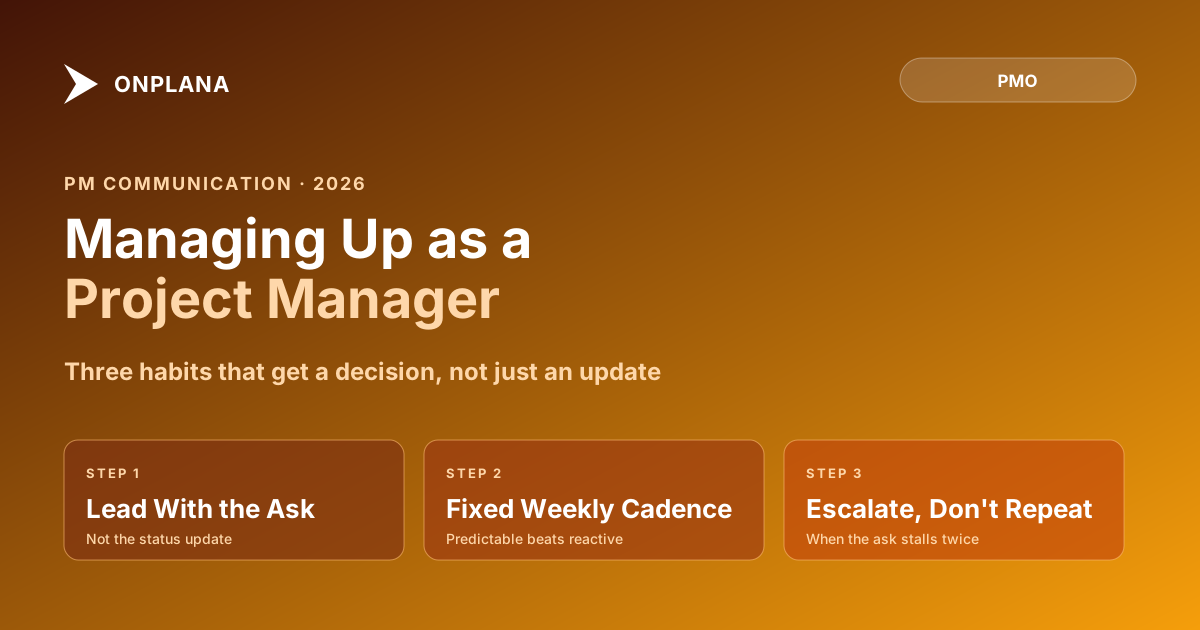
Managing Up When Your Manager Doesn't Understand the Project
Managing up as a project manager means turning schedule detail into decisions your manager can act on, not writing longer reports nobody has time to read.
Managing up as a project manager starts from a mistaken instinct. When a manager doesn't understand the project, the natural response is to explain it better: more detail, a longer status meeting, a denser deck. That instinct is almost always wrong, and it is why so many technically excellent PMs stay invisible to the people who decide their next assignment.
The manager who "doesn't get the project" usually understands it fine at the level they're paid to operate at. What they lack isn't intelligence or effort. It's time, and fluency in the specific vocabulary a schedule speaks in: float, baseline variance, dependency chains. Managing up is not a soft-skill exercise in being likable. It's a specific competency: knowing what a non-PM manager can and cannot process in the two minutes they have for you, and building a communication practice around that boundary instead of waiting for them to learn to read a Gantt chart.
The PM who never solves this problem ends up in a familiar, frustrating position. Their projects run fine. Their updates are accurate. And their manager still can't articulate, when it counts, what the PM is actually doing well or why the project deserves more resourcing. That's not a fairness problem to be solved by working harder on the schedule. It's a communication design problem, and it's solvable with a specific set of habits rather than raw effort.
The direct answer: Managing up as a project manager means converting schedule and risk detail into a small number of decisions your manager can act on, not producing more detailed reports. Most managers who "don't understand the project" understand it well enough for their role; they lack PM vocabulary and spare attention, not competence. The fix is a fixed cadence, a standard translation format (decision, options, recommendation, deadline), and a clear line for when the gap is unbridgeable and escalating past your manager is the right call instead of managing up harder.
What Managing Up Actually Means for a Project Manager
The term comes from a 1980 Harvard Business Review essay by John Gabarro and John Kotter, "Managing Your Boss", which argued that the manager relationship is a resource-dependent partnership, not a one-way reporting line. Both people depend on each other to do their jobs well: the manager depends on the PM for accurate visibility into delivery risk, and the PM depends on the manager for resourcing, prioritization air cover, and timely decisions. For a project manager specifically, that partnership runs on a narrow channel: your manager has a fraction of the context you carry about the schedule, and every message you send either respects that constraint or wastes it.
Managing up for a PM is the discipline of shrinking a complex, changing project down to the handful of things a manager actually needs: what decision is pending, what happens if it isn't made, and what you recommend. It is not spin, and it is not flattery. It is closer to what a good triage nurse does: taking a chaotic set of facts and presenting the one that requires action first.
The skill sits underneath almost every other PM competency without getting named directly in most training programs. A PM can run a technically flawless schedule, catch every dependency risk early, and still be seen as a mediocre performer if their manager never receives that information in a form they can use. Conversely, a PM running a merely adequate schedule who consistently hands their manager clean, decision-ready updates often gets rated as more capable than they technically are, purely because the manager's experience of working with them is calm and legible. Neither outcome is fair on its own terms, but both are predictable once you see managing up as a communication design problem rather than a character trait.
Why Your Manager Doesn't Understand the Project, and Why That's Normal
Most PMs read a manager's confusion as a knowledge gap to be closed with more information. It's usually a bandwidth gap instead. A manager overseeing five direct reports, each running different work, cannot hold your dependency network in their head the way you do, and they aren't supposed to. Their job is to make good calls across five different bodies of context, quickly, with partial information from each.
This is why managers who seem to "not get" a schedule can still run a department well. Their competence is in judgment and prioritization across many inputs, not in fluency with your specific critical path. Treating that as a deficiency to be corrected, rather than a structural fact of the role, is the single biggest reason PM updates go unread. The fix isn't teaching your manager to think like a scheduler. It's presenting the schedule's implications in a form that fits how they already make decisions.
Consider the concrete version of this. A PM spends twenty minutes in a 1:1 walking a manager through a dependency chain: task A feeds task B, B has a start-to-start relationship with C, C is on the critical path, and a three-day slip in A propagates to the launch date. The manager nods, asks a clarifying question about A, and leaves the meeting having absorbed maybe a third of it. Two weeks later, when the slip actually happens, the manager is surprised, not because they weren't told, but because they were told in a format their working memory couldn't retain under everything else competing for it that week. The information transfer failed even though every fact in it was true and every minute of the meeting was well-intentioned.
The Translation Layer: Turning Schedule Noise Into a Decision
Every schedule generates far more raw information than a manager can use: forty tasks, a dozen assignments, three open risks, one slipping milestone. The translation layer is the discipline of compressing that into what actually changes the manager's next action. The diagram below shows the same underlying project data on both sides; the difference is only in what gets surfaced.
Before you draft your next update, running it through the free Status Report Writer is a fast way to check whether it leads with a decision or with a list of facts; the tool is built around exactly this decision-first structure and flags updates that bury the ask.
Managing Up to Your Manager Is Not the Same as Managing a Sponsor
PMs frequently collapse these into one audience and end up serving neither well. Your manager owns your performance review, your next assignment, and whether you get resourcing fights won inside the organization. A project sponsor owns the business case: why the project exists, whether its funding continues, and whether its outcome matters at the level the organization tracks strategic bets.
The content each needs is genuinely different. Your manager needs enough to advocate for you specifically: what you're handling well, where you need support, and what would help you succeed on your next assignment as much as this one. A sponsor needs enough to defend the investment: whether the benefit case still holds, whether the project is still worth its opportunity cost, and what decision they need to make to keep it funded. A PM who sends the sponsor's investment-focused update to their manager, or their manager's career-focused update to the sponsor, produces a message that technically contains true information and serves neither reader's actual job.
This distinction matters most when your manager is also, functionally, your project's sponsor, which happens often in smaller organizations. In that case the two updates merge, but you should still be deliberate about which hat you're addressing in a given message: are you asking them to make a business case decision, or are you asking them to advocate for you and your team. Conflating the two inside a single rambling update is how a legitimate funding question gets lost inside what reads as a performance-review conversation, or vice versa.
How Do You Get a Decision From a Manager Who Isn't PM-Fluent?
The format matters more than the content. A manager who won't read four paragraphs of schedule narrative will act on a message structured this way:
- State the decision, not the status. Open with "I need a call on X by [date]," not "here's where things stand."
- Name what happens without a decision. Managers act fastest when the cost of inaction is explicit: "if we don't decide by Thursday, the launch slips four days."
- Give two or three real options, not ten. More options increase the odds of no decision at all. Narrow it yourself; that's the job.
- Recommend one option. A manager who trusts your judgment will often just approve your recommendation. Withholding a recommendation to seem neutral just pushes the analysis work back onto someone with less context than you.
- Confirm the decision in writing, same day. A verbal yes in a hallway is not a decision your project can rely on next week.
The Weekly Cadence That Prevents Ambush Decisions
Irregular updates train a manager to associate hearing from you with bad news, which makes every message you send land worse than it should. A fixed weekly slot, even a fifteen-minute one, does more for the relationship than any individual well-written update. It gives your manager a predictable moment to absorb the two or three things that changed, instead of an unpredictable stream of alerts they start to dread opening.
The same discipline that makes a steering committee report decisions instead of just updates applies one level down to your own manager. And not every manager needs the same cadence or the same depth: mapping where your manager sits on a power-interest grid against your other stakeholders clarifies how much of your limited communication effort should go to them specifically versus the sponsor, the steering committee, or the team.
When Should You Escalate Past Your Manager Instead of Managing Up?
Managing up assumes your manager can and will decide once the request is framed well. Sometimes that assumption is wrong, and the honest move is escalation, not a better-written version of the same ask.
Escalate when any of these is true: your manager has had the fully-framed decision for more than a reasonable window and still hasn't acted; the decision genuinely sits above their authority (a budget increase, a scope change that affects another department); or the cost of continued delay has become the actual risk, larger than whatever risk the manager was originally weighing. A working escalation framework exists for exactly this moment, and using it isn't a failure of managing up. Managing up harder at a manager who has already declined to decide just burns time the project doesn't have.
The judgment call most PMs get wrong is timing. Escalating too early, before you've given your manager a genuinely well-framed decision and a reasonable window to act, reads as going around them and damages the relationship you're trying to build. Escalating too late, after weeks of politely re-asking the same unanswered question, means the schedule absorbs the delay silently while you wait for permission you were never going to get. A useful rule: if you've made the same decision-ready ask twice with no response, that's the signal to escalate, not the signal to ask a third time more nicely. Tell your manager you're escalating before you do it, not after; framed as "I need to get this decided given the deadline, so I'm bringing it to [sponsor/steering committee] unless you can decide by [date]," it reads as transparent process, not insubordination.
What Managing Up Is Not
Managing up gets a bad reputation because it's frequently confused with two things it isn't. It is not hiding bad news, softening a risk until your manager can't act on it, or telling them what they want to hear instead of what's true. Both failure modes eventually produce the same outcome: a manager who is blindsided by a problem that was visible to you weeks earlier, and who now trusts your updates less, not more.
It is also not sycophancy. A manager who only ever hears "everything's on track" from you learns nothing about your judgment and gets no practice trusting your recommendations before a real crisis forces the issue. The PMs who manage up well are the ones whose bad news, when it comes, is believed immediately, because their good news was always calibrated too.
There's a longer-term cost to getting this wrong that most PMs underestimate. A manager who has been surprised by bad news twice starts discounting everything you report, good and bad, and begins seeking out independent confirmation before acting on anything you tell them. That's the opposite of what managing up is supposed to build: a relationship where your framing is trusted enough that the manager can act on your recommendation without re-litigating the underlying data every time. Rebuilding that trust after it breaks takes far longer than it took to lose, which is the real argument for surfacing bad news early and often, even when it's uncomfortable in the moment.
Run the free Status Report Writer Draft your next manager update in the decision-first format this post describes: the ask, the deadline, the options, and your recommendation. No signup required. → Open the Status Report Writer
Frequently asked questions
What does managing up mean for a project manager?
Managing up means converting the raw detail of a schedule, a risk register, and a resource picture into a small number of decisions your manager can actually act on. It is a translation skill, not a personality trait or a way of flattering your boss.
How do I get my manager to understand project risk if they've never run a schedule?
Stop explaining the schedule and start naming the decision. State the risk, the deadline for a call, two or three concrete options, and your recommendation. Managers who can't follow a dependency chain can still make a well-framed decision in under two minutes.
Is managing up the same thing as hiding bad news from your manager?
No, and confusing the two is the most common failure mode. Managing up means surfacing bad news early and framed as a decision. Hiding it, or softening it until it's unrecognizable, is the opposite of managing up: it just delays the moment your manager finds out, usually at a worse time.
How often should I update a manager who isn't fluent in project management?
A fixed weekly cadence works better than updating whenever something happens. Ad hoc updates train a busy manager to associate hearing from you with bad news, which makes them dread your messages. A predictable weekly slot, even a short one, keeps the relationship calm and makes the rare urgent message stand out.
When should I escalate past my manager instead of managing up?
Escalate when your manager has the information, understands the decision, and still isn't acting, when the delay itself is now the risk, or when the decision is genuinely above their authority. Managing up assumes your manager can and will decide once you've framed it well; escalation is what you do once that assumption has been tested and failed.
What's the difference between managing up to a manager and managing a project sponsor?
A manager owns your performance and career; a sponsor owns the project's funding and business case. You manage up to both, but the content differs: your manager needs enough to advocate for you and unblock resourcing, while the sponsor needs enough to defend the project's continued investment. Conflating the two audiences produces updates that serve neither well.
Ready to make the switch?
Start your free Onplana account and import your existing projects in minutes.