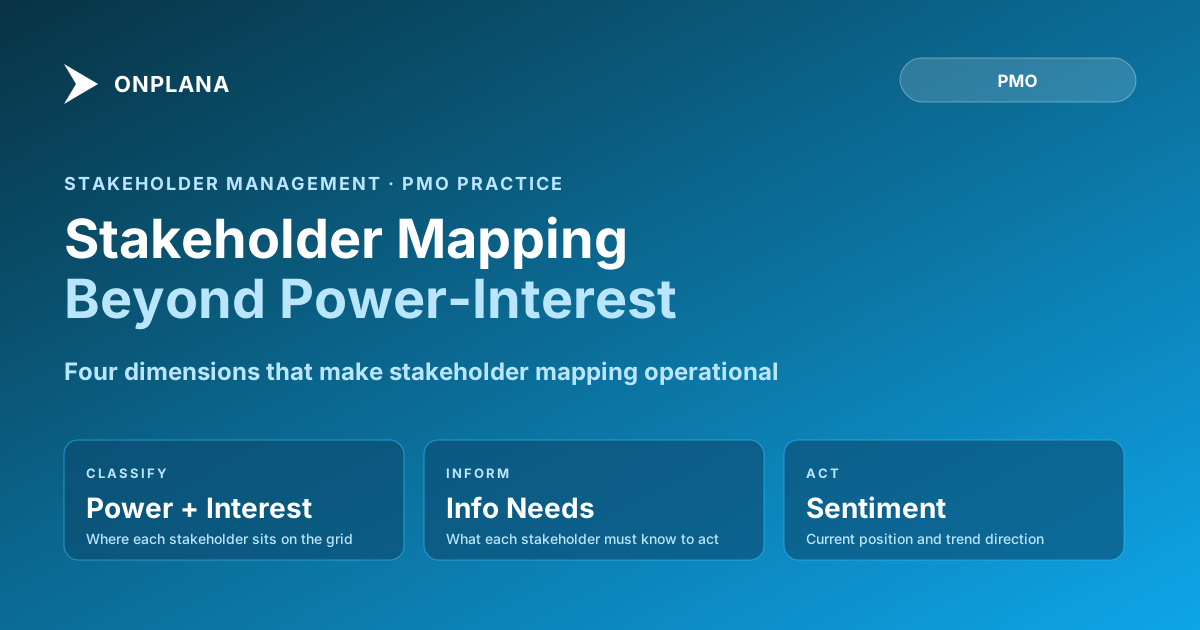
Stakeholder Mapping That Goes Beyond the Power-Interest Grid
The power-interest grid locates stakeholders but not what they need or how they're trending. Add information needs and sentiment to make mapping operational.
Here is a test. Pull out the stakeholder map for a project you know well. Find the "manage closely" quadrant. Now answer this: for each stakeholder in that quadrant, what specifically did you communicate to them last week? What does each one need to know in the next two weeks? What is each one's current position on the project?
If the map does not help you answer those questions, it is a classification tool, not a management tool. The power-interest grid is page one of stakeholder mapping. Most PMOs never reach page two.
The two dimensions the grid is built on, power and interest, locate where stakeholders sit. They do not tell you what to say to them, how they are currently feeling, or what they need from the project to remain supportive. Two additional dimensions convert the grid from a quarterly exercise into something a PM actually uses before a steering committee meeting.
TL;DR. The power-interest grid classifies stakeholders but does not make the map operational. Add two dimensions: information needs (what each stakeholder must know to stay engaged) and sentiment (their current position on the project). A four-dimension stakeholder map drives specific, timely communication rather than category-level management strategies that go stale between quarterly updates.
What the power-interest grid actually tells you
The power-interest grid was designed to help PMs prioritize relationship management effort. High power, high interest: manage closely. High power, low interest: keep satisfied. Low power, high interest: keep informed. Low power, low interest: monitor. That structure is useful because it prevents PMs from spending equal effort on stakeholders whose impact on the project varies widely.
The limitation is that the grid is static. A stakeholder's position changes slowly if at all. The VP of Engineering is always going to be high power, high interest. Classifying them as "manage closely" does not tell the PM what to manage, when to manage it, or how the relationship is currently going. The grid creates categories. It does not create a communication plan.
There is also a subtler limitation. The power axis measures formal authority: who can block the project, who controls resources, who signs off on decisions. It does not measure informal influence: who other stakeholders listen to, who shapes the steering committee's view before the formal meeting, who the executive sponsor calls when they have a concern. Informal influencers who appear low on the power axis often have more practical impact on a project's success than formally high-power stakeholders who are operationally distant from the work.
Dimension 3: What each stakeholder actually needs to know
Information needs is the dimension that converts the stakeholder map into a communication plan.
Every stakeholder has a specific set of information they need to do their job in relation to the project. A CFO stakeholder needs current budget variance against the approved baseline, the forecast to complete, and an explanation of any significant movement. They do not need the detailed sprint plan, the resource allocation by task, or the technical dependency structure. A resource manager needs the headcount demand forecast four to six weeks out and which team members are over-allocated. They do not need the executive narrative about strategic alignment.
Most communication planning makes the mistake of asking "how often should we communicate to each group" before asking "what does each group need to know." Frequency without relevant content is noise. A weekly status email that contains nothing the recipient actually needs is worse than silence: it trains them to stop reading before the one update that matters.
Defining information needs for each stakeholder requires a direct conversation, not an assumption. Ask three questions: "What information do you need from this project to do your job? How current does it need to be? In what format is it most useful?" The answers frequently surprise PMs who have been sending the same status format to every stakeholder for months.
Information needs change over the project lifecycle. A stakeholder who needed weekly timeline updates during planning may need monthly executive summaries during stable execution and daily updates during a critical cutover. Map information needs at phase transitions, not only at project start.
Dimension 4: Current sentiment
Sentiment is the dimension that tells you where the relationship is today, not where it was when the stakeholder was originally classified.
Sentiment describes a stakeholder's current emotional and political position on the project: how supportive they are, how concerned they are, and whether their position is changing. A stakeholder who was strongly supportive six weeks ago but has been sending increasingly pointed questions to the PM's manager has changed their sentiment. The power-interest grid still classifies them the same way. The communication approach needs to change immediately.
Assess sentiment on a five-point scale: strongly supportive, supportive, neutral, concerned, opposed. Track it over time. A stakeholder who moves from supportive to concerned in one month is sending a signal worth acting on before they become an escalation.
Sentiment is assessed through direct observation rather than formal reporting. What does the stakeholder say in steering committee meetings? How do they respond to status reports: do they reply, ask follow-up questions, or go quiet? Have they reached out privately to the PM, the sponsor, or another senior stakeholder with concerns? Sentiment is most visible in how people engage rather than what they formally approve.
Three sentiment signals warrant immediate attention:
A high-power stakeholder who stops asking questions has either lost interest or is gathering information through a different channel. Neither is safe to ignore. A stakeholder who begins copying their own manager on communications has escalated the relationship outside the project's governance structure. A stakeholder who was previously accessible and has become difficult to schedule has made a judgment about the project's importance relative to other demands on their time.
Building the operational stakeholder map
The four-dimension map combines the two axes of the power-interest grid with an information needs summary and a current sentiment rating for each stakeholder.
Maintain it as a living document, not a slide deck or a one-time project charter artifact. The PM should be able to update the sentiment column in five minutes after a steering committee meeting. The information needs column should be reviewed at each project phase transition and updated when a stakeholder's role changes.
The diagram below shows how the four dimensions relate to each other and to the specific actions they drive.
For each stakeholder the operational map includes: power level, interest level, grid quadrant, information needs as a brief list, communication frequency and preferred channel, current sentiment rating, last updated date, and a trend indicator showing whether sentiment is improving, stable, or declining.
The trend indicator is the most actionable field in the map. A stakeholder who is currently neutral but trending toward concerned needs different attention than one who has been neutral and stable for three months. The trend is a leading indicator; waiting for sentiment to reach "concerned" before acting means the PM is always responding rather than leading.
How to use the map before a steering committee meeting
A stakeholder map that is not consulted before every steering committee meeting is not being used operationally.
Before any significant meeting or communication cycle, review the sentiment column. Who has moved in the last two weeks? Who is trending concerned? Who has an upcoming decision that affects them? The map should take three minutes to review. Those three minutes change how the PM prepares for the meeting: who to speak with before it, what to address proactively, and which stakeholder's question is coming whether or not it gets raised on the agenda.
The information needs column drives the communication plan. For each unique stakeholder in the "manage closely" quadrant, produce a communication that directly addresses their specific needs. A CFO and a resource manager sitting in the same quadrant need entirely different content. Targeted communication requires more preparation and generates far fewer "why wasn't I told about this" conversations after the fact.
The escalation framework intersects with the stakeholder map when sentiment declines. A stakeholder who moves from supportive to concerned has raised the probability of a formal escalation. Treating a sentiment decline as an early warning, not a lagging indicator, is what converts stakeholder management from reactive to proactive.
For stakeholders in the "manage closely" quadrant who are trending concerned, request a one-on-one conversation before the concern becomes visible in a group setting. The agenda is simple: "I noticed [specific observation]. I want to understand your perspective before the next steering committee." This conversation almost always produces more useful information than any formal reporting mechanism, and it gives the stakeholder a direct channel before they find an indirect one.
When stakeholders move
Stakeholder positions shift at four predictable moments: after a significant project event such as a milestone slip, scope change, or budget variance; after an organizational change such as a new sponsor or a restructure; after a contentious decision where some stakeholders won and others did not; and at project phase transitions where the nature of stakeholder involvement changes.
Each of these moments is a trigger to update the map immediately, not a trigger to wait and see if anything shifts. The PM who updates the sentiment column after a milestone slip and acts on the changed picture has a two-week head start over the PM who waits for the next scheduled map review.
Connecting stakeholder mapping to status reporting
Stakeholder intelligence should feed directly into how the PM structures status reporting, not sit in a separate document that is updated independently. For governance structures where stakeholder health is formally tracked and reported at the portfolio level, see discipline, goals, milestones, and status reporting. The status report format that surfaces stakeholder concerns in terms leadership can act on is part of the same system the four-dimension map should inform.
A common pattern: the PM reviews the stakeholder map before writing the status report, identifies which stakeholders are trending concerned, and adds a brief stakeholder note section to the report that gives the sponsor visibility without requiring a separate briefing. This converts stakeholder management from a PM-only activity into a shared portfolio awareness.
Building stakeholder mapping as a PMO capability
Individual PMs using a four-dimension stakeholder map is useful. A PMO with a standard approach applied consistently across all projects is a strategic capability.
A PMO standard for stakeholder management includes a consistent four-dimension template, a review cadence tied to project phase gates, and a clear protocol for escalating stakeholder concerns through the governance structure before they become formal issues. It also includes a recognition that the template itself is less important than the practice: a PM who reviews and updates the map monthly learns things about the project's health that do not appear anywhere else.
PMOs without a stakeholder management standard frequently discover this gap at the most painful moment: a sponsor whose concerns were visible for weeks but never surfaced formally, a user group whose opposition to the project became visible in go-live week, a budget holder who declined to approve the next phase because their information needs had not been met for three months.
The PMO Maturity Assessment includes a stakeholder management dimension that assesses whether the PMO has a consistent standard, whether it is applied across projects, and what the gap is between current practice and a mature approach. Most PMOs that struggle with stakeholder management discover they are missing the sentiment tracking and information needs dimensions, not the power-interest grid.
Run the free PMO Maturity Assessment Twenty questions covering stakeholder management, governance, and communication planning against five maturity tiers. Get a one-page capability profile in about ten minutes. No signup required. → Open the assessment
Frequently asked questions
What is the power-interest grid in stakeholder mapping?
The power-interest grid places stakeholders on two axes, how much authority they have over the project and how much interest they have in its outcome, to determine how closely to manage each relationship. It is a classification tool, not a communication plan.
What are the four dimensions of effective stakeholder mapping?
Power (authority over the project), interest (how much they care about the outcome), information needs (what they must know to stay engaged), and sentiment (their current position on the project). The first two classify stakeholders; the last two make the map actionable.
How often should a stakeholder map be updated?
Stakeholder sentiment shifts continuously. Review sentiment monthly during active phases and immediately after significant events: a missed milestone, a scope change, a budget variance, or a leadership change. A stakeholder map that hasn't been updated in a quarter is misleading rather than useful.
What does 'information needs' mean in stakeholder mapping?
Information needs describes exactly what each stakeholder must receive to do their job in relation to the project. A CFO needs budget variance. A resource manager needs headcount forecast. A business user needs delivery dates. Information needs drive communication content; power and interest drive frequency.
How do you assess stakeholder sentiment?
Through direct observation: what stakeholders say in meetings, how they respond to status reports, whether they have raised concerns privately, and whether they are engaging or going quiet. Sentiment is most visible in how people engage, not what they formally approve.
What is stakeholder mapping used for?
Stakeholder mapping converts stakeholder intelligence into communication and relationship actions. The map is an input; the communication plan, escalation decisions, and relationship-building activities are the output. A map that does not drive specific actions has no operational value.
Ready to make the switch?
Start your free Onplana account and import your existing projects in minutes.