An Escalation Framework Project Managers Can Actually Use
Most project escalations happen two weeks late and skip two levels. A project escalation framework that defines when to escalate, to whom, and what to bring.
The most dangerous escalation is the one that arrives exactly two weeks too late. Not because the problem was invisible: it was tracked, discussed, and marked as "monitoring" on three consecutive status reports. It arrived late because the PM was waiting for it to resolve itself, and by the time it didn't, the options had narrowed from four to one.
That pattern is so common in PMOs that it reads as normal. It shouldn't. A problem that costs two days to resolve in week three costs eight days to resolve in week five, because options close, dependencies pile on, and the team has spent two weeks working around a constraint rather than eliminating it. The timing cost of a late escalation is rarely measured, which is why it keeps repeating.
A project escalation framework does not lower the bar for escalation. It raises it, by making the threshold explicit. You escalate when defined criteria are met, not when you feel uncomfortable enough. That specificity is what makes the framework actually usable under the political pressure of a real PMO.
TL;DR. A usable project escalation framework has three parts: a tier structure that maps issues to authority levels, a timing rule that converts a problem into an escalation trigger before it becomes a crisis, and a one-page package format for what to bring when you escalate. Apply the three parts consistently and your team escalates at the right moment, to the right person, with the right information.
Why most escalations are late
Three structural patterns produce late escalations. Recognizing them is the first step toward fixing them.
No timing rule. Most PMOs know what to escalate in principle: problems that exceed the PM's authority. What they lack is a rule for when. Without a timing rule, PMs monitor issues and wait for them to resolve. Most issues do resolve. The ones that don't sit in monitoring status until the PM's personal discomfort crosses some undefined threshold, which is usually two weeks past when the damage started accumulating.
The cost of escalating feels higher than the cost of waiting. Escalating a problem to a functional manager or sponsor signals that the PM could not resolve it independently. In cultures where this is read as failure, PMs delay. The irony is that a problem escalated at day three, when it has a dozen resolution paths, reflects well on the PM's judgment. The same problem escalated at day seventeen, when it has one path left and the project is already behind, does not.
The wrong package. When PMs finally escalate, many bring a week of daily notes, a multi-page impact analysis, and a request for guidance without a recommendation. Senior leaders disengaged by page two and asked to decide without adequate framing make worse decisions than senior leaders given a one-page summary with a clear recommendation. The package quality drives the outcome as much as the timing.
The project escalation framework: three tiers
A working project escalation framework maps issue types to authority levels. Three tiers cover the vast majority of project issues.
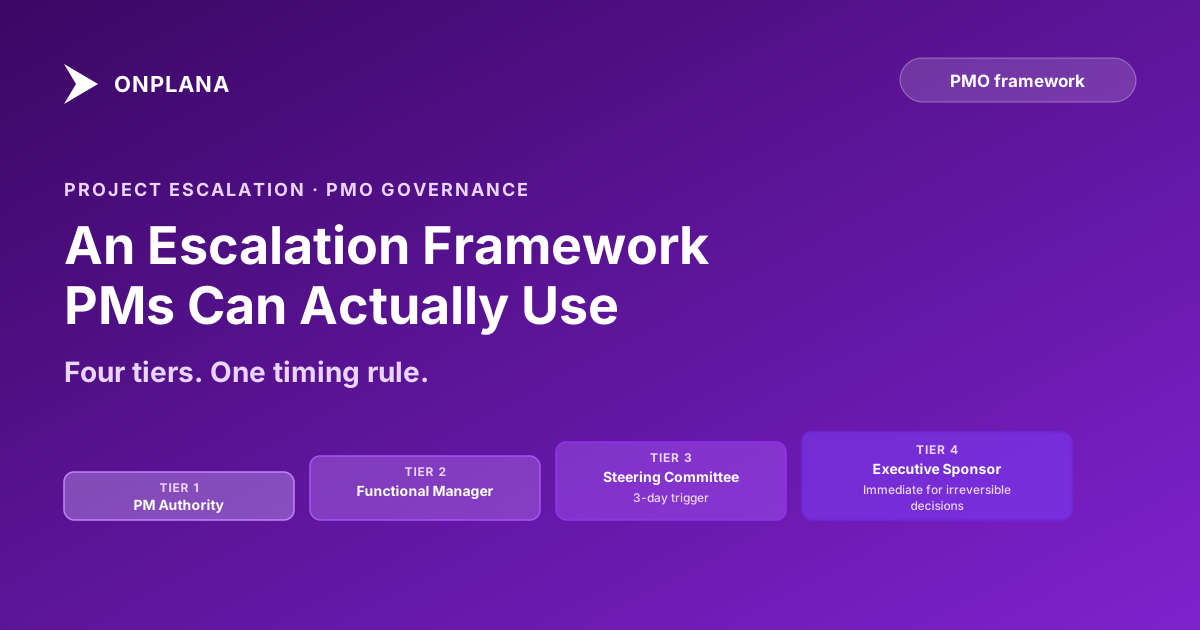
Tier 1: PM authority. Issues the PM resolves independently. Task-level scheduling decisions, intra-team technical choices within the agreed scope, minor schedule adjustments within existing float, and routine risk responses already approved in the risk management plan. No escalation needed. The PM handles it and notes the resolution in the next status report.
Tier 2: Functional manager authority. Issues that cross team or departmental boundaries, require resource decisions outside the PM's scope, or carry schedule impacts above a defined threshold (a reasonable default: five days on the critical path). The PM escalates to the relevant functional manager or department head, not to the steering committee or executive sponsor. This is the most commonly skipped tier: PMs who escalate tend to go directly to the sponsor, which bypasses the functional manager, generates resentment, and creates skip-level dependency.
Tier 3: Steering committee or executive authority. Issues that cross organizational boundaries, affect the project's fundamental scope, timeline, or approved budget, or require commitments from other departments that have not been previously agreed. These escalate with a formal recommendation and a decision ask, not a request for guidance.
The tier structure accomplishes two things. It routes issues to the right authority level, which is the level with both the information and the mandate to resolve them. And it prevents skip-level escalations, which are the most politically expensive pattern in project management.
The project risk management guide covers how risk thresholds should be calibrated in conjunction with the escalation tier thresholds. The two frameworks operate in parallel: risk management is forward-looking, escalation is response-to-current.
The timing rule: when an issue becomes an escalation
An issue becomes an escalation when two conditions hold simultaneously.
The first is an aging threshold: the issue has been tracked without resolution for a defined number of calendar days. Reasonable defaults by tier: seven calendar days for Tier 2 issues, three calendar days for Tier 3 issues. The aging clock starts on the day the issue is first logged, not the day the PM decides it's serious.
The second is an impact threshold: the issue's impact exceeds a defined level. Schedule impact above five days on the critical path, budget variance above ten percent of the remaining approved contingency, or a dependency failure that affects another project.
Both conditions must hold simultaneously. An issue that is seven days old but whose impact is one day of float does not trigger Tier 2 escalation; it is a Tier 1 issue the PM continues managing. An issue whose impact is twelve days on the critical path but has been known for only one day may trigger immediate escalation rather than waiting for the aging threshold.
There is a third condition for immediate escalation regardless of aging: any issue that will become irreversible within 48 hours. A contract deadline, a regulatory submission window, a data-deletion window. These escalate the same day they are identified.
The aging threshold does something important beyond triggering escalation: it creates a shared expectation. When the PM logs an issue and sets the aging clock, everyone on the team knows it will surface as an escalation on day seven unless resolved. That shared visibility changes behavior: team members who can resolve the issue have a concrete deadline to work toward.
The diagram below shows the four tiers and the issue types that belong to each.
What to bring when you escalate
The escalation package is one page. That is not a suggestion: it is a constraint that forces the PM to do the analytical work before the meeting.
A two-page escalation package is one page too long. Senior leaders read your first page and make a judgment about whether to continue. If you have not made the point by page one, you have lost the decision-maker's full attention before presenting your recommendation.
The one page contains four sections.
The issue in one sentence. What broke. Not the history, not the root cause analysis, not the contributing factors. "The client portal integration is failing to synchronize project status updates, affecting twelve of fifteen projects in the portfolio." One sentence. If you cannot describe the issue in one sentence, the issue is not yet well enough understood to escalate productively.
The impact as a specific number or date. "If unresolved by Friday, the Q3 portfolio review will show stale data for twelve projects, triggering a manual correction cycle that adds three days to the reporting close." Specific numbers are actionable. "This has significant schedule implications" is not. The impact statement should be precise enough that the decision-maker can evaluate the cost of waiting versus acting.
The options you have evaluated. List two or three. For each: what it costs (in days, budget, or headcount), what it resolves, and what it does not resolve. This shows the decision-maker that you have done the analysis and are not simply presenting a problem and waiting to be told what to do.
Your recommendation. This is the section most PMs leave off because it feels presumptuous. It is the most important section. You have been tracking this issue for seven days. You have more context than the person you are escalating to. The recommendation is your analysis synthesized to its conclusion. The decision-maker may override it, but they are better equipped to make a good override decision when they have something concrete to react to than when they are generating options from scratch.
The conversation itself
The escalation meeting follows a four-part structure that respects the senior leader's time and positions the PM correctly.
Lead with the recommendation: "I am escalating this because it requires your authority to resolve. My recommendation is to approve Option A." Do not spend five minutes on background before stating why you are in the room.
State the impact: "If we do not act by Thursday, we lose the integration window and the delay extends to six weeks." The impact statement is the reason the decision cannot wait.
Present your options: walk the decision-maker through the two or three alternatives briefly. One sentence each: what it costs, what it achieves.
Invite the decision: "Which option do you want me to execute?" Not "what do you think?" Not "what should we do?" A specific, closeable question. This is not the PM being passive; it is the PM completing the division of labor: you did the analysis, the senior leader applies the authority.
The escalation conversation is a facilitation, not a presentation. The PM has done the work before entering the room. The meeting is the transfer of that work into a decision.
What not to escalate
The tier structure defines what to escalate. Equally important is what to handle at the PM level without escalating.
Task-level technical decisions inside the agreed scope belong to the PM. Escalating them to a functional manager or sponsor signals uncertainty about the PM's own authority, trains senior leaders to expect involvement in operational decisions, and consumes relationship capital that is better preserved for real escalations.
Interpersonal friction within the team is a PM management issue until it becomes a performance issue that crosses the PM's authority. A team conflict that is slowing sprint delivery is a PM coaching conversation. A conflict involving a team member and a senior stakeholder may be a Tier 2 escalation.
Issues the PM can resolve with already-approved authority are PM decisions. If the solution is within existing scope, within the approved contingency budget, and within float, act and document. Do not escalate for approval you already have.
The test: if you escalated this issue and the senior leader's response is "why did you bring this to me?" the issue was below the tier threshold or was solvable with existing authority.
Building the escalation record
Every escalation generates a record: the issue, the date first logged, the date escalated, the decision made, the authority who made it, and the outcome. This is not administrative overhead; it is operational data.
The escalation record provides three things. An audit trail if any decision is later questioned. Input for the post-mortem: "we escalated this issue on day fourteen; the impact was three weeks; earlier escalation on day five could have reduced the impact to one week." And a pattern signal for the PMO director: if the same type of issue escalates repeatedly across multiple projects, the escalation is a symptom of a systemic gap, not a one-time event.
The Project Management Institute identifies issue and escalation management as a core integration management practice in its guidance for project practitioners. The record-keeping is not optional; it is what converts escalation from a crisis response into a learning system.
For the status report format that surfaces escalation status to sponsors without requiring a separate communication, see the status report writing guide. Escalations that are visible in the project status report generate fewer surprise requests for information from senior stakeholders, because the sponsor already knows the issue exists before the escalation meeting.
Run the free PMO Maturity Assessment Twenty questions about how your PMO handles escalation, governance, issue management, and decision authority. Get a structured capability profile in about ten minutes. No signup required. → Open the assessment
Frequently asked questions
When should a project manager escalate an issue?
Escalate when the issue has crossed a defined aging threshold (typically seven days for team-level issues), its impact exceeds what the PM can resolve independently, and the delay cost of waiting another week exceeds the political cost of escalating now.
What does a project escalation framework include?
Three components: a tier structure that defines which issues go to which authority level, a timing rule that converts a problem into an escalation trigger, and a package format that specifies what to bring when you escalate.
What is the biggest mistake project managers make when escalating?
Escalating too late, to the wrong level, with too much information. Most late escalations arrive with two weeks of daily status notes the recipient does not have time to read. Escalate early, one page, to the lowest authority level that can resolve it.
Should a project manager escalate directly to the executive sponsor?
Only if the executive sponsor is the appropriate authority for the specific issue and the level below cannot resolve it. Skipping levels burns credibility and trains sponsors to expect direct PM access for every problem.
What should you bring to an escalation meeting?
Four things: the issue in one sentence, the impact as a specific number or date, the options you have evaluated, and your recommendation. Arriving without a recommendation transfers the analysis burden to someone who has less context than you.
How do you build a healthy escalation culture in a PMO?
Make the framework visible, apply it consistently, and acknowledge escalations raised early rather than punishing them. Teams that escalate late do so because past escalations were ignored or responded to too slowly. The framework has to feel safe to use.
Ready to make the switch?
Start your free Onplana account and import your existing projects in minutes.