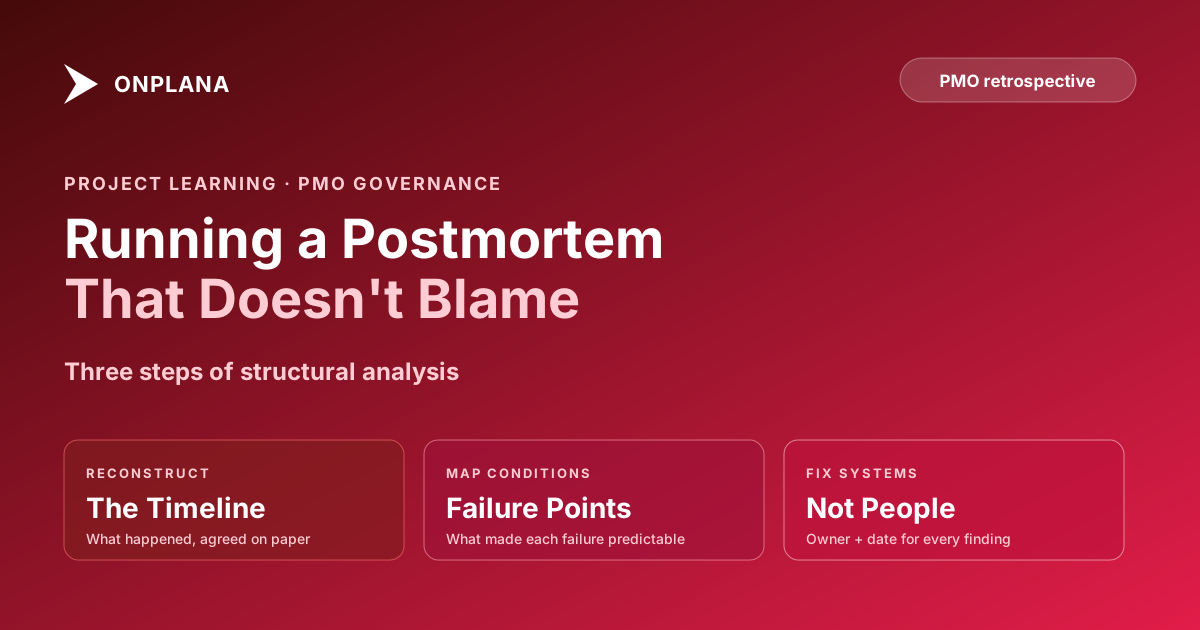
Running a Project Postmortem That Doesn't Devolve Into Blame
Blame-free postmortems are folklore. The technique that works is structural analysis: what conditions made this failure predictable, not who caused it.
The phrase "blameless postmortem" is borrowed from SRE culture (codified in Google's Site Reliability Engineering book) and largely does not survive contact with a PMO. Software incident postmortems can sometimes be genuinely blameless because infrastructure failures are frequently traceable to system conditions: a misconfigured load balancer, an untested failover path, a dependency that behaved differently under load. Project failures almost always involve human judgment calls that turned out wrong. The real question is not whether to acknowledge that. It is whether to make individual judgment the center of the conversation.
Run a project postmortem six weeks after a project that missed its deadline by four months. Put the PM in a room with the sponsor and the functional managers. Open with "this is a blameless postmortem." Watch what happens. The word blameless generates its own opposite: people who feel at risk of blame spend the entire session in posture rather than analysis. The PM defends every decision they made. The functional managers explain why their resources were constrained by other priorities. The sponsor asks pointed questions that aren't really questions. Ninety minutes later, the room produces a list of process improvements nobody will implement.
The goal is not blamelessness. The goal is structural analysis: not who made a bad decision, but what conditions made that decision likely given what the team knew at the time.
TL;DR. Blame-free project postmortems are not about pretending no one made bad decisions. They are about shifting the analytical frame from attribution (who caused this) to structural analysis (what conditions made this outcome predictable). That shift does three things: it allows more honest data collection because participants do not need to defend themselves, it produces findings the PMO can actually act on, and it converts postmortems from political exercises into learning infrastructure.
Why the "blameless" framing fails in project environments
The framing borrowed from SRE does not translate cleanly to PMOs for one structural reason: projects are executed by named individuals with explicit accountability, and when a project fails, those individuals were the ones making the judgment calls that contributed to the failure. Pretending otherwise is dishonest, and participants in the room know it.
What the blameless framing is trying to protect against is the wrong kind of accountability conversation: the one where the postmortem becomes a tribunal, where findings are used as ammunition in performance reviews, and where the output is a scapegoat rather than a systemic improvement. That protection is legitimate. The mechanism is wrong.
A more effective frame is psychological safety without individual immunization. The postmortem can acknowledge that specific decisions were made by specific people and that those decisions contributed to the outcome, without treating the postmortem as the venue for performance accountability. That distinction is between the postmortem as a learning system and the postmortem as a disciplinary process. The facilitator's job is to make that distinction explicit at the start of every session.
Postmortem facilitation practice across industries consistently identifies psychological safety as the primary predictor of whether a session produces usable findings. Not because participants need to be shielded from accountability, but because participants who feel at risk of personal consequences share less accurate data. You cannot do structural analysis on incomplete data.
The core distinction: attribution vs structural analysis
Attribution analysis asks: who made the decision that caused the failure? It locates the problem in a person.
Structural analysis asks: what conditions existed that made that decision the likely one? It locates the problem in the system the person was operating within.
The same event looks completely different from each frame. A project misses its deadline because the PM did not flag a critical dependency risk until week nine. Attribution analysis: the PM failed to manage risk effectively. Structural analysis: the project had no formal risk review process, the PM had no standardized threshold for escalating dependency risks, and the status reporting format did not include a section for dependency risks, so they tracked informally in the PM's own notes and were not visible to the sponsor.
Both analyses are factually accurate. Only the second produces findings the PMO can act on. The first produces a conversation about the PM's competence. The second produces three governance changes: add a risk review to the project cadence, define the escalation threshold for dependency risks, and update the status report format to surface dependency risk by default.
The distinction matters not just for the quality of findings but for the quality of data collection. When the frame is attribution, every participant knows the conversation is about culpability. The PM shares a version of events that minimizes their responsibility. The sponsor shares a version that minimizes their lack of visibility. The functional managers share a version that emphasizes constraints outside their control. The facilitator gets a negotiated account of events rather than an accurate one.
When the frame is structural analysis, the question changes. Not "what did you do wrong" but "what information did you have at the time you made that decision, what were you optimizing for, and what would have needed to be different in the system for a better decision to have been likely?" That question does not require self-defense. It invites honest reconstruction.
The project postmortem structure that produces systemic findings
A project postmortem session has five components, in order.
Timeline reconstruction. Before analysis, get agreement on what actually happened. This is harder than it sounds. Different participants remember different versions of events, particularly around decisions that look bad in retrospect. Build the timeline collaboratively, anchoring to written records: schedule versions, status reports, meeting notes, decision logs. The goal is a shared factual baseline before interpretation starts.
Failure point mapping. For each outcome the team considers a failure (missed deadline, cost overrun, scope drift, quality problem, stakeholder relationship damage), identify the moment when the trajectory became likely. Not when it became visible. When it became likely. This is the structural analysis anchor: if you could go back to that moment, what would have needed to be different for the outcome to have been different?
Condition inventory. For each failure point, ask what conditions existed that made the bad outcome more likely than the good one. This is the productive part of the session. Was there a process missing? An information gap? An authority ambiguity that prevented a decision from being made? A resource constraint that was known but not surfaced to the right level? A timeline pressure that made the risky decision feel necessary?
Pattern recognition. When the same conditions appear across multiple failure points in the same project, or appear in the same project that appeared in the last postmortem, those are the systemic issues. Single-instance conditions may reflect anomalies. Recurring conditions reflect the system.
Action mapping. For each systemic condition identified, define one specific change the PMO will make, the person who owns making it, and the date by which it will be in place. Findings without owners do not get implemented. Findings with owners and dates have a meaningful probability of changing the system.
The diagram below shows how the same event looks under attribution analysis versus structural analysis, and what each produces as output.
How to run the session: facilitation that stays structural
The facilitator's job is to keep the conversation on the conditions, not the decisions. This requires active redirection throughout the session, not a single framing statement at the start.
The most common derailment pattern: a participant asks "why did the PM wait until week nine?" The question sounds neutral. It is not. It assumes the PM made an active choice to wait, which immediately puts the PM in the position of explaining a decision rather than describing the conditions they were operating in. The facilitator redirects: "Let's hold the why for a moment. Can we describe what the PM knew and did not know at week five? What information was available, and what wasn't?"
That redirection shifts the unit of analysis from the decision (attributable to a person) to the information environment (attributable to a system). Once you have reconstructed the information environment accurately, the decision often looks more reasonable than the outcome suggests. A PM who did not escalate at week five because there was no formal escalation threshold, no established norm for escalating early, and a past history where early escalations had been treated as alarmism was not making a bad decision. They were operating rationally within a system that produced a bad outcome.
The session should be structured to avoid consecutive speakers on the same topic. When the same three people dominate the post-incident narrative, the room gets one version of events rather than multiple. A good facilitation technique: rotate around the table, asking each participant what they saw at each key moment. Perspectives that diverge sharply are data points, not disagreements to be resolved in the session.
Three things the facilitator should stop immediately: hypothetical blame ("well, if the PM had just checked the dependency log..."), defensive explanation that runs past two sentences ("I already have to explain why there was no risk review, I don't also need to justify why I didn't create one independently..."), and future-state discussion that happens before the current-state analysis is complete ("what we should do going forward is..."). All three are escape routes from the structural analysis. Keep the room anchored to what happened and what conditions existed, until that reconstruction is complete.
What to do with the findings
A postmortem that produces findings the PMO does not act on is worse than no postmortem. It confirms to the team that the organization uses retrospective review as a ritual rather than a learning system, and it makes future participants less willing to share accurate data.
The action-mapping step assigns each systemic finding to a specific owner with a specific deadline. The PMO lead, not the project PM, owns the findings that relate to PMO-level governance: the missing risk review process, the undefined escalation threshold, the status report format that did not surface dependency risk. The project PM may own findings that relate to their team's practices if those practices are not PMO-standard. Functional managers may own findings that relate to resource availability or decision authority within their departments.
Six weeks after the postmortem, the PMO lead reviews the action list with owners. At six weeks, most single-person actions should be complete. Process changes should be in progress. If no action has moved, the postmortem finding will recur in the next project and the next postmortem will identify the same gap.
The PMO Maturity Assessment includes a dimension for how consistently the PMO converts lessons-learned findings into governance changes. Most PMOs score well on "does the postmortem happen" and poorly on "do findings become systemic improvements." The gap between those two scores is the gap between ritual and learning.
The conditions that make postmortems fail before they start
Timing is the most common failure. Postmortems held immediately after a difficult project, before emotions have settled, often devolve into the session the structural analysis approach is designed to prevent. Postmortems held six months after a difficult project suffer from degraded memory and competing priorities. The effective window is three to six weeks after project close: recent enough that details are sharp, distant enough that the acute defensiveness has passed.
Mandatory participation that does not extend to senior stakeholders is the second failure. If the PM attends and the executive sponsor does not, the session has structural incompleteness. Some of the most significant conditions that contributed to the outcome will be in decisions made at the sponsor level: scope expansions absorbed without schedule adjustment, resource commitments made without PMO visibility, timeline pressures imposed without commensurate budget. A postmortem that cannot examine those conditions is conducting partial structural analysis.
The third failure: the report goes into a lessons-learned archive nobody reads. This is the fate of most lessons-learned documents, as covered in the lessons-learned framework. The postmortem finding has to be surfaced at the moment it is relevant to a future project: when a project with similar risk profile starts, when a PM faces a similar decision point, when the PMO is designing a new governance process. Archived lessons do not change future behavior.
Building a PMO postmortem practice
A postmortem practice requires three commitments: it happens on every project above a defined size threshold, the findings are systematically tracked, and the PMO lead reviews action completion within a defined window.
Define the threshold explicitly. Not "for projects that had significant problems" but "for projects above a defined duration and budget." The temptation to restrict postmortems to troubled projects is understandable but counterproductive: successful projects produce findings too, including findings about what worked that the PMO should deliberately replicate. Asymmetric postmortems create a selection effect where the data pool is biased toward failure conditions.
The why PMO migrations fail post covers a specific high-stakes postmortem context: what goes wrong in major transformation initiatives. The structural analysis approach applies there too, and the conditions that make migration postmortems particularly prone to blame are the same conditions that make the structural framing particularly valuable: large teams, long timelines, and many decision-makers each owning a piece of the outcome.
Run the free PMO Maturity Assessment Twenty questions about how your PMO handles governance, lessons learned, postmortems, and decision authority. Get a structured profile of where your function stands today in about ten minutes. No signup required. → Open the assessment
Frequently asked questions
What is a project postmortem?
A structured review after a project closes or after a significant incident that identifies what went wrong and why, so the PMO can prevent the same failures in future projects. It is distinct from a retrospective, which is ongoing and sprint-level.
What is the difference between a project postmortem and a retrospective?
Retrospectives are ongoing and tied to sprints or monthly intervals. Postmortems are episodic: they happen at project close or after a significant incident. Retrospectives improve process iteration by iteration; postmortems explain outcomes after the fact.
Why do postmortems turn into blame sessions?
Because most postmortems ask who caused this rather than what conditions made this likely. Attribution analysis triggers defensiveness. Structural analysis, by contrast, asks questions everyone in the room can engage with safely.
What makes a postmortem genuinely useful?
Findings that name a specific systemic condition the PMO can change, paired with an owner and a date. Findings that describe a behavior without naming a system condition produce a list of good intentions rather than actual changes.
Who should facilitate a project postmortem?
Someone who was not on the project team. A PMO lead, an internal facilitator, or a peer PM with no stake in the findings. The project PM should participate and contribute data, but not lead the session.
What should a postmortem report include?
The timeline of key decisions, the conditions that made each failure point predictable in hindsight, the specific systemic changes the PMO will make, and an owner and date for each. Findings without owners do not get implemented.
Ready to make the switch?
Start your free Onplana account and import your existing projects in minutes.