Why Lessons-Learned Documents Are Read Once and Forgotten
Project lessons learned are almost never read after they're filed. Here's what makes a lesson actionable and how to surface it at the moment it matters.
Most lessons-learned sessions follow the same arc. Three hours at project close, a facilitator with a blank Confluence template, and a team that is mentally already on the next project. The output is a document with forty line items structured as "we should communicate more" or "start planning earlier next time." It gets filed. Nobody reads it. The next project makes the same mistakes. The one after that makes them again.
The problem is not that teams do not want to learn. It is that the standard lessons-learned format produces descriptions of events rather than decisions about behavior. "The integration phase started too late" is a finding. It is not a lesson. A future PM who reads it cannot apply it to anything. There is no decision embedded in the sentence, no threshold that triggers a different action, no owner who is responsible for ensuring the pattern changes.
Lessons learned in project management exist as a category because they are supposed to reduce repeated failure. They almost never do, because the format typically used confuses documentation with knowledge transfer. A document that describes what went wrong is a record. A document that tells you specifically what to do differently, in what situation, is a lesson.
TL;DR. An actionable lesson has three parts: a specific finding, a specific decision, and a specific owner. Most lessons-learned documents have only the first. Without the decision and the owner, the document is a record of events, not a guide to behavior. The second failure mode is timing: lessons captured only at project close are the hardest to apply because they arrive after the project they describe and before the next project has started. Capture at phase closes and risk events; surface at project start and phase gates.
Why lessons-learned documents are never read
Two structural causes account for most of the failure.
The format describes events, not decisions. "The vendor delivered three weeks late" tells the next PM what happened. It does not tell them what to change in their planning, their contracts, or their risk management to make the outcome different. Without an embedded decision, the finding is historical data, not guidance.
The timing is wrong. Lessons captured at project close are available when the next project starts from scratch. At project start, the PM is overwhelmed with planning decisions and does not have time to search a database for past lessons on vendor management or schedule compression. By the time the PM encounters the situation the lesson describes, the project is already in flight and the lesson is buried in a document they have not opened in six months.
Both failures share a root cause: the lessons-learned process is designed around documentation rather than application. The goal is defined as "capturing what we learned" rather than "changing what we do next time." Until the goal shifts, the format stays wrong and the timing problem persists.
The anatomy of an actionable lessons learned entry
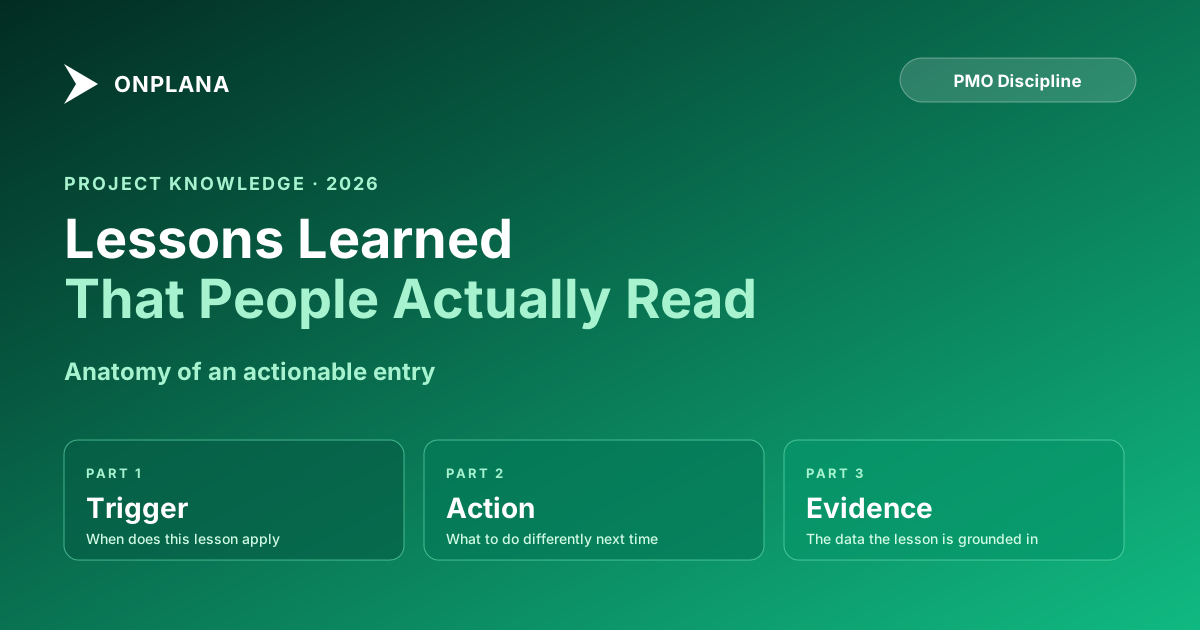
An actionable lesson has three parts.
One finding. A specific, factual description of the condition that caused the problem. Not "communication was poor" but "the integration milestone date changed twice in week 5 but the vendor was not notified until week 6, which caused a two-week delivery delay and $18,000 in change-order costs." The finding should be specific enough that a future PM reading it immediately recognizes the situation if they encounter it.
One decision. A specific behavioral instruction for the next PM in this situation. Not "communicate better" but "any change to a milestone that affects a vendor's delivery schedule triggers a written notification to the vendor within 24 hours, with confirmation of receipt required before the change is baselined." The decision should be written so it can be applied without judgment: if condition X occurs, take action Y.
One owner. The role or person responsible for ensuring the decision is applied on future projects. Not "the team" but "the PM, at each milestone review, checks the vendor communication log to confirm all recent milestone changes have been acknowledged." Owner plus decision creates an obligation. Finding alone creates nothing.
A lessons-learned entry that has all three can be trained, audited, and tracked. An entry that has only a finding cannot.
The diagram below shows the difference between a standard lessons-learned entry and an actionable one.
How to run the session so it produces useful output
The standard lessons-learned session fails before the first word is written because the framing is wrong. "What did we learn?" produces retrospective storytelling. "What would we do differently, and what is the specific trigger for doing it?" produces actionable decisions.
Two facilitation changes produce substantially better output.
Replace the four-quadrant format. Most sessions use a four-quadrant board: what went well, what went poorly, what to do more of, what to stop doing. This produces aggregated sentiments, not decisions. Replace it with a structured template: for each problem the team names, facilitator asks "what is the condition that caused this?" and "what specific action would prevent or mitigate it next time?" Write both as a pair. If the team cannot articulate a specific action, the item is not ready to become a lesson; it is still a complaint.
Assign every decision to a role before the session ends. At the end of the session, review every decision and assign it to a specific role: PM, project sponsor, resource manager, integration lead. If no one in the room owns the role that would apply the decision, the session needs to either identify who does or acknowledge that the decision will not be applied without a structural change. Decisions without role assignments become suggestions.
The Agile Alliance's resources on retrospectives describe a related challenge: many agile teams treat retrospectives as a venting session rather than a decision factory. The same diagnosis applies to waterfall lessons-learned sessions. The output format is what creates the difference; the Agile Alliance catalogs several structured retrospective formats specifically designed to produce actionable outputs rather than observations.
How to surface lessons learned at the moment they matter
Timing is as important as format. A lesson available only in a database at project close is practically inaccessible at the moments it would be applied.
Three moments when lessons are most likely to change behavior:
At project start, during planning. A new PM kicking off a project similar to a recently closed one should see the relevant lessons from that project during planning, not after they have already committed to a timeline. This requires tagging lessons by project type and surfacing them at project creation, not just at project close.
At phase gates, when scope or approach decisions are made. A scope change request that matches a known risk pattern should automatically surface the lesson from the last time that scope pattern appeared. This requires tagging lessons by phase and risk type.
When a team member encounters the exact situation the lesson describes. This is the hardest to build systematically, but the simplest version is a PM checklist at each milestone review that includes a short review of the relevant lessons for that milestone type. The checklist is the trigger; the lessons are the content.
For the most commonly recurring lessons, the right surfacing mechanism is an operational checklist rather than a document. If the same vendor-communication pattern has caused delays on three projects in a row, the fix is not adding another lessons-learned entry. It is adding a line to the milestone review checklist that the PM runs every two weeks.
The connection between structured status reporting and lessons learned is more direct than most PMOs recognize. The discipline of goals, milestones, and status reporting describes how the same structured thinking that makes status reports honest also makes post-project knowledge capture useful rather than ceremonial.
Building a lessons-learned catalog that works
A catalog is only useful if PMs can find what they need when they need it. Most lessons-learned repositories are filing systems, not retrieval systems: documents organized by project and date, with no way to search by situation type.
A lessons-learned catalog that works has two properties.
Each entry is tagged by the situation that triggers it, not the project that generated it. Tags should include: project type (software, infrastructure, compliance, migration), phase (initiation, planning, execution, close), failure mode (vendor dependency, scope growth, resource constraint, communication gap, regulatory surprise), and severity (minor delay, significant impact, project failure). A PM dealing with a vendor-dependency issue should be able to retrieve all lessons tagged with that failure mode in under 30 seconds.
The catalog is part of the PM's active workflow, not a separate archive. The most reliable way to ensure lessons are seen is to surface them inside the planning and review tools PMs already use, not in a separate knowledge base they have to remember to visit. If lessons appear as linked resources in project templates, checklist items in milestone reviews, and sidebar prompts in risk assessment forms, the access pattern becomes automatic rather than aspirational.
For the project risk management process, the connection is natural: each identified risk should cross-reference any lessons from previous projects where the same risk materialized. The project risk management guide covers how to structure a risk register that captures historical patterns alongside current project risks.
Measuring whether your lessons learned are actually changing behavior
Most PMOs never measure whether their lessons-learned process works. The implicit assumption is that documentation equals application. It does not.
Three proxies for effectiveness:
Repeated incident rate. Track how many times the same failure mode appears across projects over a 12-month period. A decreasing rate suggests lessons are being applied. A flat or increasing rate suggests the catalog exists but is not being retrieved or used.
Lesson citation rate. At each project kick-off, ask the PM to reference any relevant lessons from prior projects in the planning documentation. Count how many lessons were cited. A PMO with a healthy lessons-learned process sees most kick-off documents include at least one citation. A PMO where no kick-off documents cite prior lessons has a retrieval problem, not a capture problem.
Lesson decision closure rate. For each actionable lesson, track whether the decision was applied on the next project where it was relevant. This requires the catalog to have enough specificity to identify when a lesson is relevant and the PM review process to include a close-out step where the PM confirms whether the decision was applied and what happened.
The PMO Maturity Assessment scores knowledge management as a distinct capability domain, with specific questions about whether lessons learned are captured, tagged, surfaced, and measured for impact. PMOs that score high on this dimension almost always share one practice that others lack: the lessons are retrieved automatically during project start, not searched manually at the moment of need.
A lessons-learned process that produces documents nobody reads is not a process at all. It is a compliance activity that consumes team time and produces the appearance of institutional learning without the substance.
Run the free PMO Maturity Assessment Twenty questions about how your PMO captures, surfaces, and applies project knowledge. Get a structured capability profile in about ten minutes. No signup required. → Open the assessment
Frequently asked questions
What are lessons learned in project management?
Lessons learned are findings from a completed or in-progress project that identify what worked, what failed, and what the team would do differently. They are typically documented at project close but are more useful when captured throughout the project.
Why don't teams actually use lessons-learned documents?
Most lessons-learned documents describe what happened rather than what to do differently. Without a specific decision embedded in the lesson, a future PM reading it has no actionable instruction to follow.
What makes a project lesson actionable?
Three elements: one specific finding (what condition caused the problem), one decision (what to do differently next time), and one owner (who is responsible for applying it). A lesson with all three can be acted on; a lesson with only a finding cannot.
When should lessons learned be captured during a project?
At three points at minimum: immediately after a significant risk event or scope change (while the team still remembers the details), at phase gates or milestone closes, and at project close. Lessons captured only at close miss the most actionable moments.
What is the difference between a lessons-learned document and a retrospective?
A retrospective is a structured team session that generates candidate lessons, typically run at the end of each sprint or phase. A lessons-learned document is the curated output: the findings from retrospectives that are specific enough to guide future projects, formatted to be searchable and surfaced at the right moment.
How do you make lessons learned transferable across projects and teams?
Tag each lesson by project type, phase, and failure mode, then surface it in the PM's workflow at the matching moment: when a new project reaches the same phase, the relevant lessons appear rather than requiring the PM to search a database.
Ready to make the switch?
Start your free Onplana account and import your existing projects in minutes.