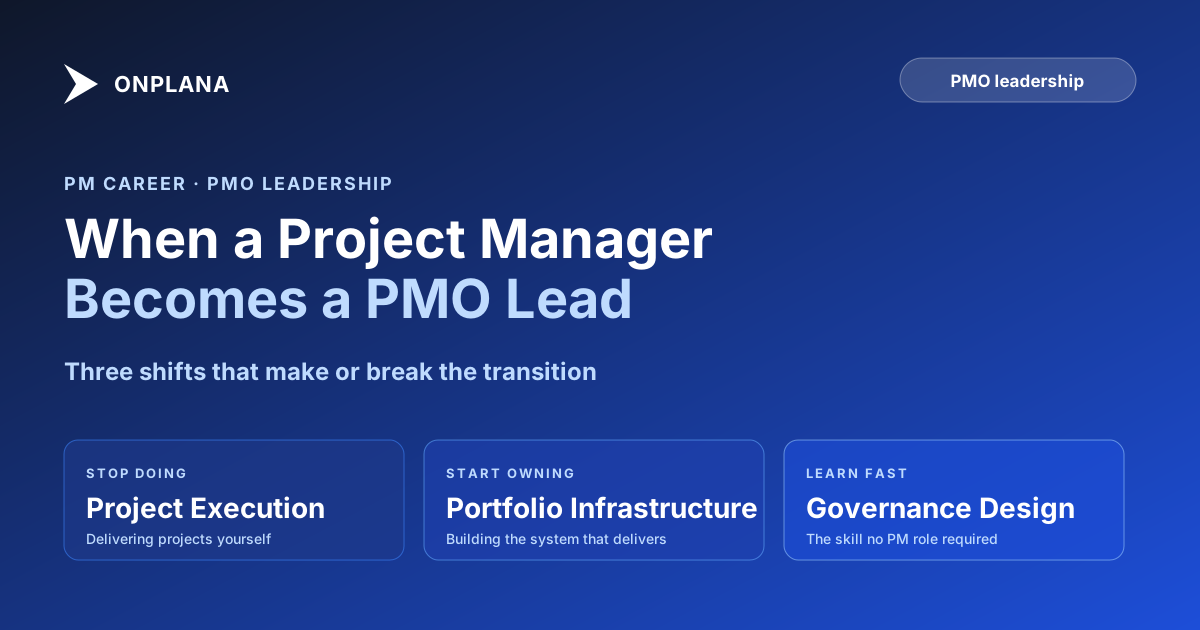
PM to PMO Transition: What a New PMO Lead Must Unlearn
Promotion to PMO lead looks like a career upgrade. The skills that made you a great PM actively undermine the new role. Here is what to unlearn first.
The promotion happens on a Friday. By Tuesday of the following week, the new PMO lead has made the PM to PMO transition official on paper but not in practice: they have taken over daily management of a struggling project, drafted a Gantt chart for next quarter, and scheduled one-on-ones with each project team member. By the end of the first month, the projects are being managed but the PMO is not being built.
This is not the exception. It is the pattern. The PM who was exceptional at delivery gets promoted to PMO lead and immediately applies the skill set that earned the promotion to a job that requires a different skill set entirely. The projects run. The function stalls.
The uncomfortable truth about the PM to PMO transition is that many of the habits that made you valuable as a PM become liabilities in the new role. Specificity becomes micromanagement. Task ownership becomes resource hoarding. Problem-solving in project execution becomes interference. The skills transfer only partly, and the gap between what transfers and what does not is where new PMO leads lose their first year.
TL;DR. The PM to PMO transition fails when the new lead treats it as a promotion rather than a role change. The job shifts from delivering a project to building the infrastructure that lets other PMs deliver. That requires new skills: governance design, portfolio-level resource decisions, stakeholder architecture, and the discipline to stay out of project execution even when you could do it faster yourself. The 90-day reorientation in this post maps that shift explicitly.
Why the PM to PMO transition feels like the same job
The reason the transition catches PMs off-guard is that the first few weeks look identical to what they were doing before. There are projects with problems. There are PMs who need coaching. There are schedules with too much risk and sponsors with too little patience. The instincts that worked for the previous five years activate immediately: identify the problem, take ownership, execute.
Those instincts are right for the problems they respond to. They are the wrong response to the PMO lead's actual job.
A PM solves the problem in front of them. A PMO lead asks: why does this type of problem keep occurring, and what would the system look like if it stopped recurring? One is execution. The other is infrastructure design. They require different analytical postures, different relationships with ambiguity, and different relationships with the people doing the work.
The PM who jumps into project execution in week two of the PMO lead role is winning a short-term battle at the cost of the longer-term credibility they need to run the function. The team learns that the PMO lead will rescue a struggling project. The PMs learn they can escalate problems upward and get relief. Leadership learns the PMO lead is a senior PM, not a functional leader. All three lessons make the PMO harder to build from that point forward.
What a PMO lead actually owns
The PMO lead's deliverable is not a project. It is a portfolio that runs predictably over time.
That requires four categories of work that most PM roles never involve.
Governance design. The rules and processes that determine how projects are initiated, approved, monitored, and closed. What a project charter must contain before a project gets funded. How status is reported and who reviews it. What authority a PM has to make decisions without escalating. These structures do not exist in most organizations until someone builds them, and the PMO lead is the person who builds them.
Resource allocation. Decisions about where capacity goes across the portfolio, not within a single project. If three projects compete for the same senior engineer, the PMO lead is the person who determines priority, not any of the individual PMs. This requires maintaining a portfolio view of resource utilization and the authority to enforce allocation decisions when they conflict.
Stakeholder infrastructure. Not managing a single stakeholder for a single project, but building the relationship architecture the whole PMO operates within. Which executives have decision authority over which project categories. How the steering committee is structured and what it is expected to decide. Who the PMO reports to and what visibility they require. Building this is political work, not delivery work.
Standard-setting. Defining what good looks like across the portfolio: schedule quality, risk management practice, status reporting format, change control process. This is not telling each PM how to manage their project. It is defining the shared baseline all projects operate from, so the PMO lead does not have to reinvent the answer for each project independently.
A useful test: if everything on this list is progressing well but the new PMO lead has not personally delivered a single project in the first six months, the transition is probably on track. If the new PMO lead has personally delivered two projects in the first six months but none of these four categories is further along than when they started, the transition is failing.
The diagram below shows the shift in work focus from PM to PMO lead across the four ownership categories.
The five PM behaviors that undermine PMO leadership
These are not character flaws. They are skills developed because they worked in a PM context and have not yet been recalibrated for the new one.
Taking over struggling projects. When a project is behind schedule and the PMO lead can see exactly what needs to happen, the easiest path is to step in. This is the most dangerous habit in the transition. Every time the PMO lead takes over a project, they confirm to the organization that PMO involvement means the PM loses authority. The team learns to wait for intervention rather than escalating early. The PMs learn that demonstrating struggle is a reliable way to get senior support. The PMO lead's calendar fills with execution work and the governance function never gets built.
Writing the schedule themselves. A PM who is skilled at scheduling will find their team's schedules genuinely frustrating. Some of them will deserve the frustration. Fixing them directly is faster than teaching. It is also fatal to the coaching relationship. The PMO lead who rewrites a PM's schedule has rewritten that PM's ownership of it. From that point forward, the schedule belongs to the PMO lead, and the PM is executing someone else's plan.
Being the first to solve every problem. PMs are trained to see a problem and move toward it. In a PMO lead role, the first move toward a problem is often the wrong move. The question is not "how do I solve this" but "which PM should solve this, what information do they need, and what authority do they need to act." Solving the problem yourself short-circuits the PM's growth and creates a single point of failure at the PMO lead level.
Measuring themselves by project outcomes. This is the identity shift most PMO leads resist longest. A PM's reputation is built on the projects they deliver. A PMO lead's reputation is built on the function they run. "How are your projects doing?" is the natural question from leaders who managed the new PMO lead as a PM. The honest answer is "I don't own any projects anymore," which feels uncomfortable until the PMO lead internalizes what they do own instead.
Avoiding political work. The governance decisions a PMO lead makes have stakeholders with preferences about those decisions. Which projects get priority access to shared engineers. What standard the PMO holds PMs to before approving a project. How much authority a PM has to make changes without steering committee review. These decisions create winners and losers. The PMO lead who defers them to the CEO to avoid the conflict has abdicated the core of the job.
What to learn: the skills no PM role required
The PM to PMO transition requires building capabilities that most PM experience does not develop.
Influencing without authority. A PM has direct authority over their project team, within limits. A PMO lead has authority over the function but no direct authority over the PMs, who often report to functional managers. Getting a PM to adopt a different scheduling standard, or getting a functional manager to honor a resource commitment, requires influence rather than hierarchy. The same principles that apply to stakeholder management in a multi-project environment apply here: understand what each stakeholder values, frame PMO decisions in terms of what they gain, and make the cost of non-compliance visible without making it personal.
Portfolio-level thinking. A PM optimizes one project. A PMO lead must optimize across a portfolio where every optimization for one project imposes a cost on others. The senior engineer available to rescue Project A is the same one Project B was counting on. Solving Project A's problem while creating Project B's problem is not portfolio management. The skill is holding the portfolio constraint visible while making individual project decisions.
Governance design. Designing a process that PMs will actually use, stakeholders will respect, and leadership will enforce is a specialized skill. Most new PMO leads inherit either no governance or governance that is not enforced, and the first design choice is whether to build from scratch or rehabilitate what exists. The change control board framework covers one specific governance design problem; the broader point is that governance design is a discipline, not intuition.
Reading the political landscape. New PMO leads often know the project landscape well before they understand the organizational politics. Who is protecting their resource pool from the PMO's view. Which sponsor has veto authority over any governance change. Which functional manager will quietly undercut any resource commitment the PMO makes. The first 90 days should include as much political mapping as portfolio mapping.
The 90-day reorientation plan
The first 90 days of the PM to PMO transition have a specific agenda, and the agenda is not "start delivering results."
Weeks one through three: audit the portfolio without fixing anything. How many projects are active, what are their statuses, where are the resource conflicts, which projects are at risk of slipping in the next quarter. Look at the existing governance: what processes nominally exist, which are actually followed, which have become dead letters. Do not make changes yet. Make observations.
Weeks four through six: map the decision architecture. Who currently makes what decisions, where decisions are getting stuck, what questions reach the PMO lead that should be resolved at a lower level, and what questions reach the CEO that should be resolved by the PMO lead. Identify the three highest-leverage governance gaps.
Weeks seven through twelve: close three specific governance gaps. Not infrastructure projects with 12-month timelines. Three specific decisions or processes that demonstrate the PMO is functioning as an authority. A new resource request process. A simplified project charter standard. A standing escalation protocol using the framework from the escalation framework for project managers. These three visible changes establish that the PMO lead is building the function, not just managing within it.
The PMO Maturity Assessment is useful at the end of the first 90 days because it gives the PMO lead a structured picture of where the function currently sits across twenty governance dimensions. The lowest-scoring areas are usually where the function was most personality-dependent rather than structure-dependent: the places where the previous lead had informal solutions that worked only while they were in the role.
When to step in and when to stay out
The hardest recurring decision in the PMO lead role is when to intervene in a struggling project versus holding the line that execution is the PM's job.
A useful test: does this project need the PMO lead's authority or their expertise?
If it needs authority (a resource allocation decision that crosses departments, a scope change that requires steering committee approval, a conflict between two PMs that requires portfolio-level adjudication), that is a PMO lead decision. Step in, make the call, document it clearly.
If it needs expertise (a better way to structure the schedule, a more effective stakeholder communication, a clearer risk assessment), that is a coaching conversation. The PMO lead coaches the PM on the approach and lets the PM execute. Doing the work yourself transfers the ownership, which makes the next PM struggle more likely rather than less.
The PMO maturity tiers framework describes what PMOs look like at each level of maturity. One consistent pattern: PMOs stuck at the reactive tiers have a PMO lead who is excellent at project execution and has inadvertently prevented the function from maturing past the point where they were individually needed.
How to measure the transition's progress
The wrong metrics: project delivery rate for specific projects the PMO lead personally touched. The right metrics: portfolio delivery rate across all projects, reduction in escalations that reach executive sponsors, PM capability improvement over time, and the number of governance decisions now made reliably at the right level without the PMO lead's involvement.
The most reliable signal that the PM to PMO transition has succeeded is not what the PMO lead is doing. It is what they have stopped doing. If the PMO lead has stopped writing schedules, stopped taking over struggling projects, and stopped being the first person called when a project has a problem, the infrastructure is starting to work.
The PMO Maturity Assessment gives a repeatable benchmark for this. Run it at 90 days, at six months, and at twelve months. The trajectory matters more than the starting score. A PMO that improves across ten dimensions in twelve months is a PMO that is being led.
Run the free PMO Maturity Assessment Twenty questions about how your PMO handles governance, decision authority, resource allocation, and PM capability. Get a structured profile of where your function currently stands in about ten minutes. No signup required. → Open the assessment
Frequently asked questions
What is the biggest mistake a new PMO lead makes?
Managing individual projects instead of managing the function. The PMO lead's job is to design the system that enables delivery across all projects, not to deliver any one of them personally.
How long does it take to transition from PM to PMO lead?
The tactical skills take a few months to acquire. The mindset shift takes six to twelve months. The hardest part is stopping the behaviors that worked well as a PM but actively undermine the PMO lead role.
What should a new PMO lead do in their first 90 days?
Audit the project portfolio, map the decision-making structure, understand who holds resource authority, and resist the urge to parachute into any struggling project to fix its delivery problems directly.
What skills does a PMO lead need that a PM does not?
Influencing without direct authority, designing governance structures, allocating resources across competing projects without owning any of them, and making the political cost of PMO decisions visible to senior leadership.
How do you build credibility as a new PMO lead?
Not by delivering a project faster than anyone expected. By resolving the decision that has been stuck for three months, standardizing the status report everyone complained about, or freeing capacity across three projects that were blocking each other.
What is the difference between a PM and a PMO lead?
A PM owns delivery of a specific project. A PMO lead owns the function that enables delivery across all projects. The distinction is between execution and infrastructure.
Ready to make the switch?
Start your free Onplana account and import your existing projects in minutes.