When to Cancel a Project: A Quarterly Kill Criteria Review
Most failed projects should have been cancelled months earlier. A quarterly kill criteria framework for when to cancel before the cost of continuing compounds.
Here is the pattern. A project has been amber for six months. The status reports say "schedule recovery plan in progress." The schedule is not recovering. The PM knows it. The sponsor suspects it. The steering committee is waiting for someone else to say it first. The project finishes eight months late and 40 percent over budget, and in the post-mortem everyone agrees it should have been cancelled the previous quarter.
That pattern is not exceptional. Most project post-mortems contain the same gap: the decision to cancel came months after the case for it was clear. The cost is real: continued headcount, ongoing procurement, disrupted dependencies, and the opportunity cost of resources that could have been redirected to something viable. The decision to continue is rarely made consciously. It is the default when nobody has defined what a cancellation would look like or when it would be triggered.
TL;DR. The decision of when to cancel a project is almost never made too early. It is almost always made too late. Two tools prevent this: kill criteria defined at project start (specific, pre-agreed conditions that trigger a cancellation review), and a quarterly portfolio review that applies those criteria to every project in the portfolio. When both are in place, cancellation becomes a policy decision rather than a political one, and it happens at the point where resource recovery is still possible.
Why failed projects keep running
Three structural patterns keep projects alive past the point where cancellation would be the cheaper outcome.
The first is the absence of kill criteria. Most project charters define what a successful project looks like. Almost none define what a failing project looks like in measurable terms. Without kill criteria, there is no formal mechanism to surface "this project should stop." The PM reports amber, the sponsor expresses concern, the steering committee notes the concern, and everybody continues. Cancellation requires someone to raise their hand and take responsibility for the decision. Nobody does that without a policy basis for making it.
The second is the sunk cost trap. "We have spent two million dollars on this. We cannot just walk away." This is the most common reason projects continue past any rational stopping point. The two million dollars is gone whether the project continues or not. The relevant question is whether the expected future benefit of the completed project exceeds the expected future cost of completion. When the answer is no, the sunk cost argument is a reason to continue wasting money, not a reason to recover it.
The third is sponsor protection. Cancelling a project a sponsor championed signals that the original decision was wrong. Sponsors who identified and funded the project feel personal exposure when cancellation is proposed. PMs who report to those sponsors experience the same pressure. Without an external process, such as a quarterly review, a portfolio-level governance gate, or a pre-committed kill criterion, the political cost of raising cancellation falls entirely on the individuals most exposed to the consequences of raising it.
What kill criteria actually are
Kill criteria are pre-agreed, measurable conditions that automatically trigger a formal cancellation review. They are not the same as cancellation itself: meeting a kill criterion means the portfolio board or steering committee reviews the project and decides whether to cancel, continue with modified scope, or restructure. The criterion is the trigger, not the verdict.
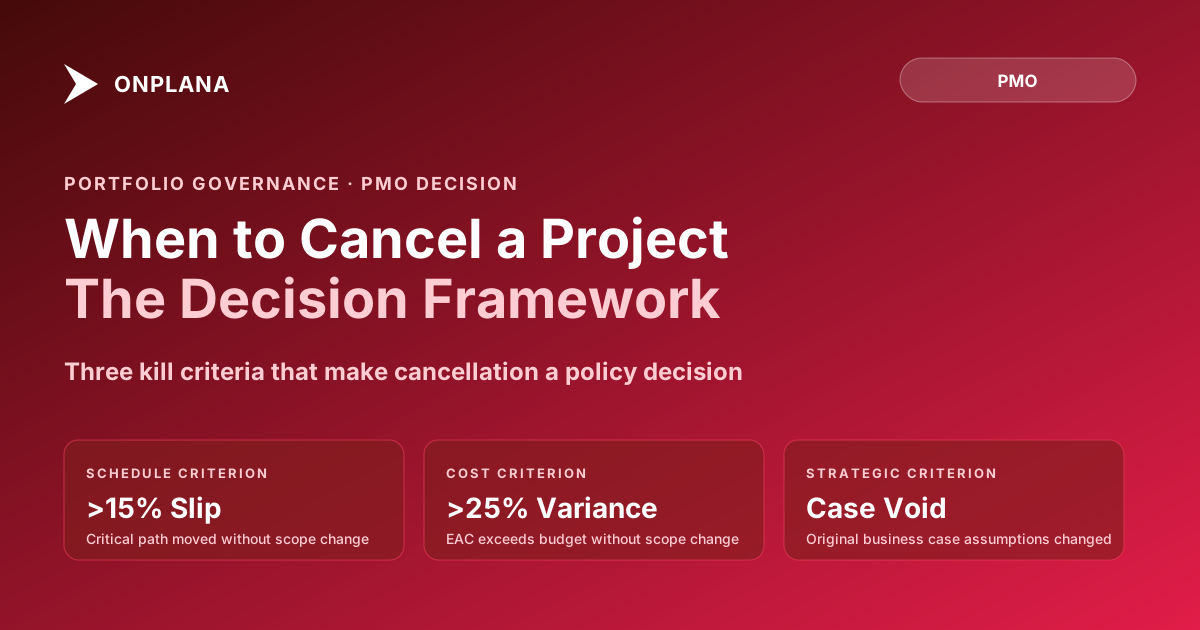
Define kill criteria in the project charter during initiation, before sunk costs accumulate and before the project is politically committed. Three categories cover the vast majority of project failures.
Schedule deviation criteria. Define a threshold at which schedule variance becomes unrecoverable without fundamental scope reduction. A common benchmark: if the critical path forecast date moves by more than 15 percent of the original planned duration, without a corresponding scope reduction approved to absorb that movement, the project enters cancellation review. A project originally planned for ten months that is now projecting fourteen months without scope change has crossed this threshold.
Cost variance criteria. Define a threshold at which budget variance signals that the original estimate was structurally wrong. A common threshold: when the estimate to complete plus actual cost to date exceeds the original approved budget by more than 25 percent, without a corresponding increase in approved scope, the project enters review.
Strategic criteria. Define the assumptions that justified the project at inception. If any of those assumptions no longer hold, the project enters review regardless of schedule and cost status. A regulatory initiative that loses its regulatory basis. A market-facing product whose target market has shifted. An internal system migration whose business need has been absorbed by a different project. Strategic kill criteria are the hardest to define in advance and the most important, because a project can track green against its original plan while becoming entirely worthless against its strategic purpose.
The quarterly cancellation review
Kill criteria need a review process to activate them. The quarterly portfolio review is that mechanism.
Once per quarter, the portfolio board or PMO director applies kill criteria to every active project. The review is not a deep-dive for each project: it is a threshold check. For each project, three questions:
- Is the schedule deviation criterion met? (Current critical path forecast versus original plan)
- Is the cost variance criterion met? (Estimate at completion versus original approved budget)
- Has any strategic assumption changed? (Review against the original business case)
If the answer to any question is yes, the project moves to a structured cancellation assessment. If all three are no, the project continues to the next quarterly review.
The quarterly review does three things the normal project review cycle does not. It creates a portfolio-level perspective: a project that appears acceptable in isolation may look different when compared against three other projects competing for the same resources. It creates a repeatable cadence: cancellation is evaluated systematically rather than only when a crisis forces the question. And it gives the PM and sponsor advance notice: a project that meets a kill criterion in Q2 has one quarter before Q3 to demonstrate recovery, rather than facing a crisis cancellation that arrives without warning.
The diagram below shows how the quarterly review flows from project status to a cancellation decision.
Building the case for cancellation
When a project enters cancellation assessment, the PMO needs three elements to make the case defensible.
The value gap. What was the project expected to deliver, and what is it now expected to deliver given the current trajectory? Express this in terms the sponsor and steering committee can evaluate: revenue impact, cost reduction, risk reduction, compliance coverage. A project expected to deliver three million dollars in annual savings that is now expected to deliver one and a half million at twice the original cost has a value gap worth quantifying explicitly.
The completion cost. What does it cost to finish this project, starting from today? Not the original budget, not what has been spent: the honest estimate to complete. This number is what sits on the other side of the cancellation decision. If the estimate to complete is $800K and the remaining value is $500K, the case writes itself. If the estimate to complete is $200K and the remaining value is $2M, continuation is clearly right. Many cancellation decisions fail because the estimate to complete is conflated with the sunk cost discussion rather than isolated from it.
The opportunity cost. What would these resources produce if redirected? This is the argument that moves sponsors who are stuck on sunk cost. Redirecting eight engineers to a different project is not "wasting" the $1.5M already spent. The $1.5M is spent whether the project continues or not. The question is whether those eight engineers produce more value continuing the current project or starting a viable one.
Present all three elements together. A cancellation case that leads with failure data gives the sponsor a reason to defend the project. A cancellation case that leads with redirected value gives the sponsor a reason to agree.
The sunk cost conversation
Every cancellation conversation runs into the sunk cost argument. The best response is not to argue against it but to redirect past it.
"We have invested too much to stop now" is a statement about what has been spent. "The estimated cost to complete is X and the expected future value is Y" is a statement about what matters. Redirect the conversation from the past to the forward-looking figures. "You are right that we have invested two million dollars. The question in front of us is whether the next $800K produces the outcome we need. Given the current trajectory, our best estimate is that it does not."
Then present the opportunity cost: "That $800K and those six engineers could start the accounts receivable project next month. That project has a clear return and no current resource slot. That is the decision: not the past spend."
Most sponsors who invoke the sunk cost argument are looking for permission to stop rather than a reason to continue. The reframing gives them the data to make the decision they already sense is right.
For the language of quantified impact in the context of risk decisions, which follows the same logic, see the project risk management guide. The framing that works for project risk works for project cancellation cases built the same way.
Running the cancellation decision
The cancellation decision belongs at the steering committee, not the PM level. The PM's role is to surface the case; the committee's role is to make the call.
Bring the three-element cancellation case to a steering committee with decision authority. The meeting has one agenda item: continue, restructure, or cancel. Bring a recommendation. A cancellation case without a recommendation transfers the analysis burden to a committee with less context than the PM and no structural incentive to make the difficult choice.
Document the decision and its rationale regardless of which way it goes. A decision to continue despite meeting kill criteria should be documented with the explicit reasoning. A decision to cancel should specify: the effective cancellation date, which deliverables will be archived versus completed, what happens to team members, and who owns stakeholder communication.
The discipline, goals, milestones, and status reporting framework covers how cancellation decisions flow through the governance reporting structure. A project that reaches cancellation review should already have had its amber status visible at the portfolio level for multiple review cycles. The cancellation decision should not be a surprise to anyone who has been reading the status reports.
What to do after cancellation
The three immediate actions after a cancellation decision: communicate, archive, and redeploy.
Communicate first. Tell the team before the rumor does. The PM should communicate the decision to team members within 24 hours of the decision, with specifics: what the decision was, why it was made, what each person's next assignment is, and the timeline for transition. A generic email from the sponsor two days later is not a substitute for a direct, specific conversation with the team.
Archive the right things. Most cancelled projects have produced work that has value: requirements documents, architecture decisions, stakeholder research, partially completed deliverables. Identify what is worth preserving before resources disperse. The archive standard is whether a future team working on a similar problem would benefit from access to it.
Redeploy intentionally. Team members from a cancelled project carry a particular morale risk: they worked on something that did not succeed, and they need clarity that the cancellation reflects strategic judgment, not their performance. The redeployment conversation should be explicit about what they contributed and what they are being asked to do next.
A cancelled project handled well leaves the team intact as a unit the organization trusts with future work. A cancelled project handled poorly leaves people wondering whether the next project they join is already failing.
For PMOs assessing whether their project governance creates the conditions for early cancellation decisions, including kill criteria, quarterly reviews, and clear decision authority, the PMO Maturity Assessment scores this across its portfolio governance dimension. Most PMOs that struggle with late cancellations are missing either the kill criteria definition or the quarterly review cadence, not the will to make the call once the evidence is clear.
Run the free PMO Maturity Assessment Score your portfolio governance, including kill criteria and cancellation readiness, against five maturity tiers. A one-page capability profile in about ten minutes. No signup required. → Open the assessment
Frequently asked questions
When should you cancel a project?
Cancel a project when the cost of continuing exceeds the expected value of completion, there is no credible recovery path, or the strategic rationale no longer holds. Define kill criteria at project start so the decision uses data rather than political judgment.
What are kill criteria in project management?
Kill criteria are pre-agreed, measurable conditions that trigger a formal cancellation review: schedule slippage beyond a threshold, cost variance above a percentage, or a strategic shift that voids the original business case. They turn a politically difficult judgment into a policy decision.
Why do failed projects keep running?
Three reasons: sunk cost fallacy (too much invested to quit), sponsor reluctance to admit the original decision was wrong, and the absence of any formal process for raising cancellation as an option. Without kill criteria and a quarterly review, cancellation only happens in crisis.
What is the sunk cost fallacy in project management?
The sunk cost fallacy is continuing a failing project because of past investment rather than future value. Money already spent cannot be recovered whether the project continues or cancels. The relevant question is whether expected future benefit exceeds expected future cost.
How do you build a case for project cancellation?
Present three things: the gap between expected and actual value delivery, a credible estimate of what it would cost to finish, and what the resources could produce if redirected. A cancellation case built on projected value is harder to dismiss than one built on cataloging past failures.
What happens to the team when a project is cancelled?
A well-managed cancellation communicates the decision before the rumor does, gives team members clarity on next assignments within two weeks, and redeployes people to active work rather than a holding pattern. The cancellation reflects PMO judgment, not the team's competence.
Ready to make the switch?
Start your free Onplana account and import your existing projects in minutes.