PMO Team Structure: Centralized, Federated, or Hybrid
The PMO team structure that worked cleanly at 15 projects starts breaking at 60. Centralized, federated, and hybrid models each fail differently as scale grows.
A PMO that worked cleanly at fifteen projects starts missing deadlines at sixty, and the PMO director's first instinct is to hire more PMs. That fixes headcount, not the actual problem: the structure that let one central team stay close to fifteen projects' worth of context cannot stay close to sixty, no matter how many people you add to it. The PMs are drowning not because there aren't enough of them, but because they're all routing through the same bottleneck that used to be a strength and is now the constraint.
This is the PMO team structure question in its most common form: not "what's the best structure" in the abstract, but "the structure that got us here has stopped working, and we don't know if that means fixing it or replacing it." The three canonical shapes, centralized, federated, and hybrid, aren't ranked by quality. They're tradeoffs between standardization and proximity, and the right one depends on scale, business-unit diversity, and how much coordination overhead the organization is willing to pay for consistency.
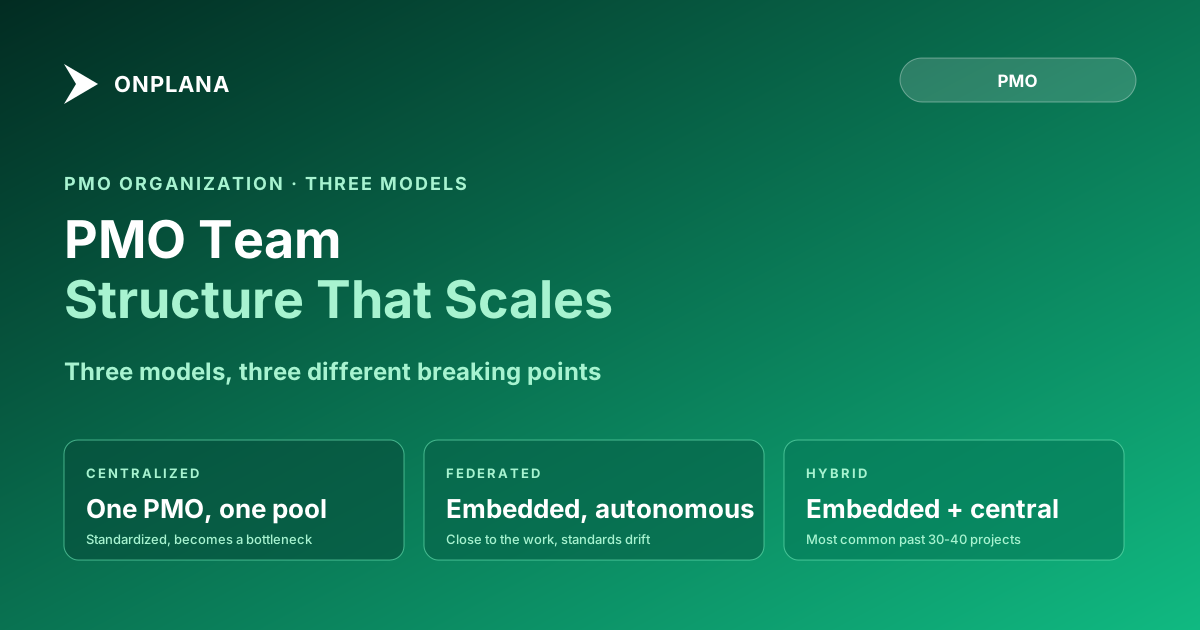
The direct answer: A centralized PMO structure puts all project managers under one PMO reporting line with shared standards and central resource allocation, trading proximity to the business for consistency. A federated PMO embeds PMs inside business units with only a light shared framework, trading standardization for proximity and speed. A hybrid PMO structure keeps PMs embedded for day-to-day work while a central function owns governance, tooling, and portfolio reporting, and is the most common fit above roughly 30-40 active projects because it captures most of both structures' benefits. The structure that worked at your last scale is not guaranteed to work at your current one; watch for bottleneck symptoms rather than assuming the model you started with is permanent.
The centralized PMO structure
A project management office can be structured along more than one axis; the supportive-controlling-directive spectrum describes how much authority a PMO exercises over individual projects, while the centralized-federated-hybrid question this post addresses describes where the PMs themselves sit organizationally. The two questions are related but answered separately, and conflating them is a common source of structural confusion.
A centralized PMO puts every project manager under one PMO reporting line, running one set of templates, one tool, one intake process, and one resource-allocation pool. The PMO director (or an equivalent) has direct authority over staffing decisions across the whole project portfolio.
Why it works. Standardization is close to free. Every project reports the same way, uses the same governance gates, and pulls from the same PM talent pool, which means the PMO can move a PM from a slowing project to an accelerating one without a negotiation across department lines. Portfolio-level reporting is trivial because the underlying data was never fragmented to begin with.
Where it breaks. Centralization scales in headcount before it breaks in structure, but it does eventually break: business units start to feel like they're getting a generic PM instead of someone who understands their specific domain, and the PMO becomes a queue. A marketing launch and a compliance remediation project pull from the same PM pool and get evaluated by roughly the same standard process, even though they need almost nothing in common from a PM. Above a certain project count and business-unit diversity, the central team physically cannot stay close enough to each business unit's context to add real value, and PMs start feeling like process administrators dropped into unfamiliar territory.
The federated PMO structure
A federated PMO embeds PMs directly inside the business units or departments, reporting primarily to that unit's leadership. A light shared framework, common templates, an occasional cross-PMO sync, a shared tool, connects them, but there's no central authority over staffing or standards enforcement.
Why it works. Proximity. A PM embedded in the engineering org for two years understands its constraints, culture, and stakeholders in a way a centrally dispatched PM never will inside a single project's lifecycle. Business-unit leadership gets a PM who feels like part of the team, not an outside resource assigned to them, which tends to produce faster trust and fewer stakeholder friction points.
Where it breaks. Standards drift, quietly and fast. Six months into a federated model, a portfolio-level status roll-up reveals that finance's PM tracks risk on a spreadsheet, engineering's PM uses a different tool entirely, and marketing hasn't updated their project charter template since it was copied from a conference slide deck two years ago. None of these PMs did anything wrong individually; nobody owned making sure they stayed comparable. Cross-project resource sharing also gets hard, because a federated PM reports to their business unit, not to a portfolio owner who can move them where the organization needs them most.
Why one person usually holds it together, until scale breaks that too
Small organizations don't really face this choice; a light, informal version of centralization, one PMO, a handful of PMs, shared everything by necessity, works fine below roughly 15-20 active projects because the coordination overhead is trivial at that scale. The structural decision starts mattering as both project count and business-unit diversity grow, and it becomes unavoidable somewhere between 30 and 60 active projects, which tracks closely with the same scale threshold where PMO Maturity Tiers research shows governance quality typically plateaus without a deliberate structural choice.
The hybrid PMO structure
A hybrid PMO structure embeds PMs in business units for day-to-day proximity and stakeholder relationships, while a central PMO function owns governance standards, the shared tool and templates, portfolio-level reporting, and PM career development and staffing pool management across the embedded PMs.
This is not a compromise in the weak sense; it's a deliberate split of two different jobs that the centralized and federated models each force into one structure. The embedded PM gets proximity and context. The central function gets standardization and the ability to see the whole portfolio clearly, without owning every PM's day-to-day relationship with their business unit.
The tradeoff hybrid accepts is coordination complexity: an embedded PM effectively has two masters, the business unit they sit inside and the PMO standard they're accountable to, and when those two pull in different directions (a business unit wants to skip a governance gate to hit a deadline, the central PMO won't allow it), the friction has to resolve somewhere. Organizations that run hybrid well write down, in advance, who wins that argument and under what conditions, the same discipline that separates a working portfolio manager and PMO director split from one where authority is never actually clear.
PMO team structure comparison
| Dimension | Centralized | Federated | Hybrid |
|---|---|---|---|
| PM reporting line | Central PMO | Business unit | Business unit, with central standards ownership |
| Standardization | High, close to uniform | Low, drifts by unit | High, enforced centrally |
| Business-unit proximity | Low to moderate | High | High |
| Cross-project resource flexibility | High | Low | Moderate |
| Coordination overhead | Low internally, high at business-unit interface | Low, until portfolio reporting is needed | Moderate, requires clear authority splits |
| Portfolio-level reporting | Easy, data is uniform | Hard, data is fragmented | Moderate, requires enforced tooling standard |
| Best fit | Smaller orgs, or ones needing tight compliance | Highly diverse business units, low cross-project dependency | Most PMOs above 30-40 active projects |
| Fails silently when mismatched | Business units route around the PMO | Standards and reporting quietly fragment | Authority disputes go unresolved between unit and PMO |
How do you know your structure has stopped fitting your scale?
The diagram above separates the two error directions, because the fix is different depending on which one you're seeing. A PMO becoming a bottleneck usually means a centralized structure needs to move toward hybrid: give business units more proximity without losing the reporting standard. Reporting quality diverging by team usually means a federated structure needs the opposite: add a thin central layer that owns standards without pulling PMs out of their business units entirely.
Migrating from one structure to another without losing what worked
The mistake most PMOs make restructuring is treating it as an announcement rather than a transition. Moving from centralized to hybrid means embedding PMs who have never reported to a business unit before, and moving from federated to hybrid means asking PMs who've had full autonomy for years to adopt standards they had no hand in setting. Either direction, done abruptly, produces resistance that looks like the new structure failing when it's actually the transition failing.
What works: pick a small number of PMs to move first, in the business units most likely to benefit and least likely to resist, and use that group to work out the authority splits (who decides on governance exceptions, who owns staffing, who resolves disputes) before rolling the structure out portfolio-wide. Document the RACI matrix that comes out of that pilot the same way a clean portfolio manager vs PMO director split needs a written boundary before the first real conflict tests it, because an undocumented structural change just relocates the ambiguity instead of resolving it.
Building the structure decision on evidence, not preference
The structure debate inside a PMO is often really a preference debate in disguise: a PMO director who came up through a centralized model tends to default to recommending one, and a PMO built by a federated-model veteran tends to drift federated regardless of whether either fits the organization's actual shape. The evidence that should drive the decision is structural, not personal: how diverse are the business units being served, how many active projects need cross-unit resourcing, and how much reporting inconsistency the organization can actually tolerate before decisions start getting made on bad data.
The PMO Maturity Assessment surfaces this gap directly by scoring governance and reporting consistency against your PMO's actual current state, which is a faster and more honest signal than any structural preference. PMOs that score low on the governance dimension are frequently running a structure that fit their organization two scale-jumps ago and never got revisited, not a structure that was wrong from the start.
Run the free PMO Maturity Assessment Fifteen questions across process, tooling, governance, risk, and reporting. Get a tier read and a specific signal on whether your PMO's structure still fits its current scale. About ten minutes, no signup. → Open the assessment
Frequently asked questions
What are the three main types of PMO team structure?
Centralized (all PMs report into one PMO with shared standards and central resource allocation), federated (PMs sit embedded in business units with a light shared framework), and hybrid (a central PMO owns governance and reporting standards while PMs stay embedded and report locally). Each fits a different organizational shape and scale.
Which PMO team structure is best?
None is universally best. Centralized fits organizations that need tight standardization and can accept the coordination overhead. Federated fits organizations where business units have distinct enough needs that a shared standard would create constant friction. Hybrid fits most PMOs above a moderate scale because it keeps standards consistent without forcing every PM through one central bottleneck.
How do I know if my PMO has outgrown its current structure?
Watch for three signals: the PMO becomes a bottleneck business units route around informally, reporting quality diverges sharply across teams because there's no shared standard, or the PMO's centralized team can no longer stay close enough to the work to catch problems early. Any one of these, sustained for more than a quarter, signals a structural mismatch.
What is a federated PMO?
A federated PMO embeds project managers directly inside the business units or departments they serve, reporting primarily to that unit's leadership, with only a light shared framework (common templates, occasional cross-PMO syncs) connecting them. It trades standardization for proximity to the work.
What is a hybrid PMO structure?
A hybrid PMO keeps project managers embedded in business units for day-to-day work and stakeholder proximity, while a central PMO function owns governance standards, tooling, portfolio-level reporting, and PM career development across the embedded PMs. It's the most common structure above roughly 30-40 active projects because it avoids the coordination overhead of full centralization without losing standardization entirely.
How many projects justify a dedicated PMO structure decision?
Below roughly 15-20 active projects, structure matters less than having any PMO at all, and a light centralized model usually works fine. The structural choice starts mattering as project count and business-unit diversity both grow, typically becoming a real decision somewhere between 30 and 60 active projects.
Ready to make the switch?
Start your free Onplana account and import your existing projects in minutes.