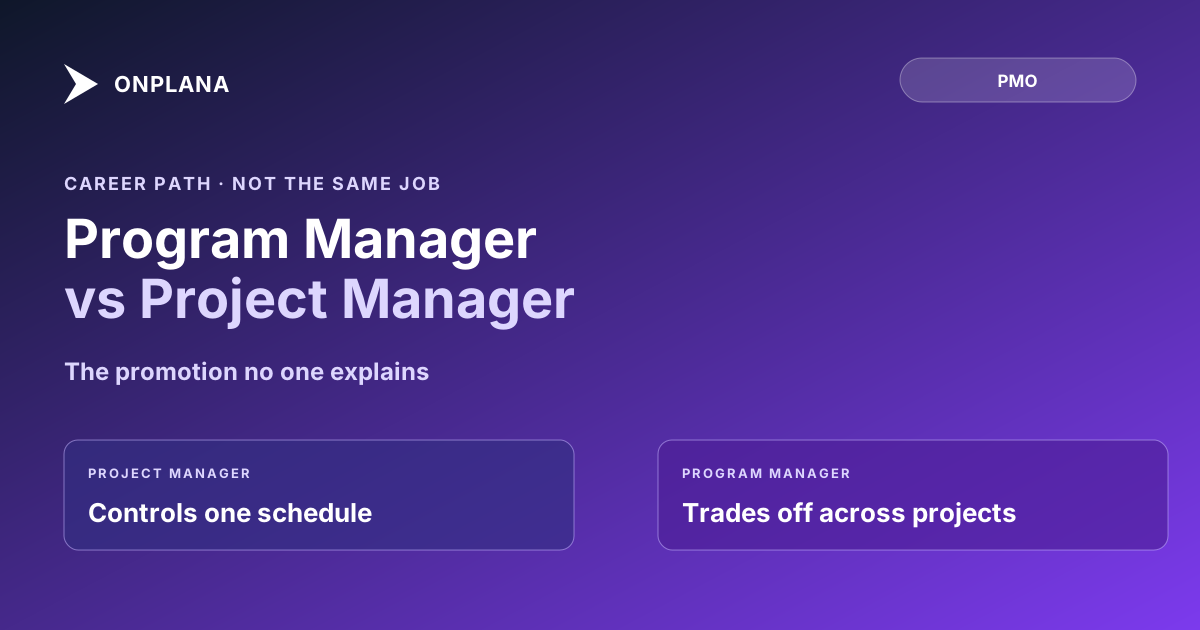
Program Manager vs Project Manager: The Promotion No One Explains
Program manager vs project manager isn't a seniority ladder. The two roles need different instincts, and the 'more of the same' promotion breaks both.
A strong project manager gets promoted to program manager, and six months later the company quietly wonders if they made a mistake. This is the program manager vs project manager problem in miniature: the new program manager is still excellent by every measure that mattered in their old job, schedules stay current, risks get logged, status reports go out on time, but the three projects under them are drifting in different directions, resources are double-booked across two of them, and nobody can say which project should win when they both need the same senior engineer next sprint. The person didn't get worse at their job. They got promoted into a different job and kept doing the old one.
This is the recurring failure in how organizations handle the transition. They treat it as a seniority ladder: do project management well enough, long enough, and you get handed a program. But program management isn't project management at a bigger scale. It rewards a different set of instincts, and the skills that made someone an excellent PM don't automatically transfer.
The direct answer: A project manager delivers one project: a single schedule, budget, team, and defined end state. A program manager coordinates a group of related projects to realize a strategic benefit that no individual project delivers alone, spending most of their time on prioritization, resource tradeoffs, and dependency management across projects rather than task-level execution within one. The project manager's success metric is "did this project hit scope, schedule, and budget." The program manager's success metric is "did the group of projects, collectively, produce the business outcome," even if that means one component project runs over budget because the program benefited more from accelerating another.
What a project manager actually owns
The project manager role is scoped tightly around a single, bounded piece of work.
One schedule, one budget, one team. The PM tracks a specific set of tasks against a specific timeline and a specific budget, with a team whose members are (mostly) dedicated to this one effort. The unit of accountability is the project itself.
Execution discipline. Sequencing tasks, managing the critical path, running status meetings, escalating blockers, keeping the schedule honest against what's actually happening rather than what the plan said would happen. This is detail work, and doing it well requires sustained attention to a bounded set of moving parts, the same discipline that separates a Defined-tier PMO from one still running Ad-Hoc.
A defined end state. Projects end. A PM knows what "done" looks like: a specific deliverable, a specific go-live date, a specific set of acceptance criteria. Success is measurable against that fixed target.
Team-level leadership. Motivating, unblocking, and coordinating the specific people assigned to this project, day to day, for the duration of the effort.
None of this is small work. It's just bounded work, and the boundary is the whole point: a PM's authority and attention are calibrated to a single project, and that focus is what makes them effective at it.
What a program manager owns that a project manager should not
Prioritization across projects that compete for the same resources. When two component projects both need the same senior architect next month, someone has to decide which project gets them and accept the consequence for the other. No individual PM has the authority or the visibility to make that call fairly; it requires seeing both projects' full context, which is exactly the program manager's job.
Benefit realization above any single deliverable. A program exists to produce a strategic outcome, market entry, a platform migration, a regulatory compliance target, that no single project delivers alone. This is the core distinction program management as a discipline is built around: a program aligns a group of projects to organizational strategy, while a project aims at a specific, bounded deliverable. The program manager tracks whether the group of projects, together, is still on track to produce that outcome, even as individual projects speed up, slow down, or get reshaped along the way.
Cross-project dependency management. When Project A's output is Project B's input, the program manager is the one who sees that dependency chain end to end. Individual PMs see their own project's dependencies; they rarely have visibility into a sibling project's schedule risk until it's already affecting them.
Governance and stakeholder alignment at the portfolio level. Programs typically report to a steering committee or executive sponsor whose interest is the strategic outcome, not any single project's schedule variance. The program manager translates project-level detail into a picture that governance body can actually act on.
Why the program manager vs project manager promotion so often goes wrong
The failure pattern is consistent enough to name directly: a company promotes its best PM to program manager and expects the same behaviors that made them successful, just applied to more things at once. That's the wrong model. Program management isn't "project management times three." It requires a different relationship with control.
A project manager's instinct, correctly, is to reduce ambiguity: pin down the schedule, close out open questions, drive toward a defined end state. A program manager operates permanently in ambiguity that doesn't fully resolve: priorities shift as market conditions change, one component project's scope cut is the right call even though it looks like a failure on that project's own scorecard, and the program manager has to make that tradeoff and defend it to people who only see the piece that got cut.
New program managers who were excellent PMs often try to resolve this discomfort the way they know how: by controlling harder. They run detailed status meetings for every component project, second-guess the component PMs' scheduling decisions, and try to personally track task-level detail across three projects at once, which is not a job any human can do well. The component PMs experience this as being micromanaged by someone who no longer trusts them, and the actual program-level work, prioritization, tradeoffs, dependency management, doesn't happen because the new program manager is too busy re-doing project management at a scale that doesn't fit in one person's attention.
A concrete version of this: a company runs three related projects toward one platform launch, each with its own PM, each hitting its own milestones cleanly. The newly promoted program manager, six weeks in, is still running each project's weekly status meeting personally, on top of the PMs' own meetings, because letting go of that visibility feels like losing control. What doesn't happen in those six weeks: nobody decides which of the three projects gets the one available database engineer when all three need that person the same week, because that decision requires stepping back from all three schedules at once, and the program manager hasn't had a free hour to do it. The launch slips by three weeks, not because any individual project failed, but because the one decision that only a program manager could make never got made.
Does a program manager manage the project managers?
Not usually as their line manager, and the distinction matters more than it sounds. In most matrix organizations, each component project's PM continues reporting through their own functional chain or PMO, while the program manager coordinates them without formal authority over their performance reviews or staffing.
What the program manager does have is decision authority over shared priorities: which project gets a contested resource, how a scope change in one project should be absorbed to protect the program's overall benefit, and how conflicting deadlines across projects get resolved. That authority works because it's scoped narrowly to cross-project questions, not because the program manager outranks the PMs on their own projects. A program manager who tries to direct a component PM's day-to-day task sequencing is stepping outside their actual authority and will find the PM (correctly) resistant to it.
How do you know your organization actually needs one?
The scale question has a cleaner answer than most people expect. You need a program manager when three or more related projects are competing for the same resources, share dependencies that cross project boundaries, or are jointly accountable for one business outcome that no single project owns alone, and no one currently has explicit authority to make the tradeoffs between them.
Below that threshold, a strong PM with good stakeholder management skills usually covers the coordination informally, project sponsors align priorities directly, and the overhead of a dedicated program role isn't justified. The mistake runs in both directions: adding a program manager to two loosely related projects creates a layer of coordination nobody needed, while leaving four interdependent projects without one means the resource conflicts and dependency risks get discovered late, usually by whichever PM's schedule breaks first.
The role comparison
| Dimension | Project manager | Program manager |
|---|---|---|
| Scope | One project | A group of related projects |
| Primary skill | Execution discipline, schedule control | Prioritization judgment, tradeoff-making |
| Success metric | Did this project hit scope, schedule, budget | Did the group of projects produce the strategic benefit |
| Time horizon | The project's lifecycle | Ongoing, often without a single fixed end date |
| Comfort with ambiguity | Works to eliminate it | Operates inside it permanently |
| Resource authority | Manages assigned team members | Arbitrates resource conflicts across projects |
| Typical reporting line | Reports to a sponsor or PMO | Reports to a steering committee or executive |
| Fails silently when missing | Task-level execution drifts | Cross-project conflicts go unresolved, benefit realization stalls |
Is this actually a promotion, or a different job?
The diagram above is the honest version of the readiness conversation most organizations skip. Years of PM experience and a clean delivery record answer the wrong question. They predict whether someone can run a tight, well-controlled project, which is valuable and not the same skill. The right question is whether the person can make a call that looks bad on one project's scorecard because it's the correct call for the program, and then stand behind that decision when the component PM (rightly) pushes back. Some excellent PMs can do this. Some can't, and staying an excellent PM is a better outcome for them and the organization than a program role that fights their instincts every day.
Building a program manager who doesn't just re-run project management
Organizations that make this transition well do three things differently from ones that don't.
They separate the promotion conversation from the skill conversation. "You've earned more responsibility" and "you have the specific judgment this role requires" are different claims, and conflating them is how a company ends up disappointed in someone who did nothing wrong except get promoted into a mismatch.
They give the new program manager explicit authority over prioritization before the first conflict happens, not after. A program manager who has to negotiate their authority to arbitrate resource conflicts in real time, mid-conflict, loses credibility with the component PMs regardless of how sound their judgment is. The authority should be established at program kickoff: this person makes the cross-project call, escalation goes to the steering committee, not around the program manager to individual PMs.
They measure program managers on the right metric from day one. If a program manager is evaluated on the aggregate schedule variance of every component project, they'll behave like a project manager managing three projects, which is the exact failure mode described above. If they're evaluated on whether the strategic benefit landed, on time and on budget, at the program level, even if that meant reshaping individual projects along the way, they'll behave like a program manager.
The PMO Maturity Assessment surfaces whether an organization has this distinction formalized at all. PMOs that score low on governance dimensions very often haven't separated program-level and project-level accountability anywhere in writing, which means every program manager transition gets re-litigated informally, the same way every project sponsor vs project manager boundary gets re-litigated without a documented RACI. The gap shows up as the same symptom in both cases: a role that exists on the org chart with no explicit description of what authority actually comes with it.
Program and project management aren't points on the same ladder. They're adjacent disciplines that happen to share a job title pattern, and an organization that promotes people up that ladder without checking whether the underlying skill actually transfers is setting its best PMs up to look like they failed at something they were never actually trained to do.
Where the program layer is formalized for agile teams, the Scaled Agile Framework names the equivalent role the Release Train Engineer.
Run the free PMO Maturity Assessment Fifteen questions across process, tooling, governance, risk, and reporting. Get an honest tier read and a specific recommendation on where role clarity is costing you, in about ten minutes. No signup required. → Open the assessment
Frequently asked questions
What is the difference between a program manager and a project manager?
A project manager delivers a single project: one schedule, one budget, one team, one defined end state. A program manager coordinates a group of related projects to realize a strategic benefit that no single project delivers alone, and spends most of their time on cross-project tradeoffs rather than task-level execution.
Is program manager a promotion from project manager?
It's usually offered as one, but it's a different job, not a bigger version of the same job. A PM who excels at schedule discipline and team execution can struggle in a program role that rewards prioritization judgment and comfort with ambiguity instead.
Does a program manager manage project managers?
Often, but not as their line manager in most matrix organizations. The program manager coordinates the PMs running the component projects, sets shared priorities, and resolves cross-project conflicts, while each PM usually still reports through their own functional or PMO chain.
What skills does program management require that project management doesn't?
Strategic prioritization under ambiguity, the ability to make tradeoffs across projects with competing claims on the same resources, and comfort operating without a single fixed schedule to control. Project management rewards precision and control; program management rewards judgment calls with incomplete information.
How do you know if your organization needs a program manager?
When you have three or more related projects competing for the same resources, sharing dependencies, or jointly responsible for one business outcome, and no one person owns the tradeoffs between them, you need a program manager. Below that scale, a strong PM with good stakeholder skills usually covers it.
What happens when someone is promoted to program manager without the right skill set?
They default to managing the program the way they managed their best project: chasing schedule variance, running detailed status meetings, and trying to control every project the way they used to control tasks. The component PMs get micromanaged, the strategic tradeoff work that actually needed a program manager doesn't get done, and the promotion reads as a failure that was actually a role mismatch.
Ready to make the switch?
Start your free Onplana account and import your existing projects in minutes.