Project Retrospectives That Actually Change Behavior
A project retrospective that produces a complaint list and no follow-through is theater. Here's the format and follow-up mechanism that actually work.
Most retrospectives are theater. Fifteen minutes on what went well, fifteen on what didn't, one action item scribbled on a sticky note that nobody looks at again, and the team goes back to work exactly as it did the sprint before. The meeting happened. Nothing changed.
A project retrospective that doesn't change behavior isn't a lightweight version of a good retrospective. It's a different activity wearing the same name: a venting session with a timer, useful for morale in small doses and worthless for the thing retrospectives actually exist to do, which is stop a team from repeating the same avoidable mistake three sprints in a row.
TL;DR. A retrospective that changes behavior needs three things most retrospectives skip: a format matched to what the team actually needs to surface, a facilitation approach that gets past safe, surface-level answers, and a small number of owned, deadlined action items that get checked at the start of the next session. Skip any one of the three and the retrospective degrades back into a complaint list nobody acts on. None of this is Scrum-specific; waterfall and hybrid teams need the same discipline at their own phase boundaries.
Why Most Project Retrospectives Produce Venting Instead of Change
A retrospective that produces venting instead of change is usually missing one specific ingredient: a decision. The team says "communication was inconsistent this sprint," everyone nods, and the meeting moves on. That sentence describes a feeling, not a decision. Nobody knows what changes tomorrow because of it.
The gap between an observation and a decision is where most retrospectives quietly fail. "Communication was inconsistent" is an observation. "Any change to a task's scope gets posted in the project channel within the hour, not just mentioned in standup" is a decision. The second sentence tells someone exactly what to do differently. The first just names a problem everyone already half-knew about and leaves the room no better equipped to fix it than they were walking in.
The second common failure is diffusion of ownership. A retrospective that produces action items assigned to "the team" instead of a named person produces action items nobody does, because everyone assumes someone else has it. Both failures compound: an unowned observation with no decision attached is the retrospective equivalent of a risk with no mitigation plan or trigger condition, noted, discussed, and then forgotten the moment the meeting ends.
Choosing a Retrospective Format That Surfaces Real Issues
Whatever format you pick, the output is a set of action items, and tracking action items as owned tasks is what decides whether any of them happen. The format is not decoration. Different formats are built to surface different kinds of problems, and running the same format every time trains a team to give the same shallow answers every time.
Start-Stop-Continue works for routine tuning on a team that's basically healthy: what should we start doing, what should we stop, what's working and should continue. It's fast, low-friction, and good for a team in a steady rhythm that just needs a regular tune-up.
The Sailboat (or Speedboat) exercise asks the team to name the wind pushing the project forward, the anchor dragging it down, the rocks ahead representing risks, and the island representing the goal. It's better than Start-Stop-Continue at surfacing systemic drag, things slowing the team down that aren't any one person's fault, because the metaphor separates "what's holding us back" from "who messed up."
The 4Ls (Liked, Learned, Lacked, Longed For) works well after a difficult phase or a project with real emotional weight, a missed deadline, a painful launch, a reorg mid-project. It gives space to what the team learned and what they wished they'd had, which surfaces gaps a more clinical format skips past.
Mad-Sad-Glad is the format to reach for when a team is carrying unresolved frustration that a purely tactical format won't surface, because it explicitly asks for the emotional read on the period, not just the operational one.
Rotate formats every few retrospectives even on a healthy team. A team that always runs Start-Stop-Continue eventually gives the same three answers by rote, because the format itself has stopped prompting anyone to think differently about what happened.
How Do You Get Past the Safe, Surface-Level Answers?
Every team has a default set of safe answers: praise the people who are in the room, avoid naming a specific decision that went badly if the person who made it is present, keep criticism aimed at process rather than people. These answers aren't dishonest exactly; they're the answers a group gives when it doesn't feel safe enough to give the real ones.
Anonymous input before the meeting surfaces what a live discussion won't. A short written prompt sent out before the retrospective, answered privately, gets more candid answers than the same question asked out loud in a room with the people involved in the problem sitting across the table. Aggregate the anonymous answers and bring the patterns, not individual quotes, into the live session.
Ask "what surprised us" instead of "what went wrong." Surprise is a less loaded question than blame, and it tends to surface the same underlying issues, a dependency nobody flagged, an estimate that was off by three times, without triggering the defensiveness that "what went wrong" invites.
Separate the facilitator from anyone with a stake in the outcome. A retrospective facilitated by the PM whose planning decisions are under discussion rarely gets candid feedback about those decisions. Rotating facilitation, or using a Scrum Master whose role is explicitly process-focused rather than delivery-accountable, removes that chilling effect.
Name the pattern, not the person, when raising something specific. "Three of the last four sprints had a story blocked on an external dependency we didn't flag in planning" invites a process fix. "Priya's stories keep getting blocked" invites a defensive response and shuts down the discussion before it produces anything useful.
Turning Observations Into Action Items That Survive the Next Two Weeks
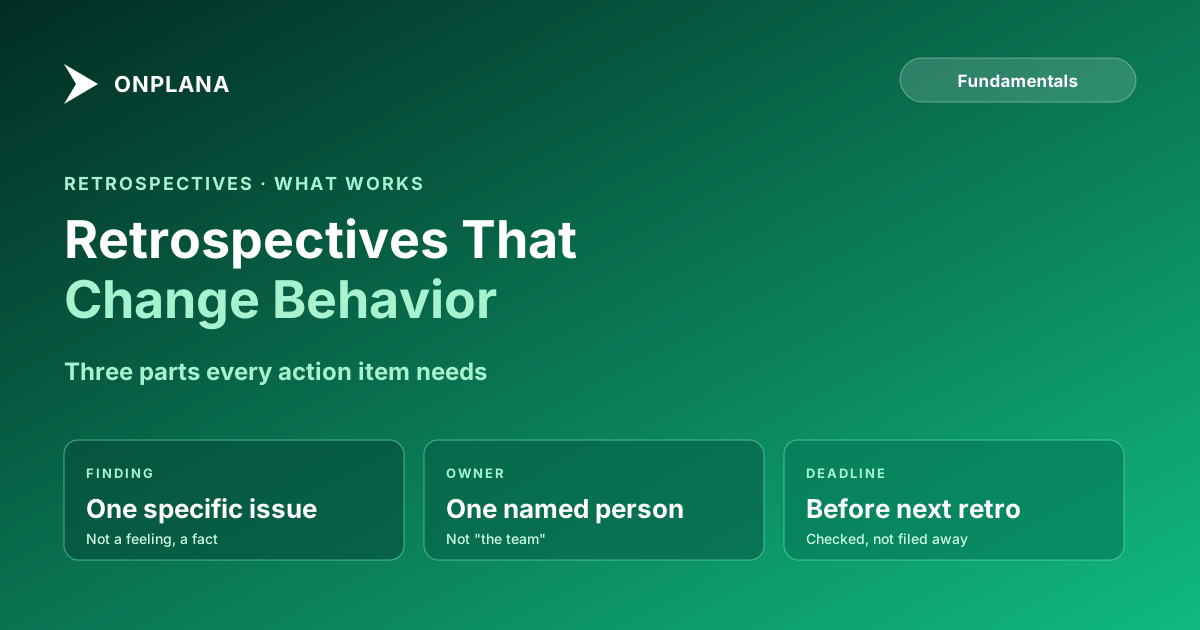
An observation becomes an action item when it has three parts, and a retrospective that skips any of them is producing decoration, not a plan.
- A specific decision, not a general intention. "Improve communication" is not an action item. "Post any scope change in the project channel within one hour of the change happening" is.
- A single named owner, not "the team." Diffuse ownership is how a good idea from a retrospective quietly dies before the next one.
- A deadline before the next retrospective, so the item has a natural checkpoint instead of drifting indefinitely.
- A visible tracking location that isn't the retrospective notes document itself, since that document typically doesn't get reopened until the next retrospective rolls around.
Cap the list at two or three action items per retrospective. A retrospective that generates ten action items generates roughly zero completed action items, because attention and accountability spread too thin to finish any of them. Pick the two or three with the highest leverage, the ones addressing a pattern that's shown up more than once, and let smaller one-off observations go without a formal action item attached.
The diagram above shows the same three observations handled two different ways. The left side is where most retrospectives stop: the discussion happened, and nothing after the discussion changes. The right side turns two of the highest-leverage observations into decisions with owners and deadlines, dropping the rest rather than diluting attention across every item raised.
Who Owns Follow-Through, and How Do You Make It Visible?
Follow-through has to be owned by someone whose job includes checking it, not just the person who volunteered to take the action item. In Scrum, that's usually the Scrum Master, whose role is explicitly about protecting the team's process, not shipping a specific deliverable. On non-Scrum teams, the PM or a designated facilitator plays the same role: opening the next retrospective by reviewing what happened to last time's action items before generating new ones.
Visibility is what actually drives follow-through, more than accountability pressure does. An action item tracked in the same tool the team already uses for its regular work, not a separate retrospective-notes document that only gets opened once every two weeks, stays in view. The same status reporting discipline that keeps a weekly update honest applies here: a commitment that only lives in one document nobody revisits functions the same as a commitment that was never made.
Opening every retrospective with a 5-minute review of the previous session's action items, done, in progress, or dropped and why, does more to change team behavior over time than any single retrospective format choice. It signals, concretely, that the last conversation mattered enough to check on. Teams that skip this step are implicitly telling themselves that retrospectives are a ritual, not a mechanism, and they adjust their candor accordingly.
How Often Should a Team Run Retrospectives?
Agile teams typically run a retrospective at the end of every sprint, which the Scrum Guide timeboxes to a maximum of three hours for a one-month sprint, scaled shorter for shorter sprints; a two-week sprint's retrospective usually runs 45 minutes to 90 minutes. That cadence works because it matches the feedback loop: a problem surfaced this sprint gets addressed before it repeats twice more.
Teams not running sprints still need a regular interval, just anchored to a different unit. Phase gates, monthly checkpoints, or major milestones all work as the trigger, as long as the interval between retrospectives isn't so long that three or four problems have already compounded by the time the team looks back at any of them. The specific interval matters less than the fact that there is one, on the calendar, that doesn't get skipped when the team is busy, which is exactly when a retrospective is most needed.
Do Waterfall and Hybrid Teams Need Retrospectives Too?
Yes, and treating retrospectives as an Agile-only artifact is one of the more expensive category errors in project management. A waterfall project still has phases, still has planning assumptions that turn out wrong, and still benefits from a structured look-back before the next phase repeats an avoidable mistake from the last one. The only thing that changes is the trigger: instead of every sprint, run one at every phase gate, every major milestone, or at minimum once per quarter on a long-running project.
Hybrid teams, running Agile execution inside a waterfall-governed portfolio, often already have the sprint-level retrospective covered and skip the phase-level one, missing the pattern that only shows up across multiple sprints: a resourcing conflict that recurs every time a new phase starts, a stakeholder approval step that consistently adds a week nobody planned for. The sprint retrospective catches what went wrong this sprint. The phase retrospective catches what keeps going wrong every time a phase starts, which no single sprint-level session is positioned to see.
Common Mistakes That Turn a Retrospective Into Theater
Running the same format every single time. A team that always does Start-Stop-Continue eventually gives the same rote answers, because the format has stopped prompting new thinking.
Letting the person accountable for the problem facilitate the discussion of it. Candor drops sharply when the facilitator has a stake in how the conversation concludes.
Generating more than three action items. Attention and ownership spread too thin to finish any of them, and the retrospective quietly becomes a wish list instead of a plan.
Assigning action items to "the team" instead of a named owner. Diffuse ownership is functionally the same as no ownership.
Never opening the next session by reviewing what happened to the last session's action items. This is the single biggest signal to a team about whether retrospectives matter, and skipping it is the fastest way to convince people they don't.
Treating retrospectives as Agile-only. Waterfall and hybrid teams that skip them repeat the same phase-level mistakes project after project, with nobody ever running the session that would have caught the pattern.
A retrospective that changes behavior isn't a longer meeting or a fancier format. It's the same fifteen minutes of honest observation, followed by two owned decisions instead of ten unowned ones, checked at the start of the next session instead of filed and forgotten. That check-in is the entire mechanism. Everything else is facilitation technique in service of getting there.
The highest-leverage findings from a retrospective are also worth a second life beyond the team that generated them. A pattern that recurs across several sprints, once it's specific and actionable enough, belongs in the kind of lessons-learned entry that a future PM can actually apply instead of staying buried in one team's meeting notes.
Frequently asked questions
What is a project retrospective?
A project retrospective is a structured team session that inspects a recently completed period of work, a sprint, a phase, or a whole project, to identify what should change before the team repeats the pattern. It differs from a status update because it looks at how the team worked, not just what got delivered.
Why do most retrospectives fail to change anything?
Most retrospectives produce a list of observations with no owner and no deadline attached, so the list quietly disappears between sessions. Without a small number of owned, tracked action items, a retrospective is a venting session, not a change mechanism.
What is the best retrospective format?
There is no single best format; the right one depends on what the team needs to surface. Start-Stop-Continue works for routine tuning, the Sailboat exercise works when a team needs to name what's dragging it down versus what's driving it forward, and the 4Ls (Liked, Learned, Lacked, Longed For) works well after a difficult or high-stakes project phase.
How often should a team run retrospectives?
Agile teams typically run one at the end of every sprint, every one to four weeks. Teams not running sprints should still run one at every major milestone or phase gate, because the interval between retrospectives is really the interval between opportunities to catch a repeating problem.
Do waterfall or hybrid teams need retrospectives?
Yes. A retrospective is not a Scrum-only artifact; it's a structured look-back that any team benefits from at phase boundaries. Waterfall and hybrid teams that skip retrospectives because they're 'not doing Agile' repeat the same planning and coordination mistakes across every phase and every project.
How many action items should come out of a retrospective?
Two or three at most, each with a named owner and a deadline before the next retrospective. A retrospective that produces ten action items produces zero completed action items, because ownership and attention diffuse across too many items to track any of them.
What is the difference between a retrospective and a lessons-learned document?
A retrospective is the live team session that generates candidate lessons. A lessons-learned document is the curated, specific output of that session, written so a future team can act on it without having attended the original meeting.
Ready to make the switch?
Start your free Onplana account and import your existing projects in minutes.