How to Measure Migration Success After a Project Online Cutover
Cutover weekend went fine. Measure migration success with the six-metric scorecard that tells a sponsor whether it actually worked, 30, 60, and 90 days out.
Cutover weekend went fine. Every project imported, the new tool rendered, nobody filed an emergency ticket. That is the sentence every migration team wants to say, and it is also, on its own, meaningless. Cutover weekend measures whether the data moved. To measure migration success, you need a different set of numbers, ones that aren't answered by a calm Saturday; they're answered 30, 60, and 90 days later, with evidence, not with a memory of how quiet the go-live channel was.
Most PMOs never build that second measurement. They declare the migration done at cutover, move the project team to the next initiative, and only discover months later, when a sponsor asks an uncomfortable question in a steering committee, that half the portfolio is still tracked in a shadow spreadsheet. The gap between "the migration technically finished" and "the migration actually worked" is exactly where this scorecard belongs.
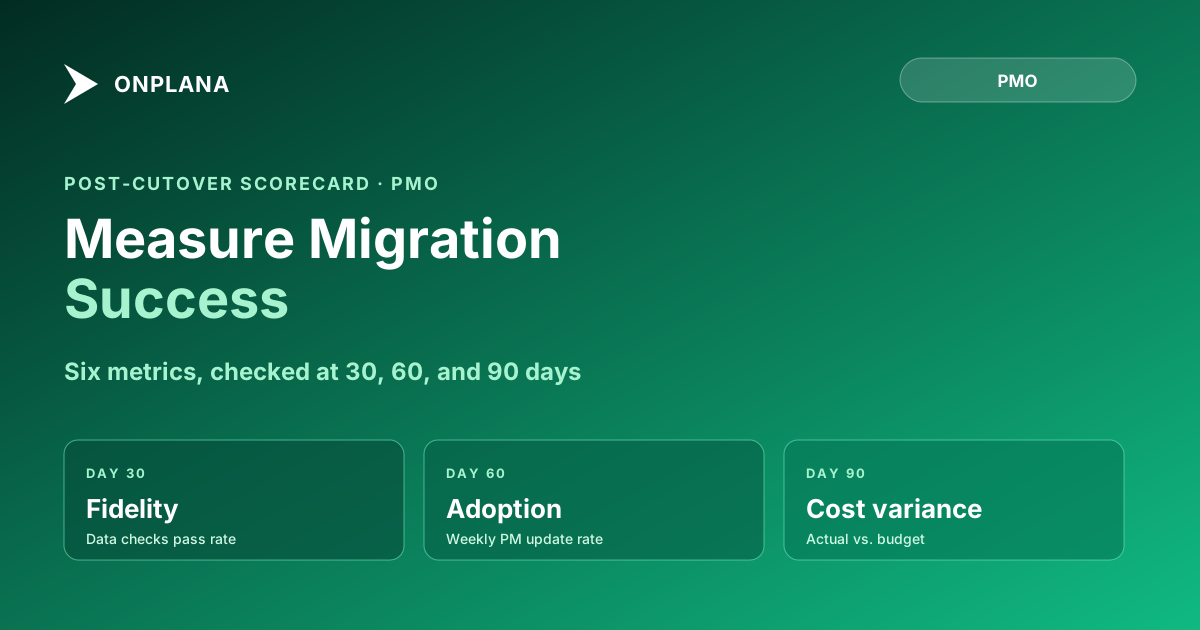
Measure migration success with six numbers, tracked at 30, 60, and 90 days: data fidelity rate, PM adoption rate, report parity, time-to-first-value, support-ticket volume, and cost variance against the migration budget. Cutover weekend only tells you the first of these looks plausible. The other five take weeks to show a real trend, and a sponsor-facing scorecard built on all six replaces "it went well" with evidence a PMO director can defend eighteen months later.
Why Cutover Weekend Doesn't Tell You Whether the Migration Worked
A cutover weekend is a technical event with a technical pass condition: did the data import without failing, and can people log in. Both are necessary and neither is sufficient. Data can import perfectly and PMs can still keep two systems running for months out of habit. A migration that "worked" on the only metric anyone measured that weekend can still be a quiet failure by day 90.
This is the same distinction covered in why Project Online migrations fail: the failures that show up on cutover weekend are loud (an import error, a login problem) and get fixed immediately because someone notices. The failures that show up later are quiet (a PM who never really switched over, a report nobody trusts) and don't announce themselves the same way. A scorecard is how a PMO catches the quiet failures on a schedule, instead of discovering them by accident in month four.
How Do You Measure Migration Success?
Measure migration success with six metrics, watched together rather than in isolation, because they answer the question a sponsor is actually asking, which is rarely "did the data move" and almost always "can I trust this system now."
| Metric | What it measures | Healthy target | Where the data comes from |
|---|---|---|---|
| Data fidelity rate | Percentage of migrated projects passing the full validation audit | 100% before any project is reported on | Post-migration data audit |
| PM adoption rate | Percentage of active projects updated weekly in the new tool | 90%+ by day 30, full by day 60 | Tool login and update logs |
| Report parity | Rebuilt dashboards matching prior reports within tolerance | Within 5% variance on key KPIs | Side-by-side dashboard comparison |
| Time-to-first-value | Days until a PM completes a real task in the new tool unassisted | Under 5 business days per PM | Onboarding and usage tracking |
| Support-ticket volume | Weekly ticket count, trend and clustering | Declining trend by week 6 | Help desk or support queue |
| Cost variance | Actual migration spend versus budget | Within 10% of the approved budget | Finance/PMO cost tracking |
The diagram below places these six metrics on the 30/60/90-day timeline where each one becomes meaningful, since checking data fidelity at day 90 or adoption at day 3 both produce noise instead of signal.
Data Fidelity Rate: The First Number That Matters
Data fidelity rate is the percentage of migrated projects that pass a structured audit: task counts, dependency types with lag, baseline snapshots, custom field values, and resource assignments, all checked against the Project Online source. The full mechanics of running that audit are covered in validating data after a Project Online migration; this scorecard just needs the pass rate as a single number, tracked over time.
Target 100 percent before any project is reported on. A migration that lets projects with failed data checks flow into status reports anyway is manufacturing bad decisions on a schedule, and the fidelity rate is the number that catches it before a sponsor does.
Adoption Rate: The Number Cutover Weekend Can't Show You
Adoption rate is the percentage of active projects showing a real weekly update from their actual PM, not a delegate catching the tool up after the fact. This is the metric that most directly separates a migration that stuck from one that didn't, and it can only be measured after cutover, because there's no adoption to track before people start actually working in the tool.
The mechanics of driving this number up, champions cohorts, a hard cutoff on old-tool access, training that survives contact with a real Monday, are covered at length in driving adoption after a PM tool migration. For this scorecard, the number itself is what matters: below 70 percent at day 30 is an adoption problem serious enough to escalate, not a rounding error to wait out.
Report Parity and Time-to-First-Value
Report parity asks a narrower but equally important question: do the rebuilt dashboards match, within a reasonable tolerance, what the same reports showed before cutover. A migration can have perfect underlying data and still lose sponsor trust if the executive dashboard shows numbers that look different from what they're used to seeing, with no explanation for the gap. Target a variance ceiling of five percent on core KPIs like project status counts and budget-versus-actual; anything wider needs an explanation attached, not a silent discrepancy.
Time-to-first-value measures something more human: how many business days pass before a given PM completes a real task in the new tool without help. A PMO that takes two weeks per PM to reach this point has an onboarding problem that will show up later as an adoption problem; a PMO averaging under five business days is converting training into actual competence quickly enough that the tool starts paying for itself inside the first month.
How Do You Account for Cost Variance Against the Migration Budget?
Cost variance compares actual migration spend, license overlap during parallel running, consultant fees, training time, contingency draws, against the approved budget. This is the metric most likely to get quietly ignored because the technical team isn't the one holding the budget, but it's exactly the number the CFO will ask about in the 90-day readout regardless of whether anyone tracked it along the way.
Pull actuals monthly rather than waiting for a single reconciliation at the end. A migration running 15 percent over budget by day 30 is a trend a PMO can still manage; the same 15 percent overrun discovered for the first time at day 90 is a surprise nobody can do anything about. For the mechanics of building the original budget this variance gets measured against, see calculating ROI on a Project Online migration and the broader CFO-proof business case this scorecard eventually reports back to.
Building the 30/60/90 Day Scorecard for Your Sponsor
- Set targets before cutover, not after. Agree on the healthy thresholds for all six metrics with the sponsor before go-live, so the day-30 report isn't the first time anyone discusses what "success" means numerically.
- Pull the same six numbers every checkpoint. Consistency matters more than precision; a sponsor needs to see a trend line across three reports, not three different-looking updates.
- Report the trend, not just the snapshot. A single data point ("adoption is at 75 percent") is less useful than the same number shown alongside day 30 and day 60, because the direction of travel tells the sponsor whether to worry.
- Flag any red metric with a specific plan, not a general reassurance. "Cost variance is at 18 percent because parallel running extended four weeks past the planned cutoff; here's the recovery plan" is a report a sponsor can act on.
- Close the migration formally at day 90. Use the scorecard as the sign-off document. A migration that's still open past day 90 without a clear reason is usually one where the PMO hasn't been willing to say out loud that it isn't finished.
What a Failed Score Actually Means
A scorecard that's red on one metric at day 30 is normal; migrations rarely land every number perfectly on the first check. A scorecard that's still red on the same metric at day 60, with no improvement, means the underlying cause hasn't been addressed, and it's very unlikely to self-correct by day 90.
Treat each metric's failure mode differently. A data fidelity miss is a re-audit-and-fix problem, bounded and mechanical. An adoption miss is a change-management problem that needs the champions-and-cutoff intervention, not more documentation. A cost variance miss needs a conversation with finance now, while there's still budget flexibility, rather than at the final reconciliation when the only options are absorbing the overrun or explaining it after the fact.
The scorecard's real value isn't the green numbers. It's that a red number gets named specifically, with a cause and a plan, at day 30 instead of surfacing as a vague sense of dysfunction at day 90 that nobody can trace back to a root cause.
Run the free Migration Cost Calculator to set the cost-variance baseline this scorecard measures against before cutover, and the PMO Maturity Assessment at each 30-day checkpoint to get an independent read on whether the PMO's tooling and process are tracking toward the target state or drifting from it.
Run the free Migration Cost Calculator Model your migration budget line by line so the cost-variance metric in this scorecard has a real baseline to compare against at day 30, 60, and 90. No signup required. → Open the Migration Cost Calculator
Microsoft's Project Online lifecycle page confirms the service retired on September 30, 2026, which was the hard deadline behind why so many PMOs are running this scorecard for the first time this year. The 90-day migration plan and first 90 days after migration cover the operational work this scorecard is designed to verify happened.
Microsoft Project Online™ is a trademark of Microsoft Corporation. Onplana is not affiliated with Microsoft.
Frequently asked questions
How do you measure migration success after a Project Online cutover?
Track six metrics on a recurring cadence: data fidelity rate, PM adoption rate, report parity, time-to-first-value, support-ticket volume, and cost variance against the migration budget. A migration with a calm cutover weekend and flat numbers on these six 30 days later is not actually finished.
Is a smooth cutover weekend the same as a successful migration?
No. Cutover weekend measures whether the data moved without an error. Migration success measures whether PMs actually work in the new tool, whether the numbers can be trusted, and whether the cost stayed within budget, none of which show up until weeks later.
What is a good adoption rate to target after a PM tool migration?
Aim for at least 90 percent of active projects showing a weekly update from their actual PM by day 30, and full adoption by day 60. A PMO still below 70 percent at day 30 has an adoption problem, not a data problem.
How long after cutover should a PMO report migration success to the sponsor?
Report at 30, 60, and 90 days, using the same six-metric scorecard each time so the sponsor sees a trend line, not three unrelated updates. The 90-day report is the one that should close the migration project formally.
What does report parity mean in a migration scorecard?
Report parity means the rebuilt dashboards in the new tool match, within an agreed tolerance, what the same reports showed on the old system for the same period. Without parity, sponsors quietly stop trusting the new numbers even if the underlying data is correct.
What if the scorecard shows a migration failing at 60 days?
Name it directly rather than waiting for it to self-correct. A failing scorecard at 60 days is recoverable with focused effort, most often a hard cutoff on old-tool access and a renewed adoption push, but it rarely recovers on its own by day 90.
Ready to make the switch?
Start your free Onplana account and import your existing projects in minutes.