Stakeholder Management for Non-PM Stakeholders: Patterns
Stakeholder management for non-PM audiences fails for a predictable reason: PM vocabulary reads as noise to people who have never run a project themselves.
A VP of Sales asks a PM for a "quick update," and the PM sends back a status matrix with RAG indicators, a dependency callout, and a burndown snapshot attached. The VP opens it, reads the first line, doesn't recognize three of the terms in it, closes the email, and two weeks later tells their own boss the project "seems behind," based on a gut feeling formed in the eight seconds they spent not reading that report. The PM did everything the PM discipline asks of them. None of it reached the person who needed it.
This is the recurring failure mode in stakeholder management for non-PM audiences, and it isn't a communication-skills problem in the usual sense. The PM in that scenario writes clearly. The report is accurate. The failure is that it was written in a vocabulary the recipient never learned, for an audience who has never sat through a project kickoff, never seen a RACI chart, and has no reason to know what "critical path" means beyond a vague sense that it sounds important. Every non-PM stakeholder, by definition, is missing the shared context a PM assumes by default, and treating that gap as the stakeholder's problem to close is how projects lose sponsors who were never actually disengaged, just unreached.
The direct answer: Stakeholder management for non-PM stakeholders works by translating PM content into the stakeholder's own vocabulary and leading with the answer to the question they actually have, not the process the PM used to get there. A delayed dependency becomes "we're waiting on the vendor, expected Friday." A RAG status becomes one plain sentence about whether the date they were promised is still real. The goal isn't teaching stakeholders to think like PMs; it's removing the translation burden from them entirely, because a stakeholder who has to decode PM vocabulary to find the one sentence they actually need will stop reading before they get there, every time.
Why do non-PM stakeholders create the same problems every time?
The pattern repeats across industries and stakeholder types because the root cause is structural, not personal. A PM's professional vocabulary, milestones, dependencies, RAG status, critical path, is a compression tool. It lets PMs communicate precisely with other PMs in a fraction of the words plain language would need. That compression only works when both sides share the code.
Non-PM stakeholders never learned the code, and they have no reason to; project management isn't their job, it's a thing that happens to affect their job. When a PM sends them compressed PM vocabulary, three things can happen, and all three are bad. The stakeholder ignores the update because decoding it isn't worth the effort, which reads to the PM as disengagement. The stakeholder misreads a term (a "yellow" status sounds urgent to someone unfamiliar with RAG conventions, when the PM meant "manageable, watching it"), which produces a panicked escalation over nothing. Or the stakeholder nods along in a meeting without actually understanding, which surfaces later as a much more expensive misunderstanding once real decisions were made on a false shared understanding.
None of these failures are about the stakeholder being difficult or the PM being unclear in the abstract. They're a predictable consequence of using a specialist vocabulary with a non-specialist audience and assuming comprehension because the sentences were grammatically correct.
Stakeholder management patterns that make PM language land with non-PM audiences
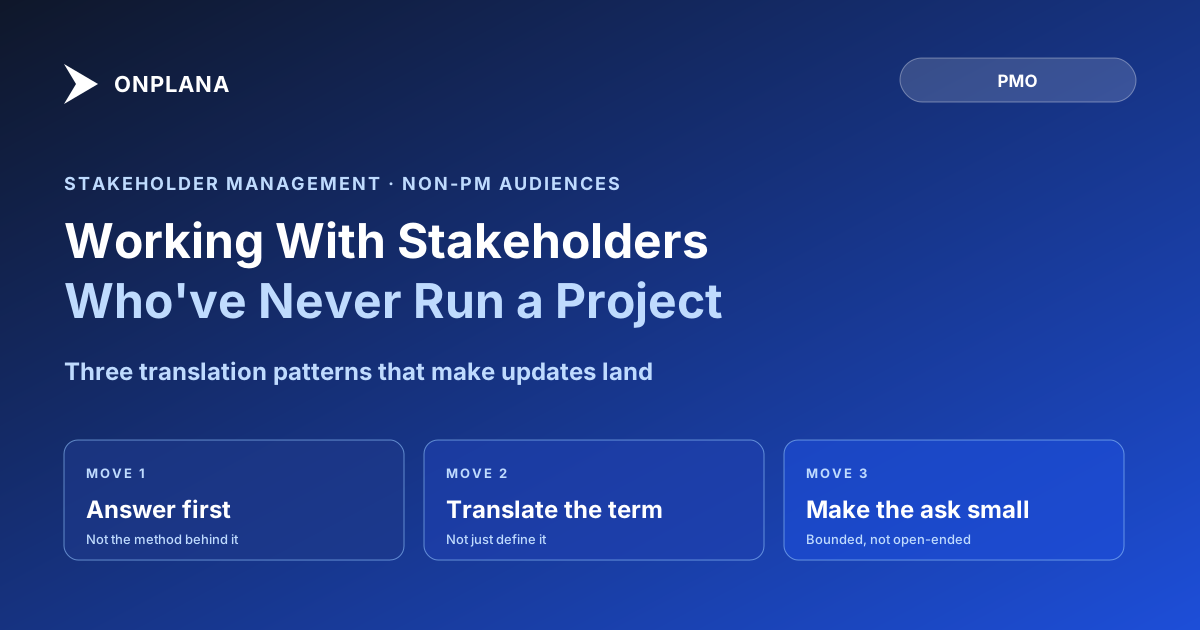
Four translation patterns cover most of what non-PM stakeholders actually need, and none of them require dumbing content down; they require re-sequencing and re-wording it.
Answer first, method second. A non-PM stakeholder's real question is almost always some version of "is the thing I was promised still going to happen when I was told." Lead every communication with the direct answer to that question, in one sentence, before any explanation of how the PM arrived at it. "We're still on track for the March 15 launch" or "the March 15 date is now at risk, here's why" belongs in sentence one, not paragraph four.
Translate the term, not just define it. Defining "critical path" in a glossary doesn't help a stakeholder who has to look it up mid-read. Translating it means never using the term at all when writing to them: instead of "this task is on the critical path," write "if this slips a day, the launch date slips a day too." The stakeholder doesn't need the PM concept; they need the consequence the concept describes.
Anchor every risk to their world, not the schedule's. A dependency slip means something different to a finance stakeholder (budget exposure) than to a store operations stakeholder (staffing the rollout differently) than to a sales stakeholder (what to tell a customer). The same underlying risk needs a different translation depending on which consequence actually lands for that specific reader, which is why one status report format sent unmodified to every stakeholder type quietly underperforms even when it's well written.
Make the ask explicit and small. When a non-PM stakeholder needs to do something, "please advise" is not an ask; it's a question mark with no shape. "I need a yes or no on the budget increase by Thursday to keep the March 15 date" is an ask. Non-PM stakeholders respond to specific, bounded requests far more reliably than open-ended ones, because an open-ended request requires them to first figure out what kind of response is even expected, and most won't do that work.
Proactive education: what to teach before you need it
Some translation burden can be permanently reduced with a small amount of proactive teaching, done once, well before the moment it matters. This is different from trying to onboard a stakeholder into full PM fluency, which is a burden placed on them for the PM's convenience, not theirs.
The teaching that pays off is narrow and specific: what the recurring status categories mean for them ("when I say yellow, it means watching closely, not urgent, and I'll tell you directly if it becomes urgent"), what a milestone in this specific project actually represents for their world, and what they should expect to hear from the PM and when, so a normal-cadence check-in doesn't read as an alarming surprise contact.
This kind of orientation works best in a single short conversation early in the relationship, not buried in a project charter nobody rereads. "Here's what I'll send you, here's how often, here's what each status color means for you specifically" takes five minutes and removes most of the future misreading before it happens. It is the same instinct behind a well-built stakeholder communication plan: matching format and cadence to the actual audience instead of defaulting to whatever the PM finds easiest to produce.
Which PM terms actually backfire with non-PM audiences?
Some PM terms don't just confuse non-PM stakeholders; they actively mislead them, because the words sound like ordinary English but carry a specialized meaning that contradicts the plain reading.
"Critical path" sounds like it means "the most important work," and stakeholders often act on that reading, pushing to prioritize critical-path tasks even when a non-critical-path task is actually more strategically urgent. It doesn't mean importance; it means schedule sensitivity. "Yellow status" sounds alarming to someone unfamiliar with RAG conventions, prompting an escalation the PM never intended. "Resource" sounds clinical and can read as dehumanizing when used about a person in front of a non-PM audience, even though PMs use it as unremarkable shorthand. "Scope creep" sounds like an accusation when said to the stakeholder whose request caused it, which shuts down the conversation exactly when the PM needs the stakeholder's cooperation to contain it.
The fix isn't a longer glossary. It's simply not using these terms with this audience at all, and reaching for the plain-language equivalent every time, a discipline closely aligned with the guidance in the U.S. government's plain language standards: write for the specific audience in front of you, not for the convenience of the writer.
Common non-PM stakeholder types and what each one needs
Not every non-PM stakeholder needs the same translation. The diagram below maps four common archetypes to the question they're actually asking and what a mistranslated update costs when it lands wrong.
| Stakeholder type | Default question | What to translate risk into | Mistranslation risk |
|---|---|---|---|
| Finance / budget sponsor | Are we still in budget | Budget exposure, not schedule detail | Silent scope creep discovered late |
| Operations / frontline | When do I need to act | Staffing and dates, not task-level detail | Team unprepared at go-live |
| Sales / customer-facing | What can I safely promise a customer | Commitment safety, not internal risk categories | Overpromising based on stale status |
| Executive sponsor | Do I need to intervene | A clear decision needed or not, not a status narrative | Surprise escalation that erodes trust |
| Clinical / regulated frontline | Does this change what I'm required to do | Compliance and procedure impact, not project mechanics | Non-compliant handoff at cutover |
| End user / affected employee | How does this change my day-to-day | Concrete before-and-after, not the rollout plan | Resistance from feeling blindsided |
The table extends the diagram with two archetypes, clinical and end-user, that don't fit neatly into the four-quadrant view but follow the same rule: translate the risk into the consequence that specific reader actually cares about.
Building trust without a shared vocabulary
Trust with non-PM stakeholders is built less by vocabulary and more by predictability: they learn quickly whether a PM's "on track" actually means on track, and whether a "small risk" stays small or turns into a surprise. That pattern of accuracy over time does more to earn a stakeholder's confidence than any individual well-translated update, because it answers the question underneath their question: can I trust what this person tells me without independently verifying it myself.
This is also where consistency across stakeholders matters. A PM who tells the sponsor one thing and the operations lead something subtly different, even unintentionally, because each conversation was translated separately and drifted, erodes trust fast once the two stakeholders compare notes. The four-dimension stakeholder map approach helps here: tracking each stakeholder's information needs explicitly, in writing, keeps the underlying facts consistent even as the translation for each audience differs.
When should you escalate instead of keep translating?
Not every stakeholder confusion is actually about vocabulary, and treating a disguised objection as a comprehension problem wastes time on both sides. A stakeholder who asks the same question three different ways after three different explanations usually isn't failing to understand the PM's language; they understand it fine and disagree with the substance, but haven't said so directly, often because disagreeing with a project outright feels more confrontational than "asking for clarification" one more time.
The signal to watch for is whether a clearer explanation actually resolves the exchange or just produces a new version of the same pushback in different words. When it's the latter, the PM's job shifts from translating better to naming the disagreement plainly and routing it to whoever can actually make the call, usually the steering committee or sponsor rather than continuing to iterate on phrasing in a conversation that was never really about phrasing.
Making this a PMO standard, not a PM-by-PM skill
Individual PMs who are naturally good at translation are a lucky asset. A PMO that only has that skill in a few people's heads has a fragility problem: the moment a strong translator leaves or gets pulled onto another project, the stakeholders they served go back to receiving reports that don't reach them, and nobody notices until trust has already eroded.
A PMO standard fixes this by building the translation patterns into the reporting templates themselves: a plain-language summary line required at the top of every status update, a stakeholder-type field that flags which translation applies, and a review step that checks whether a report would actually make sense to someone who has never sat in a project meeting. That last check is the cheapest one to run and the one most PMOs skip.
The PMO Maturity Assessment includes a stakeholder communication dimension that surfaces exactly this gap: whether translation is a PMO-wide practice or a skill living in a handful of individual PMs who happen to be good at it. Most PMOs that score low here discover the gap the expensive way, when a well-run project loses sponsor confidence anyway, for reasons that had nothing to do with how the project was actually going.
Run the free PMO Maturity Assessment Fifteen questions across process, tooling, governance, risk, and reporting. Get a tier read and a specific signal on whether stakeholder communication is a standard practice or a handful of people's individual skill. About ten minutes, no signup. → Open the assessment
Frequently asked questions
What does 'non-PM stakeholder' mean?
A non-PM stakeholder is anyone with a stake in a project's outcome who has never been trained in or worked inside formal project management: a sales VP, a finance director, a store manager, a clinician, a factory supervisor. They care about the outcome but have no fluency in PM vocabulary or artifacts.
Why does PM jargon fail with non-PM stakeholders?
Because it optimizes for precision among people who share a vocabulary, and non-PM stakeholders don't share it. A term like 'critical path' or 'RAG status' that saves a PM a paragraph of explanation among peers reads as noise to someone who has never encountered it, so they either ignore it or misread it, both of which are worse than a plain sentence.
How do you communicate project status to someone who doesn't understand project management?
Lead with the answer to the question they actually have, usually 'are we still on track for what I was promised,' in one sentence, before any supporting detail. Translate PM terms into the stakeholder's own vocabulary (a delayed dependency becomes 'we're waiting on X team, expected by Friday') and never make them ask a follow-up question just to understand the headline.
Should you teach stakeholders PM vocabulary?
Selectively, and only the handful of terms that will recur and that they'll need to act on: what a milestone means for them, what a specific recurring risk category implies for their world. Teaching the whole PM vocabulary set is a burden you're placing on them for your convenience, not theirs.
What's the biggest mistake PMs make with non-PM stakeholders?
Sending the same report format and vocabulary to a technical stakeholder and a non-technical one, then treating the non-technical stakeholder's disengagement as a sign they don't care about the project, when it's usually a sign the report wasn't written for them.
When should a PM stop trying to translate and escalate instead?
When a stakeholder's confusion is actually a disguised objection: they understand the update fine but disagree with the direction, and no amount of clearer language will resolve that. Translating harder into a disagreement just delays a conversation that needs a decision-maker, not a better explanation.
Ready to make the switch?
Start your free Onplana account and import your existing projects in minutes.