Managing Vendor-Delivered Projects Without Owning the Schedule
Vendor project management gives you accountability without control. Here's what to require contractually and how to verify delivery without owning the schedule.
Here is a test. Take the last status update your primary vendor delivered. Read it carefully. Now ask yourself: what would this status report look like if the project were four weeks behind and the vendor had not yet decided to tell you?
In most cases, the answer is: exactly the same.
Vendor project management is a visibility problem. The vendor owns the schedule, the technical decisions, the resource allocation, and the daily execution rhythm. You, the client PM, own the outcome: the business case, the budget approval, the stakeholder relationships, and the accountability when something goes wrong. The vendor collects their fees either way.
This asymmetry is structural, not a function of vendor quality. A good vendor is simply better at managing what you see than a bad vendor. The real project schedule, the one with resource loading and critical path math, almost never leaves the vendor's environment. What you receive is a curated summary, and curated summaries omit what is not going well by definition.
The response is not suspicion. Most vendors are managing professionally and reporting honestly most of the time. The response is building a verification practice that does not depend on the accuracy of their summary.
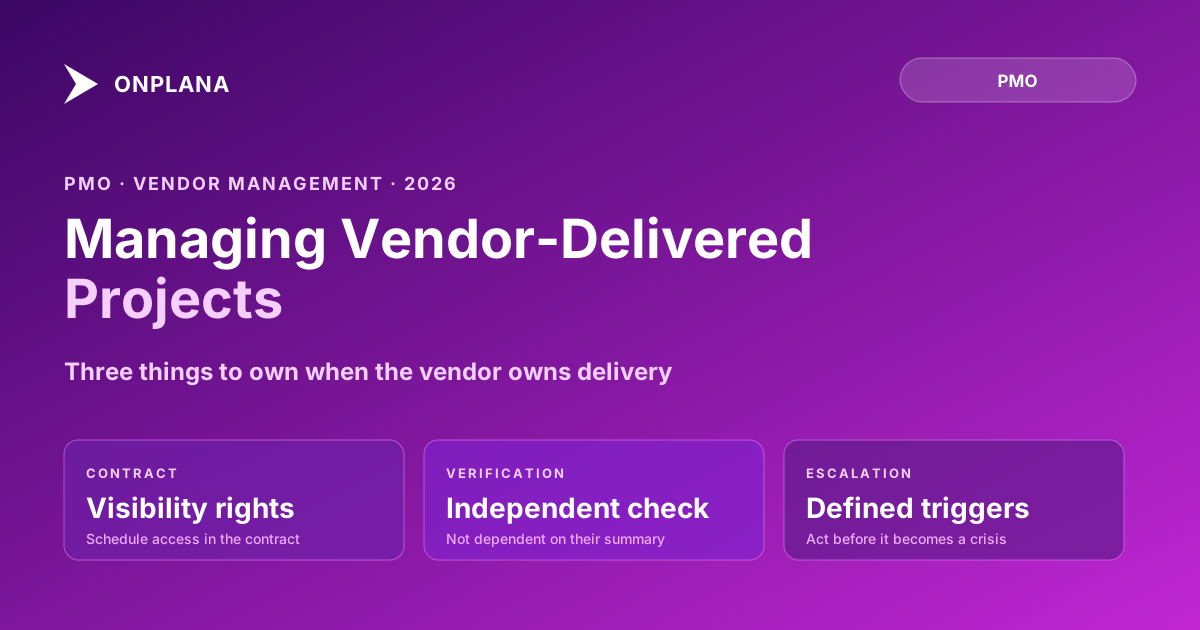
TL;DR: Vendor project management requires owning three things the vendor cannot own for you: contract language that gives you schedule visibility rights and defines escalation triggers, a verification practice that checks delivery signals independently of the vendor's status report, and documented escalation criteria so you know when to act before a problem becomes a crisis.
The visibility problem in vendor-managed delivery
The client PM's position in a vendor-managed project is structurally disadvantaged in one specific way: all information about project health flows through the vendor. The vendor controls what goes into status reports, how risks are framed, and when problems are disclosed. Even the most transparent vendor has incentives to present information in the best available light.
This is not deception. It is the natural consequence of who owns the work. When a vendor's engineer makes a technical decision that adds two weeks to the schedule, the vendor's PM will reassess options before surfacing the impact. When a resource leaves and gets replaced with someone less experienced, that change may appear in the project record as a footnote if at all. When a dependency on the client side is about to cause a delay, the vendor PM will often absorb the risk for a period before raising it.
The result is that client PMs often receive warning of a real problem two to four weeks after the vendor knew about it. By that point, the options for intervention have narrowed significantly. The job of client-side project management is to compress that lag.
For how to read vendor status reports critically, the status report writing guide covers what well-written status reports include and what gaps in the structure typically signal.
What your contract should say about scheduling
The contract is where you establish the information rights you need to verify delivery. Most project contracts define deliverables and payment milestones. Fewer define the scheduling transparency that lets you assess whether delivery is on track between milestones.
The Project Management Institute's procurement management framework provides the foundational language for thinking about these rights: the buyer owns outcome accountability; the seller owns execution; the contract is the bridge between the two. The clause structure below operationalizes that principle for schedule visibility specifically.
Contract language that supports client-side visibility:
Schedule access clause. The vendor must provide the master project schedule, at minimum at milestone level, in a format readable by the client, within five business days of project start and updated monthly or following any schedule change. The format requirement matters: a PDF screenshot of a Gantt chart is not the same as a shared tracker with current milestone dates.
Resource change notification. The vendor must notify the client PM within a defined window (typically five to ten business days) of any change to named key personnel or significant capacity change on the project. This is the early warning signal for the "new resource" problem, where a senior resource is replaced mid-project with someone less experienced, silently.
Dependency tracking. The contract should explicitly list the client-side dependencies: decisions, approvals, materials, access, or data that the vendor needs on specific dates. When client dependencies slip, the vendor has documented grounds for a schedule change. More importantly, tracking these dependencies gives the client PM an early signal: if their own organization is late on a dependency, the project is heading toward a conversation about revised timelines.
Escalation threshold. Define explicitly when the vendor is required to escalate to a named client executive. A practical standard: any milestone that is more than ten business days late, any change request that exceeds a defined cost or schedule threshold, or any risk that the vendor rates as high with no mitigation identified. Without this language, escalation becomes discretionary on the vendor's side.
Building a schedule verification practice without owning the file
Even with good contract language, a client PM who relies entirely on vendor reports has not solved the visibility problem. The verification practice is what closes the gap.
The diagram below shows the ownership split and verification approach that works in practice.
Verification, in practice, means running your own tracking that does not depend on the vendor's summary:
Milestone completion tracking. Maintain a simple log of every committed milestone date and what was actually delivered. A streak of two partial deliveries in a row is a signal worth raising in the next review. A vendor who consistently delivers partial scope against milestones is a vendor whose schedule math is optimistic.
Change request trend. Track the volume and cumulative scope impact of change requests over time. A rising change request trend in months two and three of a project often precedes a timeline conversation in month four. The requests themselves are not the problem; the trend is the signal.
Dependency readiness on your side. If client-side dependencies are late, the vendor will eventually surface the impact, but you can see it before they do. A simple dependency tracker, updated weekly, tells you whether your organization is set up to let the vendor succeed.
Deliverable first-pass acceptance rate. Track what percentage of vendor deliverables are accepted without revision on first review. A rate below 70% is an integration signal, not just a quality signal: it suggests the vendor's understanding of the requirement has drifted from yours.
The Schedule Health Check is useful here for vendor-submitted schedules: if the vendor provides a baseline at project start, uploading it surfaces dependency and baseline quality issues that may not be visible in a summary report.
The metrics that surface vendor problems early
The reliable early signals in vendor-managed projects are not the ones vendors report; they are the ones you track independently.
Four metrics that consistently predict vendor project problems four to six weeks before they surface in status reports:
Milestone hit rate. The percentage of committed milestones met on or before the committed date. A rate below 80% over a rolling four-week window is a signal worth discussing. A rate below 60% over two months is a performance conversation.
Scope change frequency. How often the vendor raises change requests, and whether the cumulative scope impact is growing faster than the project is progressing. One or two change requests in a project's life are normal. Eight change requests in six months suggests either that the original scope was underspecified or that the vendor's process lacks discipline.
Dependency lag. How often client-side dependencies are delivered late, and by how much. When this metric is high, the vendor has legitimate grounds for schedule adjustment. When it is low and the project is still slipping, the problem is on the vendor side.
Resource stability. Any change to key personnel is a risk signal. The cost of knowledge transfer on a complex technical project is often two to four weeks of effective capacity.
When vendor status reports are wrong (and how to know)
A vendor status report that says the project is green when it is not is not usually a deliberate misrepresentation. It is more often a PM who is managing to the near-term milestone and has not yet reckoned with what the cumulative schedule math implies for the delivery date.
The patterns that should prompt skepticism:
A status report that uses percentage complete without specifying what was delivered. "75% complete" means nothing without a list of delivered artifacts.
A schedule that shows all tasks parallel and all finishing on the same date. Real schedules have dependencies that create sequences. A schedule where everything converges at the deadline was designed to show the right answer, not to model the work.
A risk register with no risks rated above medium. Projects have high risks. A vendor who consistently rates everything medium is calibrating to what the client wants to see, not what the project data shows.
For a reference on what strong status reports look like from the inside, the status report writing guide covers the structural elements that make reports credible and the patterns that signal status theater.
Escalation triggers and how to document them
An escalation trigger is a defined condition under which the client PM informs a named executive and requests a vendor response. The trigger does the work of removing the subjective judgment from the escalation decision, which means the client PM is not in the position of "crying wolf" or "not speaking up soon enough." The trigger fires or it does not.
Effective escalation triggers are specific and measurable:
- Second consecutive milestone missed against a committed date.
- A change request exceeds a defined cost or schedule threshold (e.g., more than five business days of schedule impact or more than ten percent of contract value).
- The vendor declines to share the revised schedule within ten business days of a confirmed delay.
- A key resource change is not notified within the contractually required window.
When a trigger fires, the client PM documents it with the specific trigger condition, the date, and the impact assessment. The document goes to the named executive and the vendor's project sponsor simultaneously. This is not an escalation in the confrontational sense; it is the agreed notification that both parties anticipated in the contract.
The PMO Maturity Assessment includes vendor governance as one of the maturity dimensions: how consistently your PMO defines escalation criteria for external delivery and whether those criteria are applied uniformly.
What good vendor project management looks like in practice
The best client-side vendor PM relationships have a few things in common:
The client PM is visible but not intrusive. They attend milestone reviews, ask specific questions about delivery risks, and respond quickly to dependency requests. They do not attempt to direct internal vendor work, which is outside their authority and usually counterproductive.
The contract is a working document, not a filing-cabinet item. The client PM knows which clauses govern schedule disclosure, resource changes, and escalation. They reference them when needed.
The verification practice is transparent. The client PM's parallel tracking is not secret; it is shared with the vendor as a joint view of project health. This changes the dynamic from adversarial to collaborative and often improves the vendor's own reporting.
Escalation is used as designed and not avoided. The client PM who never escalates because they want to preserve the relationship is the client PM who delivers bad news to their executive too late, every time.
Building these practices takes a project or two to calibrate. The PMO that has done it consistently delivers better outcomes on vendor-managed projects than the PMO that relies on the vendor's judgment and their own optimism.
Check the technical quality of vendor-submitted schedules The free Schedule Health Check reviews baseline coverage, dependency logic, and resource data completeness in any uploaded project file. Useful for evaluating vendor-submitted baselines at project start. No signup required. → Open the Schedule Health Check
Frequently asked questions
What should a vendor-managed project contract include about scheduling?
At minimum: a requirement to share the master schedule in a readable format, defined reporting cadence with schedule-level detail, a list of named dependencies the client owns, and a clear escalation path when milestones slip.
How do you verify a vendor schedule without owning the MPP file?
Run parallel tracking on the metrics that actually predict slippage: milestone completion rate, committed vs actual delivery by sprint or phase, resource change notifications, and dependency readiness on your side. A pattern of partial delivery against milestones is the earliest reliable signal.
What metrics should a client PM track in a vendor-delivered project?
Milestone hit rate, change request volume and trend, dependency readiness on the client side, and percentage of deliverables accepted on first review. A rising change request volume or a declining first-pass acceptance rate often precedes a timeline conversation by four to six weeks.
When should a client PM escalate a vendor project issue?
Escalate when a second consecutive milestone is missed, when the vendor declines to share the revised schedule after a delay, or when the scope of a change request exceeds what the original contract contemplated. Waiting for a third missed milestone is too late in most fixed-scope engagements.
What is the difference between managing a vendor and managing a project?
Managing a project means owning the schedule and directing work. Managing a vendor means owning the outcome and influencing the vendor's process through the contract, reporting requirements, and escalation levers. The PM who treats them as the same role loses visibility without realizing it.
Should client PMs have access to the vendor's internal project schedule?
Ideally yes, at least to a published baseline with milestone dates and dependency tracking. Full MPP access is rare and often impractical; a shared project tracker with milestone-level visibility and weekly refresh is a reasonable standard to write into the contract.
Ready to make the switch?
Start your free Onplana account and import your existing projects in minutes.