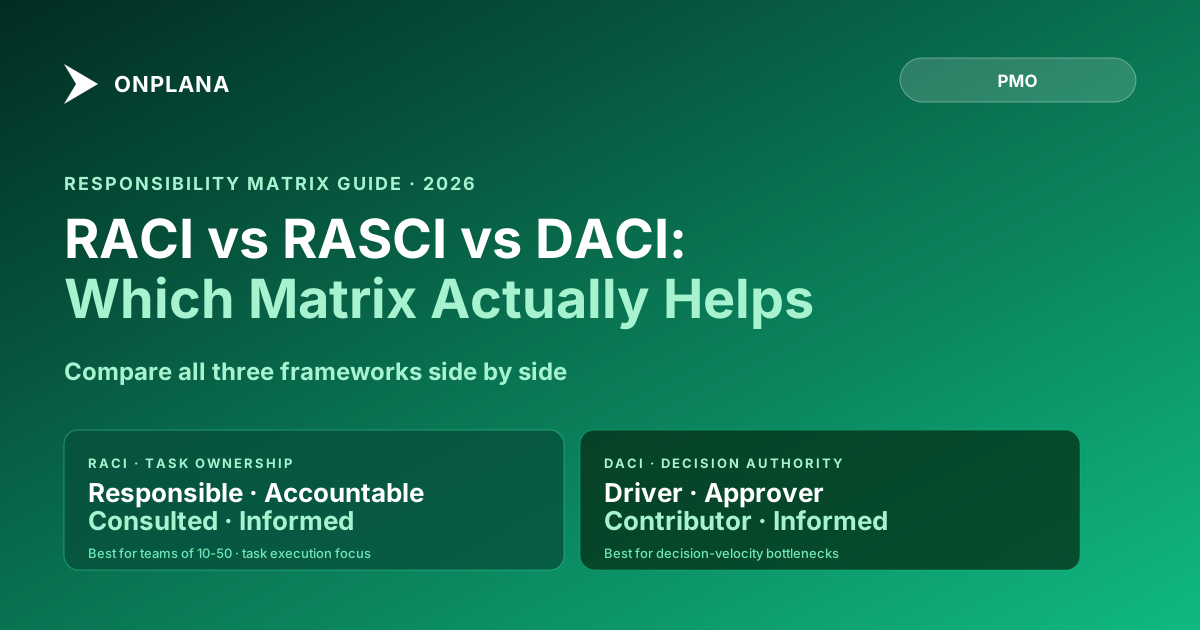
RASCI vs RACI (vs DACI): Which Matrix Actually Helps
RASCI vs RACI: what the Support role adds, when the extra row earns its keep, and when DACI fits better. Comparison table plus a direct recommendation.
RASCI is RACI plus exactly one role, the S for Supportive; that is the entire difference, and whether that one row helps or hurts depends on your team's shape. Most RACI complaints are complaints about the wrong thing. Teams blame the framework when the actual problem is a column filled with four As, a Responsible assigned to an entire department, or a matrix that was never updated past the kickoff meeting. RACI gets called bureaucratic. It gets called confusing. It gets replaced with RASCI or DACI and the confusion follows because the issue was never the acronym.
That said, RACI is not the right tool for every situation. The alternatives exist for reasons, and understanding those reasons helps you pick the matrix that will actually reduce friction instead of just adding a new layer of terminology to your project documentation.
TL;DR. RACI works for most projects. RASCI is worth adding when you have a meaningful layer of supporters who provide resources without owning outcomes. DACI solves a different problem: decision latency. Pick your framework based on where your team loses the most time, not on which acronym sounds more sophisticated.
RASCI vs RACI, the direct answer: RASCI is RACI plus exactly one role, the S (Supportive): people who contribute effort or resources to a task without owning its outcome. Everything else, including the one-Accountable-per-row rule, is unchanged. Choose RACI for most projects under 50 people; move to RASCI when you have a real contributor tier (shared services, specialist teams, borrowed capacity) that is neither Responsible nor merely Consulted. If your problem is slow decisions rather than unclear task ownership, neither variant fixes it; that is DACI's job.
| RACI | RASCI | |
|---|---|---|
| Roles | R, A, C, I | R, A, S, C, I |
| What the S adds | Not present | Supportive: provides effort or resources without owning the outcome |
| Accountability rule | Exactly one A per row | Exactly one A per row (unchanged) |
| Best team size | 10-50 people | 30-100+ people with a distinct contributor tier |
| Watch out for | Multiple As assigned; Consulted overloaded | S column used to dodge real ownership conversations |
Why the Accountable vs Responsible distinction matters so much
Before comparing frameworks, it is worth being explicit about the distinction that determines whether any responsibility matrix actually works: the difference between Accountable and Responsible.
Responsible is the person or people doing the work. You can have multiple Rs on a task. They execute.
Accountable is the single person who owns the outcome. They answer for it when something goes wrong. They sign off when something is complete. There should be exactly one A per row.
This is where most RACI matrices break down before the framework even gets a chance. Teams assign Accountable to every stakeholder who has any interest in the outcome. A project manager is A. A department head is also A. A sponsor is also A. Nobody is actually accountable. When the deliverable is late, three people each believed someone else was the owner.
The one-A-per-row rule is non-negotiable. If you take nothing else from this post, take that. Every other debate about RACI vs RASCI vs DACI is secondary to getting this right.
What RACI covers and where it falls short
RACI maps four roles across every task, decision, or deliverable in your project:
- Responsible: Does the work
- Accountable: Owns the outcome (exactly one per row)
- Consulted: Provides input before the work is done (two-way communication)
- Informed: Notified when the work is done (one-way communication)
RACI works well when your team is mid-sized (roughly 10 to 50 people), when the project has clear task boundaries, and when you need to make both execution ownership and approval authority visible in one place.
Where RACI falls short is in two specific situations. First, it provides no way to represent people who contribute effort without owning the task and without being asked for their expert opinion. A database engineer who provides compute resources for a data migration is neither Responsible (they are not running the migration), Consulted (nobody is asking their opinion on the approach), nor just Informed (they are actively contributing something). RACI has no cell for them.
Second, RACI conflates task ownership with decision authority. In organizations where the bottleneck is not task execution but decision approval, RACI does not isolate the decision-making flow clearly enough to help.
What RASCI adds (and when it earns its keep)
RASCI inserts a fifth role: Supportive. A Supportive person provides resources, effort, or assistance that the Responsible person needs to complete the work. They are active contributors without being owners.
The practical case for RASCI is strongest when:
- Your project has a meaningful layer of shared-services contributors (security reviews, legal approvals, infrastructure provisioning) who contribute effort but do not own deliverables
- Your RACI matrix has a large number of Cs that are really just resource-providers, not genuine input-givers
- You are running programs large enough that the distinction between "helping" and "advising" creates real ambiguity
The practical case against RASCI is that most teams do not need the additional granularity. If you have trouble populating the S column, that is a signal to stay with RACI. The extra role adds overhead in every matrix review without adding clarity.
RASCI originated in organizations running large infrastructure programs where a support tier was genuinely distinct from a consultation tier. It traveled into general PMO practice and often gets adopted simply because it sounds more rigorous, not because the team has a real support-tier problem.
What DACI solves (and why it solves a different problem)
DACI stands for Driver, Approver, Contributor, Informed. It was popularized by product teams at companies including Intuit and has since spread through product management practice.
The four roles:
- Driver: The person who moves the decision to closure. They gather input, run the process, own the timeline for deciding.
- Approver: The single person with final approval authority. Exactly one per decision.
- Contributor: Provides input before the decision is made.
- Informed: Notified of the outcome.
DACI is not a replacement for RACI. It is a different tool built for a different bottleneck. RACI maps task and deliverable ownership across a project. DACI maps decision authority. You can run both simultaneously on the same project: RACI for the work breakdown, DACI for the major decisions that determine project direction.
Teams that benefit most from DACI are product and strategy teams where the constraint is decision velocity, not execution clarity. If your post-mortems keep surfacing "we waited three weeks for someone to decide X," DACI is worth introducing. If your post-mortems surface "nobody knew who was supposed to do X," RACI is your tool.
The PRINCE2 project management framework treats role clarity and responsibility assignment as foundational governance tools and acknowledges that the right structure depends on organizational context, which is consistent with picking the framework based on your actual bottleneck rather than convention.
Before diving into the full comparison, it is worth checking where your PMO currently sits: the PMO Maturity Assessment can surface whether your governance gaps are in task ownership, decision authority, or both, which helps you choose the right starting point.
Side-by-side comparison: RACI, RASCI, and DACI
The table below compares the three frameworks across six dimensions. This is the diagnostic you should run before deciding which to adopt or recommend.
| Dimension | RACI | RASCI | DACI |
|---|---|---|---|
| Primary use case | Task and deliverable ownership | Task ownership with distinct resource-contribution tier | Decision authority and decision velocity |
| Number of roles | 4 (R, A, C, I) | 5 (R, A, S, C, I) | 4 (D, Ap, C, I) |
| Accountability model | Single A per row | Single A per row | Single Approver per decision |
| Best team size | 10-50 people | 30-100+ people | Any; built for product/strategy teams |
| Learning curve | Low; widely understood | Low-medium; adds one role | Low-medium; requires reframing decisions |
| Common failure mode | Multiple As assigned; C overloaded | S column used to avoid difficult conversations about ownership | Approver becomes a bottleneck; Driver is passive |
| Covers task execution? | Yes | Yes | Partially (Driver owns process, not task) |
| Covers decision authority? | Indirectly (via A) | Indirectly (via A) | Directly (Approver role) |
The comparison above illustrates where the following diagram maps the three frameworks, showing how role coverage differs across the spectrum from execution to decision-making.
The most common RACI failure modes (and how to avoid them)
Understanding why RACI fails is as useful as understanding what it is. The failure modes are consistent enough that you can audit any RACI chart for them in under ten minutes.
Multiple Accountables per row. If your chart has three people marked A on a deliverable, none of them are accountable. Go back and ask: who answers for this if it is late? That person is the A. The others may be R, C, or I.
Responsible assigned to a team or department. "Engineering team" is not a person. RACI requires named individuals. When a department holds the R, nobody on that team feels individually responsible, and the matrix creates the illusion of clarity without the substance.
Consulted overloaded. When everyone is listed as C, the consulted column becomes a political protection list rather than a functional input list. Ask: will this person's input actually change the output? If not, move them to I.
The matrix lives in a kickoff deck and is never updated. Team composition changes, sponsors change, the scope changes. A RACI chart that was accurate in week one and untouched in week eight is worse than no chart at all, because it gives incorrect guidance with false confidence.
Consulted and Informed are reversed. Consulted means you are asking for input before a decision. Informed means you are notifying after a decision. These are frequently swapped. When someone is listed as C but actually only hears results, they expect a voice they will not get, and you get stakeholder friction that appears to come from nowhere.
How to run a proper RACI review
A RACI chart is not a document you complete once. Treat it as a living artifact reviewed at phase gates and whenever a team member changes roles.
The review itself takes about 20 minutes when run correctly. Walk each row. For each row, ask:
- Is there exactly one A? If not, pick one.
- Is the R a named individual, not a team? If not, assign it.
- Would the people listed as C actually change the outcome if their input differed? If not, move them to I.
- Are there people contributing effort who are not represented? If so, add them as R or (in RASCI) as S.
Keep the chart in the same place as your project plan. Link to it from your status report so stakeholders can verify their role assignments without asking.
The PMO Maturity Assessment surfaces which governance artifacts your PMO is actually maintaining versus which exist only as stale kickoff documents. If your responsibility matrices tend to drift, the assessment can help you identify the process gaps causing it.
Picking the right framework: a recommendation by team context
The choice between RACI, RASCI, and DACI is less important than getting the fundamentals right within whichever framework you choose. That said, here is how to make the call:
| Team context | Recommended framework | Reasoning |
|---|---|---|
| Under 20 people, fast-moving project | RACI | Lowest overhead; most widely understood |
| 20-50 people, defined task tiers | RACI | Still the default; add DACI for major decisions |
| 50-100+ people, shared services model | RASCI | Support tier is genuinely distinct from consultation |
| Product or strategy team, decision-velocity bottleneck | DACI | Built for this problem |
| Highly regulated environment | RACI + DACI | RACI for execution governance, DACI for approval chains |
| Mixed methodology (agile + waterfall) | RACI | Flexible enough for both; DACI for steering committee decisions |
For teams that want to operate at the higher end of governance maturity, the right responsibility matrix is one piece of a larger structure that includes milestone definitions, status cadences, and escalation paths. The post on goals, milestones, and status reporting covers how those elements connect. The change control board guide covers the approval chain that DACI's Approver role should feed into for scope changes above the PM authority threshold.
What to do if your RACI is already broken
If you inherit a RACI chart that has all the failure modes above, you have two options.
The first is a clean-room rebuild. Throw out the existing chart and rebuild it from the current WBS with the people who are actually working the project today. This takes two to four hours for a medium-sized project and is worth it if the chart is seriously corrupted.
The second is a targeted repair. Go row by row and apply the four audit questions from the review section. Fix the multiple-A rows first. Then fix the team-as-R rows. Then prune the overloaded C columns. This produces a functional chart in under an hour and is the right approach when most of the matrix is sound but a few structural problems are causing friction.
Either way, the goal is a chart that every team member can open and immediately understand their role on any given deliverable. If a stakeholder has to ask "what does this mean for me," the chart is not doing its job.
Run the free PMO Maturity Assessment See where your PMO's governance gaps are before choosing a responsibility framework. No signup required. → Open the tool
Frequently asked questions
What is the difference between RACI and RASCI?
RASCI adds a 'Supportive' role between Responsible and Consulted. This is useful when some contributors provide resources or effort but do not own the task and are not being asked for their opinion.
When should you use DACI instead of RACI?
Use DACI when your primary need is clarifying who approves decisions rather than who executes tasks. DACI is optimized for decision-making speed; RACI covers both decisions and task execution.
What is the difference between Accountable and Responsible in a RACI matrix?
Responsible is the person doing the work. Accountable is the single person who owns the outcome and answers for it if something goes wrong. There should be exactly one Accountable per row.
Can you have more than one Accountable on a RACI chart?
No. Multiple Accountables means no one is truly accountable. If two people share accountability, neither owns the outcome. This is the most common RACI implementation error.
What does the S in RASCI stand for?
Supportive. A Supportive person provides resources, assistance, or effort to help the Responsible person complete the work, without being the owner or a formal consulted expert.
What is DACI?
DACI stands for Driver, Approver, Contributor, Informed. It structures who drives a decision to closure, who has final approval, who provides input, and who needs to be told the outcome.
What is the biggest mistake teams make with RACI matrices?
The most common mistake is assigning Accountable to everyone who has any stake in an outcome. When every senior stakeholder is listed as Accountable, the chart creates more confusion than it resolves.
How do you choose between RACI, RASCI, and DACI?
Use RACI for most projects under 50 people. Add RASCI when you have a layer of contributors who provide effort but not ownership. Use DACI when your bottleneck is decision latency, not task ownership.
Ready to make the switch?
Start your free Onplana account and import your existing projects in minutes.