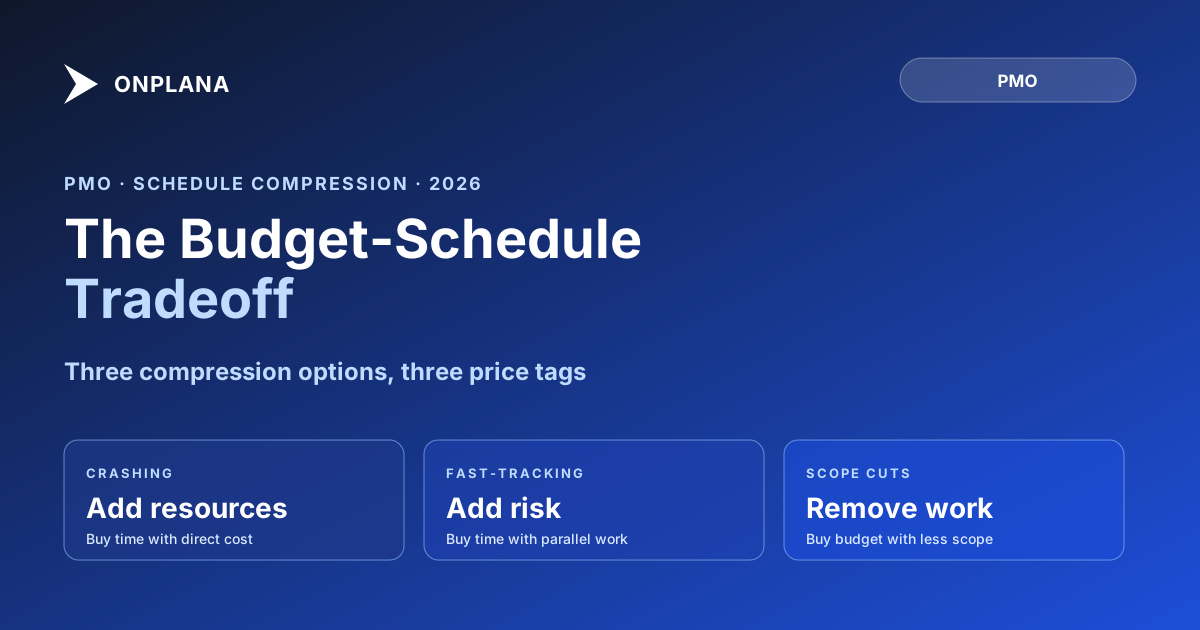
The Budget-Schedule Tradeoff That Sponsors Don't Want You to Surface
Schedule compression cost is the tradeoff sponsors avoid. Here's the math for buying time with money, and the language to surface it without getting fired.
Here is the question most project managers avoid asking out loud: do you need the deadline, or do you need the budget? Most sponsors want both. But almost every project has a moment where the real answer is one or the other, and the PM who can show the math is the PM who gets to have the honest conversation instead of watching the project fail quietly trying to satisfy both constraints simultaneously.
Budget and schedule are often treated as separate project health metrics: a budget overrun is a finance problem and a schedule slip is a delivery problem. But schedule compression cost is what connects them. That framing is convenient because it keeps the sponsor's expectations separate and unchallenged. The problem is that they are the same problem. Budget and schedule are connected through the cost of time: the cost of running longer, the cost of finishing faster, and the tradeoff between them. A PM who can quantify that connection has more options than a PM who presents them as independent.
This post covers the three compression options, what each one actually costs, how to calculate the conversion rate on a specific project, and the language that makes the tradeoff conversation a planning tool rather than a crisis response.
TL;DR: Schedule compression cost means you have three levers when deadline and budget conflict: crash (add cost to shorten the critical path directly), fast-track (add risk by running parallel work that was designed to be sequential), or cut scope (reduce deliverables to fit either constraint). Each is appropriate in specific circumstances. The PM's job is to price all three and present them as choices, not to pick one silently and defend it when it fails.
How time and money convert in a project
Every project has an implicit exchange rate between time and money. Adding one week to the schedule costs something: usually in extended resource time, carried overhead, or organizational cost of delay. Removing one week from the schedule also costs something: usually in additional resources, overtime, expedite fees, or the risk of rework from parallelizing work that was not designed to run in parallel.
This exchange rate is different on every project, and it is almost never made explicit. Sponsors tend to set both the deadline and the budget at the outset of a project without modeling what happens if they come into conflict. The PM who does not surface the exchange rate is left managing to two constraints that may be mathematically incompatible, without anyone acknowledging the incompatibility.
Surfacing the exchange rate does not mean announcing that the project is in trouble. It means knowing, before trouble arrives, what the cost of each option looks like. That knowledge is what makes it possible to present options rather than just report a problem.
The foundational tool for this analysis is the critical path method. The critical path defines the minimum project duration and identifies which specific tasks control that duration. Schedule compression only works on critical path tasks; adding resources to non-critical tasks does not change the project end date and is pure wasted cost.
Crashing: buying schedule time with direct cost
Crashing is the technique of adding resources to critical path tasks to shorten their duration. More people on a task, overtime hours, a faster-shipping vendor, a specialized contractor who can execute in half the time. Each of these adds direct cost in exchange for time.
Crashing is the most predictable compression technique because the relationship between cost and time is relatively linear and estimable. The Project Management Institute defines crashing as a schedule compression technique used to shorten the schedule duration by adding resources. The calculation is:
- Identify the critical path.
- For each task on the critical path, estimate the crash cost per week: how much would it cost to shorten this task by one week?
- Start with the cheapest tasks to crash. Compress the cheapest first, then the next cheapest, until the target schedule reduction is achieved.
- Note when compressing one path creates a new critical path: as you shorten the current critical path, a near-critical path may become the new constraint. At that point, you need to crash both paths simultaneously, which increases the marginal cost per week of schedule saved.
The practical limit of crashing is Brooks's Law: at some point, adding more people to a task slows it down rather than accelerating it because coordination cost exceeds the value of additional capacity. Complex cognitive work hits this limit faster than parallelizable physical work. A software development task that one engineer can do in eight weeks cannot usually be done in two weeks by four engineers.
For the sponsor, the output of this analysis is a curve: the cost of each additional week of schedule reduction. The curve is typically flat at first (cheap tasks crash cheaply), then rises steeply as the easy options are exhausted. Showing the curve instead of a single number makes the tradeoff decision concrete.
Fast-tracking: buying schedule time with risk
Fast-tracking is the technique of starting a task before its predecessor is complete. Instead of designing before building, start the build while design is still in progress. Instead of testing after development, start test preparation while development is still running.
Fast-tracking does not add direct cost the way crashing does. It adds risk. The risk is rework: if the design changes after the build has started, the build needs to be undone and redone. If development changes after test preparation has started, the test cases are wrong and need to be rewritten. The more the parallel activities interact, the higher the rework risk.
Fast-tracking is appropriate when the dependency between activities is weaker than the original schedule implies. If design and build actually have low interaction after the first two weeks of design, starting build in week two rather than week five is a reasonable risk to take. If design and build interact throughout, fast-tracking produces an expensive rescue project.
The cost estimate for fast-tracking is not as clean as crashing because it depends on a probability-weighted estimate of rework. A reasonable approach: estimate the likelihood of rework (low, medium, high), estimate the cost of rework if it occurs, and present the expected rework cost alongside the schedule savings. If the expected rework cost is lower than the cost of crashing by the same amount, fast-tracking wins. If not, crash instead.
Scope reduction: buying budget with deliverables
The third compression technique is the one nobody in the room wants to discuss: reducing scope to fit either constraint. Delivering less than was originally planned, on budget and on time, rather than delivering everything over budget or late.
Scope reduction is often the right answer and is almost always the last answer considered. The reason is that it requires admitting to the sponsor that the original plan could not be executed as specified, which feels like a project management failure. It is not. It is a budget and schedule constraint being made explicit rather than absorbed through heroics and then apologized for in the post-mortem.
The PM who frames scope reduction correctly presents it as a business decision, not a PM decision. The question is not "how do we deliver everything?" The question is "which pieces of the original scope deliver the most business value for the available time and budget?" That question belongs to the sponsor, not the PM. The PM's job is to provide the analysis that makes the decision possible.
For scope reduction to work as a planning tool, the project's deliverables need to be ranked by business value before the conversation arrives. A sponsor who has never thought about which features are essential and which are nice-to-have cannot make a scope reduction decision in real time. Build the ranking at project kickoff, before pressure arrives.
How to Calculate Your Schedule Compression Cost
Before a budget-schedule conversation with a sponsor, a PM should know three numbers:
The cost of meeting the deadline as planned. This is the original budget, plus any variance that has already accumulated.
The cost of the cheapest feasible schedule reduction. This is the crash analysis: what is the lowest-cost way to meet a specific deadline that the current schedule cannot meet?
The minimum viable scope set. What is the smallest deliverable set that satisfies the business case, and what is its estimated cost and timeline?
With these three numbers in hand, the PM can present the sponsor with actual options rather than a problem. The format is: Option A delivers the full scope on [date] at [cost]. Option B delivers full scope by [earlier date] at [higher cost] because of these specific additions. Option C delivers [reduced scope] on [date] at [current budget].
This framing shifts the conversation from "the project is in trouble" to "here is a decision you need to make." It also makes the PM's judgment visible in a way that builds credibility: the sponsor sees that the PM has done the analysis instead of hoping the problem resolves itself.
For the financial framing of options like these, the business case guide for Project Online migration costs covers how to present cost-time tradeoffs in a format that finance and sponsor audiences find credible.
The diagram below shows the compression options and their primary tradeoff dimension.
Presenting the tradeoff to a sponsor
The most common mistake in budget-schedule conversations is presenting one option and defending it. This puts the PM in an adversarial position with the sponsor and limits the conversation to arguing about whether the PM's preferred option is right.
The more effective structure is three scenarios with specific numbers:
Scenario A (on-plan). Full original scope, delivered at [date], at [budget]. This is where the project stands today, with current variance noted.
Scenario B (accelerated). Full original scope, delivered by [earlier date], at [higher budget] because of [specific additions to critical path tasks]. This is the crash scenario, priced explicitly.
Scenario C (reduced scope). [Specific subset of deliverables], delivered by [original date], at [current budget]. This is the scope reduction scenario, with the excluded deliverables explicitly named and a note on their relative business value.
The sponsor's job is to choose among these scenarios based on what the business actually needs. The PM's job is to have done the analysis well enough that the scenarios are credible.
A sponsor who pushes back on all three options, insisting on full scope, the original date, and the original budget, is expressing a mathematical impossibility. The PM's response is to ask which constraint is actually hard. In most cases, one constraint is harder than the others, and surfacing that fact is what opens the real negotiation.
Why sponsors resist hearing this
The resistance is not irrational. A sponsor who approves a project with a specific scope, timeline, and budget has made commitments to their own stakeholders. Reopening those commitments is uncomfortable.
But the sponsor who never hears the tradeoff analysis does not avoid the problem. They arrive at it later, with fewer options and higher costs. The PM who surfaces the tradeoff early is delivering uncomfortable information at the moment when it is still actionable. That PM is doing their job.
The language that helps: framing the conversation as a planning update rather than a problem notification. "We are tracking [metric] that suggests we need to decide whether to [specific option A] or [specific option B] before [date] or the options narrow. I have the numbers for both. When can we review them?"
A PM who arrives with numbers and options gets a decision. A PM who arrives with a problem gets a response that amounts to "try harder," which is not actionable.
The PMO Maturity Assessment includes budget and schedule governance as a maturity dimension: how consistently your PMO performs this type of compression analysis before decisions become forced, and whether the organization has processes in place to make tradeoff conversations normal rather than exceptional.
When the fixed constraint actually wins
Not every project can be negotiated. Some deadlines are genuinely hard: a regulatory submission date, a product launch tied to a market window, a legal deadline. Some budgets are genuinely fixed: a grant with defined scope, a fixed-price contract, a capital commitment that was approved in an annual budget cycle.
When the fixed constraint is real, the PM's job is different. It is not to propose options; it is to identify which trades can still be made within the constraint and which ones require executive intervention.
For a hard deadline, the question is: what is the maximum scope achievable by this date within the remaining budget? Build that scope set, deliver it, and communicate clearly what was deferred and what a follow-on phase would need to deliver the original scope.
For a hard budget, the question is: what is the minimum viable scope that satisfies the business case within this budget, and what timeline does it require? Deliver that, and be explicit about what the timeline change costs the organization in terms of delay.
In both cases, the PM who has done the Schedule Health Check analysis before these conversations knows the critical path precisely: which tasks define the deadline, what their float is, and where the compression options live. That analysis is the foundation for any honest discussion about what the project can achieve.
The PM who has run this analysis, stated the tradeoffs clearly, and received a decision from the sponsor has done their job. The outcome depends on the quality of the decision, not just the quality of the plan.
Find your critical path before the compression conversation The free Schedule Health Check identifies the critical path, surfaces near-critical paths with low float, and flags the tasks where compression options live. Run it before the next budget-schedule review meeting. → Open the Schedule Health Check
Frequently asked questions
What is schedule compression?
Schedule compression is any technique that shortens the project duration without reducing scope. The two main methods are crashing (adding resources or cost to critical path tasks) and fast-tracking (running tasks in parallel that were originally sequential).
What is the difference between crashing and fast-tracking a project schedule?
Crashing adds direct cost to buy time: more resources, overtime, faster shipping. Fast-tracking adds risk to buy time: running activities in parallel that were designed to be sequential increases the chance of rework. Crashing is predictable; fast-tracking is not.
When does schedule compression cost more than it saves?
When the activities being compressed are not on the critical path (no schedule benefit), when the parallel work in fast-tracking requires significant rework (cost exceeds savings), or when the cost of added resources exceeds the business value of the saved time.
How do you calculate the cost of crashing a project by one week?
Identify the critical path tasks that control the week in question. For each, estimate the marginal cost of compressing it by one week: overtime premium, additional contractor day rate, or expedite fee. Sum across all tasks needed to move the critical path. This is the crash cost for one week.
How do you present a budget-schedule tradeoff to a sponsor?
Present three scenarios, each with a specific cost, timeline, and risk level. Let the sponsor choose among them rather than defending one option. The PM's job is to make the tradeoff explicit and quantify each scenario, not to make the decision for the sponsor.
Is it ever right to extend the schedule to save budget?
Yes. When adding time costs less than the alternative (overtime, contractors, expedite fees) and the business impact of the delay is manageable, extending the schedule is the rational choice. This is often the right answer for internal projects where the deadline is a preference, not a hard constraint.
What is the critical path's role in schedule compression?
You can only compress the schedule by shortening the critical path. Adding resources to non-critical tasks does not change the project end date and is pure wasted cost. Crashing must target the tasks that define the minimum project duration.
Ready to make the switch?
Start your free Onplana account and import your existing projects in minutes.