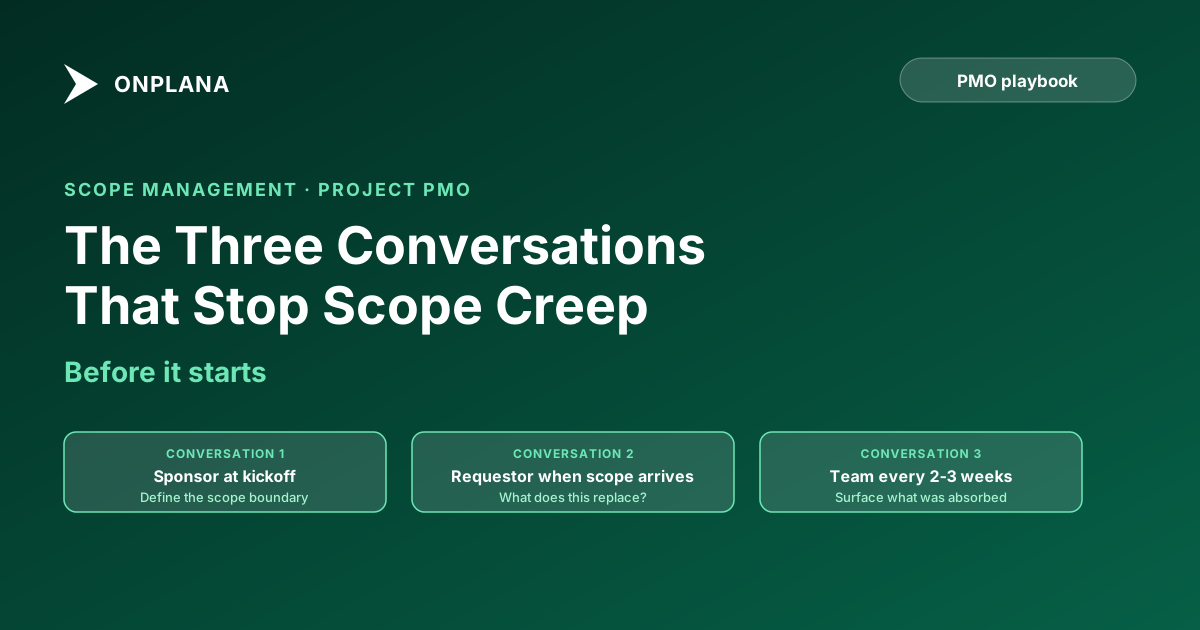
The Three Conversations That Stop Scope Creep Before It Starts
Scope creep is a conversation failure, not a process failure. Three scripts that stop it before it hits the scope creep project management change log.
Here's the pattern. A sponsor asks whether the mobile app could also include push notifications. The PM says "let me check with engineering." Engineering says it's a week's work. The PM says "we have buffer." Three weeks later the buffer is gone. Two sprints are behind. Nobody knows why the schedule slipped because each individual addition seemed manageable when it was agreed to.
That is not a scope management failure. It is a scope creep project management conversation failure. The scope entered because nobody asked the question that would have surfaced the cost. The PM didn't ask: what does this replace in the current sprint? The sponsor didn't hear: this pushes the launch feature back by a week. The team didn't flag: we're running four "small asks" in parallel and none of them are in the plan.
Change logs don't prevent this. They record it after it's already in the project. The tool that prevents it is the conversation that happens before the scope change request is agreed to.
TL;DR. Three conversations stop scope creep before it compounds. The sponsor conversation at project start establishes what failure looks like and locks the scope boundary. The requestor conversation when new scope arrives makes the schedule tradeoff explicit before agreement. The team conversation every two to three weeks surfaces absorbed changes before they become invisible delay. Each takes ten to fifteen minutes. None of them require a change log.
Why process fixes don't stop scope creep
The standard advice is to implement a formal change control process: every scope change goes through a form, gets a cost estimate, and requires sign-off. This is the right structural response to scope changes that have already arrived. It does not stop scope from arriving.
Scope enters projects through three channels that formal change control does not reach. Verbal agreements in hallway conversations, Slack threads, or post-meeting side conversations between a sponsor and an engineer happen before the PM is involved. Small additions that engineering absorbs because declining a one-hour request feels disproportionate. Sponsor requests that skip the formal process because the sponsor's authority level means nobody challenges them in the moment.
Each of these is a conversation that happened without a PM. The fix is not a better form. The fix is the PM having a different conversation first.
The second failure of process-only scope management is that change logs are backward-looking. They capture what happened, not what's about to happen. By the time a scope change appears in a change log, it has usually already been verbally agreed to. The PM is documenting something that's already committed, which means the only remaining question is how to absorb the cost, not whether to accept the scope.
The three conversations in this post are forward-looking. They change what happens before the change log opens.
Conversation 1: The sponsor conversation at project start
This conversation happens once, before the first sprint starts. Its purpose is to establish two things that most project kickoffs skip: what does this project actually need to deliver to be considered successful, and what would make it fail even if it delivered everything on the current scope list.
Most project charters answer the first question in vague terms. "A successful project will deliver a mobile application that improves the customer experience." That description does not define success in a way that creates a scope boundary. It does not tell the PM which features are non-negotiable, which are nice-to-have, or which the sponsor would trade against a tighter timeline.
The sponsor conversation asks three specific questions.
"If we run this project exactly as planned and it fails anyway, what did it fail to deliver?" This surfaces the minimum viable outcome. The answer is usually narrower than the current scope list. It tells the PM which three or four deliverables the sponsor actually cares about, which means every subsequent scope addition can be evaluated against whether it threatens those deliverables.
"What is outside scope by default?" Not "what have we agreed to exclude" but "what would you consider inappropriate to raise as a scope addition during this project?" This question is uncomfortable to ask and valuable to have answered. Sponsors who have thought about scope boundaries before the project starts are less likely to raise unbounded requests mid-sprint.
"Who has authority to approve scope changes?" One name. Not "the steering committee will review" but the name of the person whose yes or no closes the question. If that person is the sponsor, the PM knows to bring scope discussions to the sponsor. If it is the steering committee, the PM knows that unilateral sponsor requests need to be routed rather than absorbed.
The output of this conversation is a one-page scope boundary document: the three or four must-deliver outcomes, the explicit non-list, and the named scope authority. This document is more useful in practice than a ten-page project charter because it answers the questions that arise mid-project.
Conversation 2: The requestor conversation when new scope arrives
This conversation happens every time new scope is proposed, regardless of how small it appears. Its structure is three questions, asked in order.
"What does this replace?"
This is the most important question in scope management. If the answer is "nothing, we have capacity," the conversation moves to validation. If the answer is "I'm not sure," the PM has found the scope management problem before it becomes a schedule problem. Every new scope item displaces something. If the requestor cannot identify what moves, the PM must.
Most scope requests arrive without a cost analysis because the requestor has evaluated the benefit but not the displacement. They know push notifications will improve user engagement. They have not checked whether push notifications fit in the current sprint or whether adding them pushes the launch feature to the next cycle. When the PM asks "what does this replace," they are doing the analysis the requestor skipped.
"What does it delay?"
Name the specific impact. Not "this will affect the timeline" but "adding this moves the launch feature from week eight to week ten." If the PM cannot provide that specificity immediately, that specificity is the homework before the scope decision is made.
Framing the delay as a concrete number changes the conversation. A sponsor who asks for push notifications in abstract terms is making a feature request. A sponsor who hears "that moves the launch feature back by eleven days" is making a schedule decision. The two conversations produce very different outcomes. About half of scope requests that survive the first question do not survive the second.
"Who owns the decision?"
This question routes the scope change correctly. If the PM can grant the addition within existing float, it is a PM-level decision. If it crosses the critical path, it belongs at the steering committee. If it requires resources from another department, it needs the functional manager's commitment. Asking "who owns this" before agreeing ensures that the right person has authorized the change, not just the most enthusiastic one.
The diagram below shows how these three questions function as a filter before a scope change reaches the change log.
Conversation 3: The team conversation when internal drift is happening
The first two conversations address external scope pressure. The third addresses internal drift: scope that enters the project through the team's own decisions rather than through a stakeholder request.
Engineers add a small feature because it was simpler to include than to explain why not. A PM absorbs a three-day ask without logging it because logging a three-day item felt bureaucratic. A developer starts "while I'm in there" improvements that nobody requested but that seem obviously right. Three of these happen in two sprints. The sprint is now twelve days behind, and nobody can point to any single decision that caused it.
The team conversation is a fifteen-minute standing question at the start of a sprint: "What did we do in the last sprint that was not in the plan?" Not an accusation. A diagnostic. The goal is to surface absorbed scope before it compounds.
This conversation is uncomfortable the first time. It implies that work is happening outside the plan, which some teams read as a critique. Frame it differently: "The plan is our shared source of truth. When reality diverges from it, I want to know before it affects the delivery date, not two weeks after."
What you are looking for: tasks that were completed but not in the original sprint, requests that were addressed verbally and not logged, improvements that seemed like the right thing to do but were not scoped. When these surface, the PM logs them, estimates their cost retrospectively, and adjusts the plan to reflect what actually happened. This gives the sponsor an accurate picture of the schedule and gives the team a mental model of what "in scope" means versus what "seemed like the right call."
The team conversation does not require a formal process. It requires a question asked consistently. Teams that have this conversation every two to three weeks develop a different relationship with scope: they stop absorbing informally because they know it will surface in the next session, and when they surface it themselves, it is less politically charged than when the PM discovers it independently.
What scope creep actually costs, in language sponsors understand
Most PMs describe scope impact in abstract terms: "it's affecting the timeline." Sponsors who haven't felt the cost of a late project don't respond to abstractions. They respond to numbers.
The cost model for scope creep is simpler than most PMs make it. Every week of unplanned scope added mid-sprint costs approximately one week of delivery time plus recovery overhead for whatever was interrupted. A two-week scope addition that arrives in the middle of sprint three typically displaces three weeks of planned delivery, because the team switches context, the in-progress work loses momentum, and the new work arrives without complete requirements. The Project Management Institute consistently identifies poor requirements and undefined scope as primary drivers of project budget and schedule overruns in its practitioner research.
Present it that way. "Adding push notifications now will move the launch feature back eighteen days." That sentence ends the negotiation for about half of scope requests. The other half, the ones that survive, represent genuinely high-value additions where the sponsor is willing to make the tradeoff consciously. Those are the only scope changes that should ever make it to the change log: not every request, but the ones where the sponsor has explicitly chosen the tradeoff with full information.
This is what the project risk management guide calls quantified impact: putting a specific number on the consequence so the decision-maker has something real to weigh against the benefit. Abstractions don't prevent scope creep. Numbers do.
When to skip the conversation and go straight to the change log
The three-conversation framework handles most scope requests. Some bypass it entirely.
Regulatory or compliance requirements: log them, implement them, document that they were non-discretionary. There is no conversation to have about whether to accept mandatory scope.
Scope additions requested directly by the executive sponsor that cross the critical path: brief the sponsor on the impact privately, then route the change to the steering committee for formal approval. The conversation helps the sponsor understand the cost; the committee makes the decision. The sponsor's authority does not mean their requests should skip the governance process.
Scope that the team has already completed without logging: the team conversation is too late for work that's done. Log the change retroactively, trace the impact on current and future deliverables, and use the post-mortem to understand why it wasn't surfaced before completion. The team conversation prevents this pattern going forward; it does not undo what's already happened.
For the governance structures that make the change log binding rather than advisory, see discipline, goals, milestones, and status reporting. Process and conversation are not alternatives to each other; the conversation is how scope gets evaluated, and the process is how the decision gets recorded and enforced.
If you want to benchmark where your PMO sits on its scope management capability, the free PMO Maturity Assessment covers scope governance as one of its twenty dimensions. Most teams find their lowest-scoring areas are in the conversations, not the forms.
Run the free PMO Maturity Assessment Twenty questions about how your PMO handles scope, governance, escalation, and decision authority. Get a structured capability profile in about ten minutes. No signup required. → Open the assessment
Frequently asked questions
What causes scope creep in project management?
Scope creep has one root cause: shared understanding of project boundaries was never made explicit. Process fixes like change logs only record scope creep after it starts. The conversations that prevent it establish boundaries before any change request arrives.
What is the most effective way to stop scope creep?
Have three conversations before the first scope change request arrives: one with the sponsor that establishes what success and failure look like, one with the requestor when new scope arrives that makes the tradeoff explicit, and one with the team every few weeks to surface internally absorbed changes.
What should I say when a stakeholder requests scope changes?
Ask three questions: what does this replace, what does it delay, and who owns the decision. Most scope requests stall at the second question because the requestor has not evaluated the schedule tradeoff.
Why do change control processes fail to stop scope creep project management problems?
Change control records changes after they happen. It does not prevent scope from entering through informal channels: verbal agreements in hallways, small additions absorbed by the team without logging, or sponsor requests that bypass the formal process because the sponsor outranks it.
When should you escalate a scope change rather than handle it in conversation?
Escalate when the requestor's authority level exceeds what the three-conversation framework can resolve. If a sponsor is requesting scope that crosses the critical path, the change belongs at the steering committee, not in a one-on-one conversation.
What is scope creep project management best practice in a PMO?
Define scope boundaries in writing at kickoff, create a visible cost model showing what new scope displaces, and establish a named scope authority whose sign-off is required for any change. The conversations apply these structures; they are not a substitute for them.
Ready to make the switch?
Start your free Onplana account and import your existing projects in minutes.