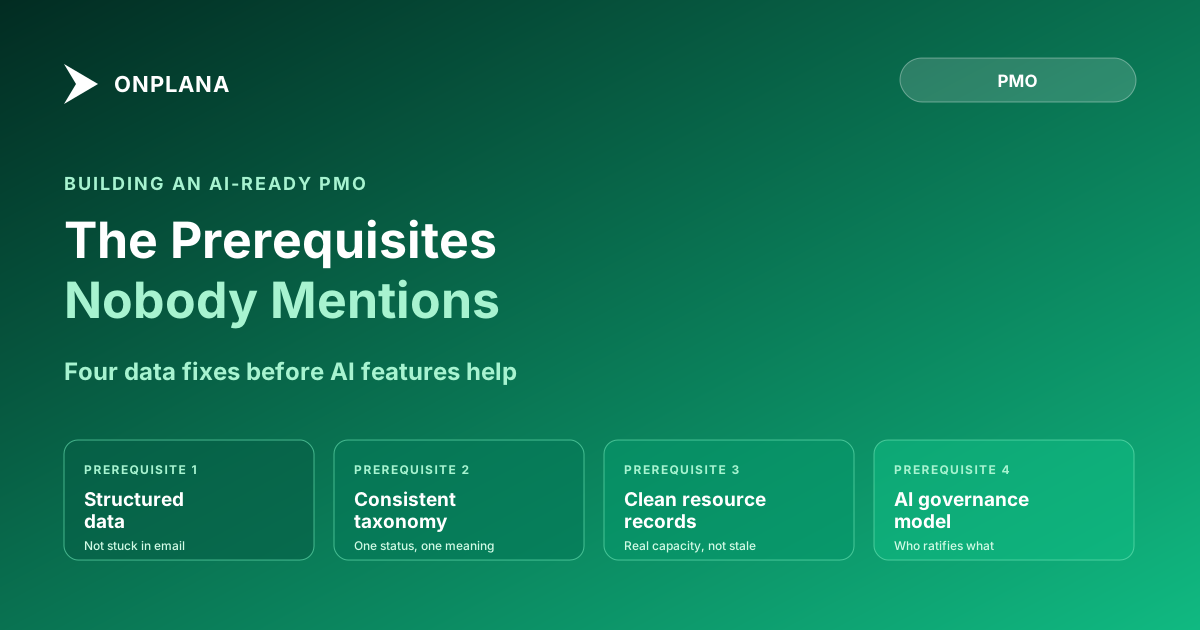
Building an AI-Ready PMO: The Prerequisites Nobody Mentions
An AI-ready PMO is mostly a data-discipline problem, not a tooling problem. The four prerequisites AI needs before its features actually help any PMO team.
Every PMO director who has sat through an AI vendor demo has had roughly the same experience two weeks after signing the contract. The risk-detection feature flags something that already blew up last month and stays quiet on the project everyone already knows is drowning. The natural-language plan generator produces a task list that would embarrass a first-week PM. The status summarizer confidently reports a schedule that hasn't matched reality in a month.
The tool is not defective. The data it is reading is.
An AI-ready PMO is defined by four data prerequisites, not by which AI features it has bought: structured project data the AI can actually parse, a consistent status and field taxonomy across the portfolio, resource records that reflect real capacity, and a governance model defining what AI may act on versus merely suggest. Fixing these before adopting AI features, or during a tool migration, is what determines whether AI output is trustworthy or noise. Most of this work is process discipline a PMO can do itself in two to four weeks; it rarely requires a dedicated data team.
Why AI adoption fails on the data, not the model
The instinct when an AI feature disappoints is to blame the model, upgrade the plan tier, or switch vendors. That instinct is usually wrong, and it is expensive because it treats a data problem as a shopping problem. A language model reasoning over project data can only be as accurate as the structure and consistency of that data allows. Feed it a portfolio where half the projects use a "status" field for red/yellow/green and the other half use it for percent-complete, and any cross-project risk summary the AI produces is comparing incompatible signals and presenting the result with the same confident tone either way.
This is not a novel observation about AI generally; the "garbage in, garbage out" principle predates language models by decades. What is specific to PMOs is how easy it is to have looked functional for years despite exactly this kind of inconsistency, because a human PM reading their own project's status field knows what it means from context, even if the field itself is ambiguous. AI reasoning across a portfolio does not have that context. It has the field, literally, and nothing else unless the underlying data gives it more.
The four data prerequisites AI actually needs
Four things determine whether AI features on top of a PMO's data are reliable or decorative. All four are process and data-hygiene work, not software purchases.
Structured project data. Tasks, dependencies, durations, and assignments need to actually live in the system the AI reads, not scattered across email threads, meeting notes, and a spreadsheet someone updates before steering committee. An AI feature cannot reason about a dependency it was never told exists.
Consistent taxonomies. Every field an AI feature reasons over needs the same meaning across every project it touches. Status, priority, risk severity, and project phase are the four fields most commonly inconsistent across a portfolio, and they are also the four most load-bearing for any AI feature that operates above the single-project level.
Clean resource records. Resource allocation, capacity, and calendar data have to reflect who is actually available and at what percentage, updated on a cadence the AI can trust. Stale resource records are the single most common cause of AI-generated resourcing suggestions that a PM immediately recognizes as wrong.
A governance model for what AI may touch. Structured data and clean taxonomies make AI output accurate. They do not make it safe to act on unattended. A PMO needs a defined answer, before turning on any AI feature that writes to the plan, for which operations the AI may execute directly and which require a human to review first. The AI governance guide for PMOs covers how to build that list operation by operation.
The diagram below shows how these four prerequisites feed into what AI features can actually deliver. Skip a layer and the features built on top of it degrade, even if the model itself is excellent.
How to audit your PMO's AI readiness in a week
A readiness audit does not require a data team or a formal project. It requires an honest look at a representative sample of the active portfolio, followed by a short list of specific fixes. Run it in this order:
- Pull 10 to 15 active projects representing your full portfolio's variety, not just the well-run ones. Include at least a few projects everyone privately knows are messy.
- Check whether status, priority, and risk severity fields use the same value set across all of them. Note every place the same field means something different from project to project.
- Spot-check resource assignments against actual current capacity. Ask two or three resource managers whether the tool's allocation numbers for their people match reality this week. Stale allocation is common and usually invisible until someone checks.
- List every dependency you know exists between these projects informally (a shared resource, a blocking deliverable, a shared vendor) and check whether the tool has that dependency recorded anywhere.
- List the AI operations you are considering turning on (drafting, risk flagging, plan generation, natural-language parsing) and, for each, write down whether it currently has a human review step. If the answer is "we haven't decided," that is the gap the audit surfaced.
The output of this audit is not a maturity score; it is a short, specific punch list: which fields need standardizing, which resource records need a refresh cadence, which dependencies need to be logged, and which AI operations need a governance decision before they turn on. That list is the actual AI-readiness roadmap, and it is usually shorter than PMOs expect. It also tends to track closely with the tooling and reporting dimensions in the broader PMO maturity model: a PMO stuck at an early maturity tier on those dimensions is almost always the same PMO whose AI output disappoints.
What "clean resource records" actually means
Resource records fail in three predictable ways, and each one produces a specific, recognizable kind of bad AI output. Allocation percentages that were entered once at project kickoff and never updated produce AI resourcing suggestions that assume someone is available when they've been at 150% capacity for two months. Generic placeholder resources ("Developer TBD") instead of named people with real calendars produce AI capacity forecasts that look complete but are actually forecasting against a fiction. Resource calendars that don't reflect approved time off produce AI-suggested schedules that quietly assume people work through their vacation.
None of these require new software to fix. They require a resource manager reviewing allocation data on a defined cadence, typically weekly for active projects, and a policy that a named resource replaces a placeholder before that resource's tasks are treated as scheduled rather than provisional.
Consistent taxonomies: why status can't mean five things
Taxonomy drift happens gradually and for reasonable-sounding local reasons. One team adopts a custom risk-severity scale because their industry's compliance framework has its own language. Another team's PM prefers percent-complete over a red/yellow/green status because it feels more precise. Individually, each choice is defensible. Collectively, they make any AI feature that reasons across projects, a portfolio risk summary, a cross-project resource view, a status-report roll-up, unreliable, because the AI is being asked to compare values that were never meant to be compared.
The fix is not to eliminate local nuance entirely; it is to define one canonical taxonomy for the handful of fields that get read across project boundaries (status, priority, risk severity, phase) and let project-specific detail live in fields that stay local to that project. A PMO does not need every field standardized. It needs the fields AI reasons over at the portfolio level standardized, which is a much shorter list.
The governance model AI needs before the features help
Clean data makes AI output accurate. It does not, on its own, make that output safe to act on without a human checking it first. A PMO that fixes its data and then turns on every available AI feature at full autonomy has solved the accuracy problem and skipped the safety problem, which is a different problem with a different fix.
The governance question is which specific AI operations may run without a human reviewing them first, and which require a human to accept, edit, or reject the proposed change before it becomes real. That decision should be made deliberately, operation by operation, scored on how expensive a wrong call is to undo and how much it costs someone outside the immediate task if the AI gets it wrong. The AI governance guide for PMOs walks through that scoring in detail; the point for readiness purposes is simpler: a PMO is not AI-ready if it has clean data but no answer yet to "which of these operations run unattended."
Sequencing: what to fix first
Not all four prerequisites need to be perfect before a PMO starts using any AI feature, and waiting for perfection before starting is its own failure mode. The practical sequence that gets a PMO usable AI output fastest:
- Fix the status and priority taxonomy first. It is the fastest fix, usually a week of PM conversations plus a field-mapping decision, and it unblocks the widest range of AI features immediately.
- Turn on read-only and draft-only AI features next (status summarization, risk flagging as suggestions) while resource-record cleanup continues in parallel. These features don't require perfect resource data to be useful and don't require a write-permission governance decision yet.
- Clean resource records on the projects where AI-assisted resourcing decisions will actually be used, not the whole portfolio at once. Prioritize the projects where allocation conflicts are already a known pain point.
- Write the governance list before turning on any write-capable AI feature, not after. This is the one prerequisite that has to be decided deliberately rather than discovered by watching what goes wrong.
A PMO evaluating its overall maturity as part of this process, not just its AI readiness specifically, can use the PMO Maturity Assessment as a starting baseline; AI readiness maps closely to the tooling and reporting dimensions that assessment already measures, and a PMO with gaps in those dimensions generally has the same gaps that make AI output unreliable.
The AI-ready PMO is a data-discipline story, not a shopping story
None of the four prerequisites above require a new AI feature, a bigger AI budget, or a more capable model. They require the unglamorous, un-demoable work of agreeing on what a field means, keeping resource records current, and writing down which decisions AI is allowed to make without asking first. That work does not show up in a vendor pitch deck, which is exactly why it gets skipped, and exactly why the PMOs that do it first get materially better results from the same AI features everyone else is disappointed by.
Check where your PMO actually stands The free PMO Maturity Assessment scores your process, tooling, governance, risk, and reporting maturity in about 10 minutes and surfaces your weakest dimension, the same dimension that usually explains disappointing AI output. → Run the PMO Maturity Assessment
Frequently asked questions
What does it mean for a PMO to be AI-ready?
An AI-ready PMO has project data structured well enough for a model to read reliably: consistent status taxonomies, resource records that reflect real capacity, dependencies and risks logged where the AI can see them, and a governance model defining what AI may act on versus merely suggest. Readiness is a data and process property, not a feature you turn on.
Why does AI project management software underperform for some PMOs and not others?
The model itself is usually not the difference. The underlying data is. A risk-detection feature reading a project where status fields are stale, dependencies are undocumented, or tasks live half in the tool and half in email will surface noise or miss real risk, regardless of how good the model is. The same feature reading disciplined data performs as advertised.
What is the single highest-leverage data fix before adopting AI features?
Standardizing status field taxonomy across the portfolio. If projects use inconsistent status values (green/yellow/red on some, percent-complete on others, a custom field on a third), any AI feature that reasons across the portfolio is working from incompatible inputs before it even starts. This is usually the fastest fix and the one with the broadest downstream effect.
How long does it take to make a PMO AI-ready?
A focused data-hygiene pass on an active portfolio of 20 to 50 projects typically takes two to four weeks of part-time effort: an audit week, a taxonomy standardization pass, and a resource-record cleanup. Larger or more fragmented portfolios take longer, but the audit itself, which tells you exactly where the gaps are, takes about a week regardless of scale.
Should a PMO fix its data before or after buying an AI-native PM tool?
Run the audit before signing, and treat what it finds as part of the buying decision, not a separate project. Migrating into a new tool is the natural moment to fix taxonomies and resource records, because the alternative is carrying the same inconsistencies into the new system and getting the same disappointing AI output there too.
Does a PMO need a data team to get AI-ready?
No. The prerequisites are process discipline, not data engineering: agreeing on a status taxonomy, keeping resource calendars current, logging dependencies where the tool can see them, and deciding which AI operations need a human gate. A PMO director and a handful of PMs can do this work directly; it does not require a dedicated data function.
Ready to make the switch?
Start your free Onplana account and import your existing projects in minutes.