AI Governance for PMOs: Guardrails That Actually Hold
AI governance PMO policies fail the moment they say only 'a human stays in the loop.' Here's the boundary model and audit trail that actually hold up.
Most AI governance policies are decoration. They say the AI "stays under human oversight" and "operates within responsible use guidelines," and then a PMO director reads that sentence and still cannot answer the one question an auditor, a CFO, or their own nervous system will eventually ask: which specific things is this model allowed to do on our real project data, unattended, and which does it need a human to sign off on first?
That question does not have a principled answer. It has a list. A working AI governance policy for a PMO is a list of operations, each one assigned to exactly one of three buckets, plus a record of every action the AI actually took. Everything else, the ethics language, the responsible-AI pledge, is the wrapper. The list is the policy.
TL;DR. AI governance PMO work means naming every AI operation touching project data and assigning it to one of three buckets: acts without a human gate, proposes and waits for a human to accept, or is permanently off-limits to AI regardless of settings. The assignment is decided by two questions, how cheap is the action to reverse and how costly is it if wrong, not by a general ethics statement. Every act-zone action needs an audit entry capturing the trigger, the data retrieved, the action taken, and who or what initiated it. Skip the audit trail and the governance policy is unenforceable the first time someone asks "prove it."
What AI Governance Actually Means for a PMO
AI governance PMO policy is not the same document as your organization's AI ethics charter, and treating it as one is the first mistake most PMOs make. An ethics charter states values: fairness, transparency, accountability. A PMO governance policy has to translate those values into a list of project operations and a ruling on each one: does AI act on this without asking, does it propose and wait, or does it never touch this at all.
The distinction matters because a values statement cannot be audited and a list can. When a stakeholder asks "did AI approve that budget change," the ethics charter has no answer. The operation list does: budget approval is a stay-out operation, so no, and here is the human approval record showing who did approve it. Governance that cannot answer that question in one lookup is not governance yet, it is a mission statement.
The Three Questions Every AI Governance Policy Has to Answer
Before writing a single rule, a PMO needs a straight answer to three questions, because every operation-level decision downstream depends on them.
What can the AI decide on its own? Not "what can it help with," which is nearly everything, but what can it commit to project state without a human clicking accept first.
What does it need permission for? Which operations produce a proposal that sits and waits, evidence attached, until a human accepts, edits, or rejects it.
What can it never touch? Which operations are off the table entirely, not configurable by an eager admin trying to save time, hard-coded out of AI authority.
A policy that only answers the first question is a productivity feature, not governance. A policy that answers all three, with named operations under each, is something you can actually defend to an auditor.
The Act, Suggest, Stay-Out Boundary
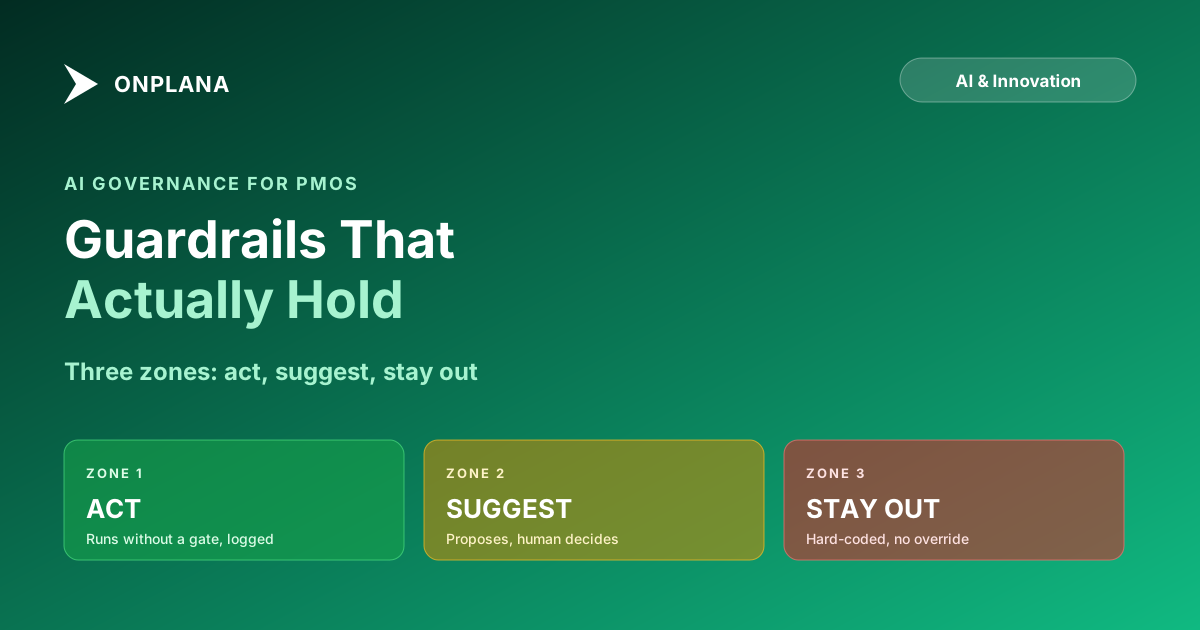
The cleanest working model for answering those three questions sorts every AI operation into exactly one of three zones, and the boundary is enforced in code rather than left as guidance a busy PM might skip under deadline pressure. Onplana's own AI decision boundaries are a concrete example of the pattern: operations like a first-draft plan or a natural-language task parse sit in the act zone because a wrong output costs thirty seconds of editing; operations like a resource shift or a rebaseline sit in the suggest zone because the AI's evidence needs a human to actually commit the change; and operations like financial commitments, baseline sign-off, and performance reviews sit in a stay-out zone no admin setting can move.
That third zone is the part governance policies most often get wrong by omission. It is easy to write rules for what AI can do. It is much rarer to see a PMO write down, explicitly, what AI is never allowed to do regardless of who asks for the exception, and that omission is exactly the gap an ambitious vendor integration or an overworked admin will eventually fill by accident.
The diagram below shows how a governance policy should route a new AI capability through this decision before it ever touches live project data.
Why Human-in-the-Loop Only Works at Defined Gates
"Human in the loop" is the phrase every AI governance slide deck leans on, and it is nearly meaningless without a definition of where the loop closes. A human reviewing every single AI output, all the time, is not oversight, it is a bottleneck that will quietly get skipped the first time a deadline is tight. A human reviewing nothing is not oversight either, it is a rubber stamp waiting to happen.
The version that actually holds is propose-ratify: the AI proposes a change on suggest-zone operations, evidence attached inline, and a human explicitly accepts, edits, or rejects before it becomes real. The gate is not "someone glanced at it," it is a discrete action a specific person took, timestamped, attributable. That distinction, an explicit accept versus a passive non-objection, is the entire difference between a governance control and governance theater.
The gate should also be sized to the operation, not applied uniformly. A risk flag on a task getting the AI's confidence level and evidence shown inline is a lightweight gate a PM clears in seconds. A proposed rebaseline affecting six months of committed schedule deserves a heavier one, possibly involving the sponsor. Same mechanism, calibrated weight.
What Should an AI Audit Trail Actually Capture?
An audit trail that only logs "AI updated task 4471" is close to useless when someone asks why. A governance-grade audit entry needs four things every time: the prompt or trigger that started the action, the actual data the model retrieved before acting (not what it was supposed to see, what it did see), the resulting action, and the identity of the user or system that initiated it, with a timestamp.
The retrieved-context field is the one most homegrown AI logging skips, and it is the one that matters most under scrutiny. "The AI moved the deadline" tells you what happened. "The AI moved the deadline because it read a comment from three weeks ago referencing an internal target, not the customer-committed date" tells you why, and that second sentence is what separates a defensible action from an indefensible one when a stakeholder pushes back.
A well-built audit trail also needs to be filterable and exportable on demand, not something engineering has to extract from raw logs when an auditor asks. If producing the trail for a specific project or a specific quarter takes more than an afternoon, the audit system itself is a governance gap.
Who Owns AI Governance in the PMO?
Ownership tends to drift to whichever team touched AI first, usually IT security, and that is a mismatch. IT security is well positioned to enforce technical controls: authentication, data access scoping, encryption. It is not positioned to decide whether a resource-shift proposal on a live project is cheap enough to auto-apply, because that is a judgment about project risk tolerance, not a security posture.
The PMO director or portfolio lead should own the operation-by-operation zone assignments, because that decision requires knowing what a wrong call actually costs on a real project, the kind of context that lives in the PMO, not in a security team's threat model. IT's role is enforcing the boundary the PMO sets (making the stay-out zone genuinely unconfigurable, for instance), not setting where the boundary sits.
In practice this means a named individual, not a committee, signs off on each zone assignment and revisits it on a fixed cadence, typically quarterly, as trust in specific operations builds or a near-miss narrows something back.
The Policy Questions to Answer Before Rolling Out AI Portfolio-Wide
Before turning AI loose across more than a pilot project, a PMO should be able to answer each of these in writing, not from memory in a meeting.
- List every AI operation touching project data, not just the marketed features. Include the quiet ones: auto-tagging, notification triggers, anything running on a schedule without a click.
- Assign each operation to act, suggest, or stay-out, using reversibility and external cost as the criteria, not vendor defaults.
- Name who owns each zone assignment and how often it gets reviewed.
- Confirm the stay-out zone is technically enforced, not just documented, meaning no admin toggle can move an operation out of it.
- Confirm every act-zone action writes an audit entry with trigger, retrieved context, action, and actor.
- Define the escalation path for when an AI action in the suggest zone gets rejected repeatedly for the same reason, so the pattern gets fixed at the source rather than re-litigated each time.
- Set the review cadence for widening or narrowing zones based on real acceptance-rate data, not a one-time policy that never revisits itself.
Skipping any one of these does not usually cause an immediate incident. It shows up eight months later, when an auditor, a new CFO, or an unhappy customer asks a specific question the PMO cannot answer with a document that already exists, and someone has to reconstruct the policy under pressure instead of pointing to it.
Where AI Governance Fails in Practice
Three failure patterns account for most of the AI governance breakdowns PMOs report after the first two quarters of real use.
The stay-out zone erodes by exception. Someone senior asks for "just this once" access to auto-approve something in the stay-out zone to hit a deadline, it gets granted informally, and six months later that exception is quietly the new normal because nobody wrote down that it was supposed to be temporary. The fix is structural: stay-out zone changes require the same named-owner sign-off as creating the zone in the first place, with an expiration date on any exception.
The audit trail exists but nobody can query it. Logging happens by default in most systems now, but a log dump is not an audit trail if answering "show me every AI action on Project X in March" takes an engineer three hours. Governance-grade logging has to be a first-class, filterable surface, not an afterthought bolted onto application logs.
Zone assignments never get revisited. A PMO sets the boundary once at rollout and treats it as settled. Real usage data (acceptance rates, near-misses, false positives) should move operations between zones over time, tighter where AI keeps getting something wrong, looser where it has earned trust. A policy that never changes is either perfectly calibrated on day one, which is unlikely, or nobody is looking at the data.
This framing of governance as an operation-by-operation boundary rather than a values statement lines up with how the NIST AI Risk Management Framework structures its govern, map, measure, and manage functions: govern sets the boundary, map identifies where AI touches real processes, measure is the audit trail, manage is the review cadence that moves operations between zones as evidence comes in. A PMO does not need to adopt the framework wholesale to borrow its shape.
Building the Muscle Before the Portfolio-Wide Rollout
None of this requires a large governance function. It requires one operation list, one named owner per zone, one enforced technical boundary around the stay-out zone, and one audit surface someone can actually query without engineering help. Most PMOs that get this right start with a single pilot project, write down the zone assignments for the handful of AI operations in play, and only widen to the full portfolio once the audit trail has actually been tested against a real "prove it" question, not just a review meeting.
A PMO maturity assessment is a reasonable place to find out where the governance gaps sit before AI adoption makes them expensive; it surfaces exactly the process and data-discipline weak points (unclear ownership, inconsistent audit habits) that turn into AI governance failures once a model is acting on the same underlying process. The agent-native approach to project management covers the token-scoped, verify-before-done design that makes an individual agent trustworthy in the first place; governance is the layer that decides, portfolio-wide, which of that agent's actions get to run without asking.
Run the free PMO Maturity Assessment Get a structured read on where your PMO's process and data discipline stand before AI adoption raises the stakes on every gap. No signup required. → Open the assessment
Frequently asked questions
What is AI governance for a PMO?
AI governance for a PMO is the set of rules that decide what an AI system is allowed to do on real project data, who is accountable when it acts, and how every action is audited. It is narrower and more concrete than an org-wide AI ethics policy: it has to name specific operations, not just principles.
Is 'a human stays in the loop' enough of an AI governance policy?
No. That phrase describes an intention, not a control. A real policy names which specific operations require a human gate, which can run unattended, and how the difference is enforced technically rather than left to individual judgment.
What should an AI audit trail record for a PMO?
At minimum: the prompt or trigger that started the action, the data the model actually retrieved, the action taken, the user or system that initiated it, and a timestamp. Without the retrieved context, an audit log only shows what happened, not why, which is the part an auditor or an angry stakeholder actually asks about.
Who should own AI governance in a PMO?
The PMO director or portfolio lead, not IT security alone and not a vendor's default settings. IT can enforce technical controls, but the decision about which project operations AI may act on versus merely suggest is a PMO judgment call about risk tolerance, not a security configuration.
How do you decide which AI operations need a human approval gate?
Score each operation on two axes: how expensive is it to undo if the AI gets it wrong, and how much does getting it wrong cost someone outside the team (a customer, a budget, a person's record). Anything cheap to reverse and low external cost can run unattended. Anything either expensive to undo or high external cost needs a gate, no exceptions.
Does AI governance slow down AI adoption in a PMO?
It changes which parts move fast. Low-risk, high-frequency operations (drafting, parsing, summarizing) can run without a gate from day one, which is most of the time savings. The gate only sits in front of the small number of operations where a wrong call is genuinely expensive, so most of the adoption curve is unaffected.
Ready to make the switch?
Start your free Onplana account and import your existing projects in minutes.