Human-in-the-Loop AI for Project Management: Where the Human Belongs
Human-in-the-loop AI for project management is neither full autonomy nor a chat sidebar. Here's the autonomy framework and the trust research behind it.
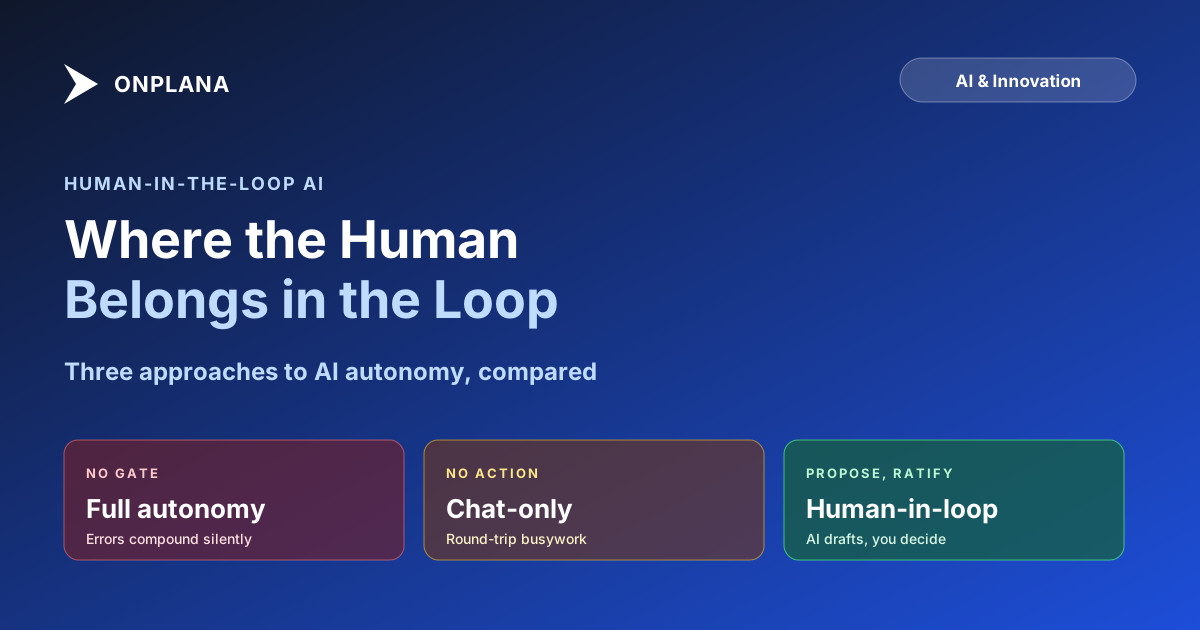
Two answers dominate the debate over how much autonomy human-in-the-loop AI should give a real project, and both are wrong. One camp wants AI to run the project end to end: parse the brief, build the schedule, update task status, ping stakeholders, no human in the loop until something breaks. The other camp wants AI kept in a chat window, answering questions when asked and touching nothing. Vendors ship one extreme or the other because both are easy to build and easy to demo. Neither is what a PMO managing real deadlines and real budgets actually needs.
The useful middle has a name: human-in-the-loop AI. The AI proposes a change and shows its evidence. A person accepts, edits, or rejects it. Only the ratified version becomes the plan of record. That sounds obvious once stated, and it is still the exception rather than the rule in most AI-in-PM product design.
Human-in-the-loop AI for project management works through a propose-ratify pattern: the AI drafts a change with its evidence attached, a person accepts, edits, or rejects it, and only the ratified version becomes real. The gate belongs on operations that are expensive to undo or costly to get wrong outside the immediate task; it should stay off high-frequency, cheap-to-reverse operations like drafting and parsing, or it becomes approval fatigue instead of oversight. Autonomy should be set per operation, not per tool, and it should widen only when a sustained acceptance rate shows the review has stopped adding decision quality.
Why full autonomy fails on real project data
Full autonomy sounds efficient until an AI system commits a wrong decision to a plan that other people are relying on. A schedule that gets silently rebaselined, a status report that gets published with an inflated confidence level, a resource reassignment that overloads someone who was already at capacity: none of these are hypothetical failure modes, they are the ordinary error rate of a language model applied to messy, incomplete project data, compounded by the fact that nobody caught the mistake before it shipped.
The deeper problem is that full autonomy removes the one signal that tells you the AI is drifting: human disagreement. A PM who reviews and occasionally rejects an AI proposal is generating a data point about where the model is unreliable. A PM who never sees the proposal because it already executed generates no such signal until the downstream damage surfaces, usually days or weeks later, in a missed milestone or a startled stakeholder.
Why chat-only assistance wastes the technology
The opposite failure is quieter and more common: AI confined to a sidebar that answers questions but never touches the actual plan. This is the shape most "AI-powered" PM tools ship, because it is the safest thing to build and the easiest thing to demo without breaking anything. It is also the shape that produces the least value, because every answer the AI gives still has to be manually re-typed into the schedule, the status report, or the task list by the person who asked the question.
Chat-only assistance treats AI as a research assistant instead of a collaborator. It is strictly worse than either extreme on the axis that matters most for a PMO: time saved per week, because the round trip between "ask AI" and "manually apply what AI said" eats most of the time the AI supposedly saved. If a PM asks an AI assistant to summarize a stalled initiative and then has to copy the summary into a status report by hand, the tool has automated the thinking and left the busywork exactly where it was.
What human-in-the-loop AI actually means: propose, evidence, ratify
Human-in-the-loop AI is a specific pattern, not a vague reassurance that "a person is involved somewhere." The pattern has three parts, and all three have to be present for the label to mean anything.
- The AI proposes a concrete state change. Not a suggestion buried in a chat transcript, an actual draft: a task, a rebaselined date, a status report, a resource reassignment, formatted exactly as it would look if applied.
- The proposal carries its evidence. The rows it was built from, the retrieved context, the reasoning trail. A proposal without evidence forces the reviewer to either rubber-stamp it or independently re-derive the answer, which defeats the point of asking AI in the first place.
- A human ratifies, edits, or rejects it before it becomes real. Ratification is a specific, logged action, not an implicit default that happens if nobody objects within some time window.
This is the propose-ratify pattern, and it is worth naming because it is different from both extremes discussed above. It is not full autonomy, because nothing becomes real without a human action. It is not chat-only assistance, because the AI's output is already formatted as an applyable state change, not a paragraph the human has to translate into action. Onplana's AI agents run on this exact shape: an agent receives evidence, proposes a state change, and waits for a human to ratify, the same discipline a PM would expect from a junior analyst handing over a draft before it goes to a stakeholder.
Which decisions actually need a human gate?
Not every AI operation needs the same level of scrutiny, and treating them identically is how human-in-the-loop design turns into approval fatigue instead of useful oversight. Two questions decide whether an operation gets a gate.
How expensive is it to undo if the AI is wrong? A misparsed task takes thirty seconds to fix. A rebaseline that quietly resets six months of drift history is not a thirty-second fix, and by the time someone notices, the original numbers may be unrecoverable.
How much does a wrong call cost someone outside the immediate task? An AI-drafted status report that a PM edits before publishing costs nothing if the draft is wrong, because it never left the PM's screen. An AI action that changes a resource's assignment, a budget line, or a customer-facing date carries a cost that lands on someone who never got to weigh in.
Operations that are cheap to undo and low in external cost can run without a gate. Operations that are either expensive to undo or high in external cost need a human to ratify them first, without exceptions carved out for convenience. This scoring approach and the audit-trail requirements that go with it are covered in more depth in the AI governance guide for PMOs; this post focuses on the autonomy question one level up from the gate itself.
The diagram below walks the decision for a single operation.
How much autonomy should each operation get?
Treating "human in the loop" as a single on/off switch is too coarse for a real PMO, because different operations warrant genuinely different levels of AI independence. A useful reference point is the levels-of-automation framework Parasuraman, Sheridan, and Wickens laid out for human-machine systems in general: automation exists on a spectrum from fully manual, through the machine offering options, through the machine executing and only then informing the human, up to fully autonomous with no human notification at all.
Mapped onto project management operations, that spectrum looks roughly like this, moving from least to most autonomous:
- Manual only. The human does the work; AI is not involved. Appropriate for financial commitments and performance-adjacent judgments.
- AI drafts, human writes from scratch if they choose. A first-draft status report or plan the human is free to ignore entirely. Zero commitment either way.
- AI proposes, human ratifies before it applies. The propose-ratify pattern described above. This is where most medium-risk PM operations belong: resource shift proposals, risk flags, schedule what-ifs.
- AI executes, human is notified and can reverse it. Appropriate only for genuinely cheap-to-reverse, high-frequency operations: natural-language task parsing, a recommendation widget refresh.
- AI executes with no notification. Reserved for read-only operations like retrieval and analysis that never change project state, where there is nothing to ratify because nothing was committed.
Most PM tools that claim "AI autonomy" are really offering level 4 or 5 dressed up as a feature list, without disclosing that the operations covered are the cheap, reversible ones. The useful question for a buyer or a PMO director is not "does this tool have autonomous AI," it's "which level does each specific operation actually run at, and does that level match how expensive that operation is to get wrong."
How trust calibration changes the gate over time
A gate that never moves is not a feature of good oversight, it is a sign nobody is measuring whether the oversight is still earning its keep. The relevant research concept is trust calibration: the idea, well documented in human-automation interaction research and reflected in frameworks like NIST's AI Risk Management Framework, that trust in an automated system should track the system's actual reliability, not run ahead of it (over-trust) or lag behind it (under-trust, where a human re-checks work a system has already proven reliable on).
In practice, calibration means tracking acceptance rate on a specific operation over a defined window, typically two to four weeks. A sustained acceptance rate above roughly 90 to 95 percent with no material edits is a signal the operation could move up one level, from gated to notify-and-reverse, without meaningfully increasing risk. A dropping acceptance rate, or edits that change the substance of the proposal rather than its formatting, is the opposite signal: the gate is doing real work and should stay, or in some cases tighten. Onplana's decision-boundary model implements a concrete version of this idea, surfacing acceptance-rate data to admins on a quarterly cycle so the widening decision is based on evidence rather than a hunch that "the AI seems fine now."
The calibration has to run in both directions. An operation that starts gated and earns its way to a lighter gate can also earn its way back if the acceptance rate drops after a model update, a data source change, or simply a run of unusual project conditions the AI has not seen before.
The failure mode: automation complacency
The research literature on human-automation interaction has a specific name for what happens when a gate stays in place but the human stops actually using it: automation complacency. The reviewer keeps clicking "accept" without reading the evidence, because the system has been right often enough that reading feels like wasted effort. The gate technically still exists. Functionally, it has become level 4 or 5 autonomy with extra clicks.
This is not a hypothetical risk specific to project management; it shows up wherever automation reliability crosses a threshold where vigilance starts to feel unnecessary, from aviation cockpit alerts to clinical decision support. The mitigation is not removing the gate, which just makes the drift official. It is making the evidence genuinely fast to check (so reading it costs seconds, not minutes) and periodically sampling ratified decisions after the fact to confirm the review is still substantive rather than reflexive. A PMO that has not looked at a sample of its own "accepted" AI proposals in the last quarter does not actually know whether its human-in-the-loop gate is still a gate.
Setting this up without over-engineering it
A PMO does not need a formal autonomy taxonomy to start. Three practical steps get most of the value:
- List the AI operations your team actually uses, not the ones a vendor demo showed. Most PMOs are using four to six regularly: drafting, parsing, risk flagging, and maybe scheduling what-ifs.
- Score each one on undo cost and external cost, using the two-question test above. This takes an afternoon, not a project.
- Put a gate on anything that scores high on either axis, and leave everything else ungated. Revisit the scoring quarterly using acceptance-rate data rather than guesswork.
The goal is not to maximize how much AI does unattended. It is to spend the review budget where a wrong call is actually expensive, and to stop spending it where the review has become theater. That is what "human in the loop" means when the phrase is doing real work instead of decorating a feature list.
If your team is evaluating how a PM tool's AI actually handles this, worth checking directly: does the vendor name the specific operations that are gated, or only describe AI oversight in the abstract? Onplana's propose-ratify agents name the operations explicitly, and the evidence attached to every proposal is visible before you ratify anything, not after.
Frequently asked questions
What does human-in-the-loop AI mean in project management?
Human-in-the-loop AI means the model can read project data, draft a proposal (a task, a schedule change, a status report), and surface it with its evidence, but a person has to accept, edit, or reject it before it becomes the plan of record. The AI does the drafting; the human owns the decision.
Is human-in-the-loop AI slower than fully autonomous AI?
On the operation itself, yes, by however long the review takes. Across a quarter, usually no, because a bad autonomous action costs far more time to unwind than a review costs to perform, and most human-in-the-loop reviews take seconds once the evidence is shown inline.
What is the propose-ratify pattern?
Propose-ratify is the specific shape human-in-the-loop AI takes in practice: the AI proposes a state change and attaches the evidence it used, the human ratifies (accepts), edits, or rejects it, and only a ratified action becomes real. It is the same shape as a PM reviewing a draft from a junior analyst before it goes to a stakeholder.
Which AI project management decisions actually need a human gate?
Score each operation on two axes: how expensive is it to undo if the AI is wrong, and how much does a wrong call cost someone outside the immediate task. Anything cheap to reverse and low external cost can run without a gate. Anything either expensive to undo or high in external cost needs a human to ratify it first, no exceptions.
Does human-in-the-loop AI create approval fatigue?
It does if every operation gets the same gate regardless of risk. The fix is not removing gates, it's calibrating them: high-frequency, low-risk operations run without a gate, and the gate budget is spent on the small number of decisions where being wrong is actually expensive.
How do you know when to loosen a human-in-the-loop gate?
Track the acceptance rate on a specific operation over a defined window, typically two to four weeks. A sustained acceptance rate above roughly 90 to 95 percent with no material edits is the signal that the gate is adding review time without adding decision quality, and it is a candidate to loosen.
Ready to make the switch?
Start your free Onplana account and import your existing projects in minutes.