Benefits Realization: Proving a Project Was Worth It
Benefits realization checks whether a project's promised value actually showed up, not just whether it shipped on time, on budget, and to spec.
Most projects close with a retrospective and a round of applause. Few close with anyone checking whether the value the business case promised actually showed up. The project delivered on time, on budget, and to spec, and the organization moved on without ever measuring the one number the business case was approved on: the benefit.
Benefits realization is the discipline of tracking a project's promised value past go-live, assigning an owner who survives the project team's disbandment, and measuring against a baseline months later to confirm the value actually landed. It does not stop at delivery. A project can hit every schedule and budget target and still fail benefits realization if the promised outcome, lower cost, higher throughput, better retention, never gets checked.
Direct answer: Benefits realization closes a loop most project management stops short of: it names a specific, measurable benefit in the business case, assigns an owner who still exists after the project team disbands, and checks the outcome against that baseline at a fixed point after go-live. Skip this step and the organization funds its next project on the same untested promise the last one made.
What Benefits Realization Actually Measures
Projects deliver outputs: a new system, a migrated dataset, a trained team. Benefits realization checks whether that output turned into an outcome, an adopted process, a changed number, and whether the outcome produced the value the business case claimed it would.
The business case makes a specific, falsifiable promise: this system will cut support costs by a stated amount, or this process change will bring cycle time down to a stated number. Benefits realization is the mechanism that goes back and checks that promise against reality, on a schedule, with a named owner, instead of assuming that on-time, on-budget delivery means the value showed up too. Those are different claims, and only one of them is actually about the benefit.
Why the Loop Usually Never Closes
Three things routinely break benefits realization before it starts. The project team disbands at go-live, so the people who understood the original business case are not around to measure against it later. The benefit's baseline was never actually captured before the project started, so there is nothing credible to compare the after-number to. And nobody owns the measurement task once the project closes, because project closure checklists track deliverables and lessons learned, not a follow-up appointment six months out.
None of these require new tooling to fix. They require deciding, at approval, who checks the number and when, and writing that decision into the business case itself instead of treating it as a favor someone might get around to. Whether that decision gets made at all is usually a governance gap, exactly the kind the free PMO Maturity Assessment is built to surface.
Building a Benefits Realization Plan
- Name the benefit as a measurable number, not a phrase. "Improve efficiency" is not measurable. "Cut average ticket resolution time from 4.2 days to 3 days" is.
- Capture the baseline before the project starts. A benefit measured only after delivery has nothing credible to compare against; the before-number has to exist first.
- Assign a benefit owner who is not the project manager. The PM's accountability ends at delivery. The benefit owner's accountability starts at go-live and runs until the benefit is measured.
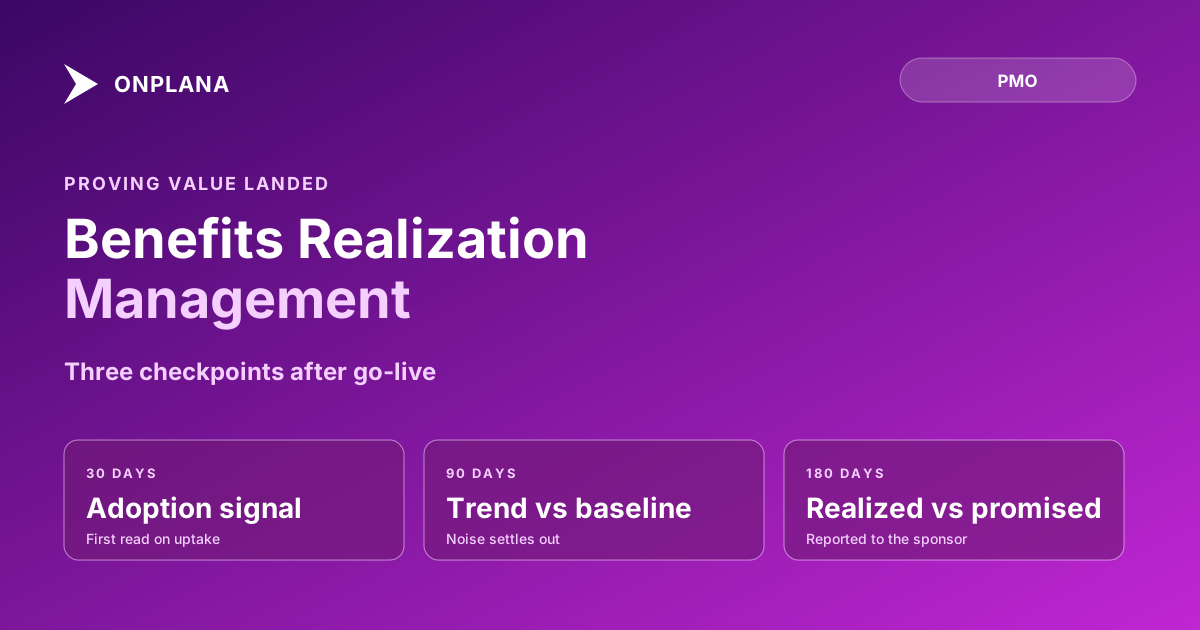
- Set the measurement dates in the business case, typically 30, 90, and 180 days post go-live for anything where adoption ramps up over time, not a single check in the week after launch.
- Report the realized number back to whoever approved the business case, even when it comes in worse than promised. A benefits process that only reports the wins is not measuring anything; it is marketing the project team.
Who Owns the Benefit After Go-Live
The single most commonly skipped step is the ownership handoff. A project manager who owns delivery is judged on schedule and budget, not on whether the sponsor's original number ever moved. Once the ribbon is cut, accountability for the benefit has to land somewhere specific, or it lands nowhere.
The diagram below shows where that handoff has to happen: project management accountability ends at delivery, and a named benefit owner's accountability starts at go-live and continues through the final measurement checkpoint.
Measuring Realized vs Promised Value
Different benefit types need different measurement windows and different owners. A cost reduction shows up in an invoice within a quarter; an adoption or retention benefit takes longer to separate signal from noise.
| Benefit type | What to track | When to measure | Who reports it |
|---|---|---|---|
| Cost reduction | Actual invoiced or budgeted spend vs. baseline | 90 days post go-live | Finance + benefit owner |
| Cycle time or throughput | Rolling trend against the pre-project baseline | 30 and 90 days | Benefit owner |
| Adoption or usage | Active-user rate vs. the target stated in the business case | 30, 60, and 90 days | Benefit owner |
| Quality or error rate | Defect or rework rate vs. baseline | 90 days | Quality lead + benefit owner |
| Retention or satisfaction | Survey trend or attrition rate | 180 days | HR or benefit owner |
The 90-day mark does most of the work in this table. It is late enough that early-adoption noise has settled and early enough that the people who approved the business case still remember what was promised.
What Changes When You Actually Close the Loop
A phase-gate review asks whether a project's value still justifies its spend while the project is in flight. Benefits realization asks the same question after the project has closed, which is the harder version because there is no longer a project to kill, only a promise to check. Both depend on the same discipline: named criteria set in advance, and a decision recorded against evidence rather than a narrative.
Closing the loop changes behavior upstream, not just downstream. Once sponsors know their realized numbers get reported back and compared to what they promised, inflated projections in the next business case get harder to write with a straight face. Measuring whether a migration actually succeeded is one concrete version of this same pattern applied to a single project type: a scorecard checked at fixed intervals after the work is done, not a status update while it's still in flight. A CFO-proof business case that names its benefit precisely at approval is also the business case that is easiest to check twelve months later, which is exactly the point.
See how benefits realization fits your PMO's maturity Run the free PMO Maturity Assessment to see where benefits tracking and other governance practices sit on your PMO's maturity curve, and what to fix first. → Take the free PMO Maturity Assessment
Frequently asked questions
What is benefits realization?
Benefits realization is the process of tracking a project's promised value past go-live: naming the benefit as a measurable number, assigning an owner who outlasts the project team, and checking the result against the original baseline on a fixed schedule.
How is benefits realization different from a business case?
A business case makes the promise before funding is approved. Benefits realization checks whether that promise came true after delivery. Most PMOs are rigorous about the first and skip the second entirely.
Who should own a project's benefits after it closes?
A named benefit owner who is not the project manager, because the PM's accountability ends at delivery while the benefit owner's accountability starts at go-live and continues through the final measurement checkpoint.
When should you measure realized benefits?
Set the measurement dates in the business case itself, typically at 30, 90, and 180 days post go-live for benefits that ramp up as adoption grows, rather than a single check in the week after launch.
What happens if a project's benefits are never measured?
The organization keeps approving future business cases on the same untested assumptions the last one made. Without a realized-versus-promised comparison, there is no feedback loop correcting for sponsors who habitually overstate value to win funding.
Ready to make the switch?
Start your free Onplana account and import your existing projects in minutes.