PMO Operating Models: Supportive, Controlling, Directive
A PMO operating model sets how much authority the PMO holds over projects: supportive, controlling, or directive, matched to risk, not a maturity rank.
Not every PMO should do the same job. A supportive PMO that tries to run projects the way a directive one does will be resented by every team it touches. A directive PMO that only offers templates and advice in a regulated enterprise will watch scope and risk drift past the point anyone can pull it back.
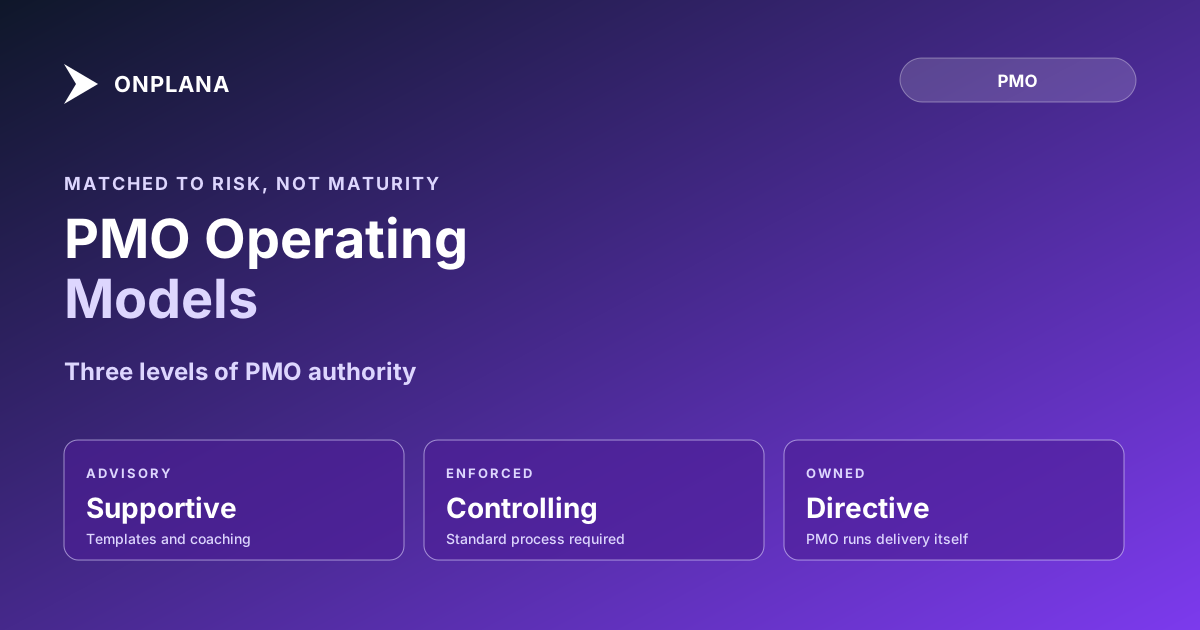
A PMO operating model is the level of authority a PMO holds over the projects in its portfolio. There are three classic variants: supportive (templates and coaching, no authority to enforce anything), controlling (a standard process the PMO requires compliance with), and directive (the PMO owns and runs the projects directly, staffed with its own project managers). The right model is not a maturity ranking from weak to strong; it is a fit question tied to how much risk the organization can tolerate from inconsistent delivery.
Direct answer: The three PMO operating models sit on a spectrum from serve-the-teams to run-the-projects. Supportive PMOs advise but can't enforce. Controlling PMOs require a standard process and audit against it. Directive PMOs own delivery outright with their own PMs. Picking the wrong one for your organization's risk tolerance and team maturity is a common, quietly expensive mistake, not a sign the PMO needs to try harder at the model it already has.
The Three PMO Operating Models, Defined
| Dimension | Supportive | Controlling | Directive |
|---|---|---|---|
| Authority over projects | None; advisory only | Enforces a defined process | Owns delivery outright |
| What it controls | Templates, tools, best-practice guidance | Methodology compliance, gate reviews | Assignment of PMs, scope, schedule |
| Typical staffing | A small coaching or tooling team | Process owners and auditors | The PMO's own bench of project managers |
| PM reporting line | Reports to the business unit | Reports to the business unit, audited by the PMO | Reports directly to the PMO |
| Decision speed | Fast; no approval gate | Moderate; gated by compliance checks | Slow; queues on PMO bandwidth |
| Failure mode | No consistency across projects | Bureaucracy resented by capable teams | Bottleneck; every project waits on PMO bandwidth |
| Best fit | Mature teams, low risk variance | Multiple teams needing consistent delivery | Regulated, safety-critical, or turnaround work |
Supportive: When Templates and Coaching Are Enough
A supportive PMO exists to make good practice easy to find, not to require anyone use it. It maintains templates, a shared methodology reference, and a coaching function project managers can pull from voluntarily. It has no authority to stop a project or reject a plan.
This model works well where project managers are already experienced and the cost of an individual project running its own way is low. It fails visibly the moment the organization needs consistency it can't get: portfolio reporting that doesn't roll up because every project tracks status differently, or a regulator asking for evidence of a standard process that was never actually standard. A supportive PMO in that environment isn't underperforming; it's the wrong model for what the organization now needs.
Controlling: When Compliance Has to Be Enforced
A controlling PMO defines a required process, gate criteria, and reporting standard, and audits projects against it. Deviating requires an exception, not a private decision. This is the most common model in mid-size PMOs managing more projects than the PMO director can track individually, because it buys consistency without needing to own every project's delivery directly.
The failure mode is the one every capable PM has a story about: a controlling PMO that enforces its checklist regardless of whether a specific project's risk profile warrants it, which trains experienced teams to treat compliance as theater and comply with the letter of the process while ignoring its intent. A controlling model earns its keep only when the criteria it enforces are genuinely risk-proportionate, not a single template applied uniformly to a $10,000 initiative and a $10 million program alike.
Directive: When the PMO Runs the Projects Itself
A directive PMO staffs projects with its own project managers, who report to the PMO rather than to the business unit sponsoring the work. The PMO owns scope, schedule, and the assignment of who runs what. This is the highest-authority model and the most resource-intensive to run, because the PMO needs enough bench strength to staff every project it's accountable for.
Directive fits environments where delivery consistency is not optional: regulated industries, safety-critical programs, or a turnaround situation where the organization has already been burned by inconsistent delivery and needs central control while it rebuilds trust. It fails when applied beyond that scope, because every project now queues on the PMO's available PM capacity, and the PMO itself becomes the bottleneck it was created to prevent.
Matching the Model to Your Organization
The diagram below walks the question that actually decides which model fits: how much risk can the organization tolerate from a project run outside PMO control.
Most PMOs that outgrow a single model don't switch wholesale; they run more than one at once, directive for the highest-risk or regulated work, controlling for standard delivery, and supportive for low-risk initiatives run by teams that have already earned the trust. The mistake worth watching for is the opposite: applying one model uniformly across a portfolio with genuinely different risk profiles, which is how a controlling PMO ends up being resented by its most capable teams while its riskiest projects still don't get the oversight they actually need.
Operating Model Is Not the Same Question as Team Structure
Operating model and team structure answer different questions and get conflated constantly. Operating model is about authority: how much control the PMO has over how a project runs. PMO team structure, centralized, federated, or hybrid, is about where PMO staff physically or organizationally sit relative to the business units they serve. A PMO can be centralized and supportive, or federated and directive; the two choices are independent, and a PMO that has only thought through one of them usually discovers the gap the first time a project in a satellite team needs an authority the org chart never defined.
Why the Wrong Model Fails Quietly
A model mismatch rarely announces itself as a single incident. A controlling PMO in a startup shows up as capable engineers quietly working around the process because the overhead doesn't match the risk of what they're building. A supportive PMO in a regulated enterprise shows up as a compliance gap nobody notices until an audit asks for evidence of a standard nobody was ever required to follow. Both failures look, from the outside, like a PMO maturity problem. Neither is; they are a model chosen for the wrong risk profile, and no amount of process refinement inside the wrong model fixes that.
Getting this right starts with an honest read of the organization's actual risk tolerance, not its stated ambitions, which is the same input that should also be shaping how demand management screens which projects even reach the PMO in the first place. Running the free PMO Maturity Assessment without first confirming the operating model fits the organization's risk profile measures the wrong thing well; the assessment works best once the model underneath it is the right one.
Check whether your operating model fits your risk profile Run the free PMO Maturity Assessment to see how your governance, process, and reporting practices score, and where a model mismatch might be hiding. → Take the free PMO Maturity Assessment
Frequently asked questions
What are the three PMO operating models?
Supportive, controlling, and directive. A supportive PMO offers templates and coaching with no authority. A controlling PMO requires compliance with a standard process. A directive PMO owns and runs projects directly with its own project managers.
Which PMO operating model is best?
None of the three is universally best. The right model depends on how much delivery-risk variance the organization can tolerate. Regulated or safety-critical environments need directive control; mature, low-risk teams do better with a supportive model that stays out of their way.
What is the difference between a PMO operating model and a PMO team structure?
Operating model is about authority: how much control the PMO has over how projects run. Team structure is about where PMO staff sit organizationally: centralized, federated, or hybrid. A PMO can be centralized and supportive, or federated and directive; the two are independent choices.
Can a PMO use different operating models for different projects?
Yes, and mature PMOs usually do. A common pattern is directive for the highest-risk or regulated projects, controlling for standard delivery, and supportive for low-risk initiatives run by experienced teams. The mistake is applying one model uniformly regardless of project risk.
What's the most common PMO operating model mismatch?
A controlling or directive PMO imposed on a mature team that doesn't need it, which reads as bureaucracy and gets quietly routed around. The reverse, a supportive PMO in a regulated enterprise where consistency is not optional, is less common but fails harder when it happens.
Ready to make the switch?
Start your free Onplana account and import your existing projects in minutes.