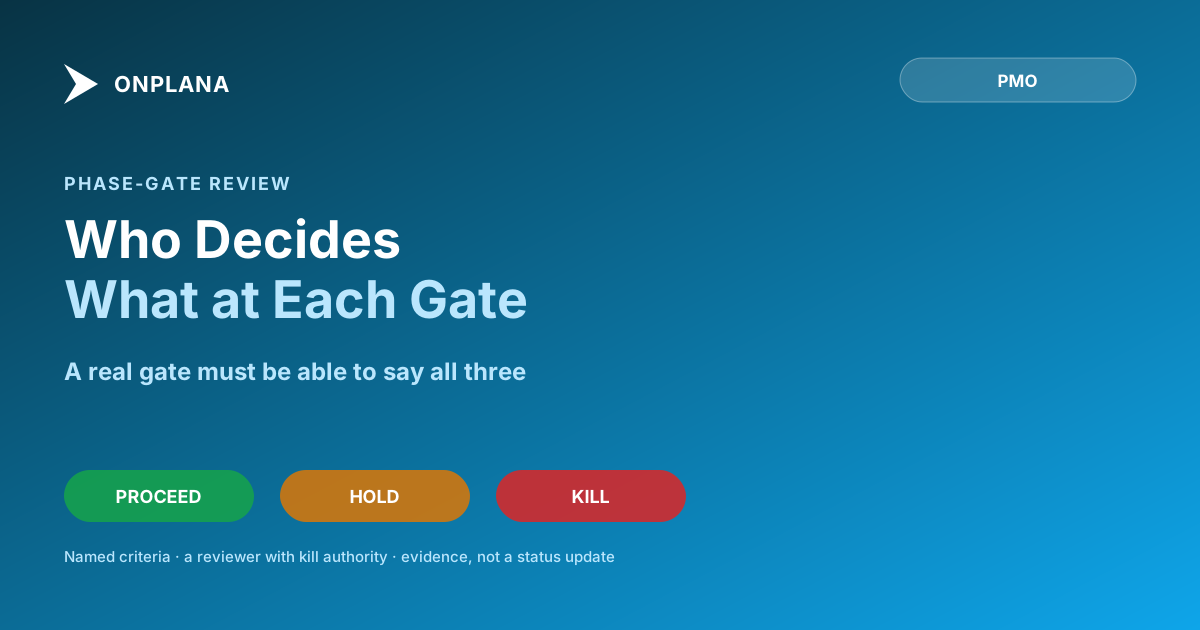
Phase-Gate Review: Who Decides What at Each Gate
A phase-gate review only works when one named reviewer can say kill, and every go, hold, or kill call requires evidence, not a status update from the PM.
Most "gate reviews" are status meetings wearing a gate's name. The project team presents a deck, the room nods, the project proceeds exactly as it would have without the meeting. Nobody in the room asked the one question a gate exists to ask: should this project keep going, on its current trajectory, with its current numbers?
A phase-gate review is a scheduled decision point between project phases where a designated reviewer, independent of the project team, evaluates the phase against defined criteria and decides to proceed, hold for rework, or kill the project outright. The review only functions as governance if all three of those outcomes are genuinely available; a gate that has never once said hold or kill isn't a decision point, it's a formality the project passes through on the way to the outcome it was always going to have.
Direct answer: A real phase-gate review needs three things a status meeting doesn't: named, measurable criteria set before the gate (not judged in the room), a designated reviewer or board with actual authority to kill the project, and a recorded go, hold, or kill decision backed by evidence rather than the PM's assessment of their own work. Strip out any one of the three and the gate becomes theater.
The Three Ingredients of a Real Phase-Gate Review
Every functioning gate review has the same three components. Most failed ones are missing at least one.
| Ingredient | What it means in practice | The tell it's missing |
|---|---|---|
| Named decision criteria | Measurable, binary pass conditions set when the phase opens, not improvised during the review ("NPV above $2M," "zero P1 defects open") | Criteria get discussed for the first time in the meeting itself |
| A reviewer with kill authority | A role, not a person, independent of the project team, with the standing to stop the project | The only people in the room are the ones who'd lose their project if it stopped |
| An evidence-based decision | Budget variance, schedule variance, and risk status pulled from the actual schedule and ledger, not from the PM's narrative | The only input is a slide deck the project team wrote about itself |
The first ingredient does most of the work. If the criteria aren't written down before the gate, the review has nothing to measure the project against except how convincing the presentation was, which correlates with presentation skill more than project health.
Who Should Own Each Gate Decision
Gate authority should sit with a role, not a name, so a reorganization or a departure doesn't leave a gate with no one able to sign off. A typical enterprise gate splits the decision three ways.
| Role | Owns | Should not own |
|---|---|---|
| Sponsor | The business case: does the value still justify the spend | The technical assessment of whether deliverables actually meet spec |
| Independent reviewer or PMO | Whether the criteria were genuinely met, using the evidence, not the presentation | The decision to proceed if criteria weren't met; that's a hold or kill, not a judgment call |
| Finance representative | Budget variance against the phase's approved spend | Scope or schedule judgment outside their remit |
The project's own PM presents at the gate and should never be the sole decision-maker in it. That isn't a comment on any individual PM's integrity; it's that nobody evaluates their own work as harshly as an independent party would, and a gate that lets the project self-certify has quietly become a status meeting again.
The diagram below shows how a gate package moves from submission to a recorded decision, and what changes downstream depending on which of the three outcomes the reviewer picks.
Why the Gate That Never Says No Isn't Governance
A gate's deterrent value comes entirely from the credible possibility of a no. If every project that has ever reached Gate 3 has proceeded past Gate 3, the review board's actual behavior has trained every project team in the organization that Gate 3 is a scheduling checkpoint, not a decision. Scope creeps and budgets drift precisely between gates, because that's where nobody is checking, and the gate itself catches nothing because it was never going to say hold or kill regardless of what showed up.
The fix isn't a stricter board. It's tracking the gate's own pass rate. A gate that has approved 100% of submissions for two years either has criteria too loose to fail anyone, or a review board that isn't independent enough to say no. Either fault is fixable once it's visible, and it's invisible until someone counts, which is exactly what the governance dimension of a PMO Maturity Assessment is built to surface.
Setting Up Your First Gate Review
- Write the criteria before the phase starts, not before the gate. A criterion written the week of the review has already been shaped to match whatever the project actually delivered.
- Assign the reviewer role, not a name. Define who sits on the review (sponsor, independent PMO reviewer, finance) by title, so the gate survives a reorganization.
- Require evidence pulled from the system of record, not a narrative deck: schedule variance from the actual schedule, budget variance from the actual ledger, open risks from the actual register.
- Record the decision, with rationale, as soon as it's made. A gate decision that isn't written down the same day tends to get remembered more favorably than it happened.
- Track the gate's pass rate over time. If it's never below 90%, the criteria or the board's independence need review, not the projects passing through.
Gate reviews depend on the same discipline as demand management: both replace an argument with a rule that was agreed before anyone knew whose project would be affected by it. A steering committee that only receives updates has the same failure mode as a gate that only says proceed, information flowing up without a decision ever attached to it.
Phase-gate and stage-gate describe the same governance model under two names, one from engineering and construction, the other from Robert Cooper's original product-development research. For a full walkthrough of running this model inside a single platform, including a 12-stage default pipeline and an audit trail per gate, see stage-gate project management software. This post is the model; that one is an implementation of it.
Check whether your governance can hold the line Run the free PMO Maturity Assessment to see how your governance dimension scores, including whether your gates have real kill authority or just a rubber stamp. → Take the free PMO Maturity Assessment
Frequently asked questions
What is a phase-gate review?
A phase-gate review is a scheduled decision point between project phases where a designated reviewer, not the project team, evaluates the phase's deliverables against predefined criteria and decides to proceed, hold, or kill the project. It's a decision event, not a status update.
What's the difference between a phase-gate review and a status meeting?
A status meeting reports on progress; a phase-gate review can stop the project. If the outcome is always to continue regardless of what's presented, it's a status meeting wearing a gate's name, not real governance.
Is phase-gate the same thing as stage-gate?
Yes. Stage-gate is Robert Cooper's original term; phase-gate is the common variant used in engineering, construction, and IT programs. Both describe the same structure: defined phases separated by formal review points.
Who should have the authority to kill a project at a gate?
One named reviewer or review board, defined by role rather than by person, so the authority survives staff turnover. The project's own PM or sponsor should never be the sole gatekeeper of their own project; that removes the independence a gate exists to provide.
How often should phase-gate reviews happen?
At the boundary of every major phase, not on a fixed calendar. A project with four real phases needs four gates; adding monthly gates on top of that turns governance into status theater and trains reviewers to rubber-stamp because most gates have nothing new to decide.
Ready to make the switch?
Start your free Onplana account and import your existing projects in minutes.