Enterprise AI Project Management: The Five-Layer Stack
Enterprise AI project management runs on five layers: data, context, model, action, and governance. Most PMOs have built two of the five and stopped.
Ask a vendor to show you their AI project management architecture and most will show you a chat bubble. That is a feature, not an architecture. A chat interface sitting on top of a general-purpose model with no retrieval discipline, no action layer, and no governance wrapper is the same product whether it is managing your portfolio or drafting a haiku.
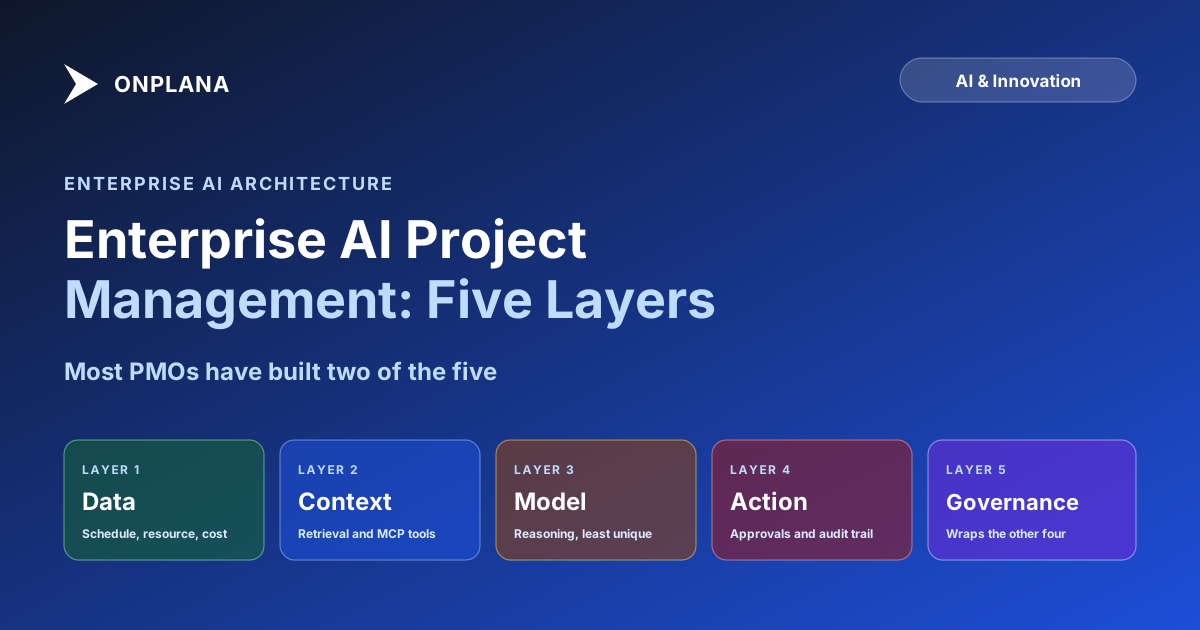
Enterprise AI project management runs on five layers: a data layer that structures schedule, resource, and financial data into something a model can reason over; a context layer that retrieves and assembles the right slice of that data; a model layer that does the reasoning; an action layer that lets the model make a change under approval and audit; and a governance wrapper that decides what the model is allowed to touch in the first place.
The direct answer: most PMOs evaluating AI tools have built two of the five layers, usually the model layer and a thin context layer, and stopped there. The data layer is assumed to already exist (it rarely does in a form a model can use), the action layer is either missing or unaudited, and the governance wrapper is an afterthought bolted on after a near-miss. The chat bubble is the least differentiated part of the stack and the part every vendor leads with.
The diagram below shows how the five layers stack, with governance wrapping the whole thing rather than sitting at the end of it.
The Data Layer: What "AI-Ready" Data Actually Means
The data layer is the one every vendor assumes is already solved and almost none actually is. AI-ready project data means structured entities, typed fields, explicit relationships between tasks and dependencies and resources and costs, not a folder of status-report PDFs and a spreadsheet someone updates by hand. A model can summarize an unstructured document reasonably well. It cannot reliably compute a resource conflict, a critical-path shift, or a budget variance from unstructured text, because those are structural queries, not summarization tasks.
The tell for a broken data layer is simple: if your PMO's schedule, resource, and financial data live in three different tools that don't share a common project ID, no AI layer built on top of that data will produce a trustworthy cross-project answer. Fixing the data layer is unglamorous and it is also the highest-leverage fix available, because every layer above it inherits its quality.
The Context Layer: Why MCP Changed the Conversation
Once data is structured, a model still needs a way to find the right slice of it for a given question, and a way to discover what actions it is allowed to take. That is the context layer, and until recently it was built as one-off REST integrations: a developer wires up specific endpoints in advance, and the model can only do what was explicitly coded.
Model Context Protocol changes that shape. Instead of a developer pre-wiring every integration, an MCP server exposes a catalog of tools that a connecting AI client discovers and calls at runtime, under the signed-in user's own permissions. The practical difference: adding a new capability to the context layer means adding a tool to the server's catalog, not shipping a new integration for every AI client that wants to use it. What MCP actually unlocks, and what it doesn't covers the mechanics in more depth.
Retrieval quality matters as much as protocol choice. A context layer that hands a model your entire project database on every query is slow, expensive, and prone to burying the relevant fact in noise. A context layer built on real retrieval, hybrid keyword and semantic search over your org's data, reranking the top candidates, then injecting only the relevant slice, is what makes answers grounded instead of guessed. Onplana's own retrieval pipeline is one worked example of what that looks like end to end.
The Model Layer Is the Least Differentiated Part
This is the layer every AI PM vendor leads with in a demo, and it is also the layer with the least genuine differentiation between vendors in 2026. Frontier models from different providers perform comparably on most project management reasoning tasks: summarizing status, drafting a plan from a brief, flagging an obvious schedule risk. The model layer matters, but a vendor whose entire pitch is "we use a good model" is describing a commodity as if it were a moat.
What does differentiate vendors at this layer is resilience: whether the platform depends on a single provider or can fail over between more than one if a provider degrades or has an outage. Claude running inside a PM platform is a useful worked example of what a specific model's reasoning depth enables, but the architectural point that matters more than any single model's benchmark score is whether the platform is locked to one provider at all.
The Action Layer: Where Trust Is Actually Won or Lost
Reading is the easy half. The action layer is where a model moves from answering questions to making changes, and it is also where most AI PM tools either stay too timid to be useful or too loose to be trusted. Every AI-initiated write needs the same three things a human-initiated write needs, plus one: scoped permissions matching the user's own role, an audit trail that records what changed and why, a way to undo it, and, the addition, a preview or approval step before an irreversible or high-blast-radius change ships.
Table stakes for a trustworthy action layer:
| Control | What it prevents |
|---|---|
| Permission scoping matching the human user's role | AI acting with more authority than the person who invoked it |
| Preview or approval mode for bulk or irreversible writes | A confused model silently bulk-editing a portfolio |
| Full audit trail on every AI-initiated change | "Something changed and nobody knows why" investigations |
| Per-action plan and tenant gates | A feature meant for one tier firing for every customer |
| Idempotency on retried calls | A network retry duplicating a task or a comment |
A platform missing any row in that table has an action layer that is either not shippable or not safe, and most "AI-native" pitches only mention the first row, if that.
The Governance Wrapper Most PMOs Skip
Governance is not a fifth layer stacked on top of the other four. It wraps all of them: which AI actions are enabled at all for a given tenant, what an individual user is capped at, and what the whole organization spends in a month. A cost cap without a per-user fair-share rule lets one heavy user drain the org's budget. A permission-scoped action layer without a tenant-level kill switch means an admin who wants to pause AI entirely, during an incident, an audit, or a compliance review, has no lever to pull.
The governance wrapper is the layer most PMOs discover they're missing only after an incident: an AI-drafted status report that overstated progress and got forwarded to a sponsor, a bulk edit that ran further than intended, a monthly AI bill nobody had visibility into until it arrived. Building the wrapper before the incident, not after, is the difference between a controlled rollout and a rushed retrofit.
Which Layers Enterprise AI Project Management Platforms Actually Need
Put the five layers next to each other and the gap is consistent across most PMOs evaluating enterprise AI project management tools for the first time:
| Layer | Usually present | Usually missing |
|---|---|---|
| Data | Some structured project data | Financial and resource data unified with schedule data under one ID |
| Context | Basic keyword search or none | Hybrid retrieval, reranking, and MCP-based tool discovery |
| Model | A single provider, no fallback | Multi-provider resilience with managed failover |
| Action | Read-only AI or unaudited writes | Approval-gated writes with a full audit trail |
| Governance | Nothing, or a manual spend review | Per-user fair-share caps and a tenant-level kill switch |
If you're evaluating an AI project management platform, ask which of these five layers the vendor can show you, not tell you about. A vendor who can walk you through the action layer's audit trail and the governance wrapper's cost controls is describing an architecture. A vendor who opens a chat window is describing a feature.
See how Onplana's AI is grounded and governed across all five layers, including the enterprise governance controls that wrap the action layer for regulated portfolios. The rest of the blog's AI and Innovation series covers each layer in more depth, from the retrieval mechanics underneath the context layer to the specific workflows the action layer currently supports.
Frequently asked questions
What is the enterprise AI project management stack?
Five layers: a data layer that structures schedule, resource, and financial data; a context layer that retrieves and assembles that data for a model; a model layer that reasons over it; an action layer that lets the model write changes under approval and audit; and a governance wrapper that decides what the model is allowed to touch. Most vendor demos show only the model layer.
What is the context layer in an AI PMO architecture?
The context layer is the retrieval and connector plumbing that gets the right slice of your project data in front of a model before it answers. It includes both how data is fetched (search, RAG, direct queries) and how tools are exposed to the model, increasingly through MCP rather than one-off API integrations.
Why does MCP matter for enterprise AI project management?
MCP (Model Context Protocol) lets an AI client discover and call a PM tool's actions directly, under the connecting user's own permissions, instead of a developer hand-wiring each integration. It moves the context and action layers from custom code to a shared, inspectable standard.
What governance controls does an enterprise AI project management platform need?
Per-tool permission and plan gates, an audit trail for every AI-initiated write, cost caps at the organization and per-user level, and tenant-level controls over which AI actions are enabled at all. Without these, the action layer is a liability, not a feature.
Can I choose or bring my own AI model on an enterprise PM platform?
On Onplana, no. Onplana runs on both Claude and Azure OpenAI, managed by Onplana with automatic failover between them; customers do not select, switch, or supply their own model deployment. The governance layer controls what the model can do, not which model runs.
Ready to make the switch?
Start your free Onplana account and import your existing projects in minutes.