Clinical Trial Scheduling: Where MS Project Falls Down
Clinical trial scheduling exposes limits standard PM tools can't handle: IRB cycles, regulatory deadlines, and enrollment timing that defies logic dependencies.
The IRB approved your protocol. In the project schedule, that records as a green milestone. What the schedule does not show is that the approval arrived three weeks after the optimistic estimate, the clinical site you planned to initiate first has two competing trials in the same initiation queue, and the CRO resource you need for site qualification is now committed to a higher-priority program through the end of the quarter.
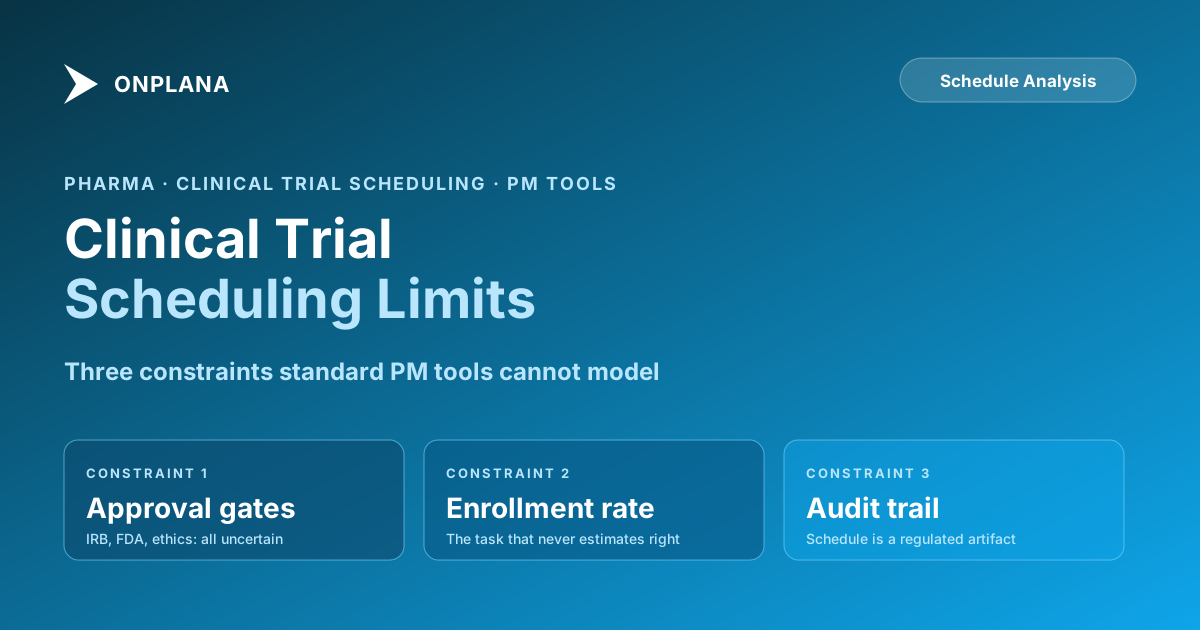
Clinical trial scheduling operates in a regulatory environment where the approval chain exists outside the PM's control, the primary enrollment activity cannot be estimated with normal accuracy, and the schedule itself is a compliance artifact that must survive external audit. Standard project management tools are built for a world where logic dependencies hold and durations can be estimated from historical data. Pharma is a world where both of those assumptions break down at exactly the milestones that matter most.
TL;DR. Clinical trial scheduling requires three capabilities standard PM tools lack: modeling approval windows with inherent uncertainty rather than point estimates, handling patient enrollment as a probabilistic activity rather than a deterministic one, and maintaining the schedule as a validated, auditable artifact rather than a working document. Where MS Project falls down for pharma is not in the Gantt chart itself but in the assumptions baked into the tool's architecture.
Why clinical trial scheduling is a different discipline
A standard project schedule assumes the PM knows roughly how long activities take and can sequence them in a deterministic order. The critical path emerges from that network, and the PM's job is to protect it. Clinical trial scheduling starts with activities whose durations are genuinely unknowable at planning time and approval gates that belong to external bodies whose decision timelines the PM cannot control.
Three features make clinical trial scheduling structurally different from most project types.
Regulatory approval chains as hard predecessors. Before a clinical trial site can begin enrolling patients, it must have IRB approval from that site's ethics committee, site initiation visit clearance from the CRO, regulatory submission approval in each country where the trial runs, and, in some geographies, a separate national competent authority approval. Each of these has a target date and an actual date. The target date is an estimate; the actual date depends on committee meeting schedules, incomplete submission responses, and queue depth. Modeling this as a single logic dependency with a fixed duration produces a schedule that is wrong before it starts.
Patient enrollment as the indefinitely elastic activity. Enrollment rate, the number of eligible patients who consent and enroll per site per month, is the driver of the trial's data collection timeline and therefore of every downstream activity. Most trials miss their initial enrollment projections; the range of miss can span months to years. A schedule that models enrollment as a fixed-duration activity with a single estimate hides the primary source of schedule risk.
The schedule as a regulated document. In GxP-regulated environments, the trial schedule may be a validated artifact: its changes must be documented, authorized, and logged. An auditor reviewing trial conduct after the fact will look at the schedule history. That history needs to show what changed, when it changed, who authorized the change, and what the justification was. Most PM tools do not provide this by default.
The three constraint categories standard tools handle poorly
Standard PM tools, including MS Project, model dependencies as logical predecessors: task A must complete before task B can start. This works for activities within the PM's control. It does not work well for the three constraint categories that dominate clinical trial scheduling.
Minimum and maximum approval windows. IRB reviews have a minimum time (committees do not meet more than once per month in most institutions) and an uncertainty range on top of that. The appropriate model for "IRB approval" is not a single-point estimate but a range with a most likely value and tail risks on both sides. Standard tools give you one duration per task. You can put in optimistic and pessimistic estimates in some tools, but integrating those into a probabilistic critical path requires Monte Carlo simulation that MS Project does not natively provide.
Concurrent multi-site initiation. A Phase II or III trial might initiate 30 to 80 sites across multiple geographies simultaneously. Each site follows the same regulatory sequence but on a different timeline driven by its local IRB meeting schedule, country-specific submission requirements, and site-specific readiness. This is a resource management problem at a scale and structure that MS Project was not designed to handle. The critical path method works for a single project, but managing 50 concurrent instances of the same critical path across different sites requires either a specialized clinical trial management system or a PM tool with robust multi-project portfolio views.
Patient enrollment as a parallel, uncertain activity. Enrollment does not end when it hits the target; it ends when it hits the target number of enrolled patients. If the actual enrollment rate is lower than estimated, the enrollment window extends, which pushes back data lock, analysis, and regulatory submission. The schedule dependency is asymmetric: finishing enrollment early saves time; finishing late costs time. This kind of conditional dependency, where the duration is determined by an outcome rather than by a plan, is not something standard scheduling tools model.
Where MS Project falls down for clinical trial scheduling
MS Project is a capable scheduling tool for projects with deterministic durations and manageable resource pools. For clinical trial scheduling, it breaks down in four specific areas.
No native probabilistic duration modeling. The three-point estimate fields (optimistic, expected, pessimistic) exist in MS Project, but they do not integrate into a probabilistic network. Running a Monte Carlo simulation on a schedule requires a third-party add-in. This is not a minor gap for pharma: the FDA's guidance on clinical trial planning emphasizes the importance of accounting for uncertainty in enrollment and approval timelines. A schedule that ignores duration uncertainty produces false precision that misleads decision-making.
No multi-site resource model. Each site in a multi-site trial has its own CRA (Clinical Research Associate), its own investigator, its own IRB, and its own set of regulatory requirements. Modeling this in MS Project requires either a single large project file with hundreds of tasks and a carefully managed resource pool, or separate project files with no cross-file visibility into aggregate enrollment and resource loading. Neither is clean. The result is that most pharma teams maintain the master trial schedule in MS Project and track site-level status separately in a spreadsheet, which means the schedule is always inconsistent with the operational reality.
No built-in change control log. Every baseline change in a clinical trial schedule that affects regulatory pathway activities needs documented justification: what changed, when, who approved it, and what the regulatory rationale was. MS Project has baseline comparison features but no change log tied to those comparisons. The PM must maintain this documentation outside the tool, which means it often does not get maintained at all, which creates audit exposure.
No validation support. Computer System Validation (CSV) is the process of ensuring that software used in regulated activities performs as specified and that changes to it are controlled. If a PM tool is used to manage a GxP-relevant schedule, the tool itself may need to be validated. MS Project is not built with CSV in mind. This is not a disqualifier for every pharma team, but it is a real constraint for organizations subject to strict regulatory oversight. The security and compliance considerations that apply to pharma IT infrastructure also apply to the tools pharma PMs use to manage their most critical schedules.
Regulatory milestone tracking as a compliance artifact
The diagram below shows the regulatory milestone sequence for a simplified Phase II trial. Each gate has an expected date and an uncertainty range; none of them are under the PM's direct control.
The milestones that matter most in a clinical trial schedule are not operational milestones like "CRF finalized" or "training materials distributed." They are regulatory milestones: IND submission, IND clearance, ethics submission per country, ethics approval, site initiation per site, first patient first visit, last patient last visit, database lock, CSR submission.
These milestones define the regulatory history of the trial. After the trial completes, when the FDA reviewer examines the conduct of the study, they will ask whether key regulatory dates were met, whether changes to the protocol altered planned milestone dates, and whether any deviations from the approved protocol were documented and authorized.
A clinical trial schedule that manages regulatory milestones as just another set of tasks misses this. Regulatory milestones need to be tagged separately, their dates need to be treated as commitments (not targets), and changes to them need to be documented with more rigor than changes to operational activities. The schedule is evidence, not a plan.
This changes how PMs should approach baseline management. Locking a baseline and then revising it should trigger a documented rationale: why did the regulatory submission date move, was the change forced by external factors or by internal replanning, and has the change been reviewed by the regulatory affairs team? Running the Schedule Health Check on a pharma project file surfaces structural issues like missing predecessors and excessive float that would be flagged in a DCMA schedule analysis, which is the closest analog in regulated industries to the FDA's own review of trial conduct documentation.
Patient enrollment: the activity you cannot estimate
Most clinical trials miss their enrollment projections. The variance is not small. A trial planning for 12 months of enrollment sometimes takes 24. A trial planning for 50 patients per site per month sometimes achieves 20. The reasons are structural: disease prevalence estimates rely on registry data that may not reflect current patient pathways, competing trials at the same sites compete for the same eligible patient pool, and patient willingness to consent depends on study burden factors like visit frequency and blood draw volume that are knowable in advance but not reliably incorporated into enrollment models.
The scheduling implication is that enrollment should be modeled with a range rather than a point estimate, and the schedule should show what happens to the study timeline under low, expected, and high enrollment scenarios. This is not a complex analysis: a simple table showing the effects of enrollment rates 20% below and 20% above the base case gives the team and the sponsor a clear view of the risk exposure before the study starts.
The practical constraint is that most PM tools represent enrollment as a single-duration task. The PM ends up maintaining the sensitivity analysis in a separate spreadsheet, which the schedule never reflects. When enrollment falls behind, the schedule update is reactive rather than proactive, because the tool was not set up to surface the trigger condition automatically.
Building a pharma-grade schedule
A pharma schedule that will survive audit review and serve the PMO effectively needs five structural properties.
- Separate regulatory and operational activities with clear tagging, so that milestone reports to the sponsor and to regulatory bodies can be generated without manual extraction.
- Locked baselines with a documented change log, maintained in the tool or adjacent to it, that records every baseline revision with date, approver, and rationale.
- Multi-scenario enrollment modeling, even if implemented as a separate tab rather than in the core schedule, with the trigger conditions that would move the team from the expected to the pessimistic scenario.
- Site-level visibility into initiation status and enrollment rate by site, so that aggregate enrollment is tracked against the per-site model rather than against an undifferentiated total.
- An audit trail for resource assignments on regulatory pathway activities, so that if a regulatory reviewer asks who was responsible for an activity at a specific point in time, the schedule can answer that question.
The ICH E6(R2) Good Clinical Practice guideline describes the documentation standards that apply to trial conduct including the management of protocol deviations, protocol amendments, and regulatory submission timelines. The schedule is part of that documentation chain. Building it with that in mind from the start is far cheaper than reconstructing it under audit pressure after the fact.
If you want a structural assessment of whether your current trial schedule has the logic quality to hold up under scrutiny, the Schedule Health Check processes .mpp and MSPDI files and surfaces missing predecessors, dangling tasks, excessive float, and over-constrained logic that would be flagged in a formal schedule review.
Run the free Schedule Health Check Upload a .mpp or MSPDI file and get a structural analysis of logic quality, float distribution, and constraint patterns in under a minute. No signup required. Open the Schedule Health Check
Microsoft Project™ is a trademark of Microsoft Corporation. Onplana is not affiliated with Microsoft.
Frequently asked questions
What makes clinical trial scheduling different from standard project scheduling?
Clinical trials have three constraint types standard PM tools are not designed for: regulatory approval windows (IRB, FDA, ethics committees) with inherent uncertainty; patient enrollment rates that depend on external factors outside the PM's control; and validation and audit-trail requirements that make schedule changes a compliance event, not just a planning adjustment.
Why does MS Project fall short for clinical trial scheduling?
MS Project handles logic dependencies well but cannot natively model probabilistic durations (enrollment rates that follow a distribution, not a single estimate), regulatory approval windows with minimum and maximum bounds, or site-initiation resource pools that span multiple sites simultaneously. It also has no built-in change control log tied to baseline changes, which is needed for CSV validation.
What is an IRB and how does it affect the project schedule?
An Institutional Review Board (IRB) is the ethics committee that must approve a clinical trial before sites can initiate. IRB review cycles typically run 4 to 8 weeks, but the actual approval date is uncertain. Scheduling as if IRB approval will arrive on the first submission date is the most common source of optimism bias in pharma project plans.
What does patient enrollment rate variability mean for scheduling?
Enrollment rate is the number of eligible patients who consent and enroll per site per month. It is estimated before the trial starts but depends on site selection, disease prevalence, competing trials, and patient willingness. Most clinical trials miss their initial enrollment projections. A schedule that treats enrollment as a deterministic activity will be wrong, often significantly.
What is computer system validation and why does it affect PM tool selection?
Computer System Validation (CSV) is the process of documenting that a software system used in a regulated activity performs as intended and that changes to it are controlled and documented. If a PM tool is used to manage a clinical trial schedule that is a GxP-relevant artifact, the tool itself may need to be validated. This is why regulated pharma teams often prefer tools with audit trails and change control.
How do you build a pharma schedule that survives an FDA audit?
Use locked baselines with documented justification for every change, maintain a change log with dates and approver names, tag regulatory milestones separately from operational ones, and document the basis for duration estimates on regulatory-pathway activities. The schedule should be legible to an auditor who does not know the project.
Ready to make the switch?
Start your free Onplana account and import your existing projects in minutes.