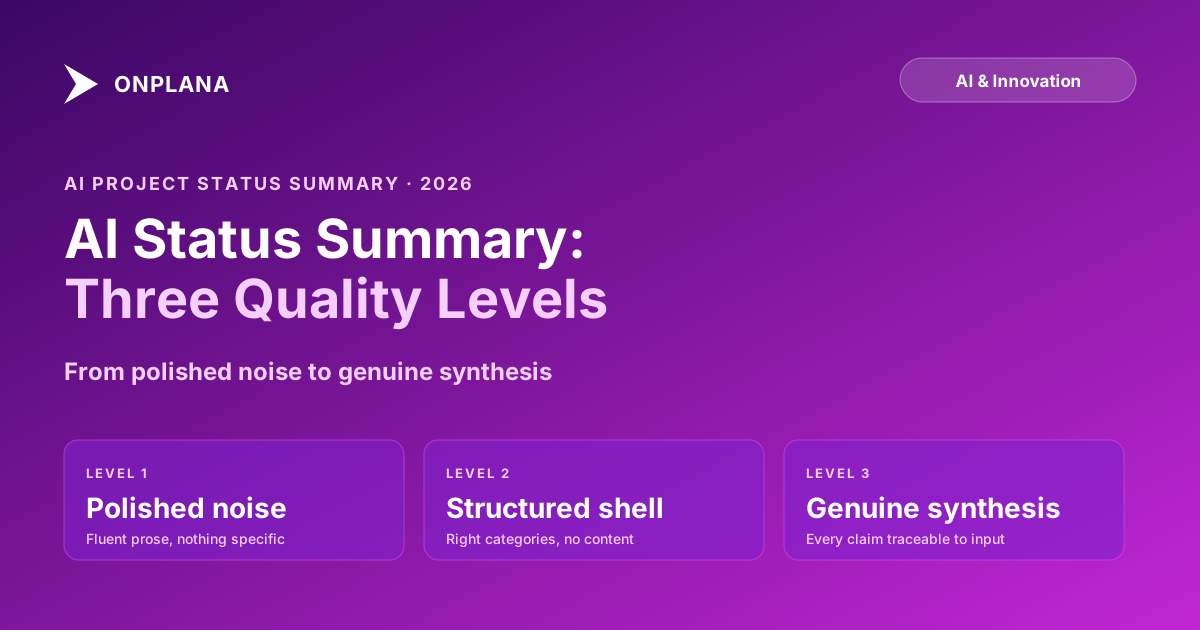
AI Project Status Summary: What Good Output Looks Like
AI project status summaries range from polished noise to genuine insight. Three worked examples show exactly what input differences produce each quality level.
Here is a real AI project status summary, submitted to a steering committee: "The project is making good progress. The team is working hard to deliver on key priorities. Some challenges have arisen but are being actively addressed. The project remains on track for delivery." Forty-three words. Four sentences. No milestone, no metric, no blocker, no named deliverable, no action required. The steering committee learned nothing useful from reading it.
That summary cost the organization $28 per user per month on an AI PM tool. The tool worked exactly as advertised. The AI produced fluent, grammatically correct prose. The summary was useless because the inputs were useless, and the AI had nothing to synthesize.
The quality of an AI project status summary is not primarily a function of which AI model your tool uses or how expensive your subscription is. It is a function of what you give the model to work with. This post shows three distinct quality levels with worked examples and the exact input differences that explain each.
TL;DR: AI project status summary quality runs from polished noise (fluent prose about nothing) to genuine synthesis (milestone-level insight with named risks and a clear ask). The output tier you land in is determined almost entirely by input structure. Good inputs are specific and quantified. Bad inputs are impressionistic. The Status Report Writer tool enforces the input structure that produces useful output in under 30 seconds.
What an AI project status summary actually produces
A status summary AI feature takes project data and produces a condensed narrative that captures the project's current state: where it stands against plan, what is blocking progress, and what decisions are needed from the reader.
The feature is genuinely valuable when it works. A PM running eight projects who needs to send a weekly summary to four stakeholder groups faces a real writing burden. AI reduces that from ninety minutes of drafting to five minutes of input preparation plus three minutes of review. The time saving compounds over months.
The feature is actively harmful when the AI produces confident-sounding output that contains no real information. Sponsors who receive polished-noise status reports stop trusting AI-generated content. Worse: they stop trusting the PM who sent it.
The three levels below cover the full range of what AI status summarization actually produces in practice.
Level 1: polished noise
Level 1 output appears when the PM feeds the AI vague, impressionistic input: general statements about team morale and directional optimism with no specific data attached.
Input to AI: "Things are going pretty well this week. Team is energized, making progress on the features. Had a couple of blockers but the team figured them out. We're still targeting the launch date."
AI output:
"The project team continued to demonstrate strong execution this week, with meaningful progress on key feature development. A few challenges emerged but were resolved through effective team collaboration. We remain confident in delivering against our target launch date. The team's commitment remains high and momentum is strong heading into next week."
That is 61 words of nothing. The steering committee learns: a project exists, it has a team, the team did something, there is a date. None of those facts is actionable. A sponsor cannot use this summary to make any decision.
In fact, this output can actively harm the project. If the PM privately knows the schedule is at risk but feeds the AI "still targeting the launch date," the AI writes "confident in delivering against our target launch date." The sponsor is now misinformed by a confident-sounding document.
Level 1 output is what AI produces when the input is impressionistic. The AI fills gaps with optimistic filler prose because that is the statistical pattern of project updates in its training data. This is a core principle of prompt engineering: large language models default to statistically likely output when the input lacks specificity. The problem is not the AI. The problem is the absence of real input.
Level 2: structured but shallow
Level 2 output comes from structured input that uses the right categories but lacks specificity within each category.
Input to AI: "Status: Amber. Blockers: vendor integration, team capacity. Completed: testing phase. Next up: UAT. Ask: none for now."
AI output:
"Project status: AMBER. Progress: The team completed the testing phase this week. Upcoming: User acceptance testing begins next week. Current blockers: vendor integration delay and team capacity constraints are affecting delivery. No action currently required from the steering committee."
This is meaningfully better. The steering committee understands the project is amber, testing was completed, UAT is next, and something about a vendor and capacity. What they do not know: which vendor, what the integration delay means for the schedule, how much capacity is constrained, when the blockers need resolution, or whether "no action required" is accurate given the amber status.
The word "amber" is doing no work because there is no specificity behind it. "Vendor integration" could mean anything from a three-day delay to a project-stopping blocker. The steering committee has been given a structure without content.
Level 2 output is what you get when a PM has learned to fill the structural template but fills it with category-level labels instead of concrete facts. It looks like a proper status report. It is not one.
Level 3: genuine synthesis
Level 3 output comes from specific, quantified input that includes context the AI can use to produce a useful synthesis.
Input to AI: "Status: AMBER. Reason: Stripe payments API integration is 6 days behind plan; consumed the sprint-2 buffer and puts UAT start at risk. Blockers: (1) Stripe spec confirmation outstanding since June 20, owner is me, escalated to their account manager, expected response June 25; (2) dev team at 90% allocation through July 2 due to overlap with Project Andover, shared developer is the constraint. Completed: auth module test suite (47/47 tests passing), user flows 1-5 documented. Next week: if Stripe confirms by June 25 integration build starts and schedule absorbs the delay. Escalate Andover resource conflict to PMO on June 27 if not released. Ask: pre-approval from steering committee to extend UAT by 5 days to June 30 if Stripe integration slips another 3 days."
AI output:
"Project status: AMBER. The Stripe payment integration is 6 days behind schedule, consuming the sprint-2 buffer and creating risk to the UAT start date. Root cause: Stripe spec confirmation has been outstanding since June 20 (escalated to account manager, response expected June 25). A second constraint is a shared developer committed to Project Andover through July 2, leaving the team at 90% allocation with no flex.
Progress this week: auth module test suite complete (47 of 47 tests passing); user flows 1-5 documented.
Recovery path: if Stripe confirms the spec by June 25, integration build starts immediately and the schedule absorbs the delay. If Stripe misses again, PMO receives the resource conflict escalation on June 27.
Steering committee ask: pre-approval to extend UAT by 5 business days to June 30 as a contingency if Stripe integration slips another 3 days. Approving this now avoids an emergency request mid-sprint."
This is useful. A sponsor reading this can make the UAT extension decision immediately. They understand what is wrong, who is responsible for fixing it, what has already been done, and what the specific ask is.
The AI did not invent any of that. It synthesized it from specific inputs. Every claim in the output traces to a specific input line. The AI's role was translation, not judgment.
The diagram below shows how input specificity drives output quality across the three levels.
The model is the same in all three examples. Input quality is the only variable that explains the output quality difference.
How to prompt toward Level 3 output every time
The structural change that closes the gap between Level 2 and Level 3 is specificity within each input field. A usable template:
Status and reason: "[COLOR]: [specific reason with a metric or named item]." Example: "AMBER: Stripe API integration is 6 days behind plan, consuming the sprint-2 buffer."
Blockers: "[Blocker name] / owner: [specific person] / escalated: [date] / expected: [date or next action]." No vague labels. If you write "vendor delay," the AI writes "vendor delay." If you write "Stripe spec confirmation outstanding since June 20, escalated to their account manager, response expected June 25," the AI writes something useful about the Stripe spec.
Accomplishments: Named deliverables with completion signals, not activities. "Auth module test suite complete: 47 of 47 tests passing" is an accomplishment. "Testing progressing" is an activity. The distinction matters because the test suite being complete is a fact the steering committee can evaluate; "testing progressing" could mean anything from 90% done to stuck.
Next-week commitments: Two to three specific outcomes with named triggers or contingencies. "If Stripe confirms spec by June 25, integration build starts immediately" is a commitment. "Continue development work" is not a commitment; it is a statement of intent with no verifiable outcome.
The ask: One direct sentence or "no action required." Every status report should state the ask explicitly. PMs who bury the ask in paragraph four, or omit it entirely, are asking steering committees to infer what is needed. AI that receives a vague ask produces a vague ask in the output.
The AI status reporting guide covers the full input structure in more detail, including how to build a reusable weekly input template that makes Level 3 output routine. The status report writing guide covers the broader weekly reporting workflow, including how to gather specific inputs from your project data through the week rather than reconstructing them from memory on report day.
What determines output quality at the team level
Individual PMs who learn the Level 3 input structure produce consistently better AI output. The more interesting challenge is making Level 3 the team default rather than the individual exception.
A PMO that standardizes on a shared input template across all PMs gets two compounding benefits. First, the AI output quality rises across the full report stack, not just for the PMs who individually discovered the template. Second, the sponsor experience improves: instead of reading a portfolio of reports in seven different structures with seven different RAG definitions, the sponsor reads a consistent structure where amber always means the same thing and the ask is always in the same place.
Without a shared template, AI status reporting often makes the consistency problem worse rather than better. Each PM discovers different prompt patterns independently. The AI output reflects those different patterns, and the portfolio of AI-generated reports is as inconsistent as the portfolio of manually written reports was before.
The AI project management guide covers the broader set of AI use cases in PM tools beyond status summarization, including how AI features integrate with schedule analysis and risk detection. Understanding the full set of AI capabilities helps PMOs decide which features to standardize on first, which is usually status summarization because the ROI is immediate and the downside of bad output is visible within one reporting cycle. Not every vendor's "AI status reports" ship from the same depth of input; the 2026 scorecard of AI project management tools breaks out which of eight platforms generate reports from live schedule data versus from a chat prompt.
When to skip AI and write the status yourself
AI status summarization is right for recurring operational summaries. It is wrong for several situations where the writing is inseparable from the judgment.
Crisis communications. When a significant mid-week issue requires immediate escalation to a sponsor, write it directly. Crisis communications carry the PM's voice and accountability in a way that AI-synthesized prose does not. Sponsors expect to hear from the PM, not from a tool, when something goes wrong.
First-impression updates to a new sponsor. The first status report a PM sends to a new stakeholder is a relationship communication, not a synthesis task. AI prose carries a slightly impersonal register that reads fine in a routine update but reads flat when the PM is trying to establish credibility with a new stakeholder.
Post-mortem and lessons-learned summaries. End-of-project summaries that will live in a knowledge base should carry explicit PM interpretation. They are interpretive documents that require the PM's judgment about what actually happened and why, not a synthesis of the project's structured data.
For every other recurring status communication, AI with Level 3 inputs produces better results faster than manual drafting, on the condition that the PM reviews the output before sending. The review step is not optional; AI can produce confident-sounding inaccuracies when inputs are ambiguous or incomplete, and "the AI wrote it" is not a defensible explanation when a steering committee questions a status claim.
Run the free Status Report Writer Prepare your inputs using the Level 3 template above, paste them in, and get a polished draft in about 10 seconds. The tool enforces the input structure that produces useful output. No signup required. Open the Status Report Writer
Frequently asked questions
What is an AI project status summary?
An AI project status summary is a condensed narrative generated from structured project data: task completion rates, milestone status, blockers with owners, schedule variance, and upcoming commitments. The AI synthesizes these inputs into a formatted first draft the PM reviews and sends. It handles translation from raw data to polished prose; the PM supplies the judgment about what the data means.
Why is my AI status summary not useful?
Almost always because the input is too vague. AI produces polished prose from whatever it receives. Impressionistic input (team working hard, things moving forward) produces impressionistic output. Specific input (Stripe API integration is 6 days late, escalated to vendor account manager June 20, expected resolution June 25) produces a useful synthesis. The model is not the variable; the input structure is.
What inputs make AI project status summaries genuinely useful?
Five specific inputs: (1) RAG status with a named, specific reason; (2) blockers with owner, escalation date, and target resolution; (3) accomplishments as named deliverables, not activities; (4) next-week commitments as specific outcomes, not ongoing work; (5) a direct ask or an explicit 'no action required.' Quantitative inputs (schedule variance percent, days behind plan) make the output more defensible.
Can AI replace the PM's judgment in status reports?
No. AI replaces the PM's typing, not the PM's judgment. The judgment calls (which blockers matter, how red is actually red, what the real ask is, what stakeholders need to know) stay with the PM. AI translates that judgment into audience-appropriate prose. Division of labor: the PM decides, the AI formats.
How does Level 3 AI output differ from Level 1?
Level 1 (impressionistic input) produces fluent prose about nothing specific: 'strong execution,' 'positive trajectory,' 'challenges being managed.' Level 3 (specific input) produces a summary where every sentence traces to a fact: the specific vendor, the specific delay in days, the specific person who owns the blocker, the specific ask from the steering committee. A sponsor can make a decision from Level 3 output. They cannot make a decision from Level 1.
When should I write a status report myself instead of using AI?
Three situations: crisis communications where a significant mid-week issue requires immediate escalation (write in your own voice); first-impression updates to a new sponsor (relationship communication, not synthesis); and post-mortem summaries that will live in a lessons-learned register and carry interpretive judgment that matters for future projects. For every other recurring operational status, AI with good inputs produces better results faster.
Ready to make the switch?
Start your free Onplana account and import your existing projects in minutes.