AI ROI in Project Management: Building the Business Case
Calculating AI project management ROI is tractable when you start from measurable inputs. A worked example with a 50-PM team shows which numbers to trust.
The AI project management ROI conversation at most PMOs runs the same way. A vendor presents a slide showing "30% productivity improvement." The PMO director asks how that number was calculated. The vendor cites a survey of users who self-reported feeling more productive. The PMO director moves on to other considerations because there is no model for what "productivity" means in PM, or how to measure it against their specific team. Three months after the tool is purchased, someone asks whether it was worth it. No one can answer.
This is not a vendor credibility problem. It is a measurement problem. AI productivity gains in PM are real and quantifiable, but the methodology for calculating them is not built into most purchasing processes. PMOs that invest the fifteen minutes to build the model before purchasing end up with better tool selections and better internal justifications for renewal.
This post builds the model from scratch, with a worked example at 50-PM scale.
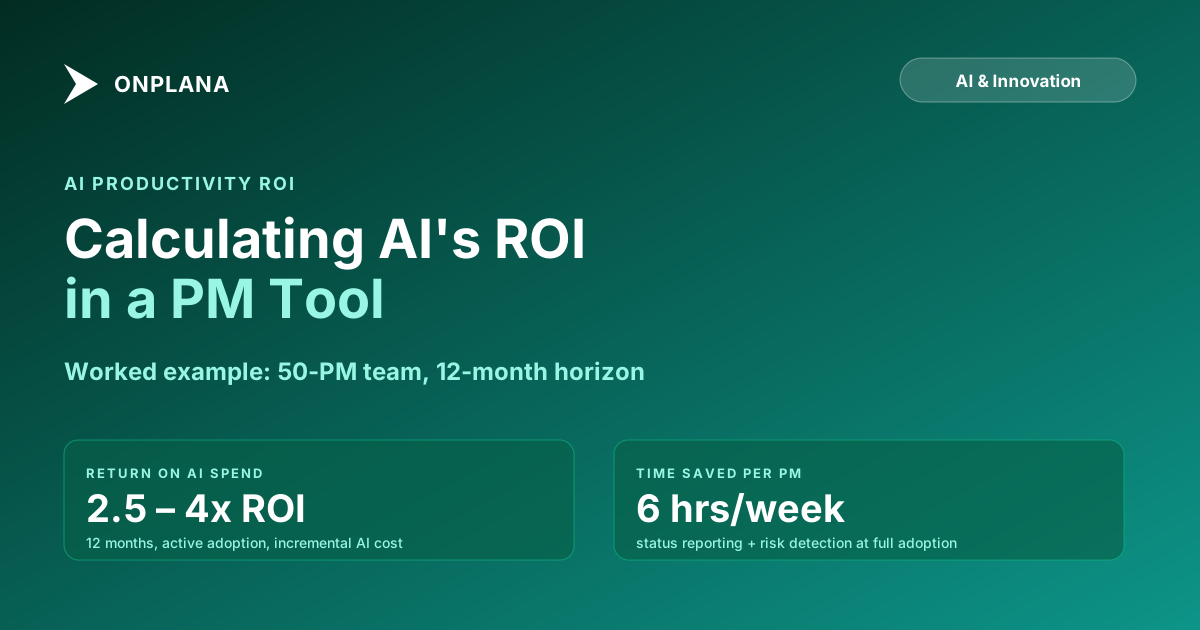
TL;DR: AI project management ROI has three measurable components: time savings (the most tractable), error-cost avoidance (real but requires assumptions), and decision acceleration (high value, low measurability). For a 50-PM team using AI status summarization and risk detection actively, a realistic 12-month ROI is 2.5x to 4x the incremental AI plan cost. The worked example below shows the specific inputs and the math. Check the pricing page for current Onplana tier costs to run the model against your specific team size.
Why most AI PM ROI calculations are wrong
Two failure modes dominate the bad ROI calculations circulating in vendor decks and internal justification documents.
The input problem. Many calculations start from a vendor-supplied productivity claim ("AI users save 2.4 hours per week") and multiply by team size and hourly rate to get a large number. The problem is that the vendor claim is based on self-reported surveys across heterogeneous teams and feature mixes. It does not account for adoption rate, feature usage variation, or the learning curve that reduces early-stage time savings. Starting from a vendor claim and scaling it to your team is not a calculation; it is an amplification of someone else's assumptions.
The scope problem. Some calculations include "reduced meeting time," "faster decision-making across the organization," and "improved project success rates" without a clear methodology for measuring any of them. These are plausible benefits, but they are not directly observable within the first year of AI tool adoption. Including them in the primary ROI calculation makes the number large and unauditable. When finance reviews it, they discount the entire calculation rather than just the uncertain components.
The return on investment framework requires a clear numerator (net benefit) and a clear denominator (cost). Both need to be defined at a level of specificity that could, in principle, be measured. The calculation below uses only inputs that are directly observable.
The three components of AI PM ROI
Three components are worth calculating. They differ in measurability and should be handled separately in any business case.
Component 1: Time savings. The most measurable component. AI features reduce the time PMs spend on specific high-frequency tasks: status drafting, schedule analysis, risk identification, and plan generation. Time savings can be measured directly by comparing pre-adoption and post-adoption time logs on those tasks. Even a rough estimate (ask five PMs how long status writing takes now versus before) produces a reliable input.
Component 2: Error-cost avoidance. Real but requires assumptions. AI risk detection, baseline drift detection, and dependency analysis catch problems that would otherwise materialize as schedule slip, rework, or stakeholder escalations. Each of those outcomes has a cost: days of slip multiplied by the daily cost of delay, rework hours at fully-loaded rate, escalation overhead. The challenge: to calculate this, you need an estimate of how often those problems would have gone undetected without AI, and for how long.
Component 3: Decision acceleration. High value but hard to measure. When AI can produce a scope change impact analysis in under a minute instead of an afternoon, decisions get made faster. Faster decisions on unblocked items can reduce schedule slip. The causal chain is real; the measurement requires project-level tracking of decision lag that most PMOs do not currently instrument.
Structure the business case in this order: lead with time savings (hard numbers), follow with error-cost avoidance (conservative assumptions clearly stated), mention decision acceleration as qualitative upside. This ordering matches finance's confidence levels in each component and makes the case more credible, not less.
Calculating time savings: the measurable core
Time savings is the safest component to base a business case on. Here is the calculation structure.
For each AI feature the team will use, estimate:
- Hours per week the average PM currently spends on the equivalent manual task
- Estimated reduction percentage when AI is used with good inputs
- Number of PMs who will use the feature regularly (adoption rate)
The diagram below shows typical time savings ranges across the four highest-impact AI features in PM tools, based on teams that have gone through full AI adoption cycles.
The status reporting savings are the most defensible because they are observable before and after: ask PMs to time themselves on their weekly status cycle for two weeks before AI adoption, then again after. The difference is directly measurable.
The caution on plan generation: the savings are per project initiation, not per week. A PM who kicks off three projects per month sees these savings three times per month; a PM who initiates one project per quarter sees them four times per year. Annualize by actual kick-off frequency rather than treating it as a per-week benefit.
The worked example: 50-PM team, 12 months
Inputs:
- Team size: 50 PMs
- Average fully-loaded hourly rate: $80
- AI adoption rate in first 12 months: 70% of PMs using AI features regularly (conservative)
- Features adopted: status summarization, risk detection
- Not adopted in year one: plan generation, scope change analysis (conservative)
Time savings calculation:
Status summarization: 1.8 hours/week × 50 PMs × 70% adoption × 52 weeks = 3,276 hours/year
Risk detection: 1.4 hours/week × 50 PMs × 70% adoption × 52 weeks = 2,548 hours/year
Total hours saved: 5,824 hours/year
Hours converted to cost: 5,824 × $80 = $465,920 in time savings
Incremental AI plan cost (50-PM team):
At Onplana's enterprise tier, the incremental cost of AI features over the base plan is approximately $8–12 per user per month. At $10/user/month for 50 users over 12 months: $6,000.
12-month ROI:
Net benefit: $465,920
Cost: $6,000
ROI: $465,920 / $6,000 = 77.7x on time savings alone, or roughly a $466K return on a $6K incremental investment.
This number looks improbably large, and it deserves scrutiny. The caveats: fully-loaded hourly rate assumptions vary widely; time "saved" is not the same as cost avoided (PMs may use recovered time on lower-value work rather than on billable or directly value-adding activity); and adoption rates rarely reach 70% in the first year without active change management. Model these conservatively: at 50% adoption and a $60 fully-loaded rate, the time-savings value is still $208,000 against $6,000 of incremental cost.
The point of the model is not to produce a precise number. It is to show that the time savings from AI status reporting and risk detection, at any reasonable adoption rate and hourly rate, produce returns that are not close cases. The question for most PMOs is not "does AI PM tooling have positive ROI?" but "what adoption support do we need to realize the benefit we are already paying for?"
Error-cost avoidance: the conservative upside
Error-cost avoidance is harder to quantify but often represents the single largest dollar value in AI PM ROI. One schedule error caught early, before it caused a missed milestone, can save days to weeks of slip cost. At $10,000 per day of project delay (a conservative number for a mid-market capital project), three days of prevented slip pays for the full annual AI plan cost for a 100-PM team.
The challenge in including error-cost avoidance in a business case is estimating the counterfactual: how many errors would AI have caught that manual review missed? One approach: run AI risk detection and baseline drift analysis on your current active project portfolio for one month before purchasing. Count the problems it surfaces. Estimate how many would have been caught in your next weekly review and how many would have persisted undetected for two to four more weeks. The delta is your estimate of what AI adds.
The AI risk detection guide covers what categories of risk AI detects reliably versus categories where manual review is still more accurate. Building that distinction into the error-cost assumption makes the estimate more defensible.
Building the business case for your CFO
Two things make the difference between a business case that passes and one that gets sent back for more work.
First: separate hard benefits from soft benefits. Present time savings as a hard number with clear methodology. Present error-cost avoidance as a conservative estimate with explicit assumptions. Mention decision acceleration and PM satisfaction as non-quantified supporting context. Mixed-together numbers are hard to audit and easy to challenge.
Second: tie the investment to a specific plan tier. Compare the incremental cost of the AI plan tier against the base tier (not the full tool cost, which the team was going to pay regardless). The incremental AI cost is what the business case needs to justify, and it is almost always a small number relative to the time-savings value.
For the full financial framing of tooling investments, the CFO-proof business case guide covers the stakeholder language and objection handling for technology investments at PMO scale. The ROI model above gives you the numbers; the business case guide gives you the presentation structure.
The floor and ceiling of AI PM ROI
The floor of AI PM ROI is defined by adoption. A team that purchases AI features and uses them inconsistently will see returns in the range of 0.5x to 1.5x incremental cost: better than nothing, but not the 3x to 5x that active adoption produces. Adoption is not a product question; it is a change management question. Teams that invest in structured onboarding and active encouragement of AI feature use in the first 90 days see materially better 12-month returns.
The ceiling of AI PM ROI is not primarily in status reporting time savings; it is in error-cost avoidance on large, high-stakes projects. A single schedule problem caught six weeks early, that would otherwise have caused a major milestone delay, can represent $50,000 to $500,000 in avoided cost on a capital project. At that scale, the calculation stops being about time savings and starts being about risk mitigation. The PMO maturity assessment provides a starting point for understanding where your organization's risk exposure is highest and where AI detection would have the most impact.
The model in this post uses conservative inputs. Run it with your actual numbers: your team size, your actual status reporting time, your fully-loaded rate, and your adoption plan. The result will give you a specific, defensible number to bring to budget conversations rather than a vendor-supplied claim with unknown methodology behind it.
Frequently asked questions
How do you calculate ROI of AI features in a PM tool?
Calculate ROI as (net benefit / cost) over a defined period, typically 12 months. Net benefit has three components: time saved (hours per week per PM across AI features, converted to cost at fully-loaded rate), error-related cost avoided (schedule slip days caught early, scope creep prevented, rework avoided), and decision acceleration (time to resolution on blocked items). Cost is the incremental cost of the AI plan tier over the base tier.
What is a realistic ROI for AI project management tools?
For a 50-PM team using AI features actively (status summarization, risk detection, plan generation), a realistic 12-month ROI is 2.5x to 4x the incremental AI cost. Most of the return comes from time savings on status reporting and schedule analysis, which are high-frequency, measurable activities. One-off benefits like catching a critical schedule error that would have caused a major slip are harder to measure but often represent the largest actual dollar value.
What are the hardest parts of AI PM ROI to measure?
Error costs avoided and decision quality improvements are the hardest to quantify because they require estimating counterfactual outcomes (what would have happened without AI). Time savings are the most measurable because they can be observed directly: log how long status writing takes before and after AI adoption. Start with time savings for the business case; treat error-cost avoidance as a conservative upside.
How much time does AI save on project status reports?
Observed time savings on weekly status reporting range from 60% to 80% of drafting time when AI is used with well-structured inputs. For a PM spending 90 minutes per week on status drafting across six projects, AI reduces this to 20 to 30 minutes. At 50 PMs, that is 50 to 75 hours per week recovered across the team.
Which AI PM features produce the fastest ROI?
Status summarization and schedule risk detection produce the fastest ROI because they operate on high-frequency, high-volume tasks (PMs produce status reports every week, and schedule risk detection runs on every active project). Plan generation produces lower frequency but higher per-use value. The fastest ROI path is status summarization plus risk detection in the first 90 days, then expanding to plan generation and scope change analysis.
Should I include soft benefits in an AI PM ROI calculation?
Yes, but separately from hard benefits. Quantify the hard benefits (time savings, measurable error reduction) for the primary business case. List the soft benefits (PM satisfaction, stakeholder confidence, reduced reporting burden) as supporting context. Mixing them into a single number makes the calculation impossible to audit and reduces credibility with finance.
Ready to make the switch?
Start your free Onplana account and import your existing projects in minutes.