Building Audit-Ready Project Plans for Regulated Industries
Your project schedule is an audit-ready project plan, or it's just a guess. Here's what auditors actually check: baselines, change logs, traceable decisions.
The audit does not assess your project management philosophy. It assesses whether your schedule is evidence.
That distinction matters because project schedules in regulated industries serve two audiences, and an audit-ready project plan has to satisfy both. The first audience is internal: the sponsor who wants to know if delivery is on track, the team who needs to know what to build next, the steering committee that reviews status. For that audience, a working Gantt with a reasonable critical path is enough.
The second audience is external: the FDA investigator, the SOX auditor, the internal quality team, the client's compliance organization. For that audience, the schedule is a document in a file, and that document either supports the claim that work was controlled and traceable, or it does not. A beautifully formatted Gantt with no baseline and a change log that says "updated per PM direction" fails this test regardless of how well the project was actually managed.
Most project managers optimize entirely for the first audience and discover the second audience exists when the audit notification arrives. By then, the options are to reconstruct records that should have been created in real time, which is expensive and often incomplete, or to produce documentation that clearly looks like it was assembled after the fact.
This post covers what auditors are actually looking for, how to structure scheduling practice to satisfy those requirements without burying the team in overhead, and where the most common documentation gaps appear.
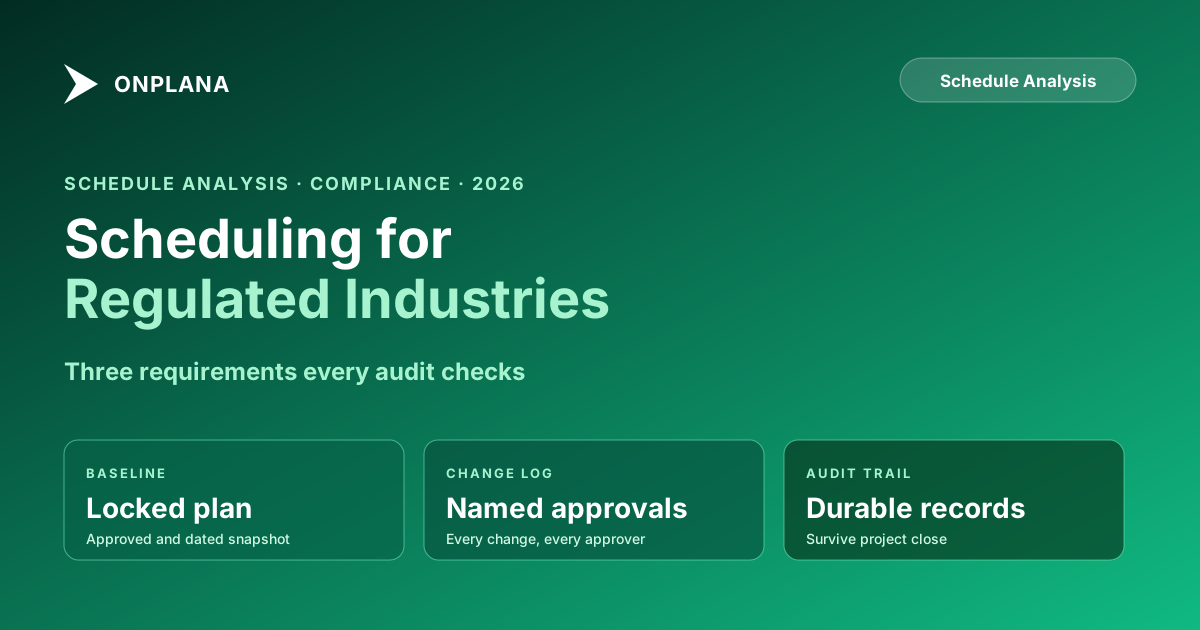
TL;DR: An audit-ready project plan requires three things that standard project schedules usually lack: a locked and dated baseline that matches the sponsor-approved scope, a documented record of every change with who approved it, and resource records that connect to what was actually delivered. Building these in from day one is straightforward. Retrofitting them after audit notification is expensive and often unconvincing.
What an auditor actually looks for in a project schedule
Auditors are not project managers. They are not evaluating whether your critical path was methodologically correct or whether your dependency types were optimal. They are checking whether your process was controlled: whether authorized people made decisions, whether changes were approved in writing, and whether the record is consistent with what you claim happened.
In practical terms, a project schedule audit typically asks for four things:
- The approved project plan as a baselined schedule with a date stamp and an identifiable approver.
- A change register listing every change to scope, budget, or schedule, with the requester, the approving authority, and the date of approval.
- Evidence of execution: timesheets, meeting minutes, or task completion records that correspond to scheduled activities.
- Traceability: the ability to connect any specific deliverable backward through the change register to the original approved plan.
What auditors find most often, and cite in findings, is not technical error. It is the absence of these basics: a current-state Gantt with no baseline, a change log with no named approvers, or resource records that do not match the schedule. The free Schedule Health Check surfaces the technical dimensions of this audit picture, particularly baseline coverage and resource data completeness, and is worth running as part of any pre-audit review.
The baseline problem: why most schedules fail at this hurdle
The most common audit gap in regulated project schedules is a missing or meaningless baseline. A baseline is a snapshot of the approved plan, locked at a specific date, against which every subsequent change is measured. Without it, the fundamental audit question, "did this project execute as approved?", cannot be answered from the project record.
In practice, many project managers set an initial baseline at project kickoff and stop there. Scope changes happen throughout the project's life. The PM updates the current plan to reflect approved changes, but the baseline stays frozen at the original kickoff state. After several months of legitimate changes, the variance between baseline and current plan is large and uninformative: it shows the total accumulated delta, not which changes were approved and when.
The correct practice in regulated environments is a baseline-per-approval model: every time a change is formally approved and incorporated into the schedule, a new baseline is saved. Most scheduling tools support multiple baselines per project. MS Project supports up to eleven. The original baseline documents the initial approved scope. Each subsequent baseline documents the cumulative approved state at a point in time. Together they give the auditor a coherent account of how the project evolved and on whose authority.
For a detailed look at how baseline drift develops and the early warning signs that precede it, the guide to hidden killers in MS Project schedules covers baseline problems as one of the most consequential schedule integrity failures in practice.
Change documentation: the approval chain is the evidence
In unregulated environments, scope changes get absorbed informally. The sponsor mentions an addition in a meeting, the PM updates the plan, and everyone moves on. In regulated environments, that informal exchange is precisely what the auditor will flag.
Every change to a regulated project schedule should follow a documented approval chain: a written change request, review by an authorized approver who is not just the PM, a recorded sign-off, and an entry in a change register that persists as part of the project file. The schedule change documents what changed technically; the change register documents who authorized it and when.
The change register does not need to be elaborate. A spreadsheet with columns for change ID, description, requester, authorizing approver, approval date, and impact on scope or schedule is adequate in most contexts. What matters is that entries are created at the time of the change, not reconstructed afterward, and that the named approver has actual authority to approve that class of change.
If your organization uses a formal change control board, each change register entry should reference the CCB meeting number or minutes document where the approval appears. Auditors verify by tracing: an isolated change register entry with no supporting record invites follow-up questions. For how to run a change control process that produces this trail as a natural output, the governance and status reporting guide covers the meeting cadence and decision documentation that make compliance a byproduct of normal operations rather than a separate track.
Audit trail requirements vary by regulated industry
The broad requirement is consistent across regulated industries: an approved plan, documented changes, and evidence of execution. The specifics vary significantly.
Pharmaceutical and medical devices. Projects related to GMP manufacturing, clinical trials, or validated systems require documentation consistent with FDA expectations. For computer system validation projects, the project schedule is often part of the validation package itself, and FDA 21 CFR Part 11 governs electronic records created as part of regulated activities. ICH E6(R2) guidelines require that clinical trial activities be documented contemporaneously, meaning task completion records must be entered in real time, not reconstructed at project closeout.
Financial services. Projects that touch financial reporting systems, controls, or processes require evidence of testing, segregation of duties, and formal approval chains. SOX auditors are specifically focused on whether the person who made a change and the person who approved it are different individuals. Your schedule approval chain needs to reflect this separation. Audit scope for SOX-related projects often extends to seven years of records.
Government and defense. Federal capital projects often require Earned Value Management reporting under OMB A-11. An EVM-compliant schedule needs a performance measurement baseline (PMB) that integrates scope, schedule, and budget. Changes to the PMB require formal re-baselining with contracting officer approval. The baseline here is not just good practice: it is a contractual artifact.
Healthcare IT. HIPAA itself does not specify project management requirements, but projects implementing or modifying systems that handle protected health information often face internal compliance review. The standard question is whether the implementation was documented well enough to reconstruct what happened if there is a breach investigation.
The common thread across all of these frameworks is traceability: the ability to connect what was done to who approved it, and what was approved to what was originally planned.
How to Build Audit-Ready Project Plans Into Your Workflow
The teams that handle audits well have been maintaining audit-ready schedules throughout the project, not in the week before the review. The difference is workflow design, not extra work.
The diagram below shows the four-stage cycle that produces a compliant project record as a natural byproduct of how the project runs, rather than as a parallel documentation effort.
Each stage produces a specific artifact: the baseline file (with date and approver), the change register (maintained in real time, not reconstructed), the archive (an immutable copy in a designated location), and the traceability package (what you hand to the auditor).
Common audit findings and how to prevent them
These are the most frequently cited deficiencies in project schedule audit reports across regulated industries:
Missing or stale baseline. The file has a baseline, but it is months old and has not been updated through multiple approved scope changes. Prevention: at every change control board meeting where a change is approved, update the baseline before the meeting ends.
Change log entries with no named approvers. The log exists but entries say "updated per PM direction" or reference a chat message. Prevention: every CCB approval generates a change register entry that names the approver and references the meeting minutes or document number where the approval appears.
Resource records that do not reconcile. Timesheets show work on a task marked incomplete in the schedule, or a completed task has no timesheet entries. Prevention: align timesheet closure dates with schedule task completion dates. In regulated environments, task sign-off should update both the timesheet and the schedule in the same workflow step.
Schedule authored in manual mode. In MS Project, manual scheduling mode makes dates free-floating text that does not recompute when predecessors change. The critical path analysis becomes meaningless. Prevention: use auto-scheduled mode for all regulated projects, and document this as part of the project management system configuration. The security and compliance overview covers how to document PM system configurations for audit purposes.
No documented retention policy. The project closes, the PM transitions off, and the schedule file lives on someone's laptop with no defined owner. Prevention: define a retention policy at project initiation, specify the archive location, name the owner of the project record.
The pre-audit schedule review
A pre-audit schedule review is a structured check run two to three weeks before a scheduled audit. Its purpose is not to clean up the record after the fact: it is to confirm that what the record says is complete and accurate. A working checklist:
- Verify baseline coverage: is the latest baseline consistent with the most recently approved change? Are all baseline fields populated with dates that make sense?
- Review the change register: does every schedule change have a corresponding entry? Are all entries complete with approver names and approval dates?
- Reconcile resource records: compare timesheet data against scheduled task work for the most recent six weeks.
- Test traceability on two or three deliverables: can you trace from the deliverable backward through the change register to the original baseline?
- Confirm the archive: is an immutable copy in the designated location and current?
The diagram below maps each checklist step to the artifact it validates.
The Schedule Health Check covers the technical dimensions of this review: baseline coverage, dependency logic, constraint issues, and resource data completeness. Running it alongside the procedural checklist above catches most audit-preparation gaps before the auditor does.
Keeping audit-readiness sustainable
Teams that handle audits well have been maintaining audit-ready schedules throughout the project. The difference between them and the teams that scramble is process design, not effort level.
A few practices that make it sustainable:
Make baseline update part of the change approval step. The change is not complete until the schedule baseline is updated. If the change control template includes baseline update as a required action item, it happens without separate prompting.
Automate the change register entry. At the end of every CCB meeting where a change is approved, one named person creates the register entry before the meeting closes. Five minutes at the meeting. If deferred, it gets forgotten.
Set a quarterly archive date. Once per quarter, an immutable copy goes to the designated archive location. Do not wait for project closeout.
Name a project record owner at initiation. When the PM transitions off and the project closes, someone still needs to be responsible for the archive. Assign this role explicitly at the start, not at the end.
None of these practices are significant additions to normal project management. What makes them look difficult is trying to retrofit them onto a project that is already six months in with no change register and no updated baselines. Start with the next project, and the audit becomes a document-retrieval exercise rather than a reconstruction effort.
The checklist above drives the same pre-audit conversation whether the audit is scheduled or surprise. A project record that passes all five checks can be produced on request in hours.
Run a pre-audit schedule health check The free Schedule Health Check covers baseline coverage, dependency logic, constraint issues, and resource data completeness: the technical dimensions most commonly flagged in audit preparation. No signup required, results in about 30 seconds. → Open the Schedule Health Check
Microsoft Project Online™ is a trademark of Microsoft Corporation. Onplana is not affiliated with Microsoft.
Frequently asked questions
What makes a project schedule audit-ready?
An audit-ready project schedule has a locked, dated baseline; a complete log of every approved change with a named approver; and resource records that reconcile with what was actually delivered.
How many baselines should a regulated project maintain?
At minimum, one: the original approved plan. Best practice is to save a new baseline at each approved change control, keeping the full history intact for audit evidence.
What is the difference between a change log and a change request?
A change request is the proposal submitted for approval; a change log is the permanent record of all approved requests. Regulated environments require both: the request for the approval trail, the log for audit evidence.
Does FDA 21 CFR Part 11 apply to project schedules?
21 CFR Part 11 governs electronic records used in FDA-regulated activities. Validation project schedules used as execution evidence may need to meet Part 11 standards if they are treated as part of the validation package.
How long should project schedule records be retained?
Retention requirements vary: FDA-regulated pharma often requires records for the product's commercial life plus two years; SOX-governed financial projects typically require seven years. Check your specific regulatory framework.
What happens during a project schedule audit?
An auditor will ask for the approved baseline, a change register with named approvers and dates, resource allocation records, and evidence that the schedule matched what was executed. Traceability is the primary test.
What scheduling mode should regulated projects use in MS Project?
Auto-scheduled mode. Manual mode makes task dates free-floating and breaks critical path calculations, which auditors will notice when they try to trace the dependency logic.
Ready to make the switch?
Start your free Onplana account and import your existing projects in minutes.