Handing a Project Over to a New PM Without Losing Context
Project handover fails when context lives in someone's head. A concrete checklist covering what to document, walk through live, and embed in the schedule.
Here is what actually happens. A project manager takes extended leave, or resigns, or is pulled to a higher-priority program. The project files are handed over. The incoming PM spends the first two weeks asking questions nobody documented: why is this dependency set up that way? What is the history with that stakeholder? Why is that task constrained to a fixed date that is not explained anywhere in the schedule? In week three, something breaks that the outgoing PM knew was fragile. Nobody still on the project knew to flag it.
The failure is not the outgoing PM's fault in the usual sense. They knew what they knew. The failure is that no structure existed to convert what was in their head into what the incoming PM could find. The schedule captured the plan. It did not capture the reasoning.
Project manager handover is the highest-leverage knowledge transfer event in a PM's tenure on a project. Done well, it compresses the incoming PM's ramp time from two months to two weeks. Done poorly, it guarantees two months of re-learning at the worst possible time, which is usually the middle of active delivery.
TL;DR. Project manager handover fails when context lives in someone's head. A concrete handover has three components: a written document covering the project state and its political context, a live walkthrough session where the outgoing PM explains the reasoning that documents cannot capture, and annotations in the schedule itself that make key decisions persistent. All three are necessary; none alone is sufficient.
Why context is what gets lost
Project schedules and status reports document decisions: what tasks exist, what the dependencies are, what the current forecast says. They rarely document reasoning: why the sequence was set up that way, what alternatives were considered and rejected, what a sponsor said in a steering committee meeting that changed how the timeline was structured.
Incoming PMs inherit the decisions without the reasoning. This creates two predictable failure modes.
The first is invisible fragility. The outgoing PM knew that one particular stakeholder needed 72 hours of advance notice before any schedule change, because of an incident six months earlier. The incoming PM sends a change notification with 24 hours of notice and spends three weeks repairing the relationship. The schedule would not have told them this. The handover document should have.
The second is unnecessary rework. The incoming PM sees a scheduling decision they disagree with, lacks the context to understand why it was made, and reverses it. Two sprints later, the same problem that drove the original decision resurfaces. The context of why the decision was made is the only thing that prevents re-solving the same problem under worse conditions.
A complete project manager handover transfers three things: the facts (what the current status is), the context (why things are the way they are), and the judgment (what to watch for that is not obvious from the current state). Documents transfer facts. Live conversations transfer context. Embedded schedule notes transfer judgment.
What to document in the handover document
The handover document is not a status report. A status report communicates current state to stakeholders. The handover document communicates operational context to a specific audience: the incoming PM. Write it for someone who will be making decisions tomorrow, not someone who needs to be reassured that things are under control.
The handover document has five sections.
Project state. The current schedule status: which milestones are complete, which are in progress, and which are at risk. Include the current critical path and the float on the two or three tasks the incoming PM should watch most closely. This is the only section that overlaps with a status report.
Open issues and risks. Every open issue and risk with its current status, owner, and the last time it was reviewed. Not the formal risk register as maintained for governance: the plain-language version of what is genuinely uncertain and what has been done about it so far.
Political context. The five to ten things about the human dynamics of the project that would take the incoming PM two months to learn independently. Who the difficult stakeholder is and what the source of the difficulty is. Which functional manager has been quietly concerned about the timeline and why. Which relationship is the most important to maintain and what sustains it. This section makes experienced PMs uncomfortable to write because it reads like institutional gossip. Write it anyway. An incoming PM who steps into a difficult stakeholder relationship without this context will learn the hard way what the outgoing PM could have told them in a paragraph.
Outstanding decisions. Every decision that is pending or will be needed in the next four to six weeks. Who owns each decision. What information the decision-maker needs to make it. When the project needs the decision to stay on track.
Known unknowns. Things the outgoing PM was monitoring that have not yet become formal risks. A vendor whose delivery cadence has been inconsistent but has not yet caused a delay. A team member who has been quietly job-searching and whose departure would affect a specific workstream. An integration dependency that was agreed informally and was never confirmed in writing.
What to cover in the live walkthrough
The handover document captures facts. The live walkthrough is where the incoming PM builds the mental model of how the project actually works.
The walkthrough is a two-hour session for complex projects. Schedule it with at least one week of overlap between the outgoing and incoming PM, so the incoming PM has time to read the document and prepare questions before the session. The outgoing PM leads; the incoming PM asks.
Five areas that are always worth covering in the walkthrough.
The schedule's hidden constraints. Walk through the critical path and name every constraint that has a non-obvious reason. "This date is fixed because the sponsor committed to a board presentation." "This dependency is set up this way because the original sequence was reversed after an integration failure in Q1." Constraints with reasons visible only to the outgoing PM are the schedule's single largest handover risk.
The stakeholder dynamics. For each significant stakeholder, give the incoming PM one sentence on the history: what they care about most, what the last difficult interaction was, and what they need from the PM to stay engaged. The incoming PM knows the names from the stakeholder register. They need the subtext.
The team's working style. Which team members communicate proactively and which need to be asked. Who the high-performers are and what their load looks like going into the next phase. Anyone who has been underperforming and what the current situation is.
The informal commitments. Any agreement made in a meeting, conversation, or email that is not captured in formal project documents. A scope boundary agreed in a hallway. An extension granted verbally. A deliverable format agreed on a call but never confirmed in writing. The incoming PM who discovers an informal commitment after the fact discovers it as a missed expectation rather than a managed one.
The next decision gate. Walk the incoming PM through the next major decision or milestone in detail: what needs to happen before it, who owns each input, and what could go wrong. The incoming PM's first test usually comes at this gate.
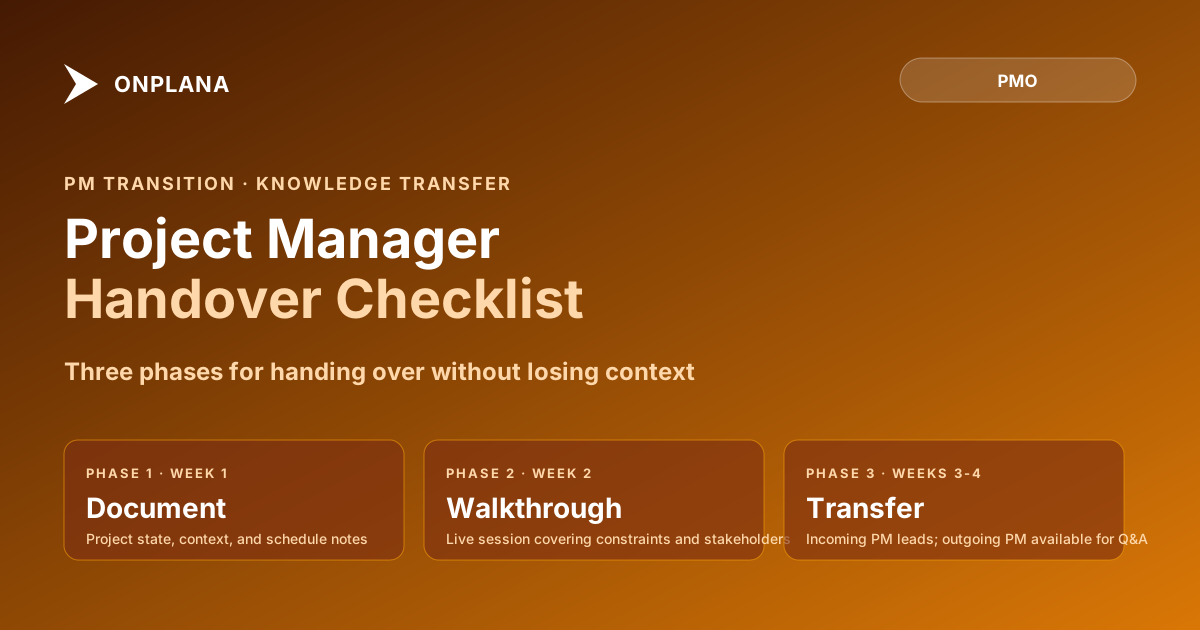
The diagram below shows the three-phase handover structure from documentation through the overlap period to full ownership transfer.
What to embed in the schedule
The live walkthrough is perishable: what the incoming PM retains from a two-hour session degrades over the following weeks as new information arrives. Embedding context in the schedule makes it persistent.
Three types of annotations belong in the schedule itself.
Constraint rationale. Every task with a constraint date or unusual dependency should carry a note explaining why. "Fixed start 2026-07-15 per sponsor board commitment (confirmed steering committee 2026-05-12)." This annotation tells the incoming PM two things: do not move this date without sponsor authority, and here is the meeting they can reference if challenged.
Baseline notes. Add a note to each milestone explaining what the original baseline was and what has changed since. "Original completion date 2026-08-01. Moved to 2026-08-29 after integration scope addition approved by CCB on 2026-04-03." The incoming PM now knows the schedule's history without reconstructing it from meeting notes.
Watch flags. Any task where the PM knows the estimate is soft, the dependency is fragile, or the resource assignment is uncertain should carry a note. "Duration estimate based on 0.5 FTE from the finance team. Confirm resource availability before this task enters in-progress." These notes convert institutional knowledge into schedule intelligence that does not evaporate when the outgoing PM clears their desk.
Before the handover is complete, run the free Schedule Health Check on the current schedule. It surfaces structural issues such as dangling tasks, missing dependencies, and constraint conflicts that the incoming PM should know about before taking ownership. A schedule with unresolved health issues becomes the incoming PM's problem; surfacing them during handover gives the outgoing PM time to document which are known and intentional versus which need resolution.
The incoming PM's first two weeks
The incoming PM's first two weeks should follow a specific pattern regardless of how thorough the handover was.
The first priority is not to make decisions. The incoming PM does not yet have enough context for the most sensitive issues. Use the first week to listen: attend standing meetings, review recent status reports, and build the stakeholder picture that supplements what the handover document provided.
The second priority is to identify the two or three decisions needed in the next two weeks and surface them early. These are the items in the "outstanding decisions" section of the handover document. The incoming PM should not leave them to drift while building context. Make those specific decisions with the best available information and explicit acknowledgment of what context they are still building.
The third priority is a one-on-one with the key sponsor in the first week. This is the relationship that most affects the incoming PM's ability to operate. The agenda: "I have been briefed on where the project stands. I want to understand what you are most concerned about, what you most need from the project over the next 60 days, and how you prefer to communicate."
For PMOs building standards for PM handover, including documentation requirements and transition checklists, see also the discipline, goals, milestones, and status reporting framework, which covers the governance context the incoming PM inherits alongside the schedule.
The PMO Maturity Assessment covers knowledge management and transition readiness as part of its organizational capability dimensions. PMOs that score low on transition readiness are usually missing either the documentation standard or the overlap period, not the institutional knowledge itself.
Run the free Schedule Health Check Upload the project schedule before completing the handover. Surface structural issues such as dangling tasks, constraint conflicts, and missing baselines that the incoming PM should receive documented rather than discover mid-project. No signup required. → Open the Schedule Health Check
Frequently asked questions
What should be included in a project manager handover?
A complete project manager handover includes the current schedule status with constraints explained, open issues and risks with their owners, the political context for key stakeholders, outstanding decisions, and at least one live walkthrough session between the outgoing and incoming PM.
Why do PM handovers fail?
Most PM handovers fail because context lives in the outgoing PM's head rather than the project files. The schedule shows what tasks exist, not why decisions were made, which stakeholders need careful handling, or what informal commitments were struck with functional managers.
How long should a PM handover take?
A structured handover takes two to three weeks for a complex project: one week of documentation, a handover session plus overlap time where both PMs are available, and a first week where the incoming PM leads with the outgoing PM available for questions.
What context is most commonly lost in PM handovers?
Stakeholder history (why a particular stakeholder is sensitive about a topic), informal commitments made outside the formal plan, and the reasoning behind scheduling decisions. These are rarely documented and rarely asked about until they cause a problem mid-project.
What should a PM do if a handover is unplanned?
For unplanned handovers, assign an interim PM for two to four weeks while conducting a schedule health review, stakeholder briefings, and a risk triage. Rushing an incoming PM into full ownership without a context transfer compounds the project risk significantly.
What should the outgoing PM leave in the project schedule?
Constraint rationale in task notes, a baseline comparison showing where the project sits against the original plan, and notes on any task where the reason behind the decision matters, not just the decision itself. These convert institutional knowledge into persistent schedule intelligence.
Ready to make the switch?
Start your free Onplana account and import your existing projects in minutes.