Unbilled Work: What Scope Creep Costs a Services Firm
Agencies rarely bill for out-of-scope work, and most lose $1,000 to $5,000 a month to it. Where unbilled work comes from and how to see it before month end.
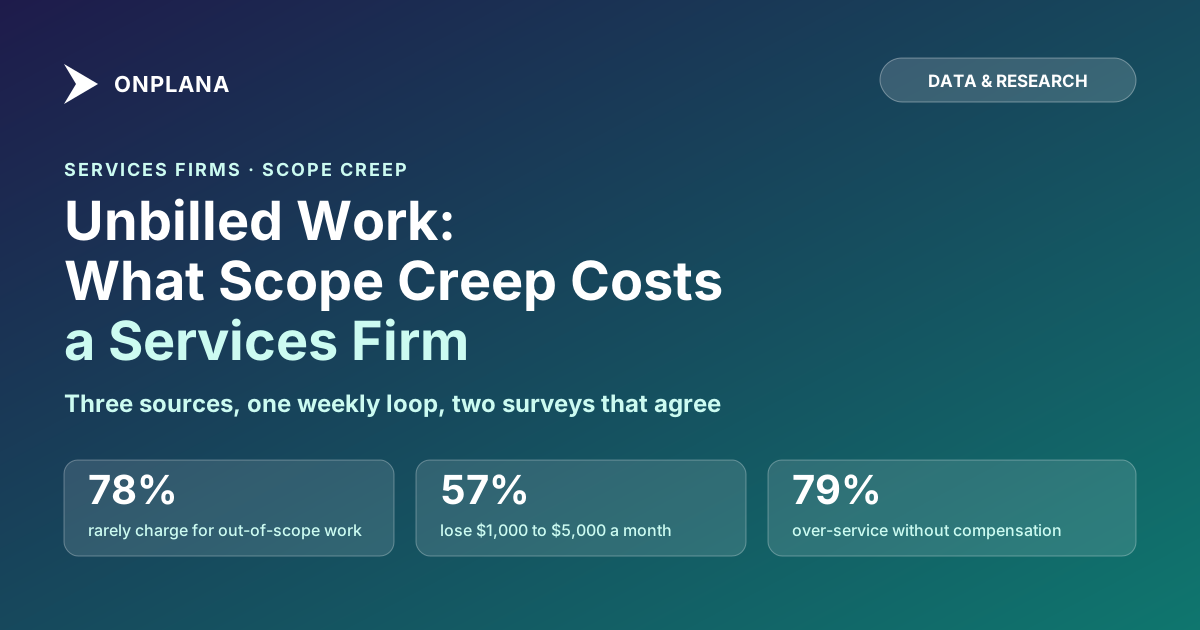
Unbilled work is the hours a services firm delivers and never invoices, and for most agencies it is a monthly line item they cannot see. In Ignition's 2025 Agency Pricing and Cash Flow Report, a survey of 273 US agency executives, 78% said they rarely or only sometimes charge for out-of-scope work. 57% put the loss at $1,000 to $5,000 a month, and 30% put it above $5,000. FunctionFox's 2025 Creative Industry Report, which asked 242 small agencies, found 79% over-servicing clients without compensation.
Two surveys, two samples, one answer: the work grows and the invoice does not.
TL;DR. Unbilled work comes from three places: the ask that was too small to quote, the quote that was never re-priced when the plan grew, and the retainer whose hours drifted above the included allowance. Time tracking cannot see any of them, because each is a gap between hours and a scope, and a timesheet only holds the hours. The fix is a weekly loop: record the ask against the client, decide whether it is in scope, re-price it if it is not, and compare hours to the quote per client every month.
Where unbilled work comes from
The three sources hide in three different places, which is why a firm that has fixed one of them still leaks.
The ask that was too small to quote. A client emails a "quick change". It takes an hour, then another, then a second round. Nobody opens a change request for an hour, so nobody opens one for the third hour either, and by the time the ask is a day and a half of work it has no record anywhere except a thread. Ignition's 78% is mostly this: firms that charge for a big scope change and absorb a hundred small ones.
The quote that was never re-priced. The proposal said 120 hours. The project plan, built a week later by a different person, came to 160. Nobody went back to the client, because the plan was internal and the number in the proposal had already been agreed. The 40 hours were given away before anyone logged a day.
The retainer that drifts. A retainer looks healthy every month because the invoice is the same. The hours underneath it are not. Without an included allowance recorded per period, the drift shows up at renewal as a margin that quietly halved over a year.
Why tracking time does not fix it
Most firms that lose money this way already track time. FunctionFox found 76% of small agencies do, and only 33% rate their tracking as highly accurate. The accuracy number is a problem, but it is not the main one.
A timesheet holds hours. Unbilled work is the difference between those hours and the scope the client agreed to pay for. That scope lives somewhere else: a proposal PDF, a retainer agreement, an email from March. A timesheet can tell you a consultant spent 31 hours on a client last week. It cannot tell you that 9 of them were on an ask nobody quoted, because the ask was never recorded as an ask.
The industry numbers say this is where the money is going now. SPI Research's 2026 benchmark put billable utilization across professional services firms at 66.4% for 2025, the lowest in the survey's history, against a healthy threshold of about 70%, while pipeline coverage sat at 175% of target. Firms are not short of work. They are delivering hours that do not turn into revenue, and the sold-versus-delivered gap is one of the few places a small firm can recover margin without winning a single new client.
The loop that catches it
None of this needs a change control board. It needs five habits, each cheap, each on a fixed cadence. The change control process that governs a large program is the heavyweight version of the same idea; this is the version a twelve-person firm will actually keep doing.
- Record the ask where the client is. Not in a thread. Every request that is not obviously inside the quote goes into one place, linked to the client, the day it arrives. Thirty seconds. The record is what makes the rest possible.
- Decide within the week. Each open ask gets one of three answers: it is in scope, it became work and needs pricing, or it was renegotiated and the client knows. An ask that sits open for a month has already been absorbed.
- Re-price when it became work. Add the line to the quote, in hours or as a fixed amount, and send it. The client accepts or declines. Either answer is better than silence, and a client told at the time rarely objects; a client surprised on an invoice three months later always does.
- Compare hours to the quote per client, monthly. Not utilization across the firm. Hours against the quoted hours for each client, and for each project inside the client. The gap is the unbilled work, named and sized.
- Give retainers an included allowance. Hours per period, on the record, so the month the client used 140 hours of a 100-hour retainer is visible in that month rather than at renewal.
The kickoff meeting is where the first habit is easiest to set, because the client is in the room and the scope is fresh. Say then that asks outside the quote will be recorded and priced, and the first re-priced line is a confirmation rather than a surprise.
What "renegotiated" looks like
The word sounds heavier than the conversation. A client asks for a third round of revisions on a deliverable quoted at two. The reply is two sentences: the quote covered two rounds, and a third adds six hours at the agreed rate. A revised quote follows with one new line. The client accepts it, or decides two rounds were enough after all.
That exchange, repeated, is the entire difference between the 78% and the 22%. It is not a pricing skill. It is a record that exists at the moment the ask arrives, so the conversation has something to point at.
Where Onplana Services fits
Onplana Services is built around exactly this loop, on top of the schedules and timesheets Onplana already runs. A client ask is filed as an idea or an issue against the client, and each client's requests view groups them by what happened next: still open, became work, or renegotiated. A deal is priced as lines, sent as a quote on a private link, and accepted by the client typing their name; when the scope changes, the lines change and the quote goes out again. Approved hours price at a cost rate and a billable rate, so the margin report reads revenue against cost per client and per project, and a retainer carries its included hours per period with over-servicing reported where it happens.
It is in development with a waitlist open. The delivery side, timesheets, rate cards and utilization, is available today on every Onplana plan.
Frequently asked questions
What is unbilled work?
Unbilled work is the hours a services firm delivers and never invoices. It comes from three places: small asks that were never quoted, quotes that were never re-priced when the plan grew, and retainers whose hours drifted above the included allowance. It is real cost with no matching revenue, so it comes straight out of margin.
How much do agencies lose to unbilled work?
In Ignition's 2025 survey of 273 US agency executives, 57% said they lose $1,000 to $5,000 a month to work they did not bill, and 30% said more than $5,000. 78% said they rarely or only sometimes charge for out-of-scope work at all.
Why does time tracking not catch scope creep?
A timesheet measures hours. Unbilled work is the gap between those hours and the scope that was sold, and a timesheet alone cannot see the scope. FunctionFox found 76% of small agencies track time but only 33% rate their tracking as highly accurate, so most firms have an approximate hour count and no record of what it was measured against.
What is the difference between scope creep and a change request?
The same client ask. Scope creep is the version that was absorbed without a decision; a change request is the version that was recorded, priced and either accepted or declined. The work may be identical. The difference is whether an invoice line exists for it.
How do you charge for out-of-scope work without losing the client?
Decide in the week the ask arrives, not at month end. Say what the ask adds in hours and money, re-issue the quote with the new line, and let the client accept it. Clients rarely object to a change they were told about at the time; they object to a surprise on the invoice three months later.
Ready to make the switch?
Start your free Onplana account and import your existing projects in minutes.