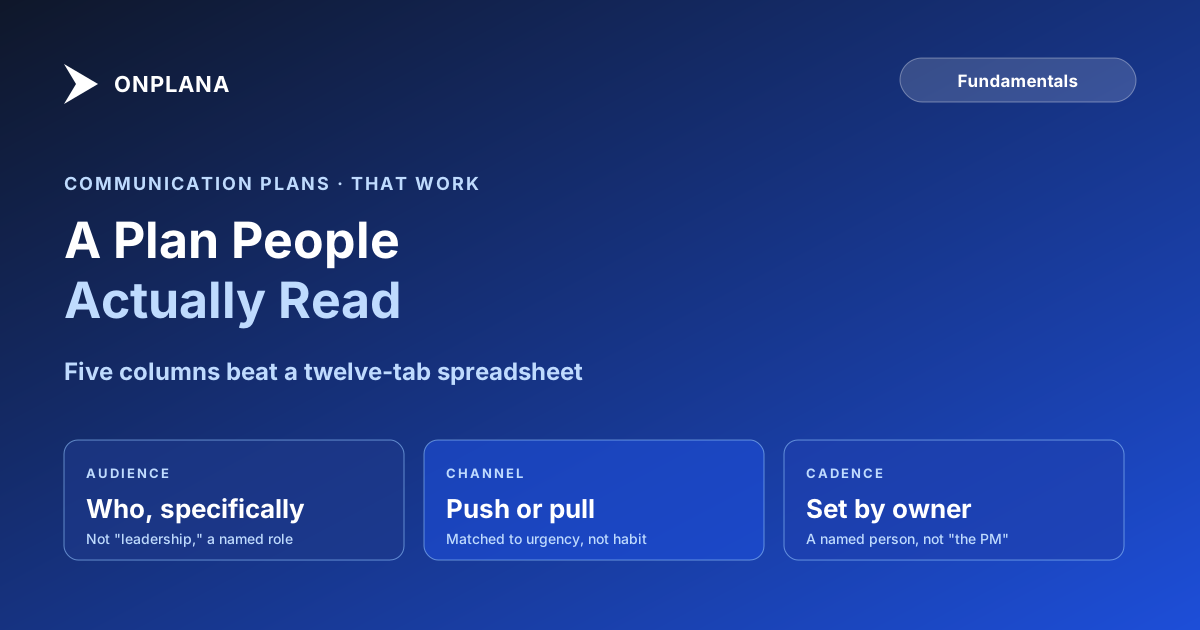
Building a Project Communication Plan That People Actually Read
A project communication plan only works if it gets reopened after kickoff. Match format and cadence to each audience, and cut the meeting that's an email.
A project communication plan gets built during kickoff week, inserted into the project charter, and then opened again exactly once: during an audit eighteen months later, when someone needs to prove one existed. In between, the actual communication on the project runs on whatever the PM felt like sending that week, which is usually more status meetings than anyone needed and fewer targeted updates than the CFO actually wanted.
That gap between the document and the behavior is the real communication problem on most projects. It's not that nobody writes a plan. It's that the plan people write doesn't answer the only question that matters day to day: what does this specific person need to hear, through what channel, and how often, before they stop reading anything you send them.
TL;DR. A project communication plan works when it answers five things for every audience: who they are, what they need to know, which channel reaches them, how often, and who's accountable for sending it. Match format and cadence to what each audience actually does with the information, push urgent or action-required items, let reference material sit in a pull channel people check on their own time, and kill any recurring meeting whose entire content could have been a two-paragraph email. A plan that isn't a one-page table gets built once and never maintained.
Why Most Communication Plans Die After Kickoff
The typical communication plan is built as a compliance artifact: a stakeholder register with a communications tab bolted on, filled out because the project charter template has a section for it, and treated as done the moment the cells are populated. It's built once, under time pressure, by a PM who's also building the schedule, the budget, and the risk register that same week. Nobody goes back to it because nothing about how it was built made it useful to go back to.
The plan that survives past kickoff is built differently. It answers a question the PM will actually need answered again next month: "who's supposed to be getting this, and are they?" That question only has a fast answer if the plan is short enough to scan in under a minute, current enough to trust without cross-checking, and specific enough that "send the exec summary to the sponsor" isn't left as an assumption everyone privately interprets differently.
The standard definition of project communications management frames communication as a planned, managed process, timely and appropriate generation, collection, and dissemination of project information, rather than an ad hoc byproduct of doing the work, which is the right instinct. Where most plans fail isn't the theory; it's that the artifact built to hold that theory is too heavy to maintain, so it gets built once and ignored.
What a Project Communication Plan Actually Has to Decide
Strip away the templates with twelve columns and a communication plan is answering five questions, and only five, for every stakeholder or stakeholder group on the project.
Audience. Who is this, specifically? Not "leadership," but "the VP of Engineering" and "the finance business partner" as separate rows, because they need different things even if they both sit in the same steering committee meeting.
Message or information need. What does this audience actually need to know to do their job in relation to the project? A resource manager needs headcount forecast. A business user needs delivery dates and what's changing for them. A sponsor needs risk exposure and any decision that needs their sign-off. Vague entries like "project updates" produce vague communication; specific entries produce useful communication.
Channel. How does this information reach them: a scheduled meeting, an email, a dashboard they check on their own, a message in a shared channel? The channel choice should follow from how urgently the audience needs to act on the information, covered in more detail below.
Frequency. How often does this need to go out? Weekly, biweekly, monthly, or event-triggered (only when something specific happens, a milestone hit or missed, a risk escalating). Frequency should match how often the underlying reality actually changes enough to be worth a fresh update, not an arbitrary calendar default.
Owner. Who is accountable for this actually happening? Not "the PM," as a blanket answer for every row, but a named person, because "the PM" as the owner of eleven different communication streams is how half of them quietly stop happening the week the PM is on leave.
Five columns, one row per audience or audience group. That's the whole structure. Everything past those five is usually decoration that makes the plan slower to build and harder to keep current.
Push vs Pull: Choosing the Right Channel for Each Message
The single decision that does the most to keep a communication plan from generating noise is choosing, deliberately, between push and pull for each message.
Push communication goes to the recipient without them asking for it: an email, a direct message, a meeting invite, an alert. It's the right choice when the information demands action or attention now, a risk that just crossed a threshold, a decision that needs a sign-off by Friday, a milestone that just slipped. Push communication that isn't actually urgent trains recipients to stop reading it, which is the exact failure mode that turns a weekly status email into something everyone archives unread.
Pull communication is made available for the recipient to retrieve on their own schedule: a live dashboard, a shared project wiki page, a folder of status reports, a portfolio view. It's the right choice for reference material, anything a stakeholder wants to check when they think of it rather than the moment it changes: overall project health, a running risk log, historical status reports, budget-to-actual tracking.
The mistake that produces the most communication fatigue on a project is pushing pull-appropriate material: sending a full status deck by email every week regardless of whether anything material changed. The audience learns, correctly, that most of what arrives in their inbox doesn't require action, and they extend that lesson to the one week it actually did.
How Often Should You Communicate With Each Audience?
Frequency should be set by how fast the underlying reality changes for that audience, not by a calendar default everyone inherited from the last project template. A core team executing daily work benefits from a daily or near-daily touchpoint, because the state of their work genuinely changes that fast. A sponsor who checks in on strategic risk and budget doesn't need daily updates on task-level movement; weekly or biweekly, tied to real milestones rather than the calendar, respects both their time and the actual pace of change they care about.
The audiences worth separating by frequency, at minimum:
- Core project team: daily standups or async updates, because their coordination needs change hour to hour.
- Sponsor and steering committee: weekly or biweekly, tied to decisions and risk, not task minutiae.
- Resource managers: as-needed plus a regular capacity check-in, since their planning horizon is usually a few weeks out.
- Broader stakeholders and end users: monthly or milestone-triggered, since they need to know things changed, not the mechanics of how.
- Finance and PMO governance: aligned to the organization's reporting cadence, typically monthly, tied to budget cycles.
Getting this wrong in either direction costs something real. Too frequent, and the audience tunes out before the message that actually mattered arrives. Too infrequent, and stakeholders start assuming silence means trouble, which generates the exact ad hoc "just checking in" pings a good communication plan is supposed to prevent.
The Status Meeting That Should Have Been an Email
Every organization has at least one recurring meeting whose entire content, every week, could have fit in a two-paragraph email: a status readout with no decisions being made, no discussion happening, just one person talking through a slide deck while everyone else's cameras stay off. It survives because cancelling a standing meeting feels riskier than the meeting itself is valuable, and nobody wants to be the person who "stopped communicating" by removing it from the calendar.
The test for whether a recurring meeting earns its slot: does it require synchronous discussion, or does it only require information transfer? A meeting exists to justify itself when attendees need to react in real time, debate a trade-off, or make a joint decision. A meeting that's really just one person reading updates aloud while others listen is a status report wearing a calendar invite, and it should be replaced with the artifact it's actually pretending to be.
Cutting a meeting like that isn't a communication reduction; it's a channel correction. The content still gets delivered, usually better, because a written update forces more precision than a live readout, and it reaches people who couldn't make the meeting time without anyone having to catch them up separately. The status reporting discipline that makes a written update worth reading is the actual replacement for the meeting that shouldn't have existed.
Building the One-Page Plan You'll Actually Maintain
| Audience | Needs to know | Channel | Frequency | Owner |
|---|---|---|---|---|
| Core team | Task status, blockers, next steps | Standup + shared board | Daily | PM |
| Sponsor | Risk, budget, decisions needed | Email + steering deck | Biweekly | PM |
| Resource managers | Upcoming capacity needs | Direct message + heatmap | As-needed | PM |
| End users | What's changing for them | Milestone-triggered email | Event-triggered | Change lead |
| Finance / PMO | Budget-to-actual, forecast | Dashboard (pull) | Monthly | PM |
| Steering committee | Go/hold/kill items, escalations | Meeting + pre-read doc | Monthly | Sponsor delegate |
A table like this fits on one screen, which is the actual test for whether a communication plan will survive past kickoff. If it takes scrolling through multiple tabs of a spreadsheet to find who owns the finance update, nobody's going to check it before finance asks where their update went. Building the stakeholder map first makes filling in the audience column faster, since the power-interest grid already tells you roughly how much attention each group needs before you decide the channel and cadence.
Tool choice shapes which channels a plan can rely on; see the best project management software for remote teams for how popular options handle notifications and guests.
How Do You Know the Plan Is Working?
A communication plan is working when three things are true, and none of them require re-reading the document itself. First, nobody's asking "why didn't I know about this" after something material happens; if a stakeholder is surprised by news that should have reached them through their assigned channel, either the channel or the frequency in their row is wrong. Second, the recurring meetings on the calendar are ones people actually engage in, not ones half the invitees mute and multitask through. Third, the PM can answer "who's supposed to be getting this update" in under ten seconds by glancing at the plan, not by trying to remember from memory who's usually on the distribution list.
When any of those three breaks down, the fix is almost never "communicate more." It's revisiting the specific row: is this the right channel for this audience, is the frequency matched to how fast their world actually changes, and is there a named owner who'll notice if it stops happening. The discipline that separates a status report people read from one they skim applies to the whole communication plan, not just the weekly update: specificity beats volume, every time.
Once the plan exists, the practice is where it succeeds or fails; stakeholder communication on the project, not in email covers how to deliver each row of the plan where its audience will read it.
Write the update people will actually read The free Status Report Writer turns milestone and risk data into a structured, skimmable update in minutes, matched to the audience it's going to. No signup required. → Open the Status Report Writer
Frequently asked questions
What is a project communication plan?
A project communication plan is a structured record of who needs to know what about a project, through which channel, how often, and who's accountable for sending it. It exists to make communication deliberate instead of ad hoc.
What should a communication plan template include?
Five columns cover the essentials: audience, the message or information need, channel, frequency, and owner. Anything beyond those five is usually decoration that makes the plan harder to maintain.
How is a communication plan different from a status report?
A communication plan is the rulebook that decides who gets which information, how often, and through what channel. A status report is one output the plan produces; most communication plans govern several other outputs too, from steering committee decks to a Slack channel nobody has to open.
Should every stakeholder get a weekly status update?
No. Weekly cadence fits stakeholders who need to act on the information regularly, typically the core team and the sponsor. Stakeholders who only need to stay informed are usually better served by a less frequent, more digestible update, or a pull channel they check on their own schedule.
What's the difference between push and pull communication?
Push communication is sent to the recipient without them asking, an email, a message, an alert. Pull communication is made available for the recipient to retrieve when they want it, a dashboard, a wiki page, a shared folder. Matching the two to the right audience is most of what makes a plan work.
How often should a communication plan itself be updated?
Review it at every major project phase change and whenever the stakeholder list changes meaningfully, not on a fixed schedule. A plan built for a 10-person pilot team stops fitting the moment the project scales to three departments, and it should be revised at that point, not left to describe a team that no longer exists.
Ready to make the switch?
Start your free Onplana account and import your existing projects in minutes.