AI Code Review: What It Catches, What It Misses
AI code review effectiveness is real for mechanical, checklist-shaped defects and weak for architecture and whether a change should exist at all.
The pitch for agent code review is that it never gets tired, never skips a file, and never rubber-stamps a 40-file diff at 5 p.m. on a Friday. All three are true. None of them are the reason agent review fails when it fails.
The direct answer: AI code review effectiveness splits cleanly into two halves. Agents are genuinely strong at mechanical, checklist-shaped problems: missing error handling, inconsistent naming, unclosed resources, a changed branch with no matching test. They are weak, reliably and predictably, at architecture, at judging intent against a specification they never saw, and at the question that matters most on any pull request: whether the change should have been written at all.
Agent code review outperforms a tired human at consistency and breadth: it checks every file in a large diff the same way, every time, and it doesn't skip the boring hunks. It reliably fails at architecture, at business-logic edge cases a test suite doesn't cover, and at the one question no pattern-matcher can answer: should this change exist. The most dangerous failure isn't a missed bug; it's a confident, well-formatted approval of code that never should have been written.
AI Code Review Effectiveness: Where It Beats a Tired Human
Consistency is the real advantage, not intelligence. A human reviewer's attention degrades across a long diff: the first ten files get a careful read, the last ten get a skim, and a Friday-afternoon review of a 40-file pull request is a worse review than the same reviewer would give on Tuesday morning. An agent applies the same checklist to file 40 that it applied to file 1. It doesn't decide a hunk is "probably fine" because it's tired of reading. That breadth is where the honest wins live: catching a missing null check on line 380 of a file nobody read past line 60, flagging an inconsistent error-handling pattern that drifted in three commits ago, or noticing that a changed function has no corresponding test update anywhere in the diff.
The Defect Classes Worth Delegating
The failures agent review catches well share a shape: they're locatable by pattern, verifiable without broader context, and don't require knowing why the code exists. Unhandled exceptions, resource leaks, naming drift from the surrounding file's conventions, an off-by-one in a loop bound, a copy-pasted block that diverged from its original in one place it shouldn't have. Testing AI-generated code covers the sibling problem on the test side: a passing suite doesn't prove the fix works, and the same mechanical, pattern-shaped checking that works for tests works for the code around them.
This class of check matters more than it used to, because the code showing up in review has changed. Independent analysis of open-source pull requests by CodeRabbit, reported by The Register in December 2025, found AI-authored pull requests averaged 10.83 flagged issues against 6.45 for human-written ones in the same repositories, with roughly 1.4 times more critical-severity findings. That's an argument for treating an AI-authored diff as a higher-scrutiny review, not a lower one, and it's exactly the mechanical class an agent reviewer is built to catch at volume.
AI Reviewer vs Human Reviewer, By Task
| Review task | Agent reviewer | Human reviewer |
|---|---|---|
| Missing error handling, unclosed resources | Catches reliably, every file | Catches when attention holds |
| Naming and convention drift | Catches reliably | Often skipped as "style nitpick" |
| Whether a changed branch has a test | Catches reliably | Frequently missed on large diffs |
| Whether the abstraction is the right one | Rarely surfaces the question | Where this judgment lives |
| Whether the change matches an implicit requirement | Cannot verify against context it never saw | Where this judgment lives |
| Whether the feature should exist at all | Never asks | The only place this gets asked |
| Consistency across a 40-file diff | Same depth on file 1 and file 40 | Degrades with reviewer fatigue |
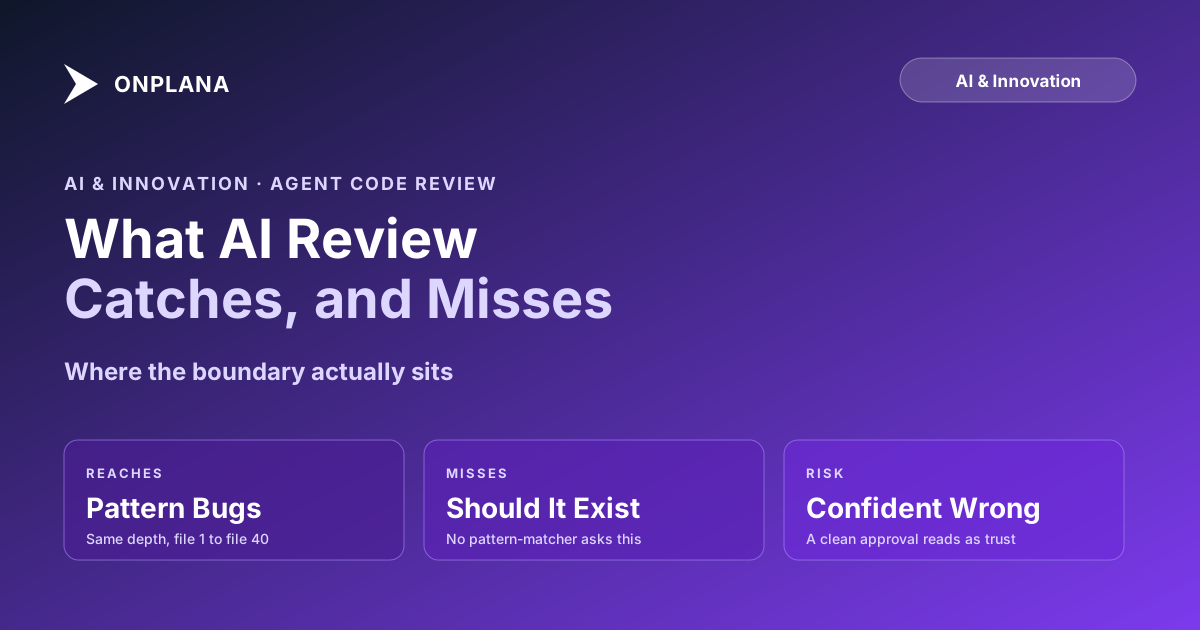
The diagram below shows the same split as a boundary: one side is what pattern-matching review reaches, the other is what stays a human judgment call regardless of how good the tooling gets.
The Failure Worth Naming: A Confident Review of Code That Shouldn't Exist
The dangerous outcome isn't a missed null check. It's an agent reviewer approving a pull request, cleanly, with every mechanical check green, for a feature that never should have shipped: an abstraction that duplicates one three files away, a workaround for a problem better solved upstream, scope creep nobody scoped. A clean approval reads as a stamp of quality, and a stamp of quality is exactly the wrong signal for a question the review never asked. AI agents in software development makes the same point from the delivery side: agents are strong at mechanical fixes and weak at judging whether a requirement is right, and code review inherits that split unchanged.
Getting the Split Right
- Route mechanical checks to the agent first. Error handling, naming, unclosed resources, and missing tests are pattern-shaped problems; let the reviewer that never skips a file catch them before a human's time gets spent on them.
- Keep architecture and "should this exist" with a human, every time. No amount of pattern-matching depth substitutes for the judgment call these questions require.
- Scope the reviewer to the diff, not the narrative around it. A PR description or comment shouldn't be able to talk an agent reviewer into approving something the code itself doesn't support.
- Treat an approval as evidence, not a decision. How to review AI-generated work before you ship it covers the ordering that applies here too: check presence and correctness before quality, and don't let a clean-looking approval skip that order.
- Give AI-authored diffs more scrutiny, not less, given what the data on issue density in AI-generated code actually shows.
Getting this split right is mostly a matter of routing, not tooling: send the checklist-shaped work to whatever catches it fastest and keep the judgment calls where judgment lives. Onplana's issue tracker keeps both classes of finding, mechanical and architectural, in the same log against the same task, so neither gets lost in a review thread that scrolls away. The rest of the Onplana blog covers where else agent judgment holds up and where it doesn't across the delivery pipeline.
Frequently asked questions
What does 'AI code review effectiveness' actually mean in practice?
It means a split, not a single score: agent review is strong on mechanical, checklist-shaped defects (missing error handling, inconsistent naming, unclosed resources) and weak on architecture and whether the change should have been written at all. Treat it as a filter for one class of problem, not a replacement for the other.
Can an agent's review approve a change that shouldn't ship?
Yes. An agent reviewer checks the diff against patterns and conventions, and a change can pass every one of those checks while still being the wrong feature, the wrong abstraction, or scope creep nobody asked for. That question stays with a human reviewer, every time.
Who's accountable if an agent's review misses a real bug?
The person who merged the change, the same as if a colleague's rubber-stamp review had missed it. An approval from an agent is evidence, not a decision, and treating it as the decision is what turns a missed defect into a shipped one.
Can someone game an agent reviewer by rewording a comment or the PR description?
Sometimes, and it's a real risk worth naming rather than waving off. An agent that takes PR text at face value can be steered toward approving something it would otherwise flag, which is why the review's job should stay scoped to the code and the diff, not to a narrative supplied by whoever wrote the description.
Does adding an agent reviewer mean less human review, or just faster review?
Faster on the part it replaces, not smaller overall. The mechanical volume, the null checks and convention drift, moves off a human's plate, but the judgment questions, architecture and whether the change should exist, still need the same human attention they always did.
Where does agent-assisted review fall short most often?
On judging intent against a specification it never saw, on architecture decisions that trade off future flexibility against present simplicity, and on the question of whether a technically correct change is still the wrong one to make. None of those are pattern-matching problems, which is exactly why pattern-matching review doesn't reach them.
Is AI-generated code reviewed the same way as human-written code?
It should get more scrutiny, not less. Independent analysis of open-source pull requests has found AI-authored code carries measurably more flagged issues than human-written code in the same repositories, which argues for treating an AI-authored diff as a higher-risk review, not a lower one.
Ready to make the switch?
Start your free Onplana account and import your existing projects in minutes.