How to Review AI-Generated Work Before You Ship It
Reviewing AI-generated work fails when quality gets checked first. Catch confident wrongness and silent omission by checking scope before judging polish.
Most teams review an agent's output the way they would review a colleague's: read the deliverable, decide whether it looks right, approve it. That habit is exactly backwards for agent work, because an agent's two most common failures both survive a skim: it states a wrong answer with total confidence, and it quietly narrows the scope of a task instead of flagging what got skipped.
The direct answer: reviewing AI-generated work means checking what the agent did not do before checking what it did. A deliverable that looks finished on a skim can still be missing a third of what the task asked for, and confident wrongness reads exactly like confident correctness until someone checks the underlying fact. Start every review with the task's original scope, not with the document sitting in front of you.
Reviewing agent output needs a different order than reviewing a person's. List what the task actually asked for, verify each piece is present, then verify each present piece is correct, in that order. Confident wrongness and silent omission are the two failures a "does this look right" skim misses, and both hide behind a deliverable that reads as complete. Review depth should scale with how much unsupervised authority the task's autonomy level allowed, not stay flat across every task.
Why an Agent's Mistakes Don't Look Like a Colleague's
A colleague who runs out of time on a task usually says so: a half-written section, a comment flagging what's left, a message asking for more time. The gap is visible because a person under time pressure tends to signal the gap. An agent under the same constraint does not signal it the same way. It returns a complete-looking document, a fully formatted report, a set of tasks that all have due dates, and the missing third of the work is not marked as missing anywhere in the output. What is a tool call covers the mechanism underneath this: the model proposes an action and reports a result, and if the underlying work quietly under-delivered, nothing in that request-response cycle forces the gap to surface on its own.
The same asymmetry shows up in confidence. A person unsure of a number usually hedges: "I think," "roughly," "worth double-checking." A model trained to produce fluent, complete-sounding text does not reliably hedge in proportion to how uncertain the underlying claim actually is, so a wrong number and a right number can read with identical confidence in the same paragraph.
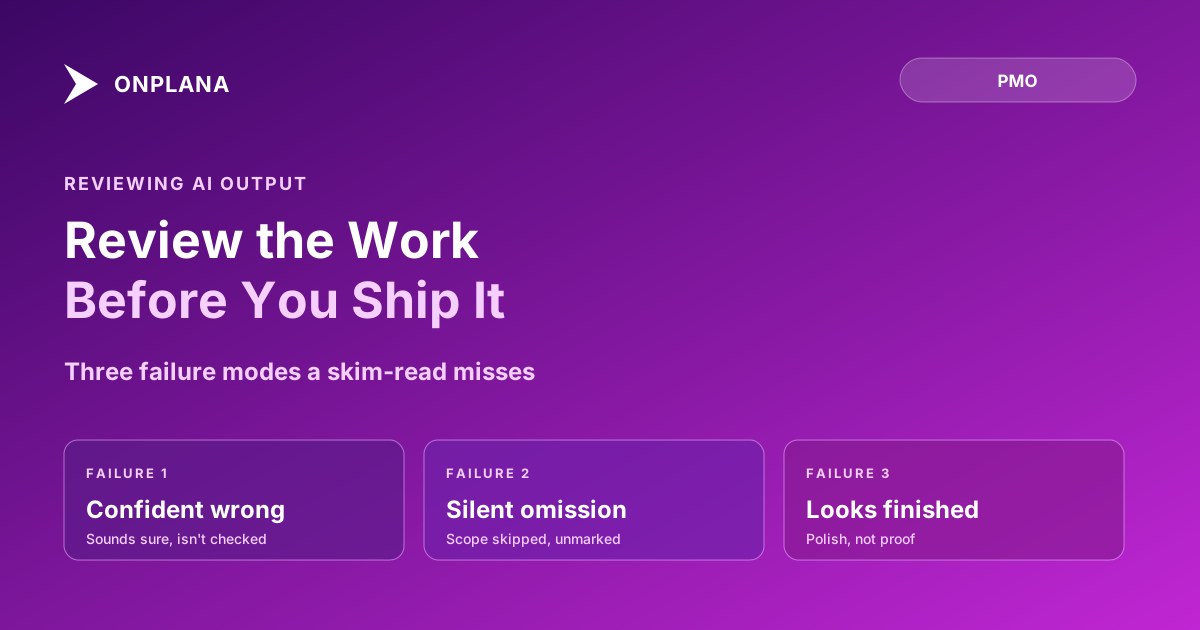
Three Failure Modes a Skim-Read Won't Catch
| Failure mode | What it looks like | Why a skim misses it |
|---|---|---|
| Confident wrongness | A stated fact, number, or recommendation delivered with no hedge, and it's wrong | Reads identically to a correct claim; nothing in the tone signals doubt |
| Silent omission | Part of the requested scope is missing, with no note that it was skipped | The delivered part looks polished, so the document reads as done |
| Looks-finished padding | Formatting, structure, and length all signal completion regardless of substance | A well-formatted wrong answer reads as more trustworthy than a plain right one |
Reviewing AI-Generated Work: The Order That Catches Each Failure
The fix is sequencing, not more scrutiny. Reviewing harder in the same order still starts from the deliverable in front of you, which is exactly the document built to look complete. Reviewing in a different order starts from the task instead.
- Re-read the original task, not the output. Write down what was actually asked for, as a list, before opening the deliverable.
- Check each item against that list for presence, not quality. Is it here at all? This step alone catches silent omission, because a missing item becomes a visible gap in a list instead of an absence hidden inside a polished document.
- Check each present item for correctness against a source you trust, not against how confident it sounds. A stated fact gets verified the same way regardless of how it's phrased.
- Only then judge quality and formatting. Structure and polish are the least informative signal in the whole review, and checking them first is what lets the first three failures slip through.
The diagram below shows why the order matters: a skim-read starts at the last step, which is exactly the step that catches neither omission nor wrongness.
How Much Review Depth a Task Needs
Not every task needs all four steps at full depth. The five levels of AI agent autonomy maps how much unsupervised authority a task carried, and review depth should track that number: a low-autonomy task where the agent drafted a suggestion for a person to approve line by line needs less of this than a high-autonomy task where the agent updated records or sent something external on its own. Human-in-the-loop versus human-on-the-loop covers the same scaling question from the supervision side: the review order above is what "on the loop" supervision actually has to check, since nobody watched the task happen in real time.
Who Owns a Miss That Gets Through Anyway
Skipping the review order does not remove accountability, it just moves it. Who is accountable when an agent is wrong covers this directly: the person who approved the output owns the miss, the same as approving a colleague's work without reading it. A review order that catches omission and confident wrongness before they ship is the cheapest way to avoid inheriting a mistake nobody actually checked.
Building this order into a habit is a five-minute discipline, not a new tool: write the task's scope down before opening the deliverable, and the two failures that survive most reviews will not survive this one.
Frequently asked questions
What's different about reviewing an agent's output compared to a person's?
A colleague who runs short on time on a task usually signals it: a half-written section, a note flagging what's left. An agent's output rarely signals a gap the same way; it returns a complete-looking deliverable whether or not the scope was actually covered, which is why the two failures to check for are confident wrongness and silent omission, not just quality.
What's the single most effective check when reviewing agent output?
Compare the deliverable against the original task's scope for presence before judging quality. Write down what was asked for as a list, then check each item is actually there. This one step catches silent omission, the failure a quality-first skim consistently misses.
Can an agent mark a task as done when it isn't actually finished?
Yes, if nothing checks completeness before the status changes. A status field reflects what the agent reported, not an independent check of what's actually present, so treat a 'done' marker as a claim to verify rather than a fact, the same way you would not take a person's word for it on a task that matters.
Who is accountable if I approve agent work that turns out to be wrong?
The person who approved it, the same as approving a colleague's work without reading it closely. Agent involvement does not create a new category of accountability; it raises the volume of approvals happening at agent speed, which is exactly why a fast, ordered review check matters more, not less.
Can a reviewer be misled by how confident the output sounds?
Yes. A model's fluency is not evidence of accuracy, and a wrong number can read with the same confidence as a right one in the same paragraph. Verify a stated fact against a source you trust independent of how it's phrased, because tone carries no information about correctness.
What if the agent quietly did less than the task asked for?
That's silent omission, and it's the failure most skim-reads miss, because the delivered portion still looks polished. Checking presence against a written list of what the task asked for, before judging quality, is what surfaces a scope gap that would otherwise stay invisible inside a finished-looking document.
Does more detail or better formatting mean the output is more reliable?
No. Formatting and length are the least informative signal in a review and are often the reason an omission or an error gets missed: a well-structured wrong answer reads as more trustworthy than a plain right one, which is why quality and polish should be the last thing checked, not the first.
Ready to make the switch?
Start your free Onplana account and import your existing projects in minutes.