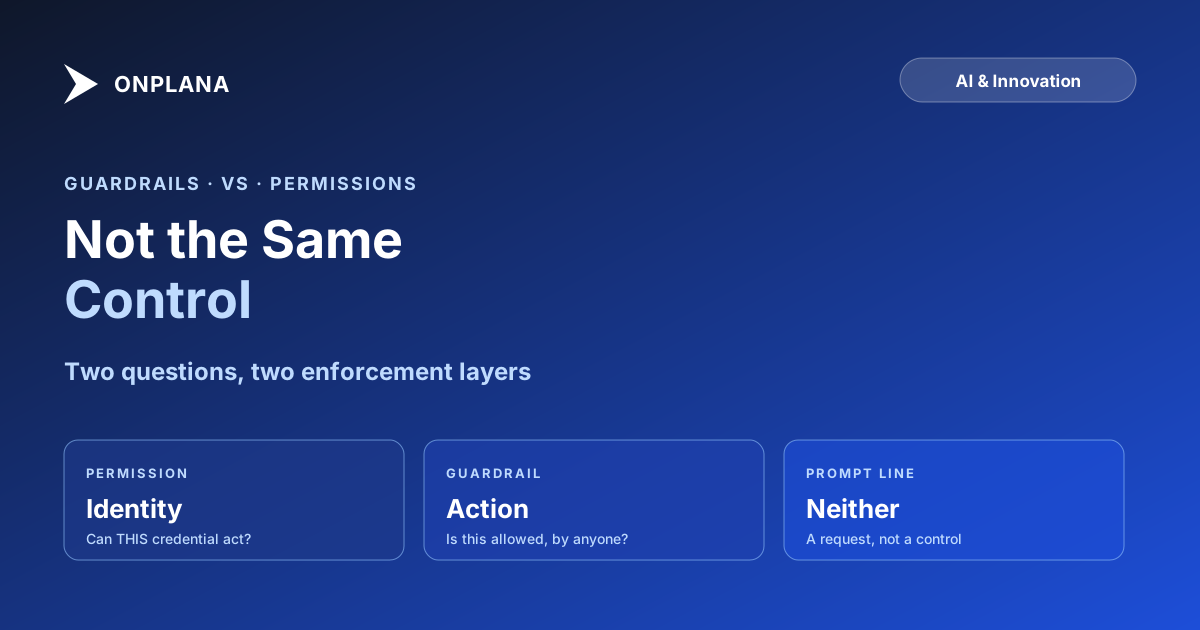
AI Guardrails vs Permissions: Not the Same Control
AI guardrails vs permissions: a permission decides what one identity may do; a guardrail decides what any identity may do here. Most teams have only one.
Most teams that stand up an AI agent buy a permission system, scope some credentials, and consider access control solved. The AI guardrails vs permissions question is where that assumption breaks: it doesn't show up until the day an agent does something that no single identity's permission grant should have allowed, because the thing that stopped it was never a permission question in the first place.
The direct answer: a permission decides what one identity, a person or an agent connection, is allowed to do. A guardrail decides what is allowed to happen here at all, independent of whose credential is attached to the request. Teams routinely buy the first and believe they have the second, and a prompt instruction telling the model to "never do X" is neither one: it is a request the model weighs, not a control the system enforces.
Permissions and guardrails answer different questions. A permission is identity-scoped: what can this credential do. A guardrail is action-scoped: what is this action allowed to do, period, no matter who holds the credential. A correctly scoped agent permission can still allow an unbounded, irreversible, or runaway-cost action if no guardrail caps the action itself. A prompt instruction is neither: it is advice the model can weigh, not a check the system enforces, which is why it fails exactly when a persuasive request asks it to.
What a Permission Actually Controls
A permission is an identity question. It answers "can this specific credential, a person's login or an agent's scoped token, reach this project, this field, this action." Permission design for AI agents covers the three things a permission model needs for an agent specifically: project-level scope instead of org-wide reach, a deny-by-default posture on anything irreversible, and a real split between what the credential can read and what it can change. All three are still identity-scoped decisions: they describe what this one connection is allowed to touch.
That is necessary and it is not sufficient. A permission grant can be exactly correct, scoped to one project, denying deletes by default, and an action that grant allows can still be unsafe if nothing bounds how much of it can happen, how fast, or under what conditions. Scoping the identity does not bound the action.
What a Guardrail Actually Controls
A guardrail is an action question, not an identity question. It answers "is this action allowed to happen here at all," regardless of which identity is requesting it. A spending cap on an automated workflow, a hard ban on external sends from a given integration, a size limit on any single bulk delete: none of these check who is asking. They check whether the action itself, taken by anyone, is inside the bound the system allows right now.
| Permission | Guardrail | |
|---|---|---|
| Question it answers | Can this identity do this? | Is this action allowed to happen here, by anyone? |
| Scoped to | A credential (person or agent connection) | An action or action class |
| Where it usually lives | Role and access-control settings | The system the action actually passes through |
| Fails when | Scope was set too wide for one identity | The action itself has no cap, regardless of identity |
| Example | This token cannot reach project Y | No single bulk delete can exceed 50 records without approval |
| Who owns fixing a gap | Whoever granted the identity's scope | Whoever owns the control layer the action passes through |
The diagram below shows why a request can clear a permission check and still need a guardrail to stop it.
Why a Prompt Instruction Is Neither
A line in a system prompt that says "never delete more than a handful of tasks without asking" looks like a guardrail and behaves like neither a permission nor a guardrail. It is a request the model weighs against every other piece of text in its context, including a task description someone wrote to sound urgent, or a comment engineered to make the bulk delete look routine. Prompt injection risk for project teams covers exactly this failure mode: a persuasive instruction embedded in ordinary-looking content and a legitimate one read identically to a model, so a rule that lives only in the prompt fails precisely when someone has a reason to make it fail.
The test that separates a real control from an instruction is simple: does the rule hold when the model is fully convinced it should not? A permission enforced at the credential layer holds regardless of what the model concludes, because the system never asks the model's opinion before checking. A guardrail enforced at the action layer holds the same way. An instruction in a prompt holds only as long as nothing in the model's context argues persuasively against it, which is not a property you can rely on once real users are writing the comments and task descriptions an agent reads.
AI Guardrails vs Permissions: Do You Need Both
Yes, and they are not substitutes for each other. A tight permission scope with no guardrails still allows a correctly scoped identity to do something unbounded. A strong guardrail with no permission model still lets any identity that reaches the system attempt anything the guardrail did not anticipate. The five levels of AI agent autonomy maps how much weight each layer needs to carry as an agent's scope widens: at low autonomy, permission scope alone mostly holds; at higher levels, an unbounded action inside a correctly scoped grant is the more likely failure, which is exactly where a guardrail earns its place.
Onplana treats these as two separate enforcement layers rather than one setting doing double duty: agent connections are scoped by credential the way security review questions for AI agent access describes, and write actions are separately metered and capped regardless of which identity is making them. Neither layer stands in for the other. The rest of the Onplana blog covers the adjacent governance decisions this split assumes are already in place, including the full security posture both layers sit inside.
Write the guardrail question down as its own line item the next time an AI agent's access gets reviewed, separate from the permission line it usually gets folded into. The two questions have different owners, different failure modes, and, most of the time, different answers.
Frequently asked questions
What is the difference between an AI guardrail and a permission?
A permission decides what one identity, a specific person or agent connection, is allowed to do. A guardrail decides what any identity is allowed to do here at all, regardless of whose credential is attached. Teams that buy a permission system often stop there and assume the guardrail question is already answered.
What are AI guardrails?
System-level rules that bound an action space no matter who or what is requesting it: a spending cap on an automated workflow, a ban on external sends from a given integration, a size limit on a bulk delete. A guardrail does not check who is asking; it checks whether the action itself is allowed to happen at all.
Is a prompt instruction in an agent's system prompt a real control?
No. An instruction is a request the model can weigh against other things it reads, including a task description or a comment written by someone else. A control is enforced by the system the agent calls, outside the model's judgment entirely, so it holds even when the model is convinced it should not.
Can someone steer an agent around a guardrail by rewording a comment or task description?
They can steer the model's judgment, which is exactly the failure mode a prompt-based rule cannot stop. A guardrail enforced in the system the agent's tool calls pass through does not care how persuasive the wording was, because it never asks the model for permission in the first place.
If our permissions are already scoped correctly, do we still need guardrails?
Yes, because a permission answers 'is this identity allowed to do this' and a guardrail answers a different question: 'is this action allowed to happen at all, by anyone, right now.' A correctly scoped agent credential can still trigger an org-wide incident, a bulk delete, a runaway spend loop, that only a guardrail with no identity check would have caught.
Can an agent do something irreversible if its permissions look fine on paper?
Yes. Permission scope answers who can reach an action; it says nothing about whether that action, taken at machine speed and volume, is safe for anyone to take unbounded. A guardrail is the layer that caps blast radius regardless of how legitimately the credential was granted.
Who is accountable when a guardrail fails to catch a bad action?
Whoever owns the control layer the guardrail was supposed to live in, the same way a missing permission scope is the fault of whoever set the grant, not the agent that used it. A missing guardrail is a design gap in the system, not a lapse in the model's judgment that a stricter prompt would have fixed.
Can a guardrail be turned off by mistake, the way a permission can be widened by mistake?
Yes, and it fails the same way: quietly. A guardrail implemented as a documented policy instead of an enforced check can be skipped under deadline pressure with nothing in the system stopping it. Treat a guardrail as broken until it is enforced somewhere a person cannot route around it by choice.
Ready to make the switch?
Start your free Onplana account and import your existing projects in minutes.