Security Review Questions for AI Agent Access
The security questions an AI agent vendor should answer cover scope, revocation, audit, and visibility. Here's what a good answer sounds like.
Most security reviews for a new AI tool ask about encryption and stop there. Encryption at rest is table stakes; it says nothing about what happens when the thing you connected has agency, when it can read a project, draft a report, or update a field on its own initiative rather than only in response to a single API call a human triggered directly.
The direct answer: the security questions for an AI agent vendor are not the questions on a generic SaaS questionnaire. Ask five instead: can access be scoped to specific projects rather than the whole org, is there an admin-controlled connection quota, does every agent action land in the same audit log as human activity, what can the vendor itself see, and what happens to the agent's access the instant you disconnect it. A vendor with concrete answers to all five is treating agent access as a governed extension of the permission system you already have. One without them is asking you to trust the model's judgment instead.
TL;DR: The five questions to ask
- Scope: can access be limited to specific projects, not the whole org?
- Quota: is there an admin-controlled cap on concurrent agent connections?
- Audit: does every agent action land in the same log as human activity?
- Visibility: what can the vendor itself see about your data and usage?
- Disconnect: does access end immediately, with nothing cached or lingering?
The Security Questions That Actually Matter for an AI Agent
Score a vendor's answer against what a concrete, checkable answer sounds like, not a reassurance.
| Question | What a good answer sounds like | Red flag |
|---|---|---|
| Can access be scoped to one project? | "A token scoped to project X can't see project Y" | "The agent has the same access as the connecting user's full account, org-wide" |
| Is there a connection quota an admin controls? | A specific number per plan tier, set by an admin | "There's no limit" or "we don't track that" |
| Does every agent action land in the audit log? | "Same log, same schema, as human activity, queryable in one place" | "We can pull logs on request" (a promise, not a system) |
| What can the vendor see? | A named, bounded list: which fields, for how long, for what purpose | Vague language like "aggregated insights" with no specifics |
| What happens on disconnect? | "Access ends immediately, revocation is a single action" | "Tokens expire within 24 hours" (a delay is not a revocation) |
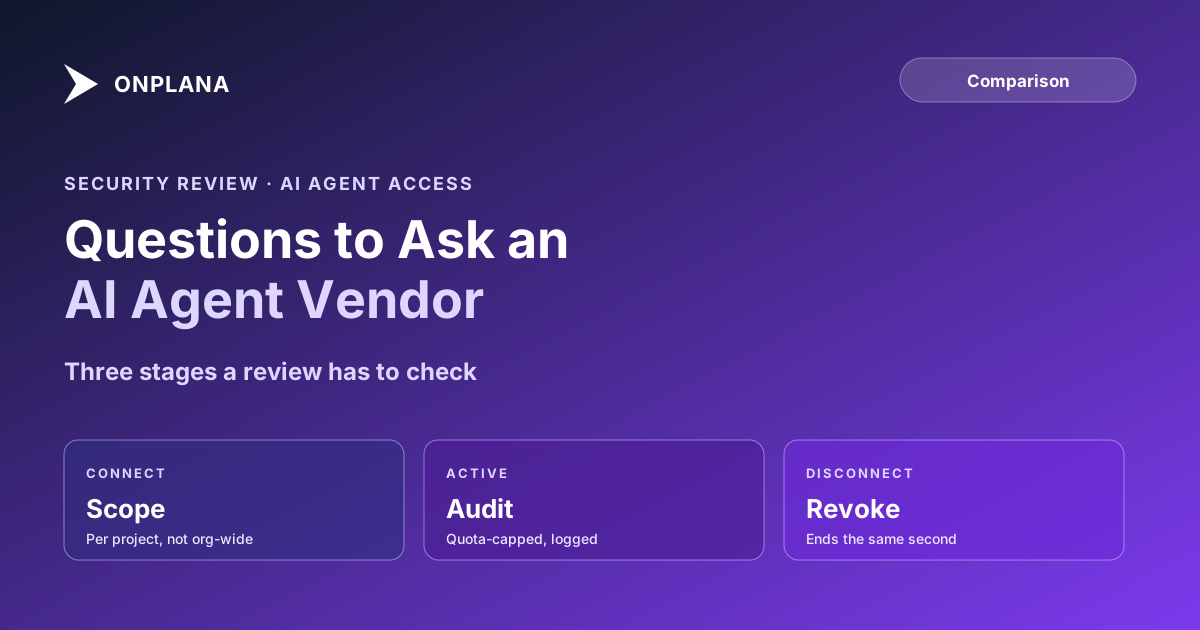
The diagram below lines up the same lifecycle a reviewer should be checking at each stage: what's true at connect, what should hold true while the agent is active, and what should happen the instant it disconnects.
Why a Generic Security Questionnaire Misses This
Standard SaaS security reviews were built for tools a human clicks through one screen at a time. Encryption, SSO, data residency, those questions still matter, but they assume the thing on the other end of the connection acts only when a person tells it to, once, for one specific request. An agent doesn't work that way: it can read across a project, chain several actions together, and act again without a fresh click from a human each time. Agent-native project management covers why that shift changes what "access" even means for a tool, and it's exactly why the five questions above sit outside a standard checklist. A vendor can pass every item on a generic questionnaire and still hand an agent org-wide, unaudited, unrevocable access, because nothing in the generic list asked about scope, quota, or revocation speed.
What Happens on Disconnect Matters as Much as What Happens on Connect
Reviewers spend most of their time on the connection step and almost none on the disconnection step, which is backwards. The connection step is the one everyone is watching closely because it's new and it's being approved for the first time. The disconnect step happens later, often when nobody senior is in the room, and it's the step that decides whether a bad trial or a compromised token actually stops mattering the moment someone notices. Ask the vendor to demonstrate revocation on a live connection during the review, not describe it. If pulling a token or removing an agent's persona takes a support ticket instead of one click in an admin screen, that's the answer to write down.
How Onplana Answers Each Question
Onplana connects agents over MCP with personal access tokens that can be scoped to specific projects rather than the whole org, so a compromised or misbehaving connection is contained to what it was actually given. Concurrent agent connections are capped by plan (2 on Free and Starter, 3 on Pro, 5 on Business, 10 on Enterprise, unlimited on Enterprise Plus) and gated behind an org.agent.connect permission key an admin controls, not something every user can turn on for themselves. Every agent tool call lands in the same audit trail as human activity, queryable in one place rather than scattered across a client-side log a vendor can't see. Onplana does not train AI models on customer project data; the connected model provider, Claude or Azure OpenAI depending on which one Onplana routes the request to, processes it at request time under enterprise data terms and doesn't retain it for training. Disconnecting an agent is the same action as removing a human teammate: pull its persona from People, and its access ends immediately. The full security and compliance overview covers the identity, encryption, and retention controls this sits inside, and Onplana's security posture next to Project Online's covers the comparison if that's the specific evaluation you're running.
A reviewer who gets concrete answers to the five questions above from any vendor, not just Onplana, has done the part of the security review that actually differs for an agent versus a normal integration. The rest of the review, encryption, residency, incident response, still applies exactly as it did before agents entered the picture. The full detail behind each of these controls is on Onplana's security page alongside the rest of the Onplana blog's agent-governance coverage for anyone running this evaluation end to end.
Frequently asked questions
What security questions should I ask an AI agent vendor?
Five that matter most: can access be scoped to specific projects instead of the whole org, is there an admin-controlled connection quota, does every agent action land in the same audit log as human activity, what can the vendor itself see, and what happens to the agent's access the moment you disconnect it. A vendor that answers all five concretely is treating agent access as governed, not assumed.
Is it safe to connect an AI agent to company data?
It's safe when access is scoped, quota-controlled, and audited the same way human access is, and unsafe when a vendor asks you to trust the model's judgment instead of a permission system. The question isn't whether AI agents are inherently risky; it's whether the specific connection you're approving has the same controls you'd require of a new employee.
What happens to an AI agent's access when we disconnect it?
Access should end immediately, the same way removing a human teammate does, not on a delay and not with lingering cached credentials. Ask the vendor to show you the revocation happening live, not describe it in a slide.
Should AI agent access be scoped per project or org-wide?
Per project by default. Org-wide access turns a single bad connection or a single compromised token into an incident that touches everything instead of one project. Scope should be the reviewer's first question, not an afterthought after the vendor's demo.
Ready to make the switch?
Start your free Onplana account and import your existing projects in minutes.