Human-in-the-Loop AI Project Management: The Review Inbox
Human-in-the-loop AI project management means an agent's draft ships only after approval. Here's how the review inbox works, and why reject means recycle bin.
The most common failure in human-in-the-loop AI project management isn't a rogue agent. It's a human who stopped reading. Grant Thornton's 2026 AI Impact Survey, fielded February 23 to March 18, 2026, found that only 5% of companies let an AI agent execute a high-stakes decision without human review, and roughly 60% cap agents at moderate-risk task automation. The uncomfortable part of that number is what it implies about the other side: once approval becomes a daily habit, the habit degrades into a click. An inbox that holds three drafts on Monday and ten by Wednesday gets rubber-stamped by Friday.
Human-in-the-loop AI project management, done right, is not a chat window where you occasionally correct an agent. It's a review inbox: everything an agent produces lands there first, nothing ships until a person approves it, and rejecting a draft moves it to the recycle bin instead of deleting it outright.
The short answer. In human-in-the-loop AI project management, an agent never publishes, sends, or closes anything on its own. Every draft it produces lands in a review inbox, where approve keeps your edits and records a sign-off under your name, and reject moves the artifact to the recycle bin with your note attached so the agent can read the feedback before its next attempt. Nothing leaves the inbox unless a person clicks approve.
How a task reaches an agent in the first place
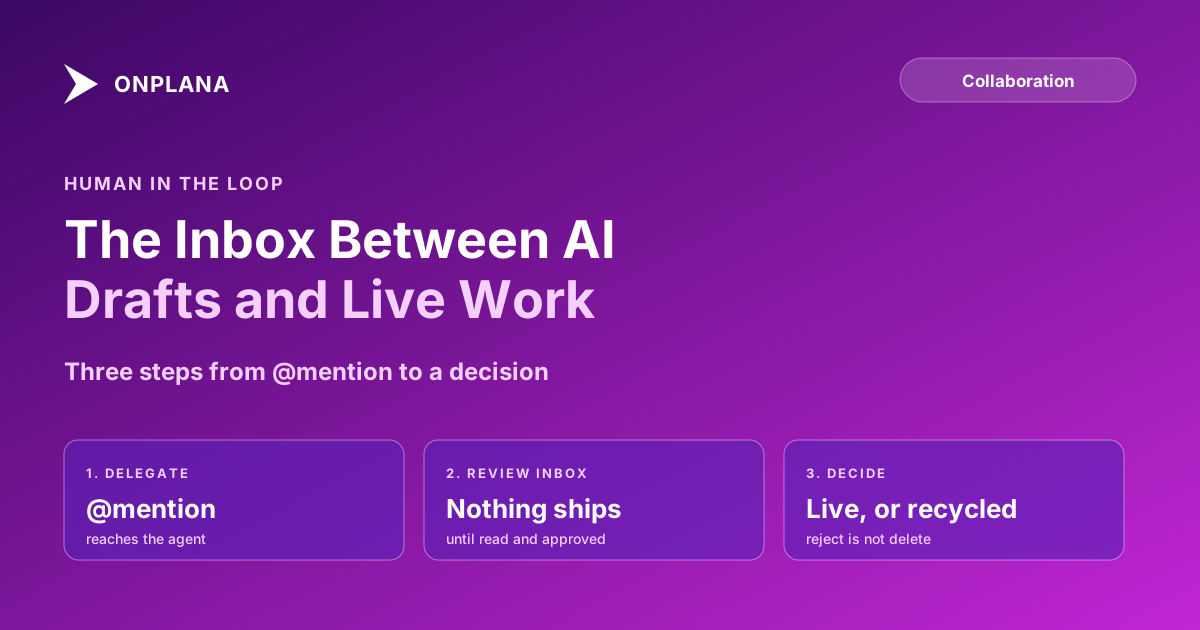
Delegating to an agent uses the same mechanism as assigning a person. Choosing to delegate a task posts an @mention, and the agent picks the work up on its next sync, not instantly, which is the same notification path a human teammate gets when someone tags them. That small detail matters: it means an agent's queue behaves like a person's queue, checkable and interruptible, rather than a background process nobody can see.
When to give an AI agent a task, and when not to covers the decision rule for what belongs in that queue at all: work with a clear brief and a checkable output goes to the agent, judgment calls and anything that ships to a customer stay with a person.
What the review inbox actually holds
The inbox collects whatever an agent produces on a delegated task: a drafted document, a status report, an email draft, a proposed list of subtasks. None of it is live yet. It sits exactly where a person would see it, review it, and decide, the same review a manager would give a junior teammate's first draft before it goes out under the team's name.
The diagram below shows the path from delegation to a decision, and the two different things that happen next depending on which way that decision goes.
Approve and reject do different things, not opposite things
Approve and reject are not mirror-image buttons. One publishes; the other doesn't delete, it defers.
| Approve | Reject | |
|---|---|---|
| What ships | Your edits if you made any, otherwise the agent's draft as written | Nothing |
| Where the artifact ends up | Stays live in its original location | Moved to the recycle bin by default |
| Record kept | A sign-off in the audit trail, tied to your account | A rejection note, tied to your account |
| What the agent does with it | Nothing further | Reads the note on its next run |
| Reversible after the fact | No, it is already live | Yes, restore from the recycle bin |
That last row is the one worth sitting with. Rejecting isn't a verdict on the agent, it's feedback the agent reads before trying again, and the artifact it produced doesn't vanish because you said no to it today.
The habit that breaks human-in-the-loop review
The Grant Thornton finding at the top of this post cuts both ways. A 5% figure for unreviewed high-stakes autonomy looks like discipline, until you notice that discipline is a behavior, not a setting. An inbox is only as good as the attention someone gives it, and the attention degrades exactly when volume goes up: the tenth draft of the week gets a faster glance than the first one did.
The fix isn't a bigger inbox or a stricter policy. It's a triage habit: read the first sentence of every draft in full, skim the rest only when the first sentence raises a question, and treat "I approved ten things today" as a number to be suspicious of, not proud of. Human in the loop vs on the loop for AI agents draws the line for which tasks need the every-action approval this inbox gives, and which ones are safe to watch from a distance instead.
Why this is the right place to put the friction
The friction in human-in-the-loop AI project management is supposed to exist between drafting and shipping, not between assigning and drafting. Delegating a task is fast on purpose, the same @mention that reaches a person reaches an agent, and comments and @mentions carry the same weight either way: a comment can redirect an agent mid-task just as it would redirect a colleague. What stops that becoming a liability is that redirection still has to clear the same review inbox before it reaches anyone else. The agent can be steered. It cannot skip the gate.
That's the actual shape of the tradeoff: fast to hand off, deliberately slow to publish. Get the second half wrong, by approving on reflex instead of on read, and the first half stops mattering.
Read more about how AI agents fit into everyday collaboration alongside comments, guest access, and shared documents, the review inbox is one piece of a plan built for people, clients, and agents working from the same page rather than three separate ones.
Onplana's own documentation on reviewing agent output covers the exact mechanics of approve, reject, and what an auditor sees afterward.
Frequently asked questions
What is the Agent Review Inbox in Onplana?
It's the one place every AI agent's output lands before it goes anywhere else, a document, an email draft, a status report, or a list of tasks, and nothing in it is sent, published, or closed until a person clicks approve.
Can an AI agent send an email or publish something on its own?
No. An agent can draft an email or a document, but it cannot send or publish it; the draft sits in the review inbox until a person approves it, and an agent never sends email on its own.
If I reject a draft, is it gone for good?
No, by default reject moves the artifact to the recycle bin rather than deleting it, so a decision you reverse, or a draft worth salvaging later, is still recoverable, and your rejection note stays attached to it.
Can someone steer an agent's output just by leaving a comment on the task?
Yes, a comment or an @mention can redirect what an agent does on its next sync, which is the point of the delegation model, and the review inbox is exactly what stops that mattering: nothing the agent produces reaches anyone else until a person reads and approves it.
Who is accountable if an approved AI draft turns out to be wrong?
The person who approved it. Approving records a sign-off in the audit trail tied to your account, so the review step puts a name behind the decision to ship rather than laundering it through the agent.
How does a task get assigned to an agent instead of a person?
The same way you'd assign a person: choosing to delegate a task to an agent posts an @mention, and the agent picks up the work on its next sync rather than instantly, the same notification path a human teammate would get.
What if I edit an agent's draft before approving it?
Your edited version is what gets saved and published, not the agent's original draft, so approval isn't an all-or-nothing vote on the agent's first attempt.
Ready to make the switch?
Start your free Onplana account and import your existing projects in minutes.