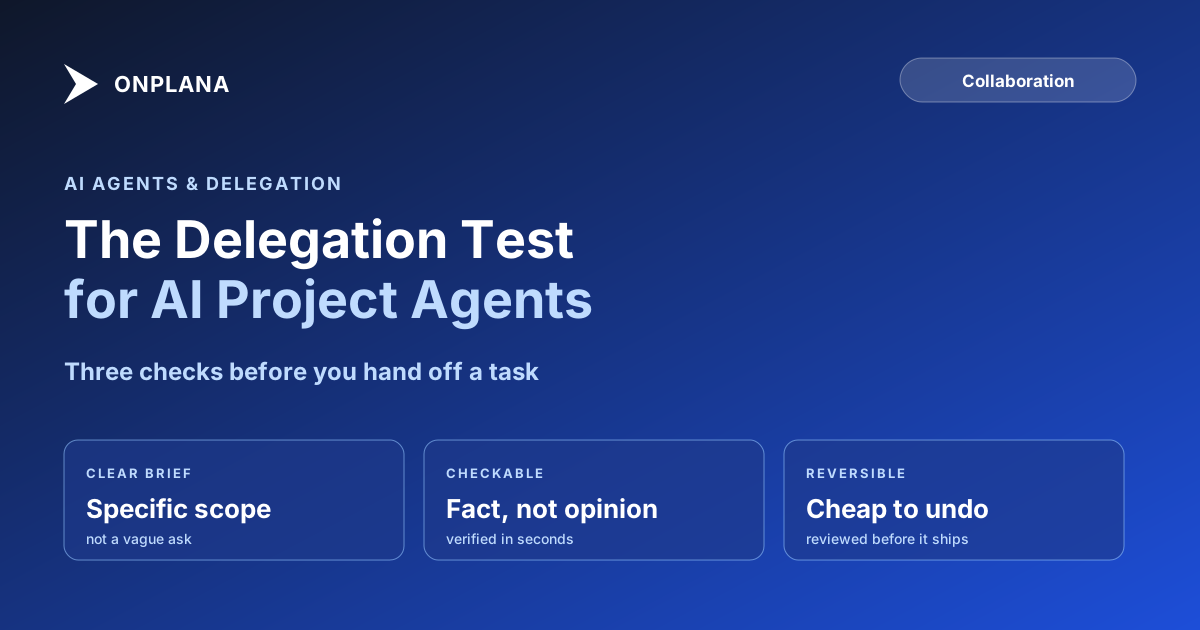
When to Delegate Tasks to an AI Agent (and When Not)
AI agent task delegation works when a task has a clear brief and a checkable result. Here is the three-part test for when to delegate tasks to AI agents.
Microsoft's 2024 Work Trend Index Annual Report, published in May 2024, found that 42% of leaders already familiar with AI expect "training a team of AI bots" to be part of their core job within five years. Most of them are still deciding what to delegate by asking how much they trust the model. That's the wrong question.
The direct answer: delegate a task to an AI agent when it has a clear brief, a checkable output, and no irreversible step if it goes wrong. Keep it with a person when the work calls for judgment, negotiation, or anything that reaches a customer without a review step first.
In short. Run every candidate task through three questions: is the brief specific enough to check against, can the output be verified without redoing the work, and is a wrong answer cheap to undo. A task that clears all three is safe to delegate regardless of how impressive or ordinary it looks. A task that fails any one of them stays with a person, no matter how much time it would save.
The Three-Part Test for What to Delegate to an AI Agent
Trust is the wrong first question because it's a property of the model, and the model doesn't change from one task to the next. What changes is the task. Three properties decide it:
A clear brief. The agent needs a specific instruction with a defined scope, the same thing you'd want before handing a task to a new hire. "Clean up the backlog" is not a brief. "Close any task in this sprint marked done for more than 48 hours with no open comments" is.
A checkable output. Someone has to be able to look at the result and know, quickly, whether it's right. A status summary can be checked against the numbers already in the project. A risk narrative that requires judging what a sponsor is actually worried about cannot be checked the same way; two competent people could write it differently and both be defensible.
No irreversible step. If the output is wrong, undoing it should cost less than the time the delegation saved. Drafting a comment costs nothing to discard. Sending an email to a client, changing a live budget figure, or closing out a vendor contract costs a great deal to walk back.
What Should Never Go to an Agent
Three categories fail the test almost every time, independent of how routine they look on the surface.
Judgment calls with no objectively right answer. Deciding whether to cut scope, extend a deadline, or reprioritize a portfolio is a values-and-context decision, not a data-lookup one. The three-check test for closing tasks makes the same point from the other direction: a task only earns autonomous closing when a fact, not an opinion, decides whether it's done.
Negotiation. Any exchange where the other party's response changes what you should say next resists a fixed brief, because the brief would have to anticipate every reply in advance.
Anything that ships straight to a customer. A client-facing email, a status update to an external stakeholder, or a contract term needs a person's judgment about tone and timing even when the underlying facts are simple. An agent never sends email on its own in Onplana for exactly this reason: drafting and sending are kept as two separate steps with a person between them.
The diagram below walks the same three questions as a decision tree, ending in either delegate or keep with a person.
How Delegation Actually Works: the @Mention, the Sync, and the Review Inbox
Once a task passes the test, delegating it in Onplana is a comment, not a workflow. As part of Onplana's team collaboration model, agents show up as assignable members: typing "Delegate to an agent" on a task, or @mentioning an agent the way you'd @mention a teammate, posts a mention the same way it would for a person. The agent picks it up on its next sync rather than acting instantly, which matters for the same reason a human teammate doesn't drop everything mid-task to react to a new comment.
Whatever the agent produces, a draft comment, a status summary, a first pass at a document, lands in the agent review inbox rather than shipping directly. Nothing is sent, published, or marked complete until a person approves it. That single checkpoint is what makes the three-part test's third condition, reversibility, hold in practice rather than just in theory: even a task that technically has an irreversible-looking output stays reversible right up until a human signs off.
Delegate or Keep? Five Examples Run Through the Test
| Task | Clear brief? | Checkable? | Reversible? | Verdict |
|---|---|---|---|---|
| Draft a status summary from data already in the project | Yes | Yes | Yes | Delegate |
| Decide whether to cut scope to hit a fixed date | No | No | No | Keep with a person |
| Triage incoming bug reports for likely duplicates and severity | Yes | Yes | Yes | Delegate |
| Tell a client the project is running behind | No | No | No | Keep with a person |
| Close a task once its linked CI check passes | Yes | Yes | Yes | Delegate |
The pattern across the "delegate" rows is not that the work is trivial, triage and status summaries both take real skill to do well. It's that a person can glance at the result and know if it's right, and if it isn't, correcting it costs a comment, not a cleanup. Agent-driven issue triage is a good worked example of a task that clears all three tests for most of its volume and fails them the moment it tries to decide an issue isn't real rather than just scoring the evidence in front of it.
Who Answers for It When the Agent Gets It Wrong
Delegating the drafting never delegates the accountability. If a delegated task's output turns out to be wrong after a person approved it, accountability lands on whoever assigned the work and approved the output, the same way it would if a direct report had produced the same mistake under their direction. That's a feature of the review-inbox model, not a gap in it: the checkpoint exists precisely so there's always a person who looked at the result before it went anywhere.
The three-part test doesn't get easier with a better model. A more capable agent produces a more convincing wrong answer just as easily as a correct one, which is exactly why the brief, the check, and the undo path matter more than how good the drafting looks.
Frequently asked questions
Can an AI agent do something irreversible if I delegate a task to it?
Yes, in theory, an agent can act on a scope wider than you meant to grant it. In Onplana, that risk is bounded by the review inbox: an agent's output lands there and nothing is sent, published, or marked final until a person approves it, so the irreversible step stays with a human even when the drafting doesn't.
What makes a task 'checkable' enough to delegate to an agent?
A checkable task has a fact that determines whether it's done right, not an opinion. 'Does this status summary match the numbers in the project' is checkable in thirty seconds. 'Is this the right message to send an unhappy client' is not, because two competent people could disagree.
Who is accountable if a delegated task's output is wrong?
The person who assigned the task and approved its output, the same person who would answer for a report's mistake made under their direction. Delegating the drafting doesn't delegate the accountability.
Can someone manipulate an agent's output by leaving a misleading comment on the task?
An @mention is how you delegate to an agent in the first place, so yes, anyone with comment access can attempt to steer it. This is exactly why nothing the agent produces goes live on its own: the review inbox is the checkpoint that catches an instruction that shouldn't have been followed.
Does delegating tasks to an AI agent make the AI bill unpredictable?
It changes the shape of the cost more than the size. Every agent action draws from your plan's AI token balance, so a task that gets sent back for revision twice costs roughly three times what a clean first pass costs. Budget for iteration, not just volume.
Where does AI agent task delegation fall short?
On anything where the hard part is deciding what to say, not producing a draft of it: negotiating a missed deadline, telling a stakeholder unwelcome news, or making a tradeoff call with no objectively right answer. An agent can draft the message; a person has to decide whether to send it.
Can an AI agent be removed from a task once it's assigned?
Yes. Unassigning the agent or removing the @mention stops it from acting on that task, the same as reassigning a task away from a person. Nothing it has already produced in the review inbox is auto-published just because the assignment changed.
Ready to make the switch?
Start your free Onplana account and import your existing projects in minutes.